
Inhaltsangabe
This book will frame Generation Y (children born between 1978 1991) for corporate leaders and managers at time when the corporate world is desperate to recruit and retain worked in this age group. It will debunk dozens of myths, including that young employees have no sense of loyalty, won t do grunt work, won t take direction, want to interact only with computers, and are only about money. This book will make a unique contribution in four key ways: It will disprove the idea that the key to recruiting, retaining, and managing this generation is to somehow make the workplace more "fun." To the contrary, Tulgan argues that the key to winning the respect of this generation, and getting the best effort out of them, is to carefully manage their expectations by never downplaying any negative aspect of a job. He will show managers how this Generation thinks transactionally in all negotiations. For them it s about what they will do for you today and what you will do for them today, not tomorrow, not five years from today, but today. He will explain why they have no interest in tying their futures to your corporation. But he will also make clear that they do have a well thought out plan for themselves, one that requires that every job they take build up their skill sets, so they become more valuable employees for someone else if and when you do not fulfill your end of the bargain, or drag your feet in doing so. But most of all, it will explain to corporate leaders that for this generation their personal life comes first, so that each job they take must accommodate itself to some need defined by their personal life. Tulgan argues that until you know the personal need the job can satisfy for a potential employee, you and the applicant may be talking past each other. Those needs are so beyond the imagination of most bosses that Tulgan devotes a third of the book to explaining how they affect the job decisions of this generation.
Die Inhaltsangabe kann sich auf eine andere Ausgabe dieses Titels beziehen.
Über die Autorin bzw. den Autor
Bruce Tulgan is internationally recognized as the leading expert on young people in the workplace. He is an advisor to business leaders and the author or coauthor of sixteen books, including the classic Managing Generation X and the best-seller It's Okay to Be the Boss. Since founding the management training firm RainmakerThinking, he has been a sought-after keynote speaker and seminar leader. Tulgan's work has been the subject of thousands of news stories, and he has written for dozens of publications, including the New York Times, USA Today, Human Resources Magazine, and the Harvard Business Review. He also holds a fourth-degree black belt in karate and is married to Debby Applegate, winner of the 2007 Pulitzer Prize for Biography.
Von der hinteren Coverseite
Praise for Not Everyone Gets a Trophy
"Thanks to Bruce, a management revolution has taken place at Joe's Crab Shack. His step-by-step approach and expert insight into generation X and Y have empowered our leaders to become great managers."?Ray Blanchette, president and CEO, Joe's Crab Shack
"If anyone deserves a trophy it's Bruce Tulgan for helping us crack the code on understanding this new generation in the workforce. ?I hope he's made some room on his mantel!"?Marianne Brush, executive vice president, Massachusetts Society of CPAs"Bruce Tulgan is a leader on this subject, and he has written a superb book that is colorful, warm, research-based, and above all, useful. His clear tips provide anyone in a supervisory position with the data they need to engage, develop, and retain Generation Y employees."?Beverly Kaye, coauthor of the best-selling Love 'Em or Lose 'Em: Getting Good People to Stay"Bruce's research on Generation Y has had a powerful impact on our leadership team. If you want a real strategic advantage in recruiting, managing, and retaining Generation Y, read this book."Greg Lucier, chairman and CEO, Invitrogen Corporation"Professionals across all industries will find Bruce's analysis of Generation Y in the workplace spot-on. He dispels the myths and provides a fresh interpretation that makes sense to those of us who have already tried the more traditional approaches to engage, train, and retain these folks. This book is a must-have tool!"?Samantha Snyder, director, Kaufman Rossin University, Kaufman, Rossin & Co."Bruce has taught many of us the importance of communicating with our workforce in a manner where workers know what is expected of them and managers provide regular feedback on how well those expectations are being met. This book helps us accomplish this more effectively with Generation Y."?Thomas A. Cappello, medical center director, North Florida/South Georgia VA Health System
Aus dem Klappentext
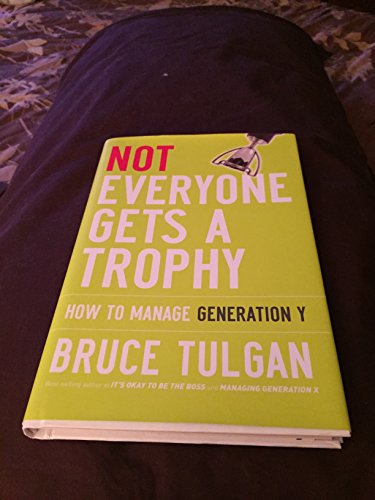
Based on more than a decade of research, Not Everyone Gets a Trophy reframes Generation Y (those born between 1978 and 1990) at a time when many employers are struggling to engage, develop, and retain them. Bruce Tulgan declares that Generation Y is the most high-maintenance workforce in history, but he argues that they also have the potential to be the most high-performing workforce in history.
As he does in his seminars, Bruce presents poignant quotes from Gen Yers and those who manage them, putting the two perspectives in conversation throughout the book. Not Everyone Gets a Trophy does what no other study of Generation Y has done:
Debunks the fourteen most common myths about Generation Y in the workplace.
Shows managers how to tune-in to Gen Yers' "short-term and transactional" mindset.
Argues that the key to success is not trying to make the workplace "fun." Rather, the key is strong, highly engaged leadership. He devotes an entire chapter to what he calls "in loco parentis management."
Provides proven, step-by-step best practices for getting Gen Yers onboard and up-to-speed?giving them the context they lack, teaching them how to manage themselves and how to be managed, and turning the very best into new leaders. Not Everyone Gets a Trophy is the essential guide for winning the talent wars and managing Generation Y.
Auszug. © Genehmigter Nachdruck. Alle Rechte vorbehalten.
Not Everyone Gets A Trophy
How to Manage Generation YBy Bruce TulganJohn Wiley & Sons
Copyright © 2009 Bruce TulganAll right reserved.
ISBN: 978-0-470-25626-8
Chapter One
MEET GENERATION YThe Most High-Maintenance Workforce in the History of the World
They keep telling me, "Here's what you get in five years, ten years, twenty years ..." But they expect me to come back to work tomorrow. What do I get tomorrow? -Gen Yer
Not long ago, the president of a health care consulting firm told me he had just interviewed a twenty-five-year-old man for a job in his firm. The young candidate came to the interview armed with a number of ordinary questions about job duties, salary, and, benefits. When these questions were answered, he made a request: "You should know that surfing is really important to me and there might be days when the surf's really up. Would you mind if I came in a little later on those days?"
* * *
At a major food conglomerate, summer interns are usually given an assignment, such as a big data-entry project, that they can complete during the course of their summer employment. An executive there shared with me the story of one of his latest interns: "On the first day, she announced she had invented a new cereal. She had a box, complete with artwork and a bag of her cereal inside, that she called her 'prototype.' Clearly she had gone to great lengths, including the recipe and nutritional information and preparing a slide show. She wanted to know when she would be able to pitch her idea to senior executives. 'The sooner the better,' she said."
* * *
An experienced nurse-manager in a busy hospital told me she stopped a new young nurse from administering the wrong medicine by intravenous drip to a patient. The manager pulled the young nurse aside and explained emphatically how serious a mistake she almost made. "I explained that this is how patients die unnecessarily. I told her, 'You need to check the wrist bracelet, then the patient's chart, then the charge list, then the IV bag. Then you need to check them all again.'" Before she was finished, the young nurse interrupted her. "Actually, you are doing this conversation wrong," she told her boss. "You are supposed to give me some positive feedback before you criticize my work." What did the manager respond? "Okay. Nice shoes. Now, about that IV bag ..."
* * *
A group of executives in the U.S. Peace Corps reported that program administrators receive e-mails on a regular basis from parents making suggestions and requests about the living accommodations and work conditions of their children stationed on missions around the world. One of the Peace Corps executives told me, "I just got an e-mail from a parent saying the meals being provided don't meet his kid's dietary needs. Could we get this young man on a nondairy diet?" The funny thing is that generals in the U.S. Army have told me similar stories about the parents of soldiers.
* * *
Another experienced manager, this one in a retail organization, told me an even more striking story. This manager was trying to correct a young associate who had just spoken rudely to a customer. The young man turned to his boss and said, "You know what? I'm thinking about buying this place. And the way you are going, you are going to be the first one out of here!"
* * *
Managing people has never been easy. Stuck between employer and employees, managers are tasked with the tough job of negotiating their often competing needs and expectations. But as these stories illustrate, being a manager is even more difficult when a new generation enters the workforce and brings with it new attitudes and behaviors. Every day, leaders and managers in organizations of all shapes and sizes in just about every industry all over the Western world tell me stories about working with the new generation of young employees-the so-called Generation Y-that suggest this might be the most difficult generation to manage yet. Managers tell me:
"They walk in the door on day one with very high expectations."
"They don't want to pay their dues and climb the ladder."
"They walk in the door with seventeen things they want to change about the company."
"They only want to do the best tasks."
"If you don't supervise them closely, they go off in their own direction."
"It's very hard to give them negative feedback without crushing their morale."
"They walk in thinking they know more than they know."
"They think everybody is going to get a trophy in the real world, just like they did growing up."
It seems to me that the vast majority of leaders and managers think Gen Yers have an attitude problem.
But isn't this always the case when a new generation joins the workforce? Doesn't every new generation of young workers irritate the older, more experienced ones? At the early career stage of life, young people are just learning to break away from the care of others (parents, teachers, institutions) and taking steps toward self-sufficiency and responsibility. Some do it more slowly than others. As they move into the adult world with the energy and enthusiasm-and lack of experience-that is natural at that stage, they are bound to clash with more mature generations.
And yet as much as human experience-such as the rite of passage into the workforce-stays the same over time, the world doesn't. One epoch may be defined by an ice age, another by global warming. What makes each generation different are these accidents of history that shape the larger world in which human beings move through their developmental life stages. So while every generation rocks the boat when they join the adult world, they also bring with them defining characteristics that alter the rules of the game for everyone going forward.
Gen Yers' "attitude" probably is not likely to go away as they mature; their high-maintenance reputation is all too real. Still, the whole picture is more complicated. Yes, Generation Y will be more difficult to recruit, retain, motivate, and manage than any other new generation to enter the workforce. But this will also be the most high-performing workforce in history for those who know how to manage them properly.
Meet Generation Y
I've been conducting in-depth interviews with young people in the workplace steadily since 1993. That was shortly before the oldest Gen Yers-those on the cusp of Generation X-started arriving in the workplace as teenagers. Since then, we've followed Gen Yers as they have become the new young workforce and have been developing a comprehensive picture of who they are, how they became that way, and what motivates them. First, to understand the historical context of Generation Y, I'd like to take a few steps back and glance at the accidents of history that defined the generations leading up to Gen Y.
The generation born before the Baby Boom, what I call the Schwarzkopf generation, grew up mostly in the 1930s and 1940s. Their young adulthood was defined by a period of confidence and stability following the upheaval of depression and war. The Baby Boomers, born between 1946 and 1964, were defined by two distinct eras: the first was characterized mostly by the stability of 1950s and early 1960s, while the second coincided with the major...
„Über diesen Titel“ kann sich auf eine andere Ausgabe dieses Titels beziehen.
Weitere beliebte Ausgaben desselben Titels

Suchergebnisse für Not Everyone Gets A Trophy: How to Manage Generation...

Beispielbild für diese ISBN
Not Everyone Gets a Trophy: How to Manage Generation Y
Anbieter: World of Books (was SecondSale), Montgomery, IL, USA
Verkäuferbewertung 5 von 5 Sternen

Zustand: Very Good. Item in very good condition! Textbooks may not include supplemental items i.e. CDs, access codes etc. Artikel-Nr. 00083491269
Gebraucht kaufen
EUR 4,56
Versand gratis
Versand innerhalb von USA
Versand innerhalb von USA
Anzahl: 5 verfügbar
Beispielbild für diese ISBN
Not Everyone Gets a Trophy: How to Manage Generation Y
Verlag:
Jossey-Bass Inc Pub (edition 1), 2009
ISBN 10: 0470256265
ISBN 13: 9780470256268
Gebraucht
Hardcover
Anbieter: BooksRun, Philadelphia, PA, USA
Verkäuferbewertung 5 von 5 Sternen
Hardcover. Zustand: Very Good. 1. With dust jacket. It's a well-cared-for item that has seen limited use. The item may show minor signs of wear. All the text is legible, with all pages included. It may have slight markings and/or highlighting. Artikel-Nr. 0470256265-11-1-29
Gebraucht kaufen
EUR 5,15
Versand gratis
Versand innerhalb von USA
Versand innerhalb von USA
Anzahl: 1 verfügbar
Beispielbild für diese ISBN
Not Everyone Gets a Trophy: How to Manage Generation Y
Anbieter: ThriftBooks-Dallas, Dallas, TX, USA
Verkäuferbewertung 5 von 5 Sternen
Hardcover. Zustand: As New. No Jacket. Pages are clean and are not marred by notes or folds of any kind. ~ ThriftBooks: Read More, Spend Less. Artikel-Nr. G0470256265I2N00
Gebraucht kaufen
EUR 6,06
Versand gratis
Versand innerhalb von USA
Versand innerhalb von USA
Anzahl: 1 verfügbar
Beispielbild für diese ISBN
Not Everyone Gets a Trophy: How to Manage Generation Y
Anbieter: ThriftBooks-Atlanta, AUSTELL, GA, USA
Verkäuferbewertung 5 von 5 Sternen
Hardcover. Zustand: As New. No Jacket. Pages are clean and are not marred by notes or folds of any kind. ~ ThriftBooks: Read More, Spend Less. Artikel-Nr. G0470256265I2N00
Gebraucht kaufen
EUR 6,06
Versand gratis
Versand innerhalb von USA
Versand innerhalb von USA
Anzahl: 1 verfügbar
Beispielbild für diese ISBN
Not Everyone Gets a Trophy : How to Manage Generation Y
Verlag:
Wiley & Sons, Incorporated, John, 2009
ISBN 10: 0470256265
ISBN 13: 9780470256268
Gebraucht
Hardcover
Erstausgabe
Anbieter: Better World Books, Mishawaka, IN, USA
Verkäuferbewertung 5 von 5 Sternen
Zustand: Good. 1st Edition. Former library copy. Pages intact with minimal writing/highlighting. The binding may be loose and creased. Dust jackets/supplements are not included. Includes library markings. Stock photo provided. Product includes identifying sticker. Better World Books: Buy Books. Do Good. Artikel-Nr. GRP17038392
Gebraucht kaufen
EUR 6,09
Versand gratis
Versand innerhalb von USA
Versand innerhalb von USA
Anzahl: 1 verfügbar
Beispielbild für diese ISBN
Not Everyone Gets a Trophy : How to Manage Generation Y
Verlag:
Wiley & Sons, Incorporated, John, 2009
ISBN 10: 0470256265
ISBN 13: 9780470256268
Gebraucht
Hardcover
Erstausgabe
Anbieter: Better World Books, Mishawaka, IN, USA
Verkäuferbewertung 5 von 5 Sternen
Zustand: Very Good. 1st Edition. Pages intact with possible writing/highlighting. Binding strong with minor wear. Dust jackets/supplements may not be included. Stock photo provided. Product includes identifying sticker. Better World Books: Buy Books. Do Good. Artikel-Nr. 4093562-6
Gebraucht kaufen
EUR 6,09
Versand gratis
Versand innerhalb von USA
Versand innerhalb von USA
Anzahl: 1 verfügbar
Beispielbild für diese ISBN
Not Everyone Gets a Trophy : How to Manage Generation Y
Verlag:
Wiley & Sons, Incorporated, John, 2009
ISBN 10: 0470256265
ISBN 13: 9780470256268
Gebraucht
Hardcover
Erstausgabe
Anbieter: Better World Books, Mishawaka, IN, USA
Verkäuferbewertung 5 von 5 Sternen
Zustand: Very Good. 1st Edition. Former library copy. Pages intact with possible writing/highlighting. Binding strong with minor wear. Dust jackets/supplements may not be included. Includes library markings. Stock photo provided. Product includes identifying sticker. Better World Books: Buy Books. Do Good. Artikel-Nr. GRP105164287
Gebraucht kaufen
EUR 6,09
Versand gratis
Versand innerhalb von USA
Versand innerhalb von USA
Anzahl: 1 verfügbar
Beispielbild für diese ISBN
Not Everyone Gets A Trophy: How to Manage Generation Y
Anbieter: Wonder Book, Frederick, MD, USA
Verkäuferbewertung 5 von 5 Sternen
Zustand: Good. Good condition. Very Good dust jacket. A copy that has been read but remains intact. May contain markings such as bookplates, stamps, limited notes and highlighting, or a few light stains. Artikel-Nr. L16M-01341
Gebraucht kaufen
EUR 6,33
Versand gratis
Versand innerhalb von USA
Versand innerhalb von USA
Anzahl: 1 verfügbar
Beispielbild für diese ISBN
Not Everyone Gets A Trophy: How to Manage Generation Y
Anbieter: Wonder Book, Frederick, MD, USA
Verkäuferbewertung 5 von 5 Sternen
Zustand: Very Good. Very Good condition. Very Good dust jacket. A copy that may have a few cosmetic defects. May also contain light spine creasing or a few markings such as an owner's name, short gifter's inscription or light stamp. Artikel-Nr. N00N-04723
Gebraucht kaufen
EUR 6,33
Versand gratis
Versand innerhalb von USA
Versand innerhalb von USA
Anzahl: 2 verfügbar
Beispielbild für diese ISBN
Not Everyone Gets A Trophy: How to Manage Generation Y
Anbieter: Wonder Book, Frederick, MD, USA
Verkäuferbewertung 5 von 5 Sternen
Zustand: As New. Like New condition. Like New dust jacket. A near perfect copy that may have very minor cosmetic defects. Artikel-Nr. U14C-04815
Gebraucht kaufen
EUR 6,33
Versand gratis
Versand innerhalb von USA
Versand innerhalb von USA
Anzahl: 1 verfügbar