
Verwandte Artikel zu SQL Bible
Inhaltsangabe
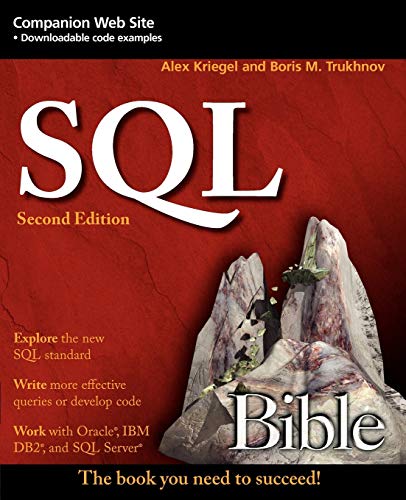
Harness SQL for Oracle 11g, IBM DB2, and Microsoft SQL Server 2008
Combining theory with everyday practicality, this definitive volume is packed with up-to-date information, new features, and explanations you need to get the very most out of SQL and its latest standard. The book is unique in that every chapter highlights how the new SQL standard applies to the three major databases, Oracle 11g, IBM DB2 9.5, and Microsoft SQL Server 2008. The result is a comprehensive, useful, and real-world reference for all SQL users, from beginners to experienced developers.
- Learn the basics of SQL and relational databases
- Explore tables, views, sequences, and other database objects
- Examine transactions and locking in multiuser environments
- Review functions mandated by the SQL standard and the three major vendors
- Access metadata information and implement database security
- Go beyond SQL to XML integration, OLAP business intelligence, and more
Companion Web Site
Find downloadable code examples and more at www.wiley.com/go/SQLBible2
Die Inhaltsangabe kann sich auf eine andere Ausgabe dieses Titels beziehen.
Über die Autorin bzw. den Autor
Alex Kriegel, PMP, MCSD/MCTS, works as a Systems Architect for the State of Oregon; prior to this he worked for Pope and Talbot, Inc., Psion Teklogix International, Inc., and for Belorussian Academy of Sciences. He received his MSc. in Physics of Metals from Belarus State Polytechnic Institute in 1988, discovered PC programming and relational databases in 1992, and has never looked back since. Alex is certified as a Project Management Professional (PMP) by the Project Management Institute, and also holds various Microsoft certifications. He is also the author of Microsoft SQL Server 2000 Weekend Crash Course (Wiley, 2001), SQL Functions (Wrox, 2005), and co-author of Introduction to Database Management (Wiley, 2007), and the first edition of this book.
Boris M. Trukhnov, OCP, has been working as Senior Technical Analyst/Oracle DBA for Pope & Talbot, Inc., in Portland, Oregon, since 1998. His previous job titles include Senior Programmer Analyst, Senior Software Developer, and Senior Operations Analyst. He has been working with SQL and relational databases since 1994. Boris holds a B.S. in Computer Science from the University of Minnesota. He is a co-author of Introduction to Database Management (Wiley, 2007).
Von der hinteren Coverseite
Harness SQL for Oracle 11g, IBM DB2, and Microsoft SQL Server 2008
Combining theory with everyday practicality, this deޮitive volume is packed with up-to-date information, new features, and explanations you need to get the very most out of SQL and its latest standard. The book is unique in that every chapter highlights how the new SQL standard applies to the three major databases, Oracle 11g, IBM DB2 9.5, and Microsoft SQL Server 2008. The result is a comprehensive, useful, and real-world reference for all SQL users, from beginners to experienced developers.
-
Learn the basics of SQL and relational databases
-
Explore tables, views, sequences, and other database objects
-
Examine transactions and locking in multiuser environments
-
Review functions mandated by the SQL standard and the three major vendors
-
Access metadata information and implement database security
-
Go beyond SQL to XML integration, OLAP business intelligence, and more
Companion Web Site
Find downloadable code examples, a full book description, and more at wiley.com/go/SQLBible2.
Aus dem Klappentext
Harness SQL for Oracle 11g, IBM DB2, and Microsoft SQL Server 2008
Combining theory with everyday practicality, this deޮitive volume is packed with up-to-date information, new features, and explanations you need to get the very most out of SQL and its latest standard. The book is unique in that every chapter highlights how the new SQL standard applies to the three major databases, Oracle 11g, IBM DB2 9.5, and Microsoft SQL Server 2008. The result is a comprehensive, useful, and real-world reference for all SQL users, from beginners to experienced developers.
-
Learn the basics of SQL and relational databases
-
Explore tables, views, sequences, and other database objects
-
Examine transactions and locking in multiuser environments
-
Review functions mandated by the SQL standard and the three major vendors
-
Access metadata information and implement database security
-
Go beyond SQL to XML integration, OLAP business intelligence, and more
Companion Web Site
Find downloadable code examples, a full book description, and more at wiley.com/go/SQLBible2.
Auszug. © Genehmigter Nachdruck. Alle Rechte vorbehalten.
SQL Bible
By Alex Kriegel Boris M. TrukhnovJohn Wiley & Sons
Copyright © 2008 Alex KriegelAll right reserved.
ISBN: 978-0-470-22906-4
Chapter One
SQL and Relational Database Management Systems
IN THIS CHAPTER
Understanding databases
Characteristics of a good database
The database market
Real-life database examples
Brief database history
SQL standards and implementation differences
Information may be the most valuable commodity in the modern world. It can take many different forms - such as accounting and payroll information, information about customers and orders, scientific and statistical data, graphics, or multimedia. We are virtually swamped with data, and we cannot - or at least we'd like to think about it this way - afford to lose it. These days we simply have too much data to keep storing it in file cabinets or cardboard boxes. The need to store large collections of persistent data safely, "slice and dice" it efficiently from different angles by multiple users, and update it easily when necessary is critical for every enterprise. That need mandates the existence of databases, which accomplish all the tasks listed, and then some. To put it simply, a database is just an organized collection of information - with emphasis on "organized."
A more specific definition often used as a synonym for "database" is database management system (DBMS). That term is wider and, in addition to the stored information, includes some methods to work with data and tools to maintain it.
NOTE
DBMS can be defined as a collection of interrelated data plus a set of programs to access, modify, and maintain the data. More about DBMS later in this chapter.
Desirable Database Characteristics
There are many differing ideas about what a database is and what it should do. Nevertheless, all modern databases should have at least the following characteristics.
Sufficient capacity
A database's primary function is to store large amounts of information. For example, an order management system for a medium-sized company can easily grow into gigabytes or even terabytes of data; the bigger the company, the more data it needs to store and rely upon. A company that wants to keep historical (archival) data will require even more storage space. The need for storage capacity is growing rapidly; the recent change in how audio and video files are being used is a good example of that. Just five or six years ago, storing movie files in a database, editing and remixing them using online tools, and sharing them on the Internet would sound almost unrealistic, and today it is our day-to-day reality. Just think of the popularity of YouTube and similar services (such as Eyespot, Grouper, Jumpcut, VideoEgg, and so on).
Adequate security and auditing
As was noted previously, enterprise data is valuable and must be stored safely. That means protection of the stored data not only from malicious or careless human activities, such as unauthorized logins, accidental information deletions or modifications, and so on, but also from hardware failures and natural disasters. For many companies, database security is not a "nice-to-have" feature, but rather a mandatory requirement regulated by a number of different level standards, including federal laws, such as the Sarbanes-Oxley Act of 2002 (Sarbox) and the Health Insurance Portability and Accountability Act of 1996 (HIPAA).
Multiuser environment
It is also important to note that, in order to be useful, the information stored in a database must be accessible to many users simultaneously at different levels of security, and, no matter what, the data must stay consistent. For example, if two users try to change the same piece of information at the same time, the result can be unpredictable (such as data corruption), so situations like that have to be handled appropriately by internal database mechanisms. Also, certain groups of users may be allowed to modify several pieces of information, browse other parts of it, and be prevented from even viewing yet another part. (Some company data, such as employee and customer personal information, can be strictly confidential with very restricted access.)
Effectiveness and searchability
Users need quick access to the data they want. It is very important not only to be able to store data, but also to have efficient algorithms to work with it. For example, it would be unacceptable for users to have to scroll through each and every record to find just one order among millions stored in the database - the response to someone's querying the database must be fast, preferably instantaneous.
NOTE
As an analogy, suppose you wanted to find all the occurrences of the word "object" in a book. You could physically browse through the entire book page by page until you reach the end. Or you could use the index and determine that the word is used on pages 245, 246, and 348. This situation is comparable to using bad or good programming algorithms.
Scalability
Databases must be flexible and easily adaptable to changing business needs. That primarily means the internal structure of database objects should be easily modifiable with minimum impact on other objects and processes. For example, to add a field in a pre-SQL database, you would have to bring the whole dataset offline - that is, make it inaccessible to users, modify it, change and recompile related programs, and so on. This is covered in more detail in the "Database Legacy" section of this chapter.
Another scalability aspect is that data typically lives longer than the hardware and software used to access and manipulate it, so it would not be very convenient to have to redesign the entire database to accommodate the current "flavor-of-the-month" development environment, for example, in case of a takeover or when company management suddenly decided to switch the production environment from Java to C#.
In addition, a small private company with a handful of customers can gradually grow into a large corporation with hundreds of thousands or even millions of users. In this case, it would be very useful to have the ability to start with a simplified, inexpensive (or even free) database edition on a small server with the ability to switch easily to the same vendor's Enterprise version on a powerful multiprocessor machine.
NOTE
A very popular and recent alternative to the idea of a powerful multiprocessor server is the concept of "grid" computing when a virtual supercomputer is being assembled from multiple nodes where each node is a relatively small server. The nodes can be easily added or removed from the system, which significantly improves its scalability.
User friendliness
Databases are not just for programmers and technical personnel (some would say not for programmers - period). Nontechnical users constitute the majority of all database users nowadays. Accountants, managers, salespeople, doctors, nurses, librarians, scientists, technicians, customer service representatives - for all these and many more people, interaction with databases is an integral part of their work. That means data must be easy to manipulate. Of course, most users will access it through a graphical user interface with a predefined set of screens and limited functionality, but ad hoc database queries and reports are becoming more and more popular, especially among sophisticated, computer-literate users.
NOTE
...
„Über diesen Titel“ kann sich auf eine andere Ausgabe dieses Titels beziehen.
Suchergebnisse für SQL Bible

Beispielbild für diese ISBN
SQL Bible
Anbieter: World of Books (was SecondSale), Montgomery, IL, USA
Verkäuferbewertung 5 von 5 Sternen

Paperback. Zustand: Good. Combining theory with everyday practicality, this definitive volume is packed with the up-to-date information, new features, and explanations you need to get the very most out of SQL and its latest standard. The book is unique in that every chapter highlights how the new SQL standard applies to the three major databases, Oracle 11g, IBM DB2 9. Artikel-Nr. 00099750130
Gebraucht kaufen
EUR 6,06
Versand gratis
Versand innerhalb von USA
Versand innerhalb von USA
Anzahl: 2 verfügbar
Beispielbild für diese ISBN
SQL Bible
Anbieter: ThriftBooks-Dallas, Dallas, TX, USA
Verkäuferbewertung 5 von 5 Sternen
Paperback. Zustand: Fair. No Jacket. Readable copy. Pages may have considerable notes/highlighting. ~ ThriftBooks: Read More, Spend Less. Artikel-Nr. G0470229063I5N00
Gebraucht kaufen
EUR 6,07
Versand gratis
Versand innerhalb von USA
Versand innerhalb von USA
Anzahl: 1 verfügbar
Beispielbild für diese ISBN
SQL Bible
Anbieter: ThriftBooks-Dallas, Dallas, TX, USA
Verkäuferbewertung 5 von 5 Sternen
Paperback. Zustand: Good. No Jacket. Pages can have notes/highlighting. Spine may show signs of wear. ~ ThriftBooks: Read More, Spend Less. Artikel-Nr. G0470229063I3N00
Gebraucht kaufen
EUR 6,07
Versand gratis
Versand innerhalb von USA
Versand innerhalb von USA
Anzahl: 1 verfügbar
Beispielbild für diese ISBN
SQL Bible
Verlag:
Wiley & Sons, Incorporated, John, 2008
ISBN 10: 0470229063
ISBN 13: 9780470229064
Gebraucht
Softcover
Anbieter: Better World Books, Mishawaka, IN, USA
Verkäuferbewertung 5 von 5 Sternen
Zustand: Good. 2nd. Former library copy. Pages intact with minimal writing/highlighting. The binding may be loose and creased. Dust jackets/supplements are not included. Includes library markings. Stock photo provided. Product includes identifying sticker. Better World Books: Buy Books. Do Good. Artikel-Nr. 10766855-6
Gebraucht kaufen
EUR 7,26
Versand gratis
Versand innerhalb von USA
Versand innerhalb von USA
Anzahl: 1 verfügbar
Beispielbild für diese ISBN
SQL Bible
Verlag:
Wiley & Sons, Incorporated, John, 2008
ISBN 10: 0470229063
ISBN 13: 9780470229064
Gebraucht
Softcover
Anbieter: Better World Books, Mishawaka, IN, USA
Verkäuferbewertung 5 von 5 Sternen
Zustand: Good. 2nd. Pages intact with minimal writing/highlighting. The binding may be loose and creased. Dust jackets/supplements are not included. Stock photo provided. Product includes identifying sticker. Better World Books: Buy Books. Do Good. Artikel-Nr. 9362616-6
Gebraucht kaufen
EUR 7,26
Versand gratis
Versand innerhalb von USA
Versand innerhalb von USA
Anzahl: 1 verfügbar
Beispielbild für diese ISBN
SQL Bible
Verlag:
Wiley & Sons, Incorporated, John, 2008
ISBN 10: 0470229063
ISBN 13: 9780470229064
Gebraucht
Softcover
Anbieter: Better World Books: West, Reno, NV, USA
Verkäuferbewertung 5 von 5 Sternen
Zustand: Good. 2nd. Pages intact with minimal writing/highlighting. The binding may be loose and creased. Dust jackets/supplements are not included. Stock photo provided. Product includes identifying sticker. Better World Books: Buy Books. Do Good. Artikel-Nr. 9362616-6
Gebraucht kaufen
EUR 7,26
Versand gratis
Versand innerhalb von USA
Versand innerhalb von USA
Anzahl: 1 verfügbar
Beispielbild für diese ISBN
SQL Bible
Anbieter: BooksRun, Philadelphia, PA, USA
Verkäuferbewertung 5 von 5 Sternen
Paperback. Zustand: Very Good. 2. It's a well-cared-for item that has seen limited use. The item may show minor signs of wear. All the text is legible, with all pages included. It may have slight markings and/or highlighting. Artikel-Nr. 0470229063-11-22
Gebraucht kaufen
EUR 8,21
Versand gratis
Versand innerhalb von USA
Versand innerhalb von USA
Anzahl: 1 verfügbar
Beispielbild für diese ISBN
SQL Bible 2e w/WS: 742
Anbieter: AwesomeBooks, Wallingford, Vereinigtes Königreich
Verkäuferbewertung 5 von 5 Sternen
Paperback. Zustand: Very Good. SQL Bible 2e w/WS: 742 This book is in very good condition and will be shipped within 24 hours of ordering. The cover may have some limited signs of wear but the pages are clean, intact and the spine remains undamaged. This book has clearly been well maintained and looked after thus far. Money back guarantee if you are not satisfied. See all our books here, order more than 1 book and get discounted shipping. Artikel-Nr. 7719-9780470229064
Gebraucht kaufen
EUR 12,75
EUR 4,86 Versand
Versand von Vereinigtes Königreich nach USA
Versand von Vereinigtes Königreich nach USA
Anzahl: 2 verfügbar
Beispielbild für diese ISBN
SQL Bible 2e w/WS: 742
Anbieter: Bahamut Media, Reading, Vereinigtes Königreich
Verkäuferbewertung 4 von 5 Sternen

Paperback. Zustand: Very Good. This book is in very good condition and will be shipped within 24 hours of ordering. The cover may have some limited signs of wear but the pages are clean, intact and the spine remains undamaged. This book has clearly been well maintained and looked after thus far. Money back guarantee if you are not satisfied. See all our books here, order more than 1 book and get discounted shipping. Artikel-Nr. 6545-9780470229064
Gebraucht kaufen
EUR 12,53
EUR 8,23 Versand
Versand von Vereinigtes Königreich nach USA
Versand von Vereinigtes Königreich nach USA
Anzahl: 2 verfügbar
Beispielbild für diese ISBN
SQL Bible
Anbieter: Majestic Books, Hounslow, Vereinigtes Königreich
Verkäuferbewertung 4 von 5 Sternen
Zustand: New. pp. 888 Illus. Artikel-Nr. 7520423
Neu kaufen
EUR 53,99
EUR 7,66 Versand
Versand von Vereinigtes Königreich nach USA
Versand von Vereinigtes Königreich nach USA
Anzahl: 3 verfügbar