
Verwandte Artikel zu The Academic Chair's Handbook (Jossey-Bass Resources...
Inhaltsangabe
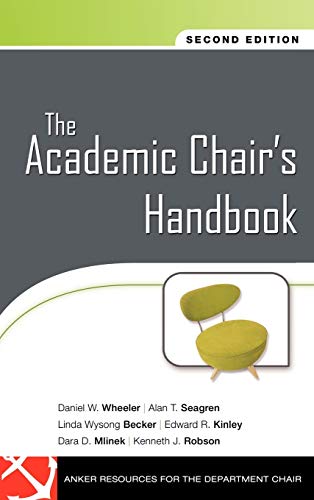
Practically focused, easily accessible, this book is directly relevant to the academic environment in which department chairs operate. The authors―internationally known experts in academic administration―conducted interviews with department chairs and heads at 38 academic institutions from across the U.S. and Canada, public and private, two-year and four-year.
The extensive interviews resulted in four thematic patterns that covered the overarching issues department chairs face: quality, change, culture, and leadership. Each chapter is packed with practical advice and concludes with questions and resources to help chairs develop constructive responses to the myriad issues facing them.
Die Inhaltsangabe kann sich auf eine andere Ausgabe dieses Titels beziehen.
Über die Autorin bzw. den Autor
Daniel W. Wheeler is professor and head of the Department of Agricultural Leadership, Education, and Communication at the University of Nebraska–Lincoln. Alan T. Seagren is professor emeritus and director of the Center for the Study of Higher and Postsecondary Education at the University of Nebraska–Lincoln. Linda Wysong Becker is vice president for student services at Union College in Lincoln, Nebraska. Edward R. Kinley is associate vice president for academic affairs and chief information officer at Indiana State University. Dara D. Mlinek is a former research assistant and instructor in the Center for the Study of Higher and Postsecondary Education at the University of Nebraska–Lincoln and participated in the research efforts focused on chairs. Kenneth J. Robson has served as a department chair, dean, and vice president. He is currently engaged in a higher education consulting practice with his partner J. Judith Eifert.
Von der hinteren Coverseite
The Academic Chair's Handbook
Every aspiring, new, and experienced chairperson will benefit from this rich resource of many integrated and well-tested strategies that foster faculty development and their own development.
Larry A. Braskamp, professor emeritus, Loyola University Chicago
This second edition of The Academic Chair's Handbook provides an updated, comprehensive, and practical guide for academic department chairs and division heads at both two- and four-year institutions. This essential resource includes new material on a variety of topics such as technology, funding and resources, departmental climate and quality, assessment, and accreditation, and describes several strategies department chairs can use to build a positive work environment that fosters professional growth of both faculty and chairs. The book's self-assessment inventory can help determine which strategy is most appropriate for a particular situation. While the strategies are upbeat, positive, and developmental, they clearly address the often harsh political realities involved in chairing academic departments.
Aus dem Klappentext
The Academic Chair's Handbook
Every aspiring, new, and experienced chairperson will benefit from this rich resource of many integrated and well-tested strategies that foster faculty development and their own development.
—Larry A. Braskamp, professor emeritus, Loyola University Chicago
This second edition of The Academic Chair's Handbook provides an updated, comprehensive, and practical guide for academic department chairs and division heads at both two- and four-year institutions. This essential resource includes new material on a variety of topics such as technology, funding and resources, departmental climate and quality, assessment, and accreditation, and describes several strategies department chairs can use to build a positive work environment that fosters professional growth of both faculty and chairs. The book's self-assessment inventory can help determine which strategy is most appropriate for a particular situation. While the strategies are upbeat, positive, and developmental, they clearly address the often harsh political realities involved in chairing academic departments.
Auszug. © Genehmigter Nachdruck. Alle Rechte vorbehalten.
The Academic Chair's Handbook
By Daniel W. Wheeler Alan T. Seagren Linda Wysong Becker Edward R. Kinley Dara D. Mlinek Kenneth J. RobsonJohn Wiley & Sons
Copyright © 2008 Daniel W. WheelerAll right reserved.
ISBN: 978-0-470-19765-3
Chapter One
Difficulties in the Building Process
If one can create a sense of community, which allows for individual and collective programs, personal development, and a sense of family to celebrate personal and collective accomplishments, a department can be a wonderful and enjoyable place to work. However, without a sense of community and family a department can be a terrible place to work in terms of having fun, being productive, and gaining satisfaction. -A chair of a large humanities department
Creating and maintaining a positive work environment for faculty is a goal to which most chairs aspire, and which can be characterized in several ways. Ideally, faculty feel they are appreciated and supported, and in turn, they feel a commitment to the department. They support and embrace the department's mission and are aligned with its goals and objectives. They also believe that their individual goals and objectives are appreciated and respected. While this might appear to be a somewhat utopian view, it does represent a vision of what departments can at least work toward, if not completely attain.
The Context for Leadership
The environment within which chairs operate today is vastly more complex and multidimensional than the one inhabited by their predecessors only a few years ago.
Higher education, facing change and high risks, is in need of new and better leadership now-not just in the presidency but at all levels. Leadership is not something that should be hoarded; it is not a zero-sum game. The goal must be to expand the number of leaders and the total amount of leadership. This means that institutions must make a continuous effort in two critical areas. The first is to improve the search process. The second is the need for leadership development-a subject that is not addressed at all on most campuses, leaving higher education as one of the few sectors of society that does not focus on a constant effort to find and develop leaders. (Newman, Couturier, & Scurry, 2004, p. 198)
Chairs today might feel at times that they are performing in a drama where not everyone is working from the same script; where actors come and go seemingly randomly; where members of the audience participate spontaneously in the action itself from time to time; and where critics who might never have seen an actual performance nevertheless pass judgment on its quality.
In periods of rapid and momentous change, such as higher education is currently experiencing, it is very challenging to get all the players in a department, far less in an entire institution, on the same page, so to speak. Compounding this problem is the fact that faculty lead very busy lives and often have only limited and intermittent attention to devote to departmental and institutional priorities. In addition, formerly passive spectators-students, parents, and the general public-have begun to get far more involved in the process and outcomes of higher education. Finally, regulatory authorities and policymakers have become much more vocal about what they consider to be the inadequacies of higher education. In short, these are some of the more vocal players who might at times operate from scripts that are quite different from those commonly found in colleges and universities.
Figure 1.1 conveys the dramatic interplay of forces that affect chairs and their departments. At the core of the enterprise lies learning and performance, which carry connotations of outcomes and productivity, two watchwords that are associated with the current educational environment. Surrounding these core functions of higher education are the systems, processes, and practices that departments employ-and chairs lead-to ensure that they produce the desired results. Building on a base of mutual trust, departments open themselves to collaboration and teamwork that lead to deeper understandings of what they do and how they do it. Ultimately, understanding forms the basis for improvement and assessment. In a fully functioning department where all of these preconditions are met, chairs can work with their faculty to envision a positive future and put realizable plans in place to ensure that common goals are achieved.
Creating a positive and productive departmental culture is at once an enormous challenge for chairs and, if done properly, a source of deep satisfaction. While there are many factors that influence a work unit's culture, we identify a set of key elements, including change management, quality assurance, assessment and accountability, advice and support, and effective leadership. How chairs work with their faculty to create conditions where innovation, quality, and results are embraced as goals for the entire department determines the extent to which they will enjoy a positive climate. We will have much more to say about these elements of departmental culture in the chapters that follow.
At yet another level, chairs participate in and are influenced by their institution's governance structures. This is not only the level at which comprehensive policies and priorities are established, but it is the buffer between the institution and its various external stakeholders. Given the rise in activity levels in the external environment, which we referred to in the Preface, the governance system in institutions has also become more active in engaging public bodies that have an interest in their operations. Once a sanctuary for the unfettered creation and expression of ideas and opinions, colleges and universities have been opened up to the play of competitive market forces and the scrutiny of policymakers and the general public.
Finally, what we call the external environment consists of a constellation of active forces that impinge on institutional autonomy and self-regulation. They include elected officials who respond to the public's demand for greater efficiency and accountability; sharp reductions in public subsidies to higher education; changing demographics and access issues; an increasingly litigious environment; and the proliferation and convergence of information technologies. However, it would be shortsighted to simply view the relationship between institutions and their environment as one in which institutions are passive while the environment is active. More and more institutions are engaging in competitive and collaborative activities ranging from establishing campuses abroad to creating spin-off companies.
This chapter presents three realities that chairs face in building a positive culture and climate: aspects related to chairing a department; characteristics of academic departments; and pressing problems facing faculty. The chapter ends with a self-assessment inventory that serves both as a means for chairs and faculty to identify concerns, as well as a way to direct attention to relevant sections of the book for suggestions or ideas.
Chairing the Department
Chairs are busy people. Daily, they face tough decisions about recruiting, developing and evaluating faculty, providing raises, managing conflicts, mediating tensions, and counseling faculty about diverse topics such as promotion and tenure, midlife crises,...
„Über diesen Titel“ kann sich auf eine andere Ausgabe dieses Titels beziehen.
Suchergebnisse für The Academic Chair's Handbook (Jossey-Bass Resources...

Beispielbild für diese ISBN
The Academic Chair's Handbook
Anbieter: World of Books (was SecondSale), Montgomery, IL, USA
Verkäuferbewertung 5 von 5 Sternen

Hardback. Zustand: Fair. * This book is practically focused, easily accessible, and directly relevant to the academic environment in which department chairs operate. * The authors conducted interviews with department chairs and heads at 38 academic institutions from across the U. S. Artikel-Nr. 00060939731
Gebraucht kaufen
EUR 6,35
Versand gratis
Versand innerhalb von USA
Versand innerhalb von USA
Anzahl: 1 verfügbar
Beispielbild für diese ISBN
The Academic Chair's Handbook
Verlag:
Wiley & Sons, Incorporated, John, 2008
ISBN 10: 047019765X
ISBN 13: 9780470197653
Gebraucht
Hardcover
Anbieter: Better World Books, Mishawaka, IN, USA
Verkäuferbewertung 5 von 5 Sternen
Zustand: Very Good. Pages intact with possible writing/highlighting. Binding strong with minor wear. Dust jackets/supplements may not be included. Stock photo provided. Product includes identifying sticker. Better World Books: Buy Books. Do Good. Artikel-Nr. 3955222-6
Gebraucht kaufen
EUR 6,36
Versand gratis
Versand innerhalb von USA
Versand innerhalb von USA
Anzahl: 1 verfügbar
Beispielbild für diese ISBN
The Academic Chair's Handbook
Verlag:
Wiley & Sons, Incorporated, John, 2008
ISBN 10: 047019765X
ISBN 13: 9780470197653
Gebraucht
Hardcover
Anbieter: Better World Books, Mishawaka, IN, USA
Verkäuferbewertung 5 von 5 Sternen
Zustand: Good. Pages intact with minimal writing/highlighting. The binding may be loose and creased. Dust jackets/supplements are not included. Stock photo provided. Product includes identifying sticker. Better World Books: Buy Books. Do Good. Artikel-Nr. 15353855-6
Gebraucht kaufen
EUR 6,36
Versand gratis
Versand innerhalb von USA
Versand innerhalb von USA
Anzahl: 1 verfügbar
Beispielbild für diese ISBN
The Academic Chair's Handbook
Verlag:
Wiley & Sons, Incorporated, John, 2008
ISBN 10: 047019765X
ISBN 13: 9780470197653
Gebraucht
Hardcover
Anbieter: Better World Books: West, Reno, NV, USA
Verkäuferbewertung 5 von 5 Sternen
Zustand: Very Good. Former library copy. Pages intact with possible writing/highlighting. Binding strong with minor wear. Dust jackets/supplements may not be included. Includes library markings. Stock photo provided. Product includes identifying sticker. Better World Books: Buy Books. Do Good. Artikel-Nr. 13097442-6
Gebraucht kaufen
EUR 6,36
Versand gratis
Versand innerhalb von USA
Versand innerhalb von USA
Anzahl: 1 verfügbar
Beispielbild für diese ISBN
The Academic Chair's Handbook
Anbieter: Wonder Book, Frederick, MD, USA
Verkäuferbewertung 5 von 5 Sternen
Zustand: Good. Good condition. 2nd edition. A copy that has been read but remains intact. May contain markings such as bookplates, stamps, limited notes and highlighting, or a few light stains. Artikel-Nr. B19B-03244
Gebraucht kaufen
EUR 6,44
Versand gratis
Versand innerhalb von USA
Versand innerhalb von USA
Anzahl: 1 verfügbar
Beispielbild für diese ISBN
The Academic Chair s Handbook 2e
Anbieter: PBShop.store UK, Fairford, GLOS, Vereinigtes Königreich
Verkäuferbewertung 5 von 5 Sternen
HRD. Zustand: New. New Book. Shipped from UK. Established seller since 2000. Artikel-Nr. FW-9780470197653
Neu kaufen
EUR 41,37
EUR 5,99 Versand
Versand von Vereinigtes Königreich nach USA
Versand von Vereinigtes Königreich nach USA
Anzahl: 15 verfügbar
Beispielbild für diese ISBN
The Academic Chair's Handbook (J-B Anker Resources for Department Chairs)
Anbieter: Majestic Books, Hounslow, Vereinigtes Königreich
Verkäuferbewertung 4 von 5 Sternen

Zustand: New. pp. xxiv + 272 Illus. Artikel-Nr. 7485674
Neu kaufen
EUR 49,10
EUR 7,76 Versand
Versand von Vereinigtes Königreich nach USA
Versand von Vereinigtes Königreich nach USA
Anzahl: 1 verfügbar
Beispielbild für diese ISBN
The Academic Chair's Handbook (Jossey-Bass Resources for Department Chairs)
Anbieter: Ria Christie Collections, Uxbridge, Vereinigtes Königreich
Verkäuferbewertung 5 von 5 Sternen
Zustand: New. In English. Artikel-Nr. ria9780470197653_new
Neu kaufen
EUR 48,80
EUR 13,48 Versand
Versand von Vereinigtes Königreich nach USA
Versand von Vereinigtes Königreich nach USA
Anzahl: Mehr als 20 verfügbar
Beispielbild für diese ISBN
The Academic Chair's Handbook 2e
Anbieter: Revaluation Books, Exeter, Vereinigtes Königreich
Verkäuferbewertung 5 von 5 Sternen
Hardcover. Zustand: Brand New. 2nd edition. 272 pages. 9.00x6.25x1.00 inches. In Stock. Artikel-Nr. x-047019765X
Neu kaufen
EUR 61,18
EUR 11,94 Versand
Versand von Vereinigtes Königreich nach USA
Versand von Vereinigtes Königreich nach USA
Anzahl: 2 verfügbar
Beispielbild für diese ISBN
The Academic Chair's Handbook
Anbieter: Kennys Bookstore, Olney, MD, USA
Verkäuferbewertung 5 von 5 Sternen
Zustand: New. * This book is practically focused, easily accessible, and directly relevant to the academic environment in which department chairs operate. * The authors conducted interviews with department chairs and heads at 38 academic institutions from across the U. S. Series: Jossey-Bass Resources for Department Chairs. Num Pages: 304 pages, Illustrations. BIC Classification: JNM. Category: (P) Professional & Vocational. Dimension: 232 x 161 x 26. Weight in Grams: 468. . 2008. 2nd Edition. Hardcover. . . . . Books ship from the US and Ireland. Artikel-Nr. V9780470197653
Neu kaufen
EUR 67,44
EUR 9,37 Versand
Versand innerhalb von USA
Versand innerhalb von USA
Anzahl: Mehr als 20 verfügbar