
Verwandte Artikel zu Essentials of Corporate Fraud (Essentials Series)
Inhaltsangabe
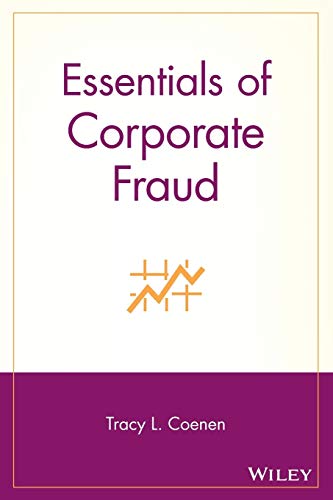
Full of valuable tips, techniques, illustrative real-world examples, exhibits, and best practices, this handy and concise paperback will help you stay up to date on the newest thinking, strategies, developments, and technologies in corporate fraud. Essentials of Corporate Fraud provides an introductory look at fraud and the kinds of fraud that can occur in various areas of a company.
Die Inhaltsangabe kann sich auf eine andere Ausgabe dieses Titels beziehen.
Über die Autorin bzw. den Autor
Tracy L. Coenen, CPA, MBA, CFE, is a fraud expert and President of Sequence Inc., a forensic accounting firm with offices in Milwaukee and Chicago. She conducts financial investigations for private and public companies, reports her findings to executives and boards of directors, and testifies in court as an expert witness. Her commentary has been featured on NBC news, and her comments printed in the Wall Street Journal, USA Today, BusinessWeek.com, CBSNews.com, and Entrepreneur.com, among others. Tracy writes articles on fraud for national business publications, including Fraud Magazine.
Von der hinteren Coverseite
Essentials of Corporate Fraud
Full of valuable tips, techniques, illustrative real-world examples, exhibits, and best practices, this handy and concise paperback will help you stay up to date on the newest thinking, strategies, developments, and technologies in corporate fraud.
"Tracy Coenen's Essentials of Corporate Fraud is the perfect primer for executives and managers about this serious issue. Very well written."
Joseph T. Wells, CFE, CPA, founder and Chairman, Association of Certified Fraud Examiners
"Accountants, attorneys, businesspeople, HR folks, and consultants can all learn from Tracy Coenen's expertise and easy-to-understand style. Want to make more money and make your life easier? Then READ THIS BOOK."
Gary Zeune, CPA, founder, The Pros & The Cons
Essentials of Corporate Fraud will challenge your concept of corporate fraud, providing an introductory look at fraud and the kinds of fraud that can occur in various areas of a company. Topics covered include:
-
People Who Commit Fraud
-
Fraud Detection and Investigation
-
Red Flags of Fraud
-
Fraud Prevention
-
Asset Misappropriation, Bribery, and Corruption
-
Best Practices in Fraud Management
-
Financial Statement Fraud
-
The Future of Fraud
There is much work to be done by companies that want to reduce opportunities for fraud. Author and fraud expert Tracy Coenen presents an insider's look at corporate fraud and equips you with real-world guidance for each stage, from detection and investigation, to prevention and warning signs, to educating employees in implementing policies and procedures specifically designed to prevent fraud.
Aus dem Klappentext
Essentials of Corporate Fraud
Full of valuable tips, techniques, illustrative real-world examples, exhibits, and best practices, this handy and concise paperback will help you stay up to date on the newest thinking, strategies, developments, and technologies in corporate fraud.
"Tracy Coenen's Essentials of Corporate Fraud is the perfect primer for executives and managers about this serious issue. Very well written."
—Joseph T. Wells, CFE, CPA, founder and Chairman, Association of Certified Fraud Examiners
"Accountants, attorneys, businesspeople, HR folks, and consultants can all learn from Tracy Coenen's expertise and easy-to-understand style. Want to make more money and make your life easier? Then READ THIS BOOK."
—Gary Zeune, CPA, founder, The Pros & The Cons
Essentials of Corporate Fraud will challenge your concept of corporate fraud, providing an introductory look at fraud and the kinds of fraud that can occur in various areas of a company. Topics covered include:
-
People Who Commit Fraud
-
Fraud Detection and Investigation
-
Red Flags of Fraud
-
Fraud Prevention
-
Asset Misappropriation, Bribery, and Corruption
-
Best Practices in Fraud Management
-
Financial Statement Fraud
-
The Future of Fraud
There is much work to be done by companies that want to reduce opportunities for fraud. Author and fraud expert Tracy Coenen presents an insider's look at corporate fraud and equips you with real-world guidance for each stage, from detection and investigation, to prevention and warning signs, to educating employees in implementing policies and procedures specifically designed to prevent fraud.
Auszug. © Genehmigter Nachdruck. Alle Rechte vorbehalten.
Essentials of Corporate Fraud
By Tracy CoenenJohn Wiley & Sons
Copyright © 2008 Tracy CoenenAll right reserved.
ISBN: 978-0-470-19412-6
Chapter One
The Fraud Problem
After reading this chapter, you will be able to
Understand the results of fraud prevention efforts over the last several years. Identify the three main components of any fraud scheme, traditionally known as the fraud triangle. Discuss the various actions companies take against those who perpetrate fraud and the reasons why they do not initiate criminal prosecutions.
Internal fraud at companies is a big enough problem to be considered an industry unto itself. It is estimated that organizations lose an average of 5% of revenue annually to internal fraud, which equates to $652 billion in losses each year just in the United States.
People often wonder why so much fraud occurs and why it is not caught sooner, thereby limiting the losses. The answer is simple. Companies have systems in place to help ensure that accounting transactions are recorded accurately and that proper procedures are followed. Companies have policies to guide the behavior of people who would generally strive to act in an ethical manner, but occasionally need rules to dictate their behavior. Those systems, procedures, and policies often work to catch errors and honest mistakes in the accounting process.
However, when an employee is committing fraud, he or she is deliberately trying to thwart those systems and policies. The person is purposely circumventing the system, while at the same time attempting to conceal his or her actions. While systems, policies, and procedures may be reasonably good at bringing errors to light, they typically cannot and do not expose fraud. Fraud constitutes a purposeful disregard for the system and a deliberate attempt to violate that system for personal gain, and most companies' systems aren't designed to stop this.
There are also the companies that have inadequate or nonexistent systems to ensure accurate accounting records and financial statements. Those companies can barely keep adequate and reliable records, even with honest employees. But if they can't even ensure a basic level of accuracy, management will hardly be able to prevent, detect, and stop fraud from within.
Internal fraud itself is troubling. Companies entrust their employees with assets, information, and customers. Business cannot be done unless companies put trust in people to sell their products or services, deliver them, collect the money, and keep accurate records. Employees must be charged with growing and managing the business, as well as doing what is in the best interest of the owners and the rest of the company. When those trusted people steal, it can be disheartening. Maybe even more troubling is the fact that so little of the proceeds of fraud are ever recovered.
A 2006 fraud survey by KPMG found that in 42% of major frauds, none of the stolen goods or money was recovered. None. The Association of Certified Fraud Examiners (ACFE) found equally disappointing results in its 2006 survey of fraud examiners. In 42% of internal fraud cases, there was no recovery of money or assets, and in 23% of cases, the recovery amounted to 25% or less of what was stolen. As both of these studies show, close to half of internal fraud victims cannot count on recovering any of the proceeds of fraud, and another one-fourth will recover only a fraction of what was stolen. Clearly, companies cannot and should not expect to recover fraud proceeds.
Progress?
With the focus on fraud since the big cases of Enron, WorldCom, and Tyco, an important question is whether or not companies are making any progress in the fight against fraud. Has the focus on the fraud issue caused them to tighten controls and take swift action against perpetrators, or have companies remained largely complacent in fighting fraud?
The general consensus seems to be that companies have made some progress in protecting themselves against fraud, but still there has not been a noticeable decrease in fraud overall. Some might argue that the progress has not been swift enough, and that is why no real results have been seen. It also may be that companies have been so focused on compliance with Sarbanes-Oxley, that most of the measures taken are merely for the sake of compliance and not designed for true fraud prevention. Companies may think that they have improved in terms of fraud prevention and detection, but that self-assessment can often be overly optimistic. Until a marked decrease in fraud is seen worldwide, the idea that companies have been effective at reducing fraud is dubious.
The ACFE conducted studies on fraud detection, investigation, and prevention in 1996, 2002, 2004, and 2006. In each of these studies, Certified Fraud Examiners were asked to estimate the amount of revenue companies lose each year to internal fraud. In the 1996, 2002, and 2004 reports, Certified Fraud Examiners estimated that 6% of revenues would be lost by companies as a result of occupational fraud and abuse. When applied to the U.S. gross domestic product, that would total $600 billion in 2002 and $660 billion in 2003.
Five percent of revenues were estimated to be lost to internal fraud in 2006, a 1% decrease from previous estimates. When applied to the 2005 U.S. gross domestic product, this is an estimated $652 billion lost to occupational fraud. It's important to remember that these particular figures are all estimates and there is much room for error. The most important conclusion we can draw from these surveys is that professional fraud investigators don't think the instance of employee fraud has decreased to any great extent during the past several years.
And let us not forget that any estimate of the total cost of fraud is just that-an estimate. There is no way for anyone to know the exact total impact of fraud, because we know that a lot of fraud goes undetected. All we are left to do is make educated guesses about the total cost of fraud by assessing the frauds that were discovered and making assumptions about the frauds that were not discovered.
How Companies See Themselves
The results of the 2006 KPMG fraud study suggest that fraud risk management is becoming more important to companies, and it is of increased importance when companies engage in strategic planning. Companies recognize the importance of image and reputation, and this may be fueling a focus on reducing fraud scandals.
The study further indicates that companies are devoting more time and resources to fraud management, with the focus generally on fraud detection and reporting. Less emphasis is being placed on fraud prevention and responses to the discovery of fraud. Survey participants reported an overall decrease in the average time it took to detect a fraud as a result of this greater focus on fraud detection.
While the increased focus on fraud detection is a good thing, the lack of attention to fraud prevention and management's response to fraud is troubling. As we will see later, a swift response to fraud is necessary to deter other employees from committing fraud. And clearly, fraud prevention efforts can pay dividends if only management would value such activities.
A 2006 global survey by Ernst & Young had findings similar to those of the KPMG study. The firm's survey of more than 500 corporate leaders found that companies had increased their spending on assessing and improving internal controls. As a...
„Über diesen Titel“ kann sich auf eine andere Ausgabe dieses Titels beziehen.
Suchergebnisse für Essentials of Corporate Fraud (Essentials Series)

Beispielbild für diese ISBN
Essentials of Corporate Fraud
Anbieter: World of Books (was SecondSale), Montgomery, IL, USA
Verkäuferbewertung 5 von 5 Sternen

Zustand: Very Good. Item in very good condition! Textbooks may not include supplemental items i.e. CDs, access codes etc. Artikel-Nr. 00099014111
Gebraucht kaufen
EUR 6,10
Versand gratis
Versand innerhalb von USA
Versand innerhalb von USA
Anzahl: 1 verfügbar
Beispielbild für diese ISBN
Essentials of Corporate Fraud
Verlag:
Wiley & Sons, Incorporated, John, 2008
ISBN 10: 047019412X
ISBN 13: 9780470194126
Gebraucht
Softcover
Anbieter: Better World Books, Mishawaka, IN, USA
Verkäuferbewertung 5 von 5 Sternen
Zustand: Very Good. Former library copy. Pages intact with possible writing/highlighting. Binding strong with minor wear. Dust jackets/supplements may not be included. Includes library markings. Stock photo provided. Product includes identifying sticker. Better World Books: Buy Books. Do Good. Artikel-Nr. 4386728-75
Gebraucht kaufen
EUR 6,11
Versand gratis
Versand innerhalb von USA
Versand innerhalb von USA
Anzahl: 1 verfügbar
Beispielbild für diese ISBN
Essentials of Corporate Fraud
Anbieter: ThriftBooks-Atlanta, AUSTELL, GA, USA
Verkäuferbewertung 5 von 5 Sternen
Paperback. Zustand: Very Good. No Jacket. May have limited writing in cover pages. Pages are unmarked. ~ ThriftBooks: Read More, Spend Less. Artikel-Nr. G047019412XI4N00
Gebraucht kaufen
EUR 6,11
Versand gratis
Versand innerhalb von USA
Versand innerhalb von USA
Anzahl: 1 verfügbar
Beispielbild für diese ISBN
Essentials of Corporate Fraud
Verlag:
Wiley & Sons, Incorporated, John, 2008
ISBN 10: 047019412X
ISBN 13: 9780470194126
Gebraucht
Softcover
Anbieter: Better World Books, Mishawaka, IN, USA
Verkäuferbewertung 5 von 5 Sternen
Zustand: Good. Former library copy. Pages intact with minimal writing/highlighting. The binding may be loose and creased. Dust jackets/supplements are not included. Includes library markings. Stock photo provided. Product includes identifying sticker. Better World Books: Buy Books. Do Good. Artikel-Nr. 11619083-6
Gebraucht kaufen
EUR 6,11
Versand gratis
Versand innerhalb von USA
Versand innerhalb von USA
Anzahl: 1 verfügbar
Beispielbild für diese ISBN
Essentials of Corporate Fraud
Anbieter: PBShop.store UK, Fairford, GLOS, Vereinigtes Königreich
Verkäuferbewertung 5 von 5 Sternen
PAP. Zustand: New. New Book. Shipped from UK. Established seller since 2000. Artikel-Nr. FW-9780470194126
Neu kaufen
EUR 36,07
EUR 4,85 Versand
Versand von Vereinigtes Königreich nach USA
Versand von Vereinigtes Königreich nach USA
Anzahl: 15 verfügbar
Beispielbild für diese ISBN
Essentials of Corporate Fraud (Essentials Series)
Anbieter: Ria Christie Collections, Uxbridge, Vereinigtes Königreich
Verkäuferbewertung 5 von 5 Sternen
Zustand: New. In English. Artikel-Nr. ria9780470194126_new
Neu kaufen
EUR 47,29
EUR 10,93 Versand
Versand von Vereinigtes Königreich nach USA
Versand von Vereinigtes Königreich nach USA
Anzahl: Mehr als 20 verfügbar
Beispielbild für diese ISBN
Essentials Of Corporate Fraud
Anbieter: Revaluation Books, Exeter, Vereinigtes Königreich
Verkäuferbewertung 5 von 5 Sternen
Paperback. Zustand: Brand New. 1st edition. 224 pages. 9.00x6.00x0.50 inches. In Stock. Artikel-Nr. x-047019412X
Neu kaufen
EUR 54,03
EUR 11,67 Versand
Versand von Vereinigtes Königreich nach USA
Versand von Vereinigtes Königreich nach USA
Anzahl: 2 verfügbar
Beispielbild für diese ISBN
Essentials of Corporate Fraud
Anbieter: Kennys Bookstore, Olney, MD, USA
Verkäuferbewertung 5 von 5 Sternen
Zustand: New. Essentials of Corporate Fraud Full of valuable tips, techniques, illustrative real-world examples, exhibits, and best practices, this handy and concise paperback will help you stay up to date on the newest thinking, strategies, developments, and technologies in corporate fraud. Series: Essentials. Num Pages: 224 pages, Illustrations. BIC Classification: JKV; KFFH; KJM. Category: (P) Professional & Vocational. Dimension: 157 x 234 x 13. Weight in Grams: 334. . 2008. 1st Edition. Paperback. . . . . Books ship from the US and Ireland. Artikel-Nr. V9780470194126
Neu kaufen
EUR 61,17
EUR 9,26 Versand
Versand innerhalb von USA
Versand innerhalb von USA
Anzahl: Mehr als 20 verfügbar
Foto des Verkäufers
Essentials of Corporate Fraud
Anbieter: moluna, Greven, Deutschland
Verkäuferbewertung 5 von 5 Sternen
Zustand: New. .presents an insider s look at corporate fraud. (The Business Journal of Milwaukee , 4/4/08)Tracy L. Coenen, CPA, MBA, CFE, is a fraud expert and President of Sequence Inc., a forensic accounting firm with offices in Milwaukee and Chicago. She condu. Artikel-Nr. 446911965
Neu kaufen
EUR 49,45
EUR 48,99 Versand
Versand von Deutschland nach USA
Versand von Deutschland nach USA
Anzahl: Mehr als 20 verfügbar