
Verwandte Artikel zu The Data Warehouse Lifecycle Toolkit: Practical Techniques...
The Data Warehouse Lifecycle Toolkit: Practical Techniques for Building Data Warehouse and Business Intelligence Systems - Softcover
Buch 2 von 3: The Data Warehouse Toolkit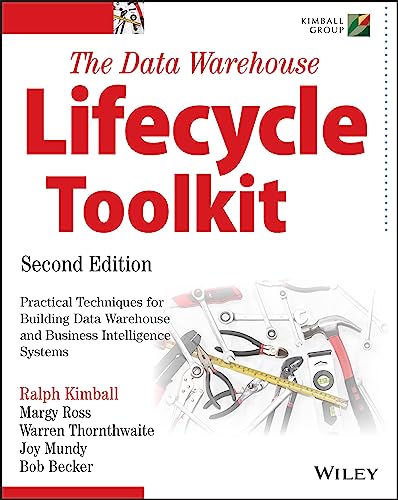
Inhaltsangabe
A thorough update to the industry standard for designing, developing, and deploying data warehouse and business intelligence systems
The world of data warehousing has changed remarkably since the first edition of The Data Warehouse Lifecycle Toolkit was published in 1998. In that time, the data warehouse industry has reached full maturity and acceptance, hardware and software have made staggering advances, and the techniques promoted in the premiere edition of this book have been adopted by nearly all data warehouse vendors and practitioners. In addition, the term "business intelligence" emerged to reflect the mission of the data warehouse: wrangling the data out of source systems, cleaning it, and delivering it to add value to the business.
Ralph Kimball and his colleagues have refined the original set of Lifecycle methods and techniques based on their consulting and training experience. The authors understand first-hand that a data warehousing/business intelligence (DW/BI) system needs to change as fast as its surrounding organization evolves. To that end, they walk you through the detailed steps of designing, developing, and deploying a DW/BI system. You'll learn to create adaptable systems that deliver data and analyses to business users so they can make better business decisions.
Die Inhaltsangabe kann sich auf eine andere Ausgabe dieses Titels beziehen.
Über die Autorin bzw. den Autor
Ralph Kimball, PhD, is the Founder of the Kimball Group and has been a leading visionary in the data warehouse industry since 1982.
Von der hinteren Coverseite
A thorough update to the industry standard for designing, developing, and deploying data warehouse and business intelligence systems
The world of data warehousing has changed remarkably since the first edition of The Data Warehouse Lifecycle Toolkit was published in 1998. In that time, the data warehouse industry has reached full maturity and acceptance, hardware and software have made staggering advances, and the techniques promoted in the premiere edition of this book have been adopted by nearly all data warehouse vendors and practitioners. In addition, the term “business intelligence” emerged to reflect the mission of the data warehouse: wrangling the data out of source systems, cleaning it, and delivering it to add value to the business.
Ralph Kimball and his colleagues have refined the original set of Lifecycle methods and techniques based on their consulting and training experience. The authors understand first-hand that a data warehousing/business intelligence (DW/BI) system needs to change as fast as its surrounding organization evolves. To that end, they walk you through the detailed steps of designing, developing, and deploying a DW/BI system. You’ll learn to create adaptable systems that deliver data and analyses to business users so they can make better business decisions.
With substantial new and updated content, this second edition of The Data Warehouse Lifecycle Toolkit again sets the standard in data warehousing for the next decade. It shows you how to:
- Identify and prioritize data ware-house opportunities
- Create an architecture plan and select products
- Design a powerful, flexible, dimensional model
- Build a robust ETL system
- Develop BI applications to deliver data to business users
- Deploy and sustain a healthy DW/BI environment
The authors are members of the Kimball Group. Each has focused on data warehousing and business intelligence consulting and education for more than 15 years; most have written other books in the Toolkit series. Learn more about the Kimball Group and Kimball University at www.kimballgroup.com.
Aus dem Klappentext
A thorough update to the industry standard for designing, developing, and deploying data warehouse and business intelligence systems
The world of data warehousing has changed remarkably since the first edition of The Data Warehouse Lifecycle Toolkit was published in 1998. In that time, the data warehouse industry has reached full maturity and acceptance, hardware and software have made staggering advances, and the techniques promoted in the premiere edition of this book have been adopted by nearly all data warehouse vendors and practitioners. In addition, the term "business intelligence" emerged to reflect the mission of the data warehouse: wrangling the data out of source systems, cleaning it, and delivering it to add value to the business.
Ralph Kimball and his colleagues have refined the original set of Lifecycle methods and techniques based on their consulting and training experience. The authors understand first-hand that a data warehousing/business intelligence (DW/BI) system needs to change as fast as its surrounding organization evolves. To that end, they walk you through the detailed steps of designing, developing, and deploying a DW/BI system. You'll learn to create adaptable systems that deliver data and analyses to business users so they can make better business decisions.
With substantial new and updated content, this second edition of The Data Warehouse Lifecycle Toolkit again sets the standard in data warehousing for the next decade. It shows you how to:
- Identify and prioritize data warehouse opportunities
- Create an architecture plan and select products
- Design a powerful, flexible, dimensional model
- Build a robust ETL system
- Develop BI applications to deliver data to business users
- Deploy and sustain a healthy DW/BI environment
The authors are members of the Kimball Group. Each has focused on data warehousing and business intelligence consulting and education for more than 15 years; most have written other books in the Toolkit series. Learn more about the Kimball Group and Kimball University at www.kimballgroup.com.
Wiley Technology Publishing
Timely. Practical. Reliable.
Visit the book's companion website at www.wiley.com/compbooks/kimball
Find templates, sample documents, checklists, and task lists on the book's companion website at www.kimballgroup.com
Auszug. © Genehmigter Nachdruck. Alle Rechte vorbehalten.
The Data Warehouse Lifecycle Toolkit
By Ralph KimballJohn Wiley & Sons
Copyright © 2008 Ralph KimballAll right reserved.
ISBN: 978-0-470-14977-5
Chapter One
Introducing the Kimball Lifecycle
Before delving into the specifics of data warehouse/business intelligence (DW/BI) design, development, and deployment, we want to first introduce the Kimball Lifecycle methodology. The Kimball Lifecycle provides the overall framework that ties together the various activities of a DW/BI implementation. The Lifecycle also ties together the content of this book, setting the stage and providing context for the detailed information that unfolds in the subsequent chapters.
This chapter begins with a historical perspective on the origination and evolution of the Kimball Lifecycle. We introduce the Lifecycle roadmap, describing the major tasks and general guidelines for effectively using the Lifecycle throughout your project. Finally, we review the core vocabulary used in the book.
We recommend that all readers take the time to peruse this brief introductory chapter, even if you are involved in only one facet of the DW/BI project. We believe it is beneficial for the entire team to understand and visualize the big picture and overall game plan. This chapter focuses on the forest; each remaining chapter will turn its attention to the individual trees.
Lifecycle History Lesson
The Kimball Lifecycle methodology first took root at Metaphor Computer Systems in the 1980s. Metaphor was a pioneering decision support vendor; its hardware/software product offering was based on LAN technology with a relational database server and graphical user interface client built on a 32-bit operating system. Nearly a quarter century ago, analysts in large corporations were using Metaphor to build queries and download results into spreadsheets and graphs. Sounds familiar, doesn't it?
Most of this book's authors worked together to implement decision support solutions during the early days at Metaphor. At the time, there were no industry best practices or formal methodologies. But the sequential steps of decision support were as obvious then as they are now; our 1984 training manual described them as extract, query, analysis, and presentation.
The authors and other Metaphor colleagues began honing techniques and approaches to deal with the idiosyncrasies of decision support. We had been groomed in traditional development methodologies, but we modified and enhanced those practices to address the unique challenges of providing data access and analytics to business users, while considering growth and extensibility for the long haul.
Over the years, the authors have been involved with literally hundreds of DW/BI projects in a variety of capacities, including vendor, consultant, IT project team member, and business user. Many of these projects have been wildly successful, some have merely met expectations, and a few have failed in spectacular ways. Each project taught us a lesson. In addition, we have all had the opportunity to learn from many talented individuals and organizations over the years. Our approaches and techniques have been refined over time - and distilled into The Data Warehouse Lifecycle Toolkit.
When we first published this book in 1998, we struggled with the appropriate name for our methodology. Someone suggested calling it the Kimball Lifecycle, but Ralph modestly resisted because he felt that many others, in addition to him, contributed to the overall approach.
We eventually determined that the official name would be the Business Dimensional Lifecycle because this moniker reinforced the unique core tenets of our methods. We felt very strongly that successful data warehousing depends on three fundamental concepts:
* Focus on the business.
* Dimensionally structure the data that's delivered to the business via ad hoc queries or reports.
* Iteratively develop the overall data warehouse environment in manageable lifecycle increments rather than attempting a galactic Big Bang.
Rewinding back to the 1990s, we were one of the few organizations emphasizing these core principles at the time, so the Business Dimensional Lifecycle name also differentiated our methods from others in the marketplace. Fast forwarding to today, we still firmly believe in these core concepts; however the industry has evolved since the first edition of the Lifecycle Toolkit was published. Now nearly everyone else touts these same principles; they've become mainstream best practices. Vocabulary from our approach including dimension tables, fact tables, and slowly changing dimensions have been embedded in the interfaces of many DW/BI tools. While it's both thrilling and affirming that the concepts have been woven into the fiber of our industry, they're no longer differentiators of our approach. Second, despite our thoughtful naming of the Business Dimensional Lifecycle, the result was a mouthful, so most people in the industry simply refer to our methods as the Kimball approach, anyhow. Therefore, we're officially adopting the Kimball Lifecycle nomenclature going forward.
In spite of dramatic advancements in technology and understanding during the last couple of decades, the basic constructs of the Kimball Lifecycle have remained strikingly constant. Our approach to designing, developing, and deploying DW/BI solutions is tried and true. It has been tested with projects across virtually every industry, business function, and platform. The Kimball Lifecycle approach has proven to work again and again. In fact, that's the reasoning behind the Kimball Group's "practical techniques, proven results" motto.
Lifecycle Milestones
The overall Kimball Lifecycle approach to DW/BI initiatives is illustrated in Figure 1-1. Successful implementation of a DW/BI system depends on the appropriate integration of numerous tasks and components. It is not enough to have the perfect data model or best-of-breed technology. You need to coordinate the many facets of a DW/BI project, much like a conductor must unify the many instruments in an orchestra. A soloist cannot carry a full orchestra. Likewise, the DW/BI implementation effort needs to demonstrate strength across all aspects of the project for success. The Kimball Lifecycle is similar to the conductor's score. It ensures that the project pieces are brought together in the right order and at the right time.
The Lifecycle diagram depicts the sequence of high level tasks required for effective DW/BI design, development, and deployment. The diagram shows the overall roadmap, while each box serves as a guidepost or mile/kilometer marker. We'll briefly describe the milestones, as well as provide references to the corresponding chapters in this book for more specific driving instructions.
Program/Project Planning
The Lifecycle begins with program and project planning, as one would expect. Throughout this book, project refers to a single iteration of the Kimball Lifecycle from launch through deployment; projects have a finite start and end. On the other hand, program refers to the broader, ongoing coordination of resources, infrastructure, timelines, and communication across multiple projects; a program is an overall umbrella encompassing more than one project. It should continuously renew itself and should rarely have an abrupt end.
Which comes first, the program or the project? Much like the classic chicken and egg conundrum, it's not always obvious which comes first. In some...
„Über diesen Titel“ kann sich auf eine andere Ausgabe dieses Titels beziehen.
Suchergebnisse für The Data Warehouse Lifecycle Toolkit: Practical Techniques...

Beispielbild für diese ISBN
The Data Warehouse Lifecycle Toolkit
Anbieter: World of Books (was SecondSale), Montgomery, IL, USA
Verkäuferbewertung 5 von 5 Sternen

Paperback. Zustand: Good. A thorough update to the industry standard for designing, developing, and deploying data warehouse and business intelligence systems The world of data warehousing has changed remarkably since the first edition of The Data Warehouse Lifecycle Toolkit was published in 1998. Artikel-Nr. 00100538593
Gebraucht kaufen
EUR 5,72
Versand gratis
Versand innerhalb von USA
Versand innerhalb von USA
Anzahl: 7 verfügbar
Beispielbild für diese ISBN
The Data Warehouse Lifecycle Toolkit
Anbieter: World of Books (was SecondSale), Montgomery, IL, USA
Verkäuferbewertung 5 von 5 Sternen
Paperback. Zustand: Fair. A thorough update to the industry standard for designing, developing, and deploying data warehouse and business intelligence systems The world of data warehousing has changed remarkably since the first edition of The Data Warehouse Lifecycle Toolkit was published in 1998. Artikel-Nr. 00109061372
Gebraucht kaufen
EUR 5,72
Versand gratis
Versand innerhalb von USA
Versand innerhalb von USA
Anzahl: 1 verfügbar
Beispielbild für diese ISBN
The Data Warehouse Lifecycle Toolkit
Anbieter: BooksRun, Philadelphia, PA, USA
Verkäuferbewertung 5 von 5 Sternen
Paperback. Zustand: Fair. 2. The item might be beaten up but readable. May contain markings or highlighting, as well as stains, bent corners, or any other major defect, but the text is not obscured in any way. Artikel-Nr. 0470149779-7-1
Gebraucht kaufen
EUR 5,73
Versand gratis
Versand innerhalb von USA
Versand innerhalb von USA
Anzahl: 1 verfügbar
Beispielbild für diese ISBN
The Data Warehouse Lifecycle Toolkit
Anbieter: ThriftBooks-Atlanta, AUSTELL, GA, USA
Verkäuferbewertung 5 von 5 Sternen
Paperback. Zustand: Good. No Jacket. Pages can have notes/highlighting. Spine may show signs of wear. ~ ThriftBooks: Read More, Spend Less. Artikel-Nr. G0470149779I3N00
Gebraucht kaufen
EUR 5,96
Versand gratis
Versand innerhalb von USA
Versand innerhalb von USA
Anzahl: 1 verfügbar
Beispielbild für diese ISBN
The Data Warehouse Lifecycle Toolkit
Anbieter: ThriftBooks-Dallas, Dallas, TX, USA
Verkäuferbewertung 5 von 5 Sternen
Paperback. Zustand: Good. No Jacket. Pages can have notes/highlighting. Spine may show signs of wear. ~ ThriftBooks: Read More, Spend Less. Artikel-Nr. G0470149779I3N00
Gebraucht kaufen
EUR 5,96
Versand gratis
Versand innerhalb von USA
Versand innerhalb von USA
Anzahl: 2 verfügbar
Beispielbild für diese ISBN
The Data Warehouse Lifecycle Toolkit
Anbieter: ThriftBooks-Phoenix, Phoenix, AZ, USA
Verkäuferbewertung 5 von 5 Sternen
Paperback. Zustand: Good. No Jacket. Pages can have notes/highlighting. Spine may show signs of wear. ~ ThriftBooks: Read More, Spend Less. Artikel-Nr. G0470149779I3N00
Gebraucht kaufen
EUR 5,96
Versand gratis
Versand innerhalb von USA
Versand innerhalb von USA
Anzahl: 1 verfügbar
Beispielbild für diese ISBN
The Data Warehouse Lifecycle Toolkit
Anbieter: ThriftBooks-Reno, Reno, NV, USA
Verkäuferbewertung 5 von 5 Sternen
Paperback. Zustand: Good. No Jacket. Pages can have notes/highlighting. Spine may show signs of wear. ~ ThriftBooks: Read More, Spend Less. Artikel-Nr. G0470149779I3N00
Gebraucht kaufen
EUR 5,96
Versand gratis
Versand innerhalb von USA
Versand innerhalb von USA
Anzahl: 1 verfügbar
Beispielbild für diese ISBN
The Data Warehouse Lifecycle Toolkit
Verlag:
Wiley & Sons, Incorporated, John, 2008
ISBN 10: 0470149779
ISBN 13: 9780470149775
Gebraucht
Softcover
Anbieter: Better World Books, Mishawaka, IN, USA
Verkäuferbewertung 5 von 5 Sternen
Zustand: Very Good. Pages intact with possible writing/highlighting. Binding strong with minor wear. Dust jackets/supplements may not be included. Stock photo provided. Product includes identifying sticker. Better World Books: Buy Books. Do Good. Artikel-Nr. 5784420-75
Gebraucht kaufen
EUR 7,38
Versand gratis
Versand innerhalb von USA
Versand innerhalb von USA
Anzahl: 1 verfügbar
Beispielbild für diese ISBN
The Data Warehouse Lifecycle Toolkit
Verlag:
Wiley & Sons, Incorporated, John, 2008
ISBN 10: 0470149779
ISBN 13: 9780470149775
Gebraucht
Softcover
Anbieter: Better World Books, Mishawaka, IN, USA
Verkäuferbewertung 5 von 5 Sternen
Zustand: Good. Pages intact with minimal writing/highlighting. The binding may be loose and creased. Dust jackets/supplements are not included. Stock photo provided. Product includes identifying sticker. Better World Books: Buy Books. Do Good. Artikel-Nr. 5784667-20
Gebraucht kaufen
EUR 7,38
Versand gratis
Versand innerhalb von USA
Versand innerhalb von USA
Anzahl: 3 verfügbar
Beispielbild für diese ISBN
The Data Warehouse Lifecycle Toolkit
Verlag:
Wiley & Sons, Incorporated, John, 2008
ISBN 10: 0470149779
ISBN 13: 9780470149775
Gebraucht
Softcover
Anbieter: Better World Books: West, Reno, NV, USA
Verkäuferbewertung 5 von 5 Sternen
Zustand: Good. Pages intact with minimal writing/highlighting. The binding may be loose and creased. Dust jackets/supplements are not included. Stock photo provided. Product includes identifying sticker. Better World Books: Buy Books. Do Good. Artikel-Nr. 5784667-20
Gebraucht kaufen
EUR 7,38
Versand gratis
Versand innerhalb von USA
Versand innerhalb von USA
Anzahl: 1 verfügbar