
Verwandte Artikel zu Evidence-Based Design for Multiple Building Types
Inhaltsangabe
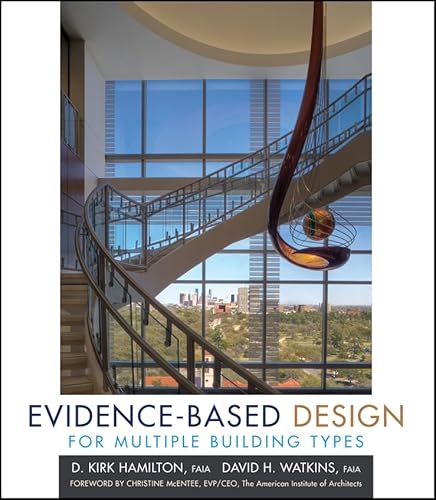
Evidence-based design, which bases design decisions on the best available current research evidence, is gaining traction among architects. Expanding the field from its origins in healthcare to other building types such as education, criminal justice, commercial, industrial, and places of worship, this book introduces design professionals to the concept of evidence-based design and its use in the creation of high performance environments. It focuses on the methods by which design professionals and their clients can create better buildings by critically interpreting the implications of credible research and careful observation of completed projects. Drawing a direct link between evidence and application, the authors provide examples of credible research that supports evidence-based design are presented, as well as specific applications and case study examples.
Die Inhaltsangabe kann sich auf eine andere Ausgabe dieses Titels beziehen.
Über die Autorin bzw. den Autor
D. KIRK HAMILTON, FAIA, FACHA, is associate director of the Center for Health Systems & Design and associate professor of architecture at Texas A&M University. His research focuses on the relationship between evidence-based design of health facilities and measurable organizational performance. A founding principal emeritus of WHR Architects, Hamilton is a board-certified healthcare architect with thirty years' experience in hospital design. Currently on the board of The Center for Health Design, Hamilton has served as president of both the AIA Academy of Architecture for Health and the American College of Healthcare Architects.
DAVID H. WATKINS, FAIA, is chairman and founding principal of WHR Architects in Houston, a nationally recognized firm specializing in high-performance buildings for healthcare, science, and higher education. A longtime advocate for advancing the knowledge resources available to the profession of architecture, Watkins served as a vice president of the American Institute of Architects (AIA) and inaugural chair of the AIA board's knowledge committee in 2004. He serves on the advisory boards for the architectural programs at Rice University and The University of Texas at Austin, and from 2005 to 2007, he was a director of the National Architectural Accrediting Board.
Von der hinteren Coverseite
"D. Kirk Hamilton, FAIA, and David H. Watkins, FAIA, have written this enlightening book showcasing the process and products of evidence-based design, a practice that should be in the top drawer of every architect's toolkit. Evidence-based design sounds a clarion call for more rigor in the knowledge-based practice of creating the built environment, as well as stronger collaboration and sharing of knowledge between client and designer. I can-t think of two people more qualified to have taken on this topic."
From the Foreword by Christine McEntee, Executive Vice President/CEO, The American Institute of Architects
GAIN A COMPETITIVE ADVANTAGE FROM RESEARCH-BASED DESIGN
Evidence-based design enables architects and their clients to optimize design decisions via a process of gathering, evaluating, and applying current best evidence from research and practice. Written by leading experts in the field of evidence-based design, this book guides the reader through the complete process, culminating in the creation of high-performance environments, including:
- Locating the best available evidence from a variety of fields and sources
- Creating meaningful collaborations with clients and users for decision making
- Recognizing and responding to the unique context of each project
- Using critical thinking to interpret the implications of research
- Establishing a strong chain of logic that links research findings to design
In addition to providing general guidelines for the evidence-based design process, the authors describe how the process is applied in the design of specific building types, including hospitals, schools, offices, retail stores, and performance spaces. Throughout the book, examples underscore the effectiveness of credible research to support evidence-based design decisions. Moreover, comprehensive case studies are presented for each building type, demonstrating, for example, how design impacts a worker's productivity and efficiency or a student's ability to learn and achieve.
Following the authors' advice, architects, interior designers, facility managers, and related professionals will learn to create better, more effective designs by moving from an approach based on intuition and anecdotal information to one solidly based on evidence and outcomes.
Aus dem Klappentext
"D. Kirk Hamilton, FAIA, and David H. Watkins, FAIA, have written this enlightening book showcasing the process and products of evidence-based design, a practice that should be in the top drawer of every architect's toolkit. Evidence-based design sounds a clarion call for more rigor in the knowledge-based practice of creating the built environment, as well as stronger collaboration and sharing of knowledge between client and designer. I can-t think of two people more qualified to have taken on this topic."
—From the Foreword by Christine McEntee, Executive Vice President/CEO, The American Institute of Architects
GAIN A COMPETITIVE ADVANTAGE FROM RESEARCH-BASED DESIGN
Evidence-based design enables architects and their clients to optimize design decisions via a process of gathering, evaluating, and applying current best evidence from research and practice. Written by leading experts in the field of evidence-based design, this book guides the reader through the complete process, culminating in the creation of high-performance environments, including:
- Locating the best available evidence from a variety of fields and sources
- Creating meaningful collaborations with clients and users for decision making
- Recognizing and responding to the unique context of each project
- Using critical thinking to interpret the implications of research
- Establishing a strong chain of logic that links research findings to design
In addition to providing general guidelines for the evidence-based design process, the authors describe how the process is applied in the design of specific building types, including hospitals, schools, offices, retail stores, and performance spaces. Throughout the book, examples underscore the effectiveness of credible research to support evidence-based design decisions. Moreover, comprehensive case studies are presented for each building type, demonstrating, for example, how design impacts a worker's productivity and efficiency or a student's ability to learn and achieve.
Following the authors' advice, architects, interior designers, facility managers, and related professionals will learn to create better, more effective designs by moving from an approach based on intuition and anecdotal information to one solidly based on evidence and outcomes.
„Über diesen Titel“ kann sich auf eine andere Ausgabe dieses Titels beziehen.
Suchergebnisse für Evidence-Based Design for Multiple Building Types

Beispielbild für diese ISBN
Evidence-Based Design for Multiple Building Types
Anbieter: Anybook.com, Lincoln, Vereinigtes Königreich
Verkäuferbewertung 5 von 5 Sternen

Zustand: Good. This is an ex-library book and may have the usual library/used-book markings inside.This book has hardback covers. In good all round condition. No dust jacket. Please note the Image in this listing is a stock photo and may not match the covers of the actual item,900grams, ISBN:9780470129340. Artikel-Nr. 2937939
Gebraucht kaufen
EUR 48,62
EUR 15,41 Versand
Versand von Vereinigtes Königreich nach USA
Versand von Vereinigtes Königreich nach USA
Anzahl: 1 verfügbar
Beispielbild für diese ISBN
Evidence-Based Design for Multiple Building Types
Anbieter: Majestic Books, Hounslow, Vereinigtes Königreich
Verkäuferbewertung 4 von 5 Sternen

Zustand: New. pp. 304. Artikel-Nr. 7492027
Neu kaufen
EUR 108,66
EUR 7,68 Versand
Versand von Vereinigtes Königreich nach USA
Versand von Vereinigtes Königreich nach USA
Anzahl: 1 verfügbar
Beispielbild für diese ISBN
Evidence-Based Design for Multiple Building Types
Anbieter: Kennys Bookstore, Olney, MD, USA
Verkäuferbewertung 5 von 5 Sternen
Zustand: New. "D. Kirk Hamilton, FAIA, and David H. Watkins, FAIA . have written this enlightening book showcasing the process and products of evidence-based design, a practice that should be in the top drawer of every architect's toolkit. Num Pages: 288 pages, Illustrations. BIC Classification: AMC; AMG. Category: (P) Professional & Vocational. Dimension: 238 x 211 x 23. Weight in Grams: 856. . 2008. 1st Edition. Hardcover. . . . . Books ship from the US and Ireland. Artikel-Nr. V9780470129340
Neu kaufen
EUR 132,41
EUR 9,37 Versand
Versand innerhalb von USA
Versand innerhalb von USA
Anzahl: 15 verfügbar
Beispielbild für diese ISBN
Evidence-Based Design: Applied Evidence-based Knowledge for Multiple Building Types
Anbieter: Revaluation Books, Exeter, Vereinigtes Königreich
Verkäuferbewertung 5 von 5 Sternen
Hardcover. Zustand: Brand New. illustrated edition. 288 pages. 9.00x8.25x1.00 inches. In Stock. Artikel-Nr. 0470129344
Neu kaufen
EUR 152,48
EUR 14,77 Versand
Versand von Vereinigtes Königreich nach USA
Versand von Vereinigtes Königreich nach USA
Anzahl: 1 verfügbar