
Verwandte Artikel zu Income Investing Today: Safety and High Income Through...
Inhaltsangabe
Income Investing Today
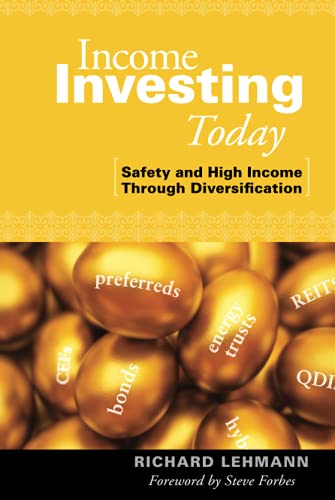
Income Investing Today details a safe alternative to the downside risks inherent in the stock market--income securities that can provide a 7% to 8% annual cash income. With this book, fixed income expert Richard Lehmann outlines income investing concepts you need to understand, various investment vehicles, and investment strategies that will help you build a safe, diversified portfolio of investments.
The investment vehicles he explains range well beyond traditional fixed income securities or creditor instruments such as bonds, to include hybrids, REITs, mutual funds, and more. He shows that the key to building a steady, growth-oriented income portfolio is to diversify over a variety of securities that depend on different drivers--that is, portfolios that are not vulnerable to any one specific economic factor such as interest rates.
The ideal guide for individual investors saving for retirement and seeking more safety in their portfolios, Income Investing Today shows how a diversified collection of income securities can equal or exceed the returns from common stock with much lower risk.
Die Inhaltsangabe kann sich auf eine andere Ausgabe dieses Titels beziehen.
Über die Autorin bzw. den Autor
RICHARD LEHMANN is President of Income Securities Advisors, Inc. (ISA), and publishes the Forbes/Lehmann Income Securities Investor newsletter, as well as the ETF Investor Newsletter and Distressed Debt Securities Newsletter. He founded the Bond Investors Association (BIA) in 1983 as an information and advocacy organization for individual bondholders. ISA is the successor to BIA. Lehmann is also a columnist with Forbes magazine and has been actively involved in fixed income advising and bond defaults since 1976. He is also the portfolio manager of the Fallen Angels Income Fund (FAINX), a publicly traded no-load fund. Lehmann has taught finance and accounting in Miami and has spoken at numerous investment seminars. He holds an MBA from Columbia University, is a CPA, and an SEC-registered investment advisor. Visit www.incomesecurities.com for more information.
Von der hinteren Coverseite
It has been widely reported that the baby boom generation has not adequately saved for their rapidly approaching retirement years. Because of this, many boomers believe the only way to catch up is by investing in common stocks. But stocks are inherently risky, particularly for those close to, or in, retirement. Income Investing Today offers an alternative income, through diversification over a variety of securities, that can provide a healthy annual cash income without the downside risks of the stock market.
The virtue of income securities, says fixed income expert Richard Lehmann, is that once you understand them, the selection process is substantially easier and safer than for stocks, for a number of reasons. Credit ratings make risk evaluation highly reliable. You also aren't as vulnerable to price fluctuations due to quarterly earnings reports and missed forecasts since the companies' survival not its prosperity is your main exposure. And you won't often see a bond or preferred drop by 20% when a company misses its sales or earnings forecasts, but when this happens it probably represents a buying opportunity.
Lehmann shows you exactly how to achieve a high level of income without inordinate amounts of risk and details the best way to diversify portfolios into nontraditional income securities across a range of sectors so that interest rates alone won't overly affect a portfolio. The author clearly explains the basic investing concepts you need to understand and the various investment vehicles that are currently attractive. He describes the full spectrum of choices available to people interested in income investments, including bonds, Canadian energy trusts, convertibles, REITs, closed end funds, hybrids, and more. In addition, he suggests specific investment strategies and portfolio allocations that will help you build a safe, diversified portfolio of investments.
In spite of all you may have heard about stocks versus income investing, it is not an either-or choice. Properly done, a portfolio with a diversification of income securities can, over time, equal or exceed the returns from common stock investing with much lower risk. It has worked for the author. In Income Investing Today he shows how it can work for you.
Aus dem Klappentext
It has been widely reported that the baby boom generation has not adequately saved for their rapidly approaching retirement years. Because of this, many boomers believe the only way to catch up is by investing in common stocks. But stocks are inherently risky, particularly for those close to, or in, retirement. Income Investing Today offers an alternative—income, through diversification over a variety of securities, that can provide a healthy annual cash income without the downside risks of the stock market.
The virtue of income securities, says fixed income expert Richard Lehmann, is that once you understand them, the selection process is substantially easier and safer than for stocks, for a number of reasons. Credit ratings make risk evaluation highly reliable. You also aren't as vulnerable to price fluctuations due to quarterly earnings reports and missed forecasts since the companies' survival—not its prosperity—is your main exposure. And you won't often see a bond or preferred drop by 20% when a company misses its sales or earnings forecasts, but when this happens it probably represents a buying opportunity.
Lehmann shows you exactly how to achieve a high level of income without inordinate amounts of risk and details the best way to diversify portfolios into nontraditional income securities across a range of sectors—so that interest rates alone won't overly affect a portfolio. The author clearly explains the basic investing concepts you need to understand and the various investment vehicles that are currently attractive. He describes the full spectrum of choices available to people interested in income investments, including bonds, Canadian energy trusts, convertibles, REITs, closed end funds, hybrids, and more. In addition, he suggests specific investment strategies and portfolio allocations that will help you build a safe, diversified portfolio of investments.
In spite of all you may have heard about stocks versus income investing, it is not an either-or choice. Properly done, a portfolio with a diversification of income securities can, over time, equal or exceed the returns from common stock investing with much lower risk. It has worked for the author. In Income Investing Today he shows how it can work for you.
Auszug. © Genehmigter Nachdruck. Alle Rechte vorbehalten.
Income Investing Today
Safety & High Income Through DiversificationBy Richard LehmannJohn Wiley & Sons
Copyright © 2007 Richard LehmannAll right reserved.
ISBN: 978-0-470-12860-2
Chapter One
The Why and How of Fixed Income
Why Consider Fixed Income?
Growth versus Income (Stocks versus Bonds)
Experts have been saying for years how much better stocks have been in providing long-term profits than bonds. Depending on which study you read, stocks have returned an estimated 7 to 11 percent a year for the past 100 to 200 years. Bonds, on the other hand, are credited with returns of just 2 to 4 percent, again depending on the study. The obvious conclusion the investor is supposed to draw from these studies is that a choice between stocks or bonds is a no-brainer. Why, then, are the fixed-income markets several times bigger than the stock market? Why do many more investment dollars go into bonds and preferreds rather than stock? There are many ways to answer this question, and in those answers, you may just find your reason for considering fixed-income securities.
The principal reason fixed-income securities have faired badly in these studies is inflation. Inflation has historically sapped anywhere from 20 percent to more than 100 percent of the return paid by bonds. While this remains a perennial weakness of fixed-income securities, it has become less so over time. The ravages of inflation are much better understood today by those in government whose responsibility is to control it. More important, the tools for controlling it are in place and not as vulnerable to the political forces of the day. Another reason for the poor showing for bonds is that such studies used U.S. Treasuries as the fixed-income benchmark. While this is the premier bond instrument in the world, it is hardly representative of the fixed-income universe. Because of its high quality, it is easily 1 to 4 percent below most other debt instruments in its rate of return. Today's bonds and preferreds offer an array of risks and yields for which no historic equivalent exists for comparison. This book focuses on many of these investment instruments, many yielding relatively low-risk returns of 8 percent or more.
A second consideration in evaluating stock-versus-bond studies is volatility. The returns cited for equities include years in which they were as much as plus or minus 20 percent. Additionally, within any given year, price fluctuations of plus or minus 50 percent are not uncommon. Hence, any given investor, depending on when and how much he or she invested, could average less than half or more than twice the 7 percent return rate, which has been cited by studies as a long-term average. Buying into a mutual fund can mitigate some of the intrayear volatility, but not the interyear volatility. Bonds, on the other hand, have only a fraction of this volatility. In fact, you control much of it by virtue of how long a maturity date or credit quality you select.
With stocks, the investor is putting his or her future into the hands of company managers whose skills, priorities, and loyalties are constantly shifting and open to question. While high salaries and generous options are given to them to ensure loyalty, this has proven only partially successful and may serve to encourage risk taking beyond their management skills in order to enhance stock prices. With bonds and preferreds, investors are insulated against most mismanagement unless it proves fatal, but even then, they stand ahead of shareholders in being repaid in any corporate reorganization or liquidation. Investing via a mutual fund further removes the investors' control over their funds, since now the judgments and priorities of the fund managers are a factor as well.
Looking forward, I doubt whether past history is the best way to predict future performance. The principal reason for this is that past stock performance was in large part due to high dividend payments. According to a recent study by Robert Arnott and Peter Bernstein in the Financial Analysts Journal, as much as 5 percent of the 7 percent historic return for stocks came through dividend yields. During the 1990s this percentage dwindled to 1.5 percent. This is one of the unintended consequences of management stock options. Since stock options become valuable through price appreciation, not dividends, profits are going to be used either to buy back shares or launch new ventures, no matter how marginal. The study went on to note that only 1.4 percent of the 7 percent historic return came from earnings growth. Since economic growth has been over 2 percent for most of this century, it means public companies are not keeping pace with the economy as a whole. Hence, the money retained by corporations got a poorer return for investors than the 5 percent that they distributed. What then can we expect now that dividend payouts have slipped to only 1.5 percent? Although recent tax law changes have made dividends more attractive, increases in dividend payouts have been slow to gain momentum, which has not been helped by the fact that the tax law change is set to expire in 2010 unless extended by Congress.
The main reason, though, why bonds will continue to outsell common stocks is that they reflect the wisdom expressed best by Ben Franklin: "A bird in the hand is worth two in the bush." Fixed-income securities offer a definite rate of return and a definite date in the future when they will return a definite amount owed. These are, or should be, of ever-increasing importance the closer one gets to retirement.
Selecting stock investments differs from selecting a fixed-income security in one critical respect. In order to profit in stocks, the company must prosper. Not so for fixed income. To make money in fixed-income investments, the company need only survive. Making a judgment about a company's ability to prosper is often extremely complex, because it is so dependent on such intangibles as the general economy, the legal environment, industry trends, management ability, and just plain good luck. Judging a company's ability to survive is more dependent on data and much less dependent on intangibles. Learn how to understand the data and you've learned how to invest.
Understanding the data, however, does require learning how to interpret it. This is not to say that the intangibles affecting stocks don't also affect bonds, but rather that the effect is generally not as severe and takes place over a longer period of time.
What Kind of Investor Are You?
You may have picked up this book precisely because you don't know the answer to this question. Hopefully, you will be able to answer it before you are finished reading. The question usually comes up because many individuals fail or even resist putting themselves into a defined category. Yeah, I'm unique. But I haven't saved enough for my retirement, and I'm getting close enough to retirement to worry, and I don't have a clear plan for saving or a clear investment strategy, and I don't even know how much I'll need to retire, and my present investments are going nowhere. Sure, you're unique, but maybe you can find your spouse or an anonymous friend in the following investor types.
The first and most common investor species is the buy and hold investor. These investors buy good, safe things like Treasuries, munis, CDs, money market funds, and investment-grade bonds. They want to sleep well at night, so they take no risks. They also get a lousy rate of return. Ideally, we'd all like to be so...
„Über diesen Titel“ kann sich auf eine andere Ausgabe dieses Titels beziehen.
Suchergebnisse für Income Investing Today: Safety and High Income Through...

Beispielbild für diese ISBN
Income Investing Today: Safety and High Income Through Diversification
Anbieter: World of Books (was SecondSale), Montgomery, IL, USA
Verkäuferbewertung 5 von 5 Sternen

Hardback. Zustand: Good. Income Investing Today Income Investing Today details a safe alternative to the downside risks inherent in the stock market--income securities that can provide a 7% to 8% annual cash income. Artikel-Nr. 00074528607
Gebraucht kaufen
EUR 6,32
Versand gratis
Versand innerhalb von USA
Versand innerhalb von USA
Anzahl: 1 verfügbar
Beispielbild für diese ISBN
Income Investing Today : Safety and High Income Through Diversification
Verlag:
Wiley & Sons, Incorporated, John, 2007
ISBN 10: 0470128607
ISBN 13: 9780470128602
Gebraucht
Hardcover
Erstausgabe
Anbieter: Better World Books: West, Reno, NV, USA
Verkäuferbewertung 5 von 5 Sternen
Zustand: Good. 1st Edition. Pages intact with minimal writing/highlighting. The binding may be loose and creased. Dust jackets/supplements are not included. Stock photo provided. Product includes identifying sticker. Better World Books: Buy Books. Do Good. Artikel-Nr. 6222044-75
Gebraucht kaufen
EUR 6,56
Versand gratis
Versand innerhalb von USA
Versand innerhalb von USA
Anzahl: 1 verfügbar
Beispielbild für diese ISBN
Income Investing Today : Safety and High Income Through Diversification
Verlag:
Wiley & Sons, Incorporated, John, 2007
ISBN 10: 0470128607
ISBN 13: 9780470128602
Gebraucht
Hardcover
Erstausgabe
Anbieter: Better World Books, Mishawaka, IN, USA
Verkäuferbewertung 5 von 5 Sternen
Zustand: Good. 1st Edition. Former library copy. Pages intact with minimal writing/highlighting. The binding may be loose and creased. Dust jackets/supplements are not included. Includes library markings. Stock photo provided. Product includes identifying sticker. Better World Books: Buy Books. Do Good. Artikel-Nr. 8009585-75
Gebraucht kaufen
EUR 6,56
Versand gratis
Versand innerhalb von USA
Versand innerhalb von USA
Anzahl: 1 verfügbar
Beispielbild für diese ISBN
Income Investing Today: Safety and High Income Through Diversification
Anbieter: ThriftBooks-Dallas, Dallas, TX, USA
Verkäuferbewertung 5 von 5 Sternen
Hardcover. Zustand: Very Good. No Jacket. May have limited writing in cover pages. Pages are unmarked. ~ ThriftBooks: Read More, Spend Less. Artikel-Nr. G0470128607I4N00
Gebraucht kaufen
EUR 6,64
Versand gratis
Versand innerhalb von USA
Versand innerhalb von USA
Anzahl: 1 verfügbar
Beispielbild für diese ISBN
Income Investing Today: Safety and High Income Through Diversification
Anbieter: ThriftBooks-Atlanta, AUSTELL, GA, USA
Verkäuferbewertung 5 von 5 Sternen
Hardcover. Zustand: Very Good. No Jacket. Former library book; May have limited writing in cover pages. Pages are unmarked. ~ ThriftBooks: Read More, Spend Less. Artikel-Nr. G0470128607I4N10
Gebraucht kaufen
EUR 6,64
Versand gratis
Versand innerhalb von USA
Versand innerhalb von USA
Anzahl: 1 verfügbar
Beispielbild für diese ISBN
Income Investing Today: Safety and High Income Through Diversification
Anbieter: ThriftBooks-Dallas, Dallas, TX, USA
Verkäuferbewertung 5 von 5 Sternen
Hardcover. Zustand: Very Good. No Jacket. Former library book; May have limited writing in cover pages. Pages are unmarked. ~ ThriftBooks: Read More, Spend Less. Artikel-Nr. G0470128607I4N10
Gebraucht kaufen
EUR 6,64
Versand gratis
Versand innerhalb von USA
Versand innerhalb von USA
Anzahl: 1 verfügbar
Beispielbild für diese ISBN
Income Investing Today
Anbieter: Majestic Books, Hounslow, Vereinigtes Königreich
Verkäuferbewertung 4 von 5 Sternen

Zustand: New. pp. 234 Illus. Artikel-Nr. 7522124
Neu kaufen
EUR 32,40
EUR 7,67 Versand
Versand von Vereinigtes Königreich nach USA
Versand von Vereinigtes Königreich nach USA
Anzahl: 3 verfügbar
Beispielbild für diese ISBN
Income Investing Today: Safety and High Income Through Diversification
Anbieter: Ria Christie Collections, Uxbridge, Vereinigtes Königreich
Verkäuferbewertung 5 von 5 Sternen
Zustand: New. In English. Artikel-Nr. ria9780470128602_new
Neu kaufen
EUR 33,65
EUR 13,32 Versand
Versand von Vereinigtes Königreich nach USA
Versand von Vereinigtes Königreich nach USA
Anzahl: Mehr als 20 verfügbar
Beispielbild für diese ISBN
Income Investing Today Safety and High Income Through Diversification
Anbieter: Revaluation Books, Exeter, Vereinigtes Königreich
Verkäuferbewertung 5 von 5 Sternen
Hardcover. Zustand: Brand New. 1st edition. 234 pages. 9.25x6.25x1.00 inches. In Stock. Artikel-Nr. x-0470128607
Neu kaufen
EUR 39,33
EUR 11,80 Versand
Versand von Vereinigtes Königreich nach USA
Versand von Vereinigtes Königreich nach USA
Anzahl: 2 verfügbar
Beispielbild für diese ISBN
Income Investing Today
Anbieter: Kennys Bookstore, Olney, MD, USA
Verkäuferbewertung 5 von 5 Sternen
Zustand: New. Income Investing Today Income Investing Today details a safe alternative to the downside risks inherent in the stock market--income securities that can provide a 7% to 8% annual cash income. Num Pages: 234 pages, , black & white illustrations. BIC Classification: KFFM. Category: (P) Professional & Vocational. Dimension: 244 x 166 x 23. Weight in Grams: 528. . 2007. 1st Edition. Hardcover. . . . . Books ship from the US and Ireland. Artikel-Nr. V9780470128602
Neu kaufen
EUR 42,66
EUR 9,36 Versand
Versand innerhalb von USA
Versand innerhalb von USA
Anzahl: Mehr als 20 verfügbar