
Verwandte Artikel zu Guinness: The 250 Year Quest for the Perfect Pint
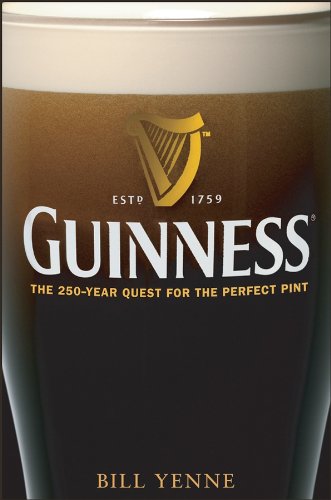
Inhaltsangabe
A perfectly poured history of the world's greatest beer.
"Joseph Conrad was wrong. The real journey into the Heart of Darkness is recounted within the pages of Bill Yenne's fine book. Guinness (the beer) is a touchstone for brewers and beer lovers the world over. Guinness (the book) gives beer enthusiasts all the information and education necessary to take beer culture out of the clutches of light lagers and back into the dark ages. Cheers!"
-Sam Calagione, owner, Dogfish Head Craft Brewery and author of Brewing Up a Business, Extreme Brewing, and Beer or Wine?
"Marvelous! As Bill Yenne embarks on his epic quest for the perfect pint, he takes us along on a magical tour into the depths of all things Guinness. Interweaving the tales of the world's greatest beer and the nation that spawned it, Yenne introduces us to a cast of characters worthy of a dozen novels, a brewery literally dripping with history, and-of course-the one-and-only way to properly pour a pint. You can taste the stout porter on every page."
-Dan Roam, author of The Back of the Napkin: Solving Problems and Selling Ideas with Pictures
Die Inhaltsangabe kann sich auf eine andere Ausgabe dieses Titels beziehen.
Über die Autorin bzw. den Autor
Bill Yenne has been writing extensively about beer and brewing history for two decades and has discussed these subjects as a featured guest on the History Channel. He is the author of more than forty books on a variety of historical topics, and a member of the American Society of Journalists and Authors.
Von der hinteren Coverseite
A perfectly poured history of the world's greatest beer.
"Joseph Conrad was wrong. The real journey into the Heart of Darkness is recounted within the pages of Bill Yenne's fine book. Guinness (the beer) is a touchstone for brewers and beer lovers the world over. Guinness (the book) gives beer enthusiasts all the information and education necessary to take beer culture out of the clutches of light lagers and back into the dark ages. Cheers!"
―Sam Calagione, owner, Dogfish Head Craft Brewery and author of Brewing Up a Business, Extreme Brewing, and Beer or Wine?
"Marvelous! As Bill Yenne embarks on his epic quest for the perfect pint, he takes us along on a magical tour into the depths of all things Guinness. Interweaving the tales of the world's greatest beer and the nation that spawned it, Yenne introduces us to a cast of characters worthy of a dozen novels, a brewery literally dripping with history, and―of course―the one-and-only way to properly pour a pint. You can taste the stout porter on every page."
―Dan Roam, author of The Back of the Napkin: Solving Problems and Selling Ideas with Pictures
Aus dem Klappentext
For millions of beer lovers the world over, a properly poured pint of Guinness Stout is as close to perfection as beer gets. Each year, fans of the legendary black liquidation enjoy two billion pints of the beer known for its distinctive creamy head and rich drinkability. Ireland's most famous export, Guinness Stout and the people who have brewed it hold a unique place in the history of beer, business, and Ireland itself.
They say that good things come to those who wait. When you wait on a perfectly poured pint of Guinness Stout, you know you're getting something good. It's more than just a pint of beer; it's a mouthwatering visual presentation of the quality and taste you're about to enjoy. And millions wait patiently for their pint every day. To find out why, famed beer and beverage writer Bill Yenne talks to everyone from Guinness's master brewer to typical pubgoers about the beer they hold dear. Whatever magic makes it so delicious, it's powerful enough to soothe the souls of beer lovers from Dublin to Boston to Buenos Aires to Lagos, and everywhere in between.
But Guinness is more than a delicious beverage, it's also the name of the remarkable family of brewers and entrepreneurs whose story is worthy of legend, and who occupy a prominent place in Irish history. In Guinness, Yenne traces the 250-year tale of the family and its namesake beer. Beginning with Arthur Guinness, the entrepreneur patriarch who first began brewing at St. James's Gate, Dublin, in 1759, the story follows succeeding generations of the Guinness family through the years. Yenne follows not just the fortunes of the family Guinness, but also the development of the brand and the beer from Arthur's earliest porter to the beer that is enjoyed in 150 countries today.
For Guinness aficionados, this tale offers an inside look at a legendary brewing company and the craftsmanship and pride that go into every keg. For anyone who hopes to keep their business vibrant and dynamic for the next few centuries, the book offers important lessons on continuity, quality, and innovation. For everyone who loves a good beer story, Guinness offers a perfect pint more than two centuries in the pouring.
Sit back and enjoy.
Auszug. © Genehmigter Nachdruck. Alle Rechte vorbehalten.
Guinness
The 250 Year Quest for the Perfect PintBy Bill YenneJohn Wiley & Sons
Copyright © 2008 Bill YenneAll right reserved.
ISBN: 978-0-470-12052-1
Chapter One
Origins
Brewing has been part of civilization since antiquity. Professor Solomon Katz at the University of Pennsylvania has found Sumerian recipes for beer that date back four millennia, and beer is mentioned often in ancient Egyptian literature. As H. F. Lutz points out in Vitaculture and Brewing in the Ancient Orient, published in 1922, Middle Kingdom texts from Beni Hasan "enumerate quite a number of different beers." Among these a "garnished beer" and a "dark beer." As David Ryder points out in the Newsletter of the American Society of Brewing Chemists, Egyptian beer "was also used as a medicine, a tonic for building strength ... a universal cure for coughs and colds, shortness of breath, problems of the stomach and lungs, and a guard against indigestion."
It has been suggested that the brewing of beer is at least as old as the baking of bread, and certainly both have been practiced since the dawn of recorded history. Indeed, the art and science of the brewer and those of the baker are quite similar, both involving grain, water, and yeast. In fact, the Sumerians baked barley loaves called bappir that could be stored in the dry climate and either eaten as bread of mixed with malted barley to form a mash for brewing.
Beer, by definition, is a beverage originating with grain, in which the flavor of the grain is balanced through the addition of other flavorings. Since the Middle Ages, those other flavorings have principally been hops. Today, a brewer typically starts the process with cereal grains-usually, but not exclusively, barley. The grains are malted, meaning that they are germinated and quickly dried. The extent to which malted grain is then roasted imparts a specific color to the beer, a step in the process that is obviously important to making Guinness what it is. The malt is then mashed, meaning that it is soaked long enough for enzymes to convert starch into fermentable sugar. The mashing takes place in a vessel that is generally called a mash tun, although the old Irish term kieve has always been the word favored at Guinness.
Next, water is added to the mash to dissolve the sugars, resulting in a thick, sweet liquid called wort. The wort is then boiled in what brewers call a brew kettle. At this point, most brewers add hops, the intensely flavored flower of the humulus lupulus plant. Originally a preservative as much as a flavoring, hops have been used by brewers for centuries. Throughout history, brewers have occasionally added seasonings other than hops to their beer. The Egyptians added flavorings such as fruit and honey, and certain modern beers contain fruit and spices.
Finally, the yeast is added to the cooled, hopped wort and the mixture is set aside to ferment into beer. During the fermentation process, the yeast converts the sugars into alcohol and carbon dioxide.
Having been brewed at the birth of civilization in the regions surrounding the Mediterranean, the beverage grew up with that civilization. Beer is mentioned by Xenophon and Aristotle (as quoted by Athenaeus). Among others, the Roman consul and scholar Pliny the Younger estimated that nearly 200 types of beer were being brewed in Europe by the first century. The Latin texts refer to the barley beverages as cerevisia or cerevisium, root words that are still with us in the Spanish and Portuguese words for beer-cerveza and cerveja-as well as in the latin name for brewer's yeast, saccharomyces cerevisiae.
Brewing, like wine making, was practiced in the lands whose shores were washed by the Mediterranean, but it was also practiced in Europe's northern latitudes. Here, cereal grains and brewing flourished, while grapes and viticulture usually did not.
In the British Isles, brewing existed in the misty distant past, long predating the Roman occupation. In the first century, Pedanius Dioscorides, the Greek pharmacologist and botanist traveled extensively throughout the Roman Empire collecting various substances with medicinal properties. He observed that the Britons and the Hiberi, as the Romans called the Irish, used a liquor variously known as "cuirim," "courm," or "courmi," an ale made from barley. Meanwhile, cuirim is also mentioned in the first century, the Tin B Cailnge (The Cattle Raid of Cooley), the central tale in the Ulster Cycle, one of the four great cycles that make up the core of Irish mythology. In these stories, the Irish king Conchobar (Conor) MacNessa spends his day drinking cuirim "until he falls asleep therefrom."
The beer brewed in the Middle Ages was similar to modern ale, which is fermented at cellar temperatures using saccharomyces cerevisiae, a top-fermenting yeast. Today, such beer styles include porter and stout, as well as ale. These beers are distinct from lager beer, which is fermented at much colder temperatures using saccharomyces carlsbergensis, a bottom-fermenting yeast. Lager, whose cultural importance is described in more detail later, is also fermented for a longer time than top-fermented beers. Perfected in Germany early in the nineteenth century, lager is named for the German word meaning "to store," a reference to the longer fermentation.
The use of hops to flavor the beer, which is now the universally accepted standard, originated in central Europe, while in the British Isles, bayberries and ivy berries, as well as the flowers of the heath and other bitter herbs, rather than hops, were used as seasonings up through the Middle Ages.
In the fifth century Senchus Mor, the well-known book of the ancient laws of Ireland, there are abundant references to the growing of barley for malt, and to the enjoyment of ale. Later in the fifth century, a man named Mescan is widely described as having been the brewmaster of St. Patrick's household. In the ancient texts on the life of St. Patrick that were translated by Whitley Stokes in the 1880s, we learn that while the saint was dining with the King of Tara, "The wizard Lucatmael put a drop of poison into Patrick's cruse, and gave it into Patrick's hand: but Patrick blessed the cruse and inverted the vessel, and the poison fell thereout, and not even a little of the ale fell. And Patrick afterwards drank the ale."
Thomas Messingham, the seventeenth century Irish hagiologist who published biographies of many Irish saints, made note of the fact that the celebrated St. Brigid of Kildare (451-525) was, herself, a brewer. Translations from Rawlinson Manuscript B512 in the Bodleian Library at Oxford explain that Brigid was extremely diligent about brewing high quality ale that was filled with nutrients. The Rawlinson papers also note that she once supplied 17 churches with an Easter Ale that she brewed from one sack of malt.
At the beginning of the seventh century, when Irish monks set out to revitalize classical scholarship in Europe by founding monasteries as centers of learning, at least two of them brought the brewer's art. Saint Columbanus (543-615) and Saint Gall (550-646) traveled into the Frankish and Italian duchys, setting up a number of such cloisters, and legend has it that these places had breweries. This probably contributed to the tradition of European monastic brewing that survives-especially in Belgium-into the twenty-first century. A biography of Columbanus notes that "When the hour of refreshment...
„Über diesen Titel“ kann sich auf eine andere Ausgabe dieses Titels beziehen.
Suchergebnisse für Guinness: The 250 Year Quest for the Perfect Pint

Beispielbild für diese ISBN
Guinness: The 250 Year Quest for the Perfect Pint
Anbieter: ThriftBooks-Reno, Reno, NV, USA
Verkäuferbewertung 5 von 5 Sternen

Hardcover. Zustand: Good. No Jacket. Pages can have notes/highlighting. Spine may show signs of wear. ~ ThriftBooks: Read More, Spend Less. Artikel-Nr. G0470120525I3N00
Gebraucht kaufen
EUR 6,93
Versand gratis
Versand innerhalb von USA
Versand innerhalb von USA
Anzahl: 1 verfügbar
Beispielbild für diese ISBN
Guinness: The 250 Year Quest for the Perfect Pint
Anbieter: ThriftBooks-Atlanta, AUSTELL, GA, USA
Verkäuferbewertung 5 von 5 Sternen
Hardcover. Zustand: Good. No Jacket. Pages can have notes/highlighting. Spine may show signs of wear. ~ ThriftBooks: Read More, Spend Less. Artikel-Nr. G0470120525I3N00
Gebraucht kaufen
EUR 6,93
Versand gratis
Versand innerhalb von USA
Versand innerhalb von USA
Anzahl: 1 verfügbar
Beispielbild für diese ISBN
Guinness: The 250 Year Quest for the Perfect Pint
Anbieter: ThriftBooks-Dallas, Dallas, TX, USA
Verkäuferbewertung 5 von 5 Sternen
Hardcover. Zustand: Good. No Jacket. Pages can have notes/highlighting. Spine may show signs of wear. ~ ThriftBooks: Read More, Spend Less. Artikel-Nr. G0470120525I3N00
Gebraucht kaufen
EUR 6,93
Versand gratis
Versand innerhalb von USA
Versand innerhalb von USA
Anzahl: 1 verfügbar
Beispielbild für diese ISBN
Guinness: The 250 Year Quest for the Perfect Pint
Anbieter: ThriftBooks-Atlanta, AUSTELL, GA, USA
Verkäuferbewertung 5 von 5 Sternen
Hardcover. Zustand: Very Good. No Jacket. May have limited writing in cover pages. Pages are unmarked. ~ ThriftBooks: Read More, Spend Less. Artikel-Nr. G0470120525I4N00
Gebraucht kaufen
EUR 6,93
Versand gratis
Versand innerhalb von USA
Versand innerhalb von USA
Anzahl: 1 verfügbar
Beispielbild für diese ISBN
Guinness : The 250 Year Quest for the Perfect Pint
Verlag:
Wiley & Sons, Incorporated, John, 2007
ISBN 10: 0470120525
ISBN 13: 9780470120521
Gebraucht
Hardcover
Erstausgabe
Anbieter: Better World Books, Mishawaka, IN, USA
Verkäuferbewertung 5 von 5 Sternen
Zustand: Very Good. 1st Edition. Pages intact with possible writing/highlighting. Binding strong with minor wear. Dust jackets/supplements may not be included. Stock photo provided. Product includes identifying sticker. Better World Books: Buy Books. Do Good. Artikel-Nr. 8626648-6
Gebraucht kaufen
EUR 7,38
Versand gratis
Versand innerhalb von USA
Versand innerhalb von USA
Anzahl: 1 verfügbar
Beispielbild für diese ISBN
Guinness : The 250 Year Quest for the Perfect Pint
Verlag:
Wiley & Sons, Incorporated, John, 2007
ISBN 10: 0470120525
ISBN 13: 9780470120521
Gebraucht
Hardcover
Erstausgabe
Anbieter: Better World Books: West, Reno, NV, USA
Verkäuferbewertung 5 von 5 Sternen
Zustand: Very Good. 1st Edition. Pages intact with possible writing/highlighting. Binding strong with minor wear. Dust jackets/supplements may not be included. Stock photo provided. Product includes identifying sticker. Better World Books: Buy Books. Do Good. Artikel-Nr. 8626648-6
Gebraucht kaufen
EUR 7,38
Versand gratis
Versand innerhalb von USA
Versand innerhalb von USA
Anzahl: 1 verfügbar
Beispielbild für diese ISBN
Guinness: The 250 Year Quest for the Perfect Pint
Anbieter: AwesomeBooks, Wallingford, Vereinigtes Königreich
Verkäuferbewertung 5 von 5 Sternen
Hardcover. Zustand: Very Good. Guinness: The 250 Year Quest for the Perfect Pint This book is in very good condition and will be shipped within 24 hours of ordering. The cover may have some limited signs of wear but the pages are clean, intact and the spine remains undamaged. This book has clearly been well maintained and looked after thus far. Money back guarantee if you are not satisfied. See all our books here, order more than 1 book and get discounted shipping. Artikel-Nr. 7719-9780470120521
Gebraucht kaufen
EUR 3,75
EUR 4,86 Versand
Versand von Vereinigtes Königreich nach USA
Versand von Vereinigtes Königreich nach USA
Anzahl: 2 verfügbar
Beispielbild für diese ISBN
Guinness: The 250 Year Quest for the Perfect Pint
Anbieter: WorldofBooks, Goring-By-Sea, WS, Vereinigtes Königreich
Verkäuferbewertung 5 von 5 Sternen
Hardback. Zustand: Very Good. The book has been read, but is in excellent condition. Pages are intact and not marred by notes or highlighting. The spine remains undamaged. Artikel-Nr. GOR001675745
Gebraucht kaufen
EUR 4,33
EUR 6,61 Versand
Versand von Vereinigtes Königreich nach USA
Versand von Vereinigtes Königreich nach USA
Anzahl: 8 verfügbar
Beispielbild für diese ISBN
Guinness: The 250 Year Quest for the Perfect Pint
Anbieter: WorldofBooks, Goring-By-Sea, WS, Vereinigtes Königreich
Verkäuferbewertung 5 von 5 Sternen
Hardback. Zustand: Fair. A readable copy of the book which may include some defects such as highlighting and notes. Cover and pages may be creased and show discolouration. Artikel-Nr. GOR006421311
Gebraucht kaufen
EUR 4,33
EUR 6,61 Versand
Versand von Vereinigtes Königreich nach USA
Versand von Vereinigtes Königreich nach USA
Anzahl: 1 verfügbar
Beispielbild für diese ISBN
Guinness : The 250 Year Quest for the Perfect Pint
Verlag:
Wiley & Sons, Incorporated, John, 2007
ISBN 10: 0470120525
ISBN 13: 9780470120521
Gebraucht
Hardcover
Erstausgabe
Anbieter: Better World Books Ltd, Dunfermline, Vereinigtes Königreich
Verkäuferbewertung 5 von 5 Sternen
Zustand: Good. 1st Edition. Pages intact with minimal writing/highlighting. The binding may be loose and creased. Dust jackets/supplements are not included. Stock photo provided. Product includes identifying sticker. Better World Books: Buy Books. Do Good. Artikel-Nr. 5578490-75
Gebraucht kaufen
EUR 5,72
EUR 5,90 Versand
Versand von Vereinigtes Königreich nach USA
Versand von Vereinigtes Königreich nach USA
Anzahl: 1 verfügbar