
Verwandte Artikel zu Painless Project Management: A Step-by-Step Guide for...
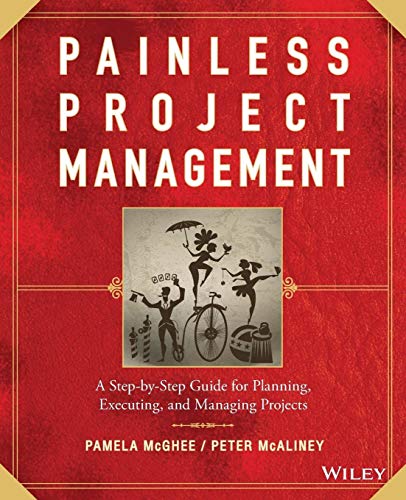
Painless Project Management: A Step-by-Step Guide for Planning, Executing, and Managing Projects - Softcover
Inhaltsangabe
A detailed guide to successful, efficient project management, written by two pros with a combined 55 years "in the trenches!"
Project management is a vital and growing component of many organizations and can literally make or break a company. In this step-by-step guide, two project management consultants present a comprehensive guide to effective project management, complete with real stories and case studies from actual project managers. This straightforward guide cuts through the technical jargon to present an easy-to-follow, easy-to-learn approach to executing any project from beginning to end. Project managers, as well as those who want to learn more about project management, will find this guide to be an indispensable resource for all their projects.
Die Inhaltsangabe kann sich auf eine andere Ausgabe dieses Titels beziehen.
Über die Autorin bzw. den Autor
PAMELA McGHEE, PMP, President and owner of McGhee Enterprises, a project management and IT consulting firm, has consulted with thousands of project managers at Fortune 500 companies. She is a long-standing faculty member at the American Management Association, where she conducts project management and IT seminars. Ms. McGhee is also an adjunct instructor at Baruch College in New York, where she teaches basic and advanced project management.
PETER McALINEY, PMP, CMC, is President of Chenery and Company, Inc., which specializes in strategy implementation and project management. He has worked with such corporations as Coca-Cola and GM, as well as with several academic institutions. He is currently developing online project management education programs and assists organizations with cross-cultural communications challenges on virtual team projects.
Von der hinteren Coverseite
A simple system for managing even the most complex projects
Project management can be a real pain, but doing it right can mean the difference between a business that soars and one that sinks. Painless Project Management makes it simple by cutting through the jargon, formulas, and needless complexity with an easy, step-based approach for managing virtually any project, big or small, from beginning to end.
Veteran project managers McGhee and McAliney present a comprehensive guide to effective project management, complete with real stories and case studies from actual project managers. The authors reveal how the complexity of project management is not in the process itself, but in the people and organizational relationships that must also be managed. They boil down the basics of project management so you can design a simple, effective plan for any project and follow it through to a successful completion.
Once you do that, they show you how to handle the people and issues that make project management such a challenge, including:
- Communicating project plans to colleagues and top management
- Delegating, organizing, and coordinating duties
- Tracking and reporting on project status
- Managing resources, budgets, and timelines
- Changing tacks and goals on the fly
- Dealing with project disruptions
Includes downloadable forms at
WWW.PAINLESSPROJECTMANAGEMENT.INFO
Aus dem Klappentext
A simple system for managing even the most complex projects
Project management can be a real pain, but doing it right can mean the difference between a business that soars and one that sinks. Painless Project Management makes it simple by cutting through the jargon, formulas, and needless complexity with an easy, step-based approach for managing virtually any project, big or small, from beginning to end.
Veteran project managers McGhee and McAliney present a comprehensive guide to effective project management, complete with real stories and case studies from actual project managers. The authors reveal how the complexity of project management is not in the process itself, but in the people and organizational relationships that must also be managed. They boil down the basics of project management so you can design a simple, effective plan for any project and follow it through to a successful completion.
Once you do that, they show you how to handle the people and issues that make project management such a challenge, including:
- Communicating project plans to colleagues and top management
- Delegating, organizing, and coordinating duties
- Tracking and reporting on project status
- Managing resources, budgets, and timelines
- Changing tacks and goals on the fly
- Dealing with project disruptions
Includes downloadable forms at
WWW.PAINLESSPROJECTMANAGEMENT.INFO
Auszug. © Genehmigter Nachdruck. Alle Rechte vorbehalten.
Painless Project Management
A Step-by-Step Guide for Planning, Executing, and Managing ProjectsBy Pamela McGhee Peter McAlineyJohn Wiley & Sons
Copyright © 2007 Pamela McGheeAll right reserved.
ISBN: 978-0-470-11721-7
Chapter One
Introduction to Project Management
Project management is as old as we are. Africans used project management to build the great pyramids. Mayans used project management to build their temples and pyramids. Romans used project management to build aqueducts to carry water from the mountains to their cities. Chinese used project management to build the Great Wall. In fact, almost all important human achievements have required the use of project management.
Project management allows us to control the process and progress of invention. It allows us to apply and keep track of resources needed to produce that new product or service. Project management allows us to gather and harness resources toward a specific end or outcome.
Businesses and organizations have ongoing needs for new products and services to sell or use. These items or services may never have been created before, or they may represent new versions of existing entities. Either way, their creation requires the establishment of a project, and all projects need project management.
To start, we need to define a few of the terms we use throughout the book:
Project: A unique, one-time work effort with a defined start and a defined end, the objectives of which are defined in advance by those who are paying the bill (and those who have vested interests) and are to be achieved by the use of finite and limited resources. Projects are temporary work, bounded by time, resources, and requirements.
Project management: The processes involved in managing a project that requires the application of planning, team building, communicating, controlling, decision making, and closing skills, using specific tools and techniques.
Project manager: The person responsible and accountable for managing a project's planning and performance. He or she is the single point of accountability for a project.
Project Management Life Cycle (PMLC): A series of phases undertaken to deliver a required project outcome (product or service.)
Product or service: The end result of the project undertaken to produce it.
Sponsor: Those responsible for giving rise to, permitting, supporting, and paying for the project.
Stakeholder: Anyone with a vested interest in the outcome of the project. Also those who provide requirements or input as to the project's outcome.
Owner: Those who will own, operate, and maintain the product or service delivered by the project.
Client: Those for whom the project manager is managing the project.
Project management allows us to invent things-products or services that we need or want to have-on a schedule and with control over the process. In the past 20 years or so, businesses and organizations have been producing new and improved products and services at an ever-increasing rate, therefore, project management has become a larger and larger component of businesses, institutions, organizations, and governments.
In a nutshell, a project manager, using the PMLC, delivers a product or service to those who paid for its development. He or she does not deliver the project. The project is only the mechanism of production. The project manager delivers the product or service paid for by the sponsor/stakeholders/clients/owners.
Every project is approached in the same way, all of the time, each time. There is a defined series of steps to go through based on responses to the following issues:
1. Determine what new product or service the sponsor/stakeholders/clients/owners (the bill payers and those with vested interests) want and their willingness to pay for it.
2. Describe a desirable product or service that they can get within an acceptable time frame.
3. Use the planning process to create the specifications of the product or service and to schedule and estimate the cost of its development (called costing).
4. Apply controls and techniques for quality, risks, costs, and changes during the development (execution) of the product or service.
5. Deliver the product or service.
6. After delivery, assess what was done, how well it was done, the degree of client satisfaction with the product or service, and how the process can be improved for the next project.
In addition, don't forget, everyone involved must be kept informed as long as the project is alive-from beginning to end.
The 100,000-Foot View
All projects have similar characteristics. They flow through four main stages (see Figure 1.1), each stage characterized by activities that occur and deliverables that are produced.
A helpful way to think about a project-no matter what type or size-is to build a road map to connect these four stages. Actually, you want to build a series of road maps, with each one more detailed than the one before it. Start with Conceptualizing by establishing a Business Case. Then, proceed to Planning. Planning has two major components: (1) writing a Project Charter and (2) developing the actual project plan by defining the work to be done, scheduling it, and costing that work. This is done repeatedly until time and cost estimates are sufficiently refined and validated.
In Executing and Controlling, the project manager primarily oversees and supervises the work required to build the product or service, while handling those unanticipated changes (i.e., "change orders") that pop up in every project and rain down upon every project manager. After the product or service is produced (and tested!), it is turned over to the original sponsor/stakeholders/clients/owners. Is the project over?
No!
After the sponsor/stakeholders/clients/owners have taken possession of their product or service, the project manager, the project team, and the clients (if they can be convinced to do so) conduct the Project Close or Post Mortem phase, the last phase of the PMLC.
This last phase is important because it is where the project manager, the project team, and the clients learn what went well (so they can replicate it) and what went badly (so they don't do it again). In addition, the financial and administrative books are closed, the team members reassigned, and project documentation is completed and filed-accessible to those carrying out future projects so that the process need not be reinvented and future projects can be carried out even better.
The Project Manager's Role
The project manager has multiple roles (Table 1.1). First, project managers are in charge of managing the resources needed to deliver the product of the project, managing the budget and time line, and managing the process. Second, they need to be able to perform the duties of a traditional manager-delegating, negotiating, persuading, organizing, coordinating, facilitating, and team building. Third, they must manage and execute the communications plan-or-more simply to decide what to tell and to whom. Fourth, they must understand the underlying business purpose of the project well enough to make the correct decisions to manage the project's execution.
As far as...
„Über diesen Titel“ kann sich auf eine andere Ausgabe dieses Titels beziehen.
Suchergebnisse für Painless Project Management: A Step-by-Step Guide for...

Beispielbild für diese ISBN
Painless Project Management : A Step-by-Step Guide for Planning, Executing, and Managing Projects
Verlag:
Wiley & Sons, Incorporated, John, 2007
ISBN 10: 0470117214
ISBN 13: 9780470117217
Gebraucht
Softcover
Anbieter: Better World Books, Mishawaka, IN, USA
Verkäuferbewertung 5 von 5 Sternen

Zustand: Good. Pages intact with minimal writing/highlighting. The binding may be loose and creased. Dust jackets/supplements are not included. Stock photo provided. Product includes identifying sticker. Better World Books: Buy Books. Do Good. Artikel-Nr. 5775276-6
Gebraucht kaufen
EUR 10,55
Versand gratis
Versand innerhalb von USA
Versand innerhalb von USA
Anzahl: 1 verfügbar
Beispielbild für diese ISBN
Painless Project Management : A Step-by-Step Guide for Planning, Executing, and Managing Projects
Verlag:
Wiley & Sons, Incorporated, John, 2007
ISBN 10: 0470117214
ISBN 13: 9780470117217
Gebraucht
Softcover
Anbieter: Better World Books: West, Reno, NV, USA
Verkäuferbewertung 5 von 5 Sternen
Zustand: Very Good. Pages intact with possible writing/highlighting. Binding strong with minor wear. Dust jackets/supplements may not be included. Stock photo provided. Product includes identifying sticker. Better World Books: Buy Books. Do Good. Artikel-Nr. 5321066-6
Gebraucht kaufen
EUR 10,55
Versand gratis
Versand innerhalb von USA
Versand innerhalb von USA
Anzahl: 1 verfügbar
Beispielbild für diese ISBN
Painless Project Management : A Step-by-Step Guide for Planning, Executing, and Managing Projects
Verlag:
Wiley & Sons, Incorporated, John, 2007
ISBN 10: 0470117214
ISBN 13: 9780470117217
Gebraucht
Softcover
Anbieter: Better World Books, Mishawaka, IN, USA
Verkäuferbewertung 5 von 5 Sternen
Zustand: Very Good. Former library copy. Pages intact with possible writing/highlighting. Binding strong with minor wear. Dust jackets/supplements may not be included. Includes library markings. Stock photo provided. Product includes identifying sticker. Better World Books: Buy Books. Do Good. Artikel-Nr. GRP91598718
Gebraucht kaufen
EUR 10,55
Versand gratis
Versand innerhalb von USA
Versand innerhalb von USA
Anzahl: 1 verfügbar
Beispielbild für diese ISBN
Painless Project Management +URL
Anbieter: ThriftBooks-Dallas, Dallas, TX, USA
Verkäuferbewertung 5 von 5 Sternen
Paperback. Zustand: Very Good. No Jacket. May have limited writing in cover pages. Pages are unmarked. ~ ThriftBooks: Read More, Spend Less. Artikel-Nr. G0470117214I4N00
Gebraucht kaufen
EUR 10,60
Versand gratis
Versand innerhalb von USA
Versand innerhalb von USA
Anzahl: 1 verfügbar
Beispielbild für diese ISBN
Painless Project Management +URL
Anbieter: ThriftBooks-Atlanta, AUSTELL, GA, USA
Verkäuferbewertung 5 von 5 Sternen
Paperback. Zustand: Very Good. No Jacket. May have limited writing in cover pages. Pages are unmarked. ~ ThriftBooks: Read More, Spend Less. Artikel-Nr. G0470117214I4N00
Gebraucht kaufen
EUR 10,60
Versand gratis
Versand innerhalb von USA
Versand innerhalb von USA
Anzahl: 1 verfügbar
Beispielbild für diese ISBN
Painless Project Management : A Step-by-Step Guide for Planning, Executing, and Managing Projects
Verlag:
Wiley & Sons, Incorporated, John, 2007
ISBN 10: 0470117214
ISBN 13: 9780470117217
Gebraucht
Softcover
Anbieter: Better World Books Ltd, Dunfermline, Vereinigtes Königreich
Verkäuferbewertung 5 von 5 Sternen
Zustand: Very Good. Former library copy. Pages intact with possible writing/highlighting. Binding strong with minor wear. Dust jackets/supplements may not be included. Includes library markings. Stock photo provided. Product includes identifying sticker. Better World Books: Buy Books. Do Good. Artikel-Nr. GRP91598718
Gebraucht kaufen
EUR 6,13
EUR 5,91 Versand
Versand von Vereinigtes Königreich nach USA
Versand von Vereinigtes Königreich nach USA
Anzahl: 1 verfügbar
Beispielbild für diese ISBN
Painless Project Management
Anbieter: PBShop.store UK, Fairford, GLOS, Vereinigtes Königreich
Verkäuferbewertung 5 von 5 Sternen
PAP. Zustand: New. New Book. Shipped from UK. Established seller since 2000. Artikel-Nr. FW-9780470117217
Neu kaufen
EUR 19,74
EUR 5,93 Versand
Versand von Vereinigtes Königreich nach USA
Versand von Vereinigtes Königreich nach USA
Anzahl: 15 verfügbar
Beispielbild für diese ISBN
Painless Project Management
Anbieter: Majestic Books, Hounslow, Vereinigtes Königreich
Verkäuferbewertung 4 von 5 Sternen

Zustand: New. pp. x + 252 Illus. Artikel-Nr. 7522096
Neu kaufen
EUR 24,00
EUR 7,68 Versand
Versand von Vereinigtes Königreich nach USA
Versand von Vereinigtes Königreich nach USA
Anzahl: 3 verfügbar
Beispielbild für diese ISBN
Painless Project Management: A Step-by-Step Guide for Planning, Executing, and Managing Projects
Anbieter: Ria Christie Collections, Uxbridge, Vereinigtes Königreich
Verkäuferbewertung 5 von 5 Sternen
Zustand: New. In English. Artikel-Nr. ria9780470117217_new
Neu kaufen
EUR 25,87
EUR 13,34 Versand
Versand von Vereinigtes Königreich nach USA
Versand von Vereinigtes Königreich nach USA
Anzahl: Mehr als 20 verfügbar
Beispielbild für diese ISBN
Painless Project Management
Anbieter: Kennys Bookstore, Olney, MD, USA
Verkäuferbewertung 5 von 5 Sternen
Zustand: New. A detailed guide to successful, efficient project management, written by two pros with a combined 55 years "in the trenches!" Project management is a vital and growing component of many organizations and can literally make or break a company. Num Pages: 264 pages, Illustrations. BIC Classification: KJMP. Category: (P) Professional & Vocational. Dimension: 233 x 192 x 15. Weight in Grams: 462. . 2007. 1st Edition. Paperback. . . . . Books ship from the US and Ireland. Artikel-Nr. V9780470117217
Neu kaufen
EUR 31,97
EUR 9,37 Versand
Versand innerhalb von USA
Versand innerhalb von USA
Anzahl: Mehr als 20 verfügbar