
Verwandte Artikel zu Practitioner's Guide to Statistics and Lean Six...
Inhaltsangabe
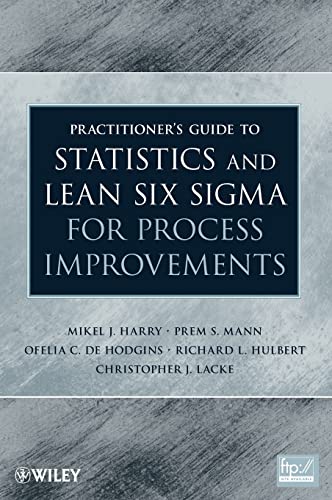
This hands-on book presents a complete understanding of Six Sigma and Lean Six Sigma through data analysis and statistical concepts
In today's business world, Six Sigma, or Lean Six Sigma, is a crucial tool utilized by companies to improve customer satisfaction, increase profitability, and enhance productivity. Practitioner's Guide to Statistics and Lean Six Sigma for Process Improvements provides a balanced approach to quantitative and qualitative statistics using Six Sigma and Lean Six Sigma methodologies.
Emphasizing applications and the implementation of data analyses as they relate to this strategy for business management, this book introduces readers to the concepts and techniques for solving problems and improving managerial processes using Six Sigma and Lean Six Sigma. Written by knowledgeable professionals working in the field today, the book offers thorough coverage of the statistical topics related to effective Six Sigma and Lean Six Sigma practices, including:
-
Discrete random variables and continuous random variables
-
Sampling distributions
-
Estimation and hypothesis tests
-
Chi-square tests
-
Analysis of variance
-
Linear and multiple regression
-
Measurement analysis
-
Survey methods and sampling techniques
The authors provide numerous opportunities for readers to test their understanding of the presented material, as the real data sets, which are incorporated into the treatment of each topic, can be easily worked with using Microsoft Office Excel, Minitab, MindPro, or Oracle's Crystal Ball software packages. Examples of successful, complete Six Sigma and Lean Six Sigma projects are supplied in many chapters along with extensive exercises that range in level of complexity. The book is accompanied by an extensive FTP site that features manuals for working with the discussed software packages along with additional exercises and data sets. In addition, numerous screenshots and figures guide readers through the functional and visual methods of learning Six Sigma and Lean Six Sigma.
Practitioner's Guide to Statistics and Lean Six Sigma for Process Improvements is an excellent book for courses on Six Sigma and statistical quality control at the upper-undergraduate and graduate levels. It is also a valuable reference for professionals in the fields of engineering, business, physics, management, and finance.
Die Inhaltsangabe kann sich auf eine andere Ausgabe dieses Titels beziehen.
Über die Autorin bzw. den Autor
Mikel J. Harry, PhD, is President and Chairman of the Board of the Six Sigma Management Institute. He is considered the principal architect of Six Sigma and one of the world's leading authorities in the field. Dr. Harry also focuses his research on applications of experimental design, inferential statistics, and statistical process control.
Prem S. Mann, PhD, is Professor and Chair of the Department of Economics at Eastern Connecticut State University. Dr. Mann has published numerous articles in the areas of labor economics, microeconomics, and statistics. He is the author of Introductory Statistics, Seventh Edition (Wiley).
Ofelia C. De Hodgins, MS, is a Six Sigma Global Master Black Belt. She has over twenty-five years of consulting experience in manufacturing and finance and has published more than thirty journal articles in the areas of physics, industrial engineering, statistics, and Statistical Process Control (SPC).
Richard L. Hulbert, MBA, is Vice President of Systems and Technology for the Bank of New York Mellon. He has more than thirty-five years of industry experience in the areas of network engineering, installation, implementation, network operations of technology infrastructure, distributed systems, market data, and government telecommunications.
Christopher J. Lacke, PhD, is Associate Professor of Mathematics at Rowan University. He has published numerous journal articles in his areas of research interest, which include decision analysis, Bayesian analysis, and operations research.
Von der hinteren Coverseite
This hands-on book presents a complete understanding of Six Sigma and Lean Six Sigma through data analysis and statistical concepts
In today's business world, Six Sigma, or Lean Six Sigma, is a crucial tool utilized by companies to improve customer satisfaction, increase profitability, and enhance productivity. Practitioner's Guide to Statistics and Lean Six Sigma for Process Improvements provides a balanced approach to quantitative and qualitative statistics using Six Sigma and Lean Six Sigma methodologies.
Emphasizing applications and the implementation of data analyses as they relate to this strategy for business management, this book introduces readers to the concepts and techniques for solving problems and improving managerial processes using Six Sigma and Lean Six Sigma. Written by knowledgeable professionals working in the field today, the book offers thorough coverage of the statistical topics related to effective Six Sigma and Lean Six Sigma practices, including:
-
Discrete random variables and continuous random variables
-
Sampling distributions
-
Estimation and hypothesis tests
-
Chi-square tests
-
Analysis of variance
-
Linear and multiple regression
-
Measurement analysis
-
Survey methods and sampling techniques
The authors provide numerous opportunities for readers to test their understanding of the presented material, as the real data sets, which are incorporated into the treatment of each topic, can be easily worked with using Microsoft Office Excel, Minitab, MindPro, or Oracle's Crystal Ball software packages. Examples of successful, complete Six Sigma and Lean Six Sigma projects are supplied in many chapters along with extensive exercises that range in level of complexity. The book is accompanied by an extensive FTP site that features manuals for working with the discussed software packages along with additional exercises and data sets. In addition, numerous screenshots and figures guide readers through the functional and visual methods of learning Six Sigma and Lean Six Sigma.
Practitioner's Guide to Statistics and Lean Six Sigma for Process Improvements is an excellent book for courses on Six Sigma and statistical quality control at the upper-undergraduate and graduate levels. It is also a valuable reference for professionals in the fields of engineering, business, physics, management, and finance.
Aus dem Klappentext
This hands-on book presents a complete understanding of Six Sigma and Lean Six Sigma through data analysis and statistical concepts
In today's business world, Six Sigma, or Lean Six Sigma, is a crucial tool utilized by companies to improve customer satisfaction, increase profitability, and enhance productivity. Practitioner's Guide to Statistics and Lean Six Sigma for Process Improvements provides a balanced approach to quantitative and qualitative statistics using Six Sigma and Lean Six Sigma methodologies.
Emphasizing applications and the implementation of data analyses as they relate to this strategy for business management, this book introduces readers to the concepts and techniques for solving problems and improving managerial processes using Six Sigma and Lean Six Sigma. Written by knowledgeable professionals working in the field today, the book offers thorough coverage of the statistical topics related to effective Six Sigma and Lean Six Sigma practices, including:
-
Discrete random variables and continuous random variables
-
Sampling distributions
-
Estimation and hypothesis tests
-
Chi-square tests
-
Analysis of variance
-
Linear and multiple regression
-
Measurement analysis
-
Survey methods and sampling techniques
The authors provide numerous opportunities for readers to test their understanding of the presented material, as the real data sets, which are incorporated into the treatment of each topic, can be easily worked with using Microsoft Office Excel, Minitab, MindPro, or Oracle's Crystal Ball software packages. Examples of successful, complete Six Sigma and Lean Six Sigma projects are supplied in many chapters along with extensive exercises that range in level of complexity. The book is accompanied by an extensive FTP site that features manuals for working with the discussed software packages along with additional exercises and data sets. In addition, numerous screenshots and figures guide readers through the functional and visual methods of learning Six Sigma and Lean Six Sigma.
Practitioner's Guide to Statistics and Lean Six Sigma for Process Improvements is an excellent book for courses on Six Sigma and statistical quality control at the upper-undergraduate and graduate levels. It is also a valuable reference for professionals in the fields of engineering, business, physics, management, and finance.
„Über diesen Titel“ kann sich auf eine andere Ausgabe dieses Titels beziehen.
Suchergebnisse für Practitioner's Guide to Statistics and Lean Six...

Beispielbild für diese ISBN
Practitioner's Guide to Statistics and Lean Six Sigma for Process Improvements
Verlag:
Wiley & Sons, Incorporated, John, 2010
ISBN 10: 0470114940
ISBN 13: 9780470114940
Gebraucht
Hardcover
Anbieter: Better World Books, Mishawaka, IN, USA
Verkäuferbewertung 5 von 5 Sternen

Zustand: Good. Former library copy. Pages intact with minimal writing/highlighting. The binding may be loose and creased. Dust jackets/supplements are not included. Includes library markings. Stock photo provided. Product includes identifying sticker. Better World Books: Buy Books. Do Good. Artikel-Nr. 45187840-6
Gebraucht kaufen
EUR 56,85
Versand gratis
Versand innerhalb von USA
Versand innerhalb von USA
Anzahl: 1 verfügbar
Beispielbild für diese ISBN
Practitioner's Guide to Statistics and Lean Six Sigma for Process Improvements
Anbieter: PBShop.store UK, Fairford, GLOS, Vereinigtes Königreich
Verkäuferbewertung 5 von 5 Sternen
HRD. Zustand: New. New Book. Shipped from UK. Established seller since 2000. Artikel-Nr. FW-9780470114940
Neu kaufen
EUR 159,98
EUR 9,99 Versand
Versand von Vereinigtes Königreich nach USA
Versand von Vereinigtes Königreich nach USA
Anzahl: 15 verfügbar
Beispielbild für diese ISBN
The Practitioner's Guide to Statistics and Lean Six Sigma for Process Improvements
Anbieter: Majestic Books, Hounslow, Vereinigtes Königreich
Verkäuferbewertung 4 von 5 Sternen

Zustand: New. pp. xxv + 800 Illus. Artikel-Nr. 8152215
Neu kaufen
EUR 212,37
EUR 7,65 Versand
Versand von Vereinigtes Königreich nach USA
Versand von Vereinigtes Königreich nach USA
Anzahl: 3 verfügbar
Beispielbild für diese ISBN
Practitioner's Guide to Statistics and Lean Six Sigma for Process Improvements
Anbieter: Ria Christie Collections, Uxbridge, Vereinigtes Königreich
Verkäuferbewertung 5 von 5 Sternen
Zustand: New. In English. Artikel-Nr. ria9780470114940_new
Neu kaufen
EUR 209,94
EUR 17,58 Versand
Versand von Vereinigtes Königreich nach USA
Versand von Vereinigtes Königreich nach USA
Anzahl: Mehr als 20 verfügbar
Foto des Verkäufers
The Practitioner\ s Guide to Statistics and Lean Six Sigma for Process Improvements
Anbieter: moluna, Greven, Deutschland
Verkäuferbewertung 5 von 5 Sternen
Zustand: New. Mikel J. Harry, PhD, is President and Chairman of the Board of the Six Sigma Management Institute. He is considered the principal architect of Six Sigma and one of the world s leading authorities in the field. Dr. Harry also focuses his research on applicat. Artikel-Nr. 446911699
Neu kaufen
EUR 187,66
EUR 48,99 Versand
Versand von Deutschland nach USA
Versand von Deutschland nach USA
Anzahl: Mehr als 20 verfügbar
Beispielbild für diese ISBN
The Practitioner's Guide to Statistics and Lean Six Sigma for Process Improvements
Anbieter: Revaluation Books, Exeter, Vereinigtes Königreich
Verkäuferbewertung 5 von 5 Sternen
Hardcover. Zustand: Brand New. 1st edition. 800 pages. 10.00x7.20x1.70 inches. In Stock. Artikel-Nr. x-0470114940
Neu kaufen
EUR 258,52
EUR 23,53 Versand
Versand von Vereinigtes Königreich nach USA
Versand von Vereinigtes Königreich nach USA
Anzahl: 2 verfügbar
Beispielbild für diese ISBN
The Practitioner's Guide to Statistics and Lean Six Sigma for Process Improvements
Anbieter: Kennys Bookstore, Olney, MD, USA
Verkäuferbewertung 5 von 5 Sternen
Zustand: New. This hands-on book presents a complete understanding of Six Sigma and Lean Six Sigma through data analysis and statistical conceptsIn today's business world, Six Sigma, or Lean Six Sigma, is a crucial tool utilized by companies to improve customer satisfaction, increase profitability, and enhance productivity. Num Pages: 832 pages, Illustrations. BIC Classification: KJMQ. Category: (P) Professional & Vocational. Dimension: 189 x 262 x 43. Weight in Grams: 1610. . 2010. 1st Edition. Hardcover. . . . . Books ship from the US and Ireland. Artikel-Nr. V9780470114940
Neu kaufen
EUR 273,15
EUR 9,33 Versand
Versand innerhalb von USA
Versand innerhalb von USA
Anzahl: Mehr als 20 verfügbar
Foto des Verkäufers
Practitioner's Guide for Six S
Anbieter: AHA-BUCH GmbH, Einbeck, Deutschland
Verkäuferbewertung 5 von 5 Sternen
Buch. Zustand: Neu. Neuware - This hands-on book presents a complete understanding of Six Sigma and Lean Six Sigma through data analysis and statistical conceptsIn today's business world, Six Sigma, or Lean Six Sigma, is a crucial tool utilized by companies to improve customer satisfaction, increase profitability, and enhance productivity. Practitioner's Guide to Statistics and Lean Six Sigma for Process Improvements provides a balanced approach to quantitative and qualitative statistics using Six Sigma and Lean Six Sigma methodologies.Emphasizing applications and the implementation of data analyses as they relate to this strategy for business management, this book introduces readers to the concepts and techniques for solving problems and improving managerial processes using Six Sigma and Lean Six Sigma. Written by knowledgeable professionals working in the field today, the book offers thorough coverage of the statistical topics related to effective Six Sigma and Lean Six Sigma practices, including:\* Discrete random variables and continuous random variables\* Sampling distributions\* Estimation and hypothesis tests\* Chi-square tests\* Analysis of variance\* Linear and multiple regression\* Measurement analysis\* Survey methods and sampling techniquesThe authors provide numerous opportunities for readers to test their understanding of the presented material, as the real data sets, which are incorporated into the treatment of each topic, can be easily worked with using Microsoft Office Excel(r), Minitab(r), MindPro(r), or Oracle's Crystal Ball(r) software packages. Examples of successful, complete Six Sigma and Lean Six Sigma projects are supplied in many chapters along with extensive exercises that range in level of complexity. The book is accompanied by an extensive FTP site that features manuals for working with the discussed software packages along with additional exercises and data sets. In addition, numerous screenshots and figures guide readers through the functional and visual methods of learning Six Sigma and Lean Six Sigma.Practitioner's Guide to Statistics and Lean Six Sigma for Process Improvements is an excellent book for courses on Six Sigma and statistical quality control at the upper-undergraduate and graduate levels. It is also a valuable reference for professionals in the fields of engineering, business, physics, management, and finance. Artikel-Nr. 9780470114940
Neu kaufen
EUR 262,11
EUR 47,07 Versand
Versand von Deutschland nach USA
Versand von Deutschland nach USA
Anzahl: 2 verfügbar