
Verwandte Artikel zu Building Great Sentences: How to Write the Kinds of...
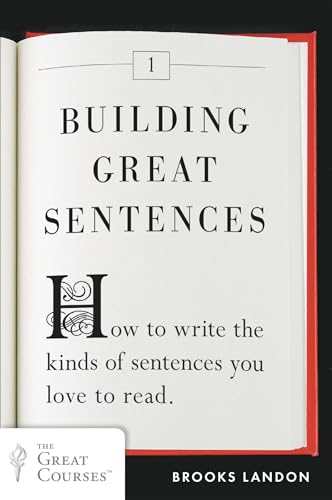
Building Great Sentences: How to Write the Kinds of Sentences You Love to Read (Great Courses, 1, Band 1) - Softcover
Inhaltsangabe
Based on the bestselling series from The Great Courses, Building Great Sentences celebrates the sheer joy of language—and will forever change the way you read and write.
Great writing begins with the sentence. Whether it’s two words (“Jesus wept.”) or William Faulkner’s 1,287-word sentence in Absalom! Absalom!, sentences have the power to captivate, entertain, motivate, educate, and, most importantly, delight. Yet, the sentence-oriented approach to writing is too often overlooked in favor of bland economy. Building Great Sentences teaches you to write better sentences by luxuriating in the pleasures of language.
Award-winning Professor Brooks Landon draws on examples from masters of long, elegant sentences—including Don DeLillo, Virginia Woolf, Joan Didion, and Samuel Johnson—to reveal the mechanics of how language works on thoughts and emotions, providing the tools to write powerful, more effective sentences.
Die Inhaltsangabe kann sich auf eine andere Ausgabe dieses Titels beziehen.
Über die Autorin bzw. den Autor
Dr. Brooks Landon is Herman J. and Eileen S. Schmidt Professor of English and Collegiate Fellow at The University of Iowa and Director of the University’s General Education Literature Program. He lives in Iowa.
Auszug. © Genehmigter Nachdruck. Alle Rechte vorbehalten.
Introduction
We live in a world of words. Digital media inundate us with language in a twenty-four/seven barrage never possible in the world of printer’s ink. Constant Web updates, blogs, e-mails, instant messaging, tweets, Facebook comments, and a cascade of electronic texts give us expanded opportunities to share our writing with others. Even in the age of Skype and FaceTime we continue to interact with others through writing. More and more it is important that we represent ourselves to the world through writing that is effective—clear, precise, satisfyingly informative writing that reveals the individuality and sophistication of our thinking. And we cannot be effective writers without writing effective sentences.
Whatever the medium, print or digital, our basic unit of communication is the sentence. Good sentences are alive. We experience them in time, and we react to their unfolding as they twist and turn, challenging us, teasing us, surprising us, and sometimes boring or confusing us as we read them. This book will explore the ways we can make our sentences better. To accomplish that we need to understand how making our sentences longer or shorter can make them more effective, more informative, more satisfying. We need to understand how taking control of building and trimming our sentences can improve our writing.
Our goals will be to learn about how sentences work, what they do, and how we can think and talk about them in ways that will help both our own writing and our understanding of prose style. We will stretch our sense of all the things a sentence can be or do. We will explore the mysterious concept of “style” to discover what style does and does not mean. This is a book in which we will dance with language, not a book in which we will trudge toward remedial correctness.
Dancing with language can be a rowdy affair. We might wish this dance had the precision, rules, and predictability of a tango, but it probably has much more in common with freestyle dancing that is more spontaneous and more creative, open to new steps and encouraging the reinterpretation of old ones. When the writer dances with language, toes do sometimes get stepped on as rules are broken. Of course, in dancing, as in writing, we need some ideas of what the rules are before we can break them. Before this dancing metaphor runs away with me, however, I better start talking as the writing teacher I am, rather than the dancing instructor I most certainly am not.
I’m no writing guru with mystical formulas for success. I am both a longtime student of writing theory and a writing teacher with over thirty years of experience. During that time, I’ve both learned a lot about writing and passed along what I’ve learned to several generations of students. What I believe and teach about writing is more thoughtful than theoretical, based more on what I’ve found helpful to my students in the classroom than on strict adherence to any single philosophy or theory of composition. My approach to teaching writing does, however, grow out of the three broad categories of writing instruction that are focused on the sentence.
At the heart of my approach is Francis Christensen’s belief in the value of cumulative sentences built by adding modifying phrases to base clauses or “kernel” sentences. I expand Christensen’s advocacy of cumulative sentences by identifying and explaining the value of a range of syntactical and rhetorical patterns, forms, or schemes I ask my students to imitate until they learn how to adapt these patterns to their own uses. In trusting the value of imitation as a basis for rather than as the opposite of creativity, I am championing a classical approach to writing I believe remains highly effective. The third component of my approach to writing incorporates many of the assumptions of sentence-combining strategies popular in the 1970s. I’ll say more about the nature and history of those three sentence-based approaches in my final chapter, after you’ve had a chance to experience and try out some of my particular spin on their methods and assumptions. For now I want to assure you that my approach to building great sentences grows out of pedagogies of proven effectiveness and promotes ways of building better sentences that fine writers know and practice. In drawing from and finding ways to combine these three broad approaches to the sentence I also try to provide a better understanding of the ways in which our standards and “rules” for effective writing have changed over time—and continue to evolve.
No rules or formulas or mechanical protocols can prepare us for the infinite number of tasks our sentences must accomplish, but there are a number of basic strategies we can learn that help make our sentences more effective. I’m going to introduce you to a broad range of techniques, but a particular favorite of mine is the cumulative sentence, an especially useful syntax employed by professional writers and best understood in terms first laid out by composition theorist Francis Christensen back in the 1960s.
Before we can work with a specific syntax, we need to understand the basic principles that guide the creation and use of all sentences. Accordingly, this book will look closely and carefully at sentences from a number of different angles, starting with their underlying logic and moving through the reasons why we cannot separate the content of a sentence from its form, its meaning from its style. We will look at the ways sentences work, from the most basic kernel sentences that are nothing more than a subject joined with a verb, to the most elaborate and extended master sentences, some stretching to lengths of more than one hundred words.
In examining the ways in which sentences work and why they sometimes don’t work, we will also encounter, understand, and possibly even master some of the secrets of prose style. Everyone who writes about prose style advances a particular view of it, and each view reflects the personal values and preferences of that particular writer. Yet somehow we generally agree that there is something called prose style. We generally agree on a number of aspects of writing that seem to have something to do with style, and we generally agree that there are some writers, ranging from Shakespeare to Virginia Woolf, Joan Didion to John Updike, Don DeLillo to Marilynne Robinson, who just seem to be better at it than others. When
F. Scott Fitzgerald writes in The Great Gatsby, describing Daisy, “Her face was sad and lovely with bright things in it, bright eyes and a bright passionate mouth, but there was an excitement in her voice that men who had cared for her found difficult to forget: a singing compulsion, a whispered ‘Listen,’ a promise that she had done gay, exciting things just a while since and that there were gay, exciting things hovering in the next hour,” who can doubt that we are in the hands of a great writer?
This book can’t begin to explain all of the mysteries of prose style. Nor can it offer universally agreed-upon standards for writing that is great or even effective. What this book can do is look closely and carefully at sentences, the most important building blocks of prose, the foundation of written communication, and the essential units of prose style. I hope you will join me in considering and celebrating the magic of the sentence as you think about and try out some of the writing strategies I suggest in this book. All of my ideas about sentences may not fit your goals for your own writing, but I hope you will find my discussion useful even when you do not agree with some of its parts. My ultimate goal, you see, is not to get you to agree with me about a specific view of writing but to encourage you to join me in the...
„Über diesen Titel“ kann sich auf eine andere Ausgabe dieses Titels beziehen.
Suchergebnisse für Building Great Sentences: How to Write the Kinds of...

Beispielbild für diese ISBN
Building Great Sentences: How to Write the Kinds of Sentences You Love to Read (Great Courses, 1)
Verlag:
Plume (edition Great Courses), 2013
ISBN 10: 0452298601
ISBN 13: 9780452298606
Gebraucht
Paperback
Anbieter: BooksRun, Philadelphia, PA, USA
Verkäuferbewertung 5 von 5 Sternen

Paperback. Zustand: Fair. Great Courses. The item might be beaten up but readable. May contain markings or highlighting, as well as stains, bent corners, or any other major defect, but the text is not obscured in any way. Artikel-Nr. 0452298601-7-1-13
Gebraucht kaufen
EUR 6,28
Versand gratis
Versand innerhalb von USA
Versand innerhalb von USA
Anzahl: 1 verfügbar
Beispielbild für diese ISBN
Building Great Sentences: How to Write the Kinds of Sentences You Love to Read
Anbieter: World of Books (was SecondSale), Montgomery, IL, USA
Verkäuferbewertung 5 von 5 Sternen
Paperback. Zustand: Good. Based on the bestselling series from The Great Courses, Building Great Sentences celebrates the sheer joy of language?and will forever change the way you read and write. Great writing begins with the sentence. Whether it?s two words (?Jesus wept.?) or William Faulkner?s 1,287-word sentence in Absalom! Absalom!, sentences have the power to captivate, entertain, motivate, educate, and, most importantly, delight. Yet, the sentence-oriented approach to writing is too often overlooked in favor of bland economy. Building Great Sentences teaches you to write better sentences by luxuriating in the pleasures of language. Award-winning Professor Brooks Landon draws on examples from masters of long, elegant sentences?including Don DeLillo, Virginia Woolf, Joan Didion, and Samuel Johnson?to reveal the mechanics of how language works on thoughts and emotions, providing the tools to write powerful, more effective sentences. Artikel-Nr. 00110360045
Gebraucht kaufen
EUR 8,47
Versand gratis
Versand innerhalb von USA
Versand innerhalb von USA
Anzahl: 1 verfügbar
Beispielbild für diese ISBN
Building Great Sentences: How to Write the Kinds of Sentences You Love to Read
Anbieter: World of Books (was SecondSale), Montgomery, IL, USA
Verkäuferbewertung 5 von 5 Sternen
Paperback. Zustand: Fair. Based on the bestselling series from The Great Courses, Building Great Sentences celebrates the sheer joy of language?and will forever change the way you read and write. Great writing begins with the sentence. Whether it?s two words (?Jesus wept.?) or William Faulkner?s 1,287-word sentence in Absalom! Absalom!, sentences have the power to captivate, entertain, motivate, educate, and, most importantly, delight. Yet, the sentence-oriented approach to writing is too often overlooked in favor of bland economy. Building Great Sentences teaches you to write better sentences by luxuriating in the pleasures of language. Award-winning Professor Brooks Landon draws on examples from masters of long, elegant sentences?including Don DeLillo, Virginia Woolf, Joan Didion, and Samuel Johnson?to reveal the mechanics of how language works on thoughts and emotions, providing the tools to write powerful, more effective sentences. Artikel-Nr. 00107241659
Gebraucht kaufen
EUR 8,47
Versand gratis
Versand innerhalb von USA
Versand innerhalb von USA
Anzahl: 1 verfügbar
Beispielbild für diese ISBN
Building Great Sentences
Anbieter: BookOutlet, Jefferson City, TN, USA
Verkäuferbewertung 5 von 5 Sternen
Paperback. Zustand: New. Paperback. Publisher overstock, may contain remainder mark on edge. Artikel-Nr. 9780452298606B
Beispielbild für diese ISBN
Building Great Sentences: How to Write the Kinds of Sentences You Love to Read
Anbieter: Magers and Quinn Booksellers, Minneapolis, MN, USA
Verkäuferbewertung 5 von 5 Sternen
paperback. Zustand: Very Good. May have light to moderate shelf wear and/or a remainder mark. Complete. Clean pages. Artikel-Nr. 1421679
Gebraucht kaufen
EUR 7,84
EUR 3,51 Versand
Versand innerhalb von USA
Versand innerhalb von USA
Anzahl: 1 verfügbar
Beispielbild für diese ISBN
Building Great Sentences: How to Write the Kinds of Sentences You Love to Read
Anbieter: Revaluation Books, Exeter, Vereinigtes Königreich
Verkäuferbewertung 5 von 5 Sternen
Paperback. Zustand: Brand New. 267 pages. 8.25x5.25x0.50 inches. In Stock. Artikel-Nr. __0452298601
Neu kaufen
EUR 15,67
EUR 11,61 Versand
Versand von Vereinigtes Königreich nach USA
Versand von Vereinigtes Königreich nach USA
Anzahl: 1 verfügbar
Beispielbild für diese ISBN
Building Great Sentences
Anbieter: Majestic Books, Hounslow, Vereinigtes Königreich
Verkäuferbewertung 4 von 5 Sternen

Zustand: New. pp. 288. Artikel-Nr. 56744674
Neu kaufen
EUR 20,38
EUR 7,55 Versand
Versand von Vereinigtes Königreich nach USA
Versand von Vereinigtes Königreich nach USA
Anzahl: 1 verfügbar
Beispielbild für diese ISBN
Building Great Sentences: How to Write the Kinds of Sentences You Love to Read (Great Courses)
Anbieter: WorldofBooks, Goring-By-Sea, WS, Vereinigtes Königreich
Verkäuferbewertung 5 von 5 Sternen
Paperback. Zustand: Fair. A readable copy of the book which may include some defects such as highlighting and notes. Cover and pages may be creased and show discolouration. Artikel-Nr. GOR015082253
Gebraucht kaufen
EUR 23,92
EUR 6,50 Versand
Versand von Vereinigtes Königreich nach USA
Versand von Vereinigtes Königreich nach USA
Anzahl: 1 verfügbar
Beispielbild für diese ISBN
Building Great Sentences: How to Write the Kinds of Sentences You Love to Read (Great Courses)
Anbieter: WorldofBooks, Goring-By-Sea, WS, Vereinigtes Königreich
Verkäuferbewertung 5 von 5 Sternen
Paperback. Zustand: Very Good. The book has been read, but is in excellent condition. Pages are intact and not marred by notes or highlighting. The spine remains undamaged. Artikel-Nr. GOR008608231
Gebraucht kaufen
EUR 23,92
EUR 6,50 Versand
Versand von Vereinigtes Königreich nach USA
Versand von Vereinigtes Königreich nach USA
Anzahl: 1 verfügbar
Beispielbild für diese ISBN
Building Great Sentences: How to Write the Kinds of Sentences You Love to Read (Great Courses)
Anbieter: Kennys Bookstore, Olney, MD, USA
Verkäuferbewertung 5 von 5 Sternen
Zustand: New. 2013. Paperback. . . . . . Books ship from the US and Ireland. Artikel-Nr. V9780452298606
Neu kaufen
EUR 24,69
EUR 9,23 Versand
Versand innerhalb von USA
Versand innerhalb von USA
Anzahl: 15 verfügbar