
Inhaltsangabe
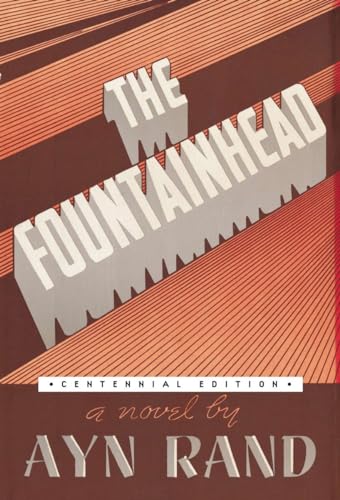
The revolutionary literary vision that sowed the seeds of Objectivism, Ayn Rand's groundbreaking philosophy, and brought her immediate worldwide acclaim.
This modern classic is the story of intransigent young architect Howard Roark, whose integrity was as unyielding as granite...of Dominique Francon, the exquisitely beautiful woman who loved Roark passionately, but married his worst enemy...and of the fanatic denunciation unleashed by an enraged society against a great creator. As fresh today as it was then, Rand’s provocative novel presents one of the most challenging ideas in all of fiction—that man’s ego is the fountainhead of human progress...
“A writer of great power. She has a subtle and ingenious mind and the capacity of writing brilliantly, beautifully, bitterly...This is the only novel of ideas written by an American woman that I can recall.”—The New York Times
Die Inhaltsangabe kann sich auf eine andere Ausgabe dieses Titels beziehen.
Über die Autorin bzw. den Autor
Born February 2, 1905, Ayn Rand published her first novel, We the Living, in 1936. Anthem followed in 1938. It was with the publication of The Fountainhead (1943) and Atlas Shrugged (1957) that she achieved her spectacular success. Rand’s unique philosophy, Objectivism, has gained a worldwide audience. The fundamentals of her philosophy are put forth in three nonfiction books, Introduction to Objectivist Epistemology, The Virtues of Selfishness, and Capitalism: The Unknown Ideal. They are all available in Signet editions, as is the magnificent statement of her artistic credo, The Romantic Manifesto.
Auszug. © Genehmigter Nachdruck. Alle Rechte vorbehalten.
"...Architecture, my friends, is a great art based on two cosmic principles: Beauty and Utility. In a broader sense, these are but part of the three eternal entities: Truth, Love and Beauty. Truth -- to the traditions of our Art, Love -- for our fellow men whom we are to serve, Beauty -- ah, Beauty is a compelling goddess to all artists, be it in the shape of a lovely woman or a building....Hm....Yes....In conclusion, I should like to say to you, who are about to embark upon your careers in architecture, that you are now the custodians of a sacred heritage....Hm....Yes....So, go forth into the world, armed with the three eternal enti -- armed with courage and vision, loyal to the standards this great school has represented for many years. May you all serve faithfully, neither as slaves to the past nor as those parvenus who preach originality for its own sake, which attitude is only ignorant vanity. May you all have many rich, active years before you and leave, as you depart from this world, your mark on the sands of time!"
Guy Francon ended with a flourish, raising his right arm in a sweeping salute; informal, but with an air, that gay, swaggering air which Guy Francon could always permit himself. The huge hall before him came to life in applause and approval.
A sea of faces, young, perspiring and eager, had been raised solemnly -- for forty-five minutes -- to the platform where Guy Francon had held forth as the speaker at the commencement exercises of the Stanton Institute of Technology, Guy Francon who had brought his own person from New York for the occasion; Guy Francon, of the illustrious firm of Francon & Heyer, vice-president of the Architects' Guild of America, member of the American Academy of Arts and Letters, member of the National Fine Arts Commission, Secretary of the Arts and Crafts League of New York, chairman of the Society for Architectural Enlightenment of the U.S.A.; Guy Francon, knight of the Legion of Honor of France, decorated by the governments of Great Britain, Belgium, Monaco and Siam; Guy Francon, Stanton's greatest alumnus, who had designed the famous Frink National Bank Building of New York City, on the top of which, twenty-five floors above the pavements, there burned in a miniature replica of the Hadrian Mausoleum a wind-blown torch made of glass and the best General Electric bulbs.
Guy Francon descended from the platform, fully conscious of his timing and movements. He was of medium height and not too heavy, with just an unfortunate tendency to stoutness. Nobody, he knew, would give him his real age, which was fifty-one. His face bore not a wrinkle nor a single straight line; it was an artful composition in globes, circles, arcs and ellipses, with bright little eyes twinkling wittily. His clothes displayed an artist's infinite attention to details. He wished, as he descended the steps, that this were a co-educational school.
The hall before him, he thought, was a splendid specimen of architecture, made a bit stuffy today by the crowd and by the neglected problem of ventilation. But it boasted green marble dados, Corinthian columns of cast iron painted gold, and garlands of gilded fruit on the walls; the pineapples particularly, thought Guy Francon, had stood the test of years very well. It is, thought Guy Francon, touching; it was I who built this annex and this very hall, twenty years ago; and here I am.
The hall was packed with bodies and faces, so tightly that one could not distinguish at a glance which faces belonged to which bodies. It was like a soft, shivering aspic made of mixed arms, shoulders, chests and stomachs. One of the heads, pale, dark haired and beautiful, belonged to Peter Keating.
He sat, well in front, trying to keep his eyes on the platform, because he knew that many people were looking at him and would look at him later. He did not glance back, but the consciousness of those centered glances never left him. His eyes were dark, alert, intelligent. His mouth, a small upturned crescent faultlessly traced, was gentle and generous, and warm with the faint promise of a smile. His head had a certain classical perfection in the shape of the skull, in the natural wave of black ringlets about finely hollowed temples. He held his head in the manner of one who takes his beauty for granted, but knows that others do not. He was Peter Keating, star student of Stanton, president of the student body, captain of the track team, member of the most important fraternity, voted the most popular man on the campus.
The crowd was there, thought Peter Keating, to see him graduate,and he tried to estimate the capacity of the hall. They knew of his scholastic record and no one would beat his record today. Oh, well, there was Shlinker. Shlinker had given him stiff competition, but he had beaten Shlinker this last year. He had worked like a dog, because he had wanted to beat Shlinker. He had no rivals today....Then he felt suddenly as if something had fallen down, inside his throat, to his stomach, something cold and empty, a blank hole rolling down and leaving that feeling on its way: not a thought, just the hint of a question asking him whether he was really as great as this day would proclaim him to be. He looked for Shlinker in the crowd; he saw his yellow face and gold-rimmed glasses. He stared at Shlinker warmly, in relief, in reassurance, in gratitude. It was obvious that Shlinker could never hope to equal his own appearance or ability; he had nothing to doubt; he would always beat Shlinker and all the Shlinkers of the world; he would let no one achieve what he could not achieve. Let them all watch him. He would give them good reason to stare. He felt the hot breaths about him and the expectation, like a tonic. It was wonderful, thought Peter Keating, to be alive.
His head was beginning to reel a little. It was a pleasant feeling. The feeling carried him, unresisting and unremembering, to the platform in front of all those faces. He stood -- slender, trim, athletic -- and let the deluge break upon his head. He gathered from its roar that he had graduated with honors, that the Architects' Guild of America had presented him with a gold medal and that he had been awarded the Prix de Paris by the Society for Architectural Enlightenment of the U.S.A. -- a four-year scholarship at the Ecole des Beaux Arts in Paris.
Then he was shaking hands, scratching the perspiration off his face with the end of a rolled parchment, nodding, smiling, suffocating in his black gown and hoping that people would not notice his mother sobbing with her arms about him. The President of the Institute shook his hand, booming: "Stanton will be proud of you, my boy." The Dean shook his hand, repeating: "...a glorious future...a glorious future...a glorious future..." Professor Peterkin shook his hand, and patted his shoulder, saying: "...and you'll find it absolutely essential; for example, I had the experience when I built the Peabody Post Office..." Keating did not listen to the rest, because he had heard the story of the Peabody Post Office many times. It was the only structure anyone had ever known Professor Peterkin to have erected, before he sacrificed his practice to the responsibilities of teaching. A great deal was said about Keating's final project -- a Palace of Fine Arts. For the life of him, Keating could not remember at the moment what that project was.
Through all this, his eyes held the vision of Guy Francon shaking his hand, and his ears held the sounds of Francon's mellow voice: "...as I have told you, it is still open, my boy. Of course, now that you have this scholarship...you will have to decide...a Beaux-Arts diploma is very important to a young man...but I should be delighted to have you in our office...."
The banquet of the class of '22 was long and solemn. Keating listened to the speeches with interest; when he heard the endless sentences about "young men as...
„Über diesen Titel“ kann sich auf eine andere Ausgabe dieses Titels beziehen.
Weitere beliebte Ausgaben desselben Titels

Suchergebnisse für The Fountainhead: A novel. Afterword by Leonard Peikoff

Beispielbild für diese ISBN
The Fountainhead
Anbieter: World of Books (was SecondSale), Montgomery, IL, USA
Verkäuferbewertung 5 von 5 Sternen

Zustand: Acceptable. Item in acceptable condition! Textbooks may not include supplemental items i.e. CDs, access codes etc. Artikel-Nr. 00103025719
Gebraucht kaufen
EUR 4,16
Versand gratis
Versand innerhalb von USA
Versand innerhalb von USA
Anzahl: 2 verfügbar
Beispielbild für diese ISBN
The Fountainhead
Anbieter: World of Books (was SecondSale), Montgomery, IL, USA
Verkäuferbewertung 5 von 5 Sternen
Zustand: Good. Item in good condition. Textbooks may not include supplemental items i.e. CDs, access codes etc. Artikel-Nr. 00103118239
Gebraucht kaufen
EUR 4,16
Versand gratis
Versand innerhalb von USA
Versand innerhalb von USA
Anzahl: 6 verfügbar
Foto des Verkäufers
The Fountainhead
Anbieter: Dream Books Co., Denver, CO, USA
Verkäuferbewertung 5 von 5 Sternen
Zustand: acceptable. This copy has clearly been enjoyedâ"expect noticeable shelf wear and some minor creases to the cover. Binding is strong, and all pages are legible. May contain previous library markings or stamps. Artikel-Nr. 4EKGRJ00DYFM_ns
Gebraucht kaufen
EUR 5,62
Versand gratis
Versand innerhalb von USA
Versand innerhalb von USA
Anzahl: 2 verfügbar
Beispielbild für diese ISBN
The Fountainhead
Anbieter: ThriftBooks-Reno, Reno, NV, USA
Verkäuferbewertung 5 von 5 Sternen
Paperback. Zustand: Fair. No Jacket. Former library book; Readable copy. Pages may have considerable notes/highlighting. ~ ThriftBooks: Read More, Spend Less. Artikel-Nr. G0452286379I5N10
Gebraucht kaufen
EUR 5,65
Versand gratis
Versand innerhalb von USA
Versand innerhalb von USA
Anzahl: 1 verfügbar
Beispielbild für diese ISBN
The Fountainhead
Anbieter: ThriftBooks-Atlanta, AUSTELL, GA, USA
Verkäuferbewertung 5 von 5 Sternen
Paperback. Zustand: Very Good. No Jacket. May have limited writing in cover pages. Pages are unmarked. ~ ThriftBooks: Read More, Spend Less. Artikel-Nr. G0452286379I4N00
Gebraucht kaufen
EUR 5,65
Versand gratis
Versand innerhalb von USA
Versand innerhalb von USA
Anzahl: 1 verfügbar
Beispielbild für diese ISBN
The Fountainhead
Anbieter: ThriftBooks-Reno, Reno, NV, USA
Verkäuferbewertung 5 von 5 Sternen
Paperback. Zustand: Very Good. No Jacket. May have limited writing in cover pages. Pages are unmarked. ~ ThriftBooks: Read More, Spend Less. Artikel-Nr. G0452286379I4N00
Gebraucht kaufen
EUR 5,65
Versand gratis
Versand innerhalb von USA
Versand innerhalb von USA
Anzahl: 1 verfügbar
Beispielbild für diese ISBN
The Fountainhead
Anbieter: ThriftBooks-Atlanta, AUSTELL, GA, USA
Verkäuferbewertung 5 von 5 Sternen
Paperback. Zustand: Good. No Jacket. Pages can have notes/highlighting. Spine may show signs of wear. ~ ThriftBooks: Read More, Spend Less. Artikel-Nr. G0452286379I3N00
Gebraucht kaufen
EUR 5,65
Versand gratis
Versand innerhalb von USA
Versand innerhalb von USA
Anzahl: Mehr als 20 verfügbar
Beispielbild für diese ISBN
The Fountainhead
Anbieter: ThriftBooks-Reno, Reno, NV, USA
Verkäuferbewertung 5 von 5 Sternen
Paperback. Zustand: Very Good. No Jacket. Former library book; May have limited writing in cover pages. Pages are unmarked. ~ ThriftBooks: Read More, Spend Less. Artikel-Nr. G0452286379I4N10
Gebraucht kaufen
EUR 5,65
Versand gratis
Versand innerhalb von USA
Versand innerhalb von USA
Anzahl: 1 verfügbar
Beispielbild für diese ISBN
The Fountainhead
Anbieter: ThriftBooks-Dallas, Dallas, TX, USA
Verkäuferbewertung 5 von 5 Sternen
Paperback. Zustand: Very Good. No Jacket. May have limited writing in cover pages. Pages are unmarked. ~ ThriftBooks: Read More, Spend Less. Artikel-Nr. G0452286379I4N00
Gebraucht kaufen
EUR 5,65
Versand gratis
Versand innerhalb von USA
Versand innerhalb von USA
Anzahl: 1 verfügbar
Beispielbild für diese ISBN
The Fountainhead
Anbieter: ThriftBooks-Phoenix, Phoenix, AZ, USA
Verkäuferbewertung 5 von 5 Sternen
Paperback. Zustand: Fair. No Jacket. Readable copy. Pages may have considerable notes/highlighting. ~ ThriftBooks: Read More, Spend Less. Artikel-Nr. G0452286379I5N00
Gebraucht kaufen
EUR 5,65
Versand gratis
Versand innerhalb von USA
Versand innerhalb von USA
Anzahl: 12 verfügbar