
Verwandte Artikel zu The Darwin Awards 3: Survival of the Fittest
Inhaltsangabe
The hilarious New York Times bestselling phenomenon and the perfect funny gift!
Honoring those who improve our gene pool by inadvertently removing themselves fromit, The Darwin Awards III includes more than one hundred brand new, hilariously macabre mishaps and misadventures.
From a sheriff who inadvertently shot himself twice, to the insurance defrauder who amputated his leg with a chainsaw; from a farmer who avoided bee stings by sealing his head in a plastic bag to the man crushed by the branch he just trimmed, The Darwin Awards III proves again that when it comes to stupidity, no species does it like we do.
Featuring scientific and safety discussions and filled with illustrations depicting inspiring examples of evolution in action, The Darwin Awards III shows once more how uncommon common sense still is.
Die Inhaltsangabe kann sich auf eine andere Ausgabe dieses Titels beziehen.
Über die Autorin bzw. den Autor
A graduate of UC Berkeley with a degree in molecular biology, Wendy Northcutt began collecting the stories that make up the Darwin Awards in 1993. Her award-winning Web site www.DarwinAwards.com is one of the most popular humor pages on the Web. The Darwin Awardshave been profiled in USA Today, The Wall Street Journal, Entertainment Weekly, and on NPR’s All Things Considered. Wendy is the author of the international bestsellers The Darwin Awards: Evolution in Action, The Darwin Awards 2: Unnatural Selection, The Darwin Awards 3: Survival of the Fittest, The Darwin Awards 4: Intelligent Design, The Darwin Awards: Next Evolution, and The Darwin Awards: Countdown to Extinction.
Auszug. © Genehmigter Nachdruck. Alle Rechte vorbehalten.
Introduction
Darwin Awards are not for everyone—only a select few earn this dubious distinction. Review the rules, the categories, and the evolutionary concepts underpinning the Darwin Awards.
THE DARWIN AWARDS: DEFINED
Darwin Awards are bestowed upon individuals who improve our gene pool by removing themselves from it in a spectacularly stupid manner. They involve themselves in situations that a person with even a modicum of common sense would avoid, and their subsequent and predictable demise removes a set of judgment- impaired genes from circulation, thereby ensuring the long-term survival of the human race—which now contains one less idiot.
Every time a Darwin Award winner eradicates himself (or, occasionally, herself) from the population, we can breathe a sigh of relief, knowing that our descendants won’t have to deal with—or breed with—the descendants of this mental midget, who lacks the ability to survive his own appallingly ill-conceived ideas.
Of necessity this honor is awarded posthumously, except in rare instances where a nominee eliminates only his ability to reproduce.
These stories are not mere tragic accidents. They are astonishing misapplications of judgment of such magnitude that the observer can only shake his head ruefully at the poetic justice dished out by fate to a deserving recipient.
The Darwin Awards commemorate the not-so-unexpected demise of a wood thief crushed by the overhead tree branch he methodically sawed in half while standing beneath it (page 37); two men competing to see who’s the bravest of them all by holding lit fireworks in their mouths (page 55); a judge who pulled the pin of a live grenade introduced into evidence (page 41); and all the absentminded catastrophes caused by those who repeatedly stump us with their cluelessness.
Want to feel like a genius? The next time you feel foolish, stupid, or incompetent, seek out the Darwin Awards and read a few of these true tales of misadventure. You’ll soon realize how brilliant you really are, compared with the morons featured on these pages.
And you will probably find yourself taking a few personal pledges while reading this book, such as: “I will keep pointy metal objects away from electrical wires.” “I will not suck gasoline into a vacuum cleaner.” “I will hold no fireworks in my mouth.” “No sleeping in the road for me!”
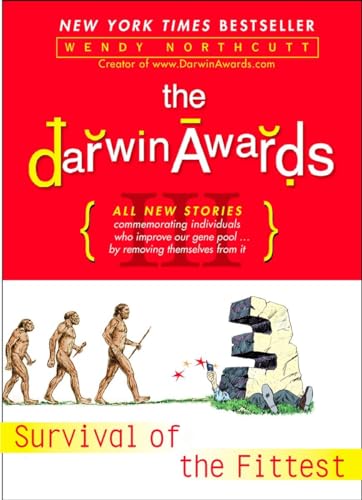
There is an especial danger in new technology, which presents challenges that some people find insurmountable. The cover illustration shows the quintessential modern Darwin Award winner, holding a cell phone, intent on the wrong signals, and clueless in the face of impending doom. The image of a squashed cell-phone user typifies the absentminded human animal, unaware of dicey circumstances and headed for trouble.
Cell phones have become ubiquitous, but humans are still singularly ill equipped to use these devices safely. Although we have been communicating for millennia, we have not yet evolved the multitasking aptitude needed to talk on a cell phone while driving. Put one of these lethal instruments to the ear of the average driver, and a traffic accident is quite likely to occur. In fact, accidents involving cell phones are too common to be eligible for a Darwin Award unless additional stupidity is present. “What’s That Sound?” on page 160 and “(un) Armed and Dangerous” on page 190 are two sterling examples.
As more and more people remove themselves from the gene pool while using cell phones, the species as a whole will become better equipped to safely coexist with this new technology. As the population of cell- phone idiots is slowly depleted, one can imagine a golden day, far in the future, when cell phones are considered as safe to use as a faucet.
A 2002 Harvard study estimated that 6 percent of U.S. traffic accidents are caused by drivers talking on cell phones, resulting in 2,600 deaths and 330,000 injuries. In January 2003, the California Highway Patrol reported that cell phones are the leading cause of crashes attributed to driver distraction, a category that covers 10 percent of all crashes.
Reference: San Jose Mercury News
THE RULES
Now that the concept of the Darwin Awards has been explained, a discussion of the rules will not only elucidate their genesis, but also illuminate some of the more obscure questions that arise when evaluating nominees.
There are five basic rules:
Reproduction Out of the gene pool!
Excellence The event transcends common stupidity.
Self-selection They did it to themselves!
Maturity But not a child or handicapped person.
Veracity Confirmed or, at least, plausible.
Reproduction
The candidate is no longer able to contribute to the gene pool.
The traditional method of satisfying this requirement is to cause one’s own death. However, the occasional rebel opts for sterilization, which allows him more time to enjoy the dubious notoriety of winning this award.
The existence of offspring, though potentially deleterious to the gene pool, does not disqualify a nominee. Children inherit only half of each parent’s genetic material and thus have their own chance to survive or snuff themselves—if, for instance, the “play with combustibles” gene has been passed along. If they have inherited the “play with combustibles” gene, but have also inherited a “use caution when ... ” gene, then they are potential innovators and possible assets to the human race. Therefore, each nominee is judged based on whether or not she has removed her own genes, without consideration to number of offspring or, in the case of an elderly winner, the likelihood of producing offspring regardless of an untimely demise.
Excellence
The candidate suffered an astounding lapse of judgment.
It takes a phenomenal failure of common sense to earn a Darwin Award. Common idiocies such as playing Russian roulette, falling off a boat, or sleeping next to a smoldering cigarette are not sufficient to win the dubious distinction of a Darwin. On the other hand, playing Russian roulette with land mines, jumping off a boat into shark-infested waters knowing you cannot swim, or sleeping with a smoldering cigarette under an oxygen tent ... just might win you a Darwin Award!
It has been argued that more emphasis should be placed on the stupidity aspect, and less on the extreme nature of the stupidity. After all, humans are supposedly able to learn from their mistakes, and yet time and time again we manage to fall down stairs and drop radios into bathtubs. There is merit to this criticism, as natural selection is undoubtedly eliminating “bad driver” genes more rapidly than it’s eliminating “grenade juggling” genes. However, it is not amusing to read dozens of stories about poor driving! Therefore, the Darwin Awards are given only to those who show their flagrant disregard for the laws of nature in a novel way.
Those who participate in extreme sports are not automatically eligible, as they knowingly assume an increased risk of death. They are, in a sense, correctly applying their judgment that the entertainment is worth the risk. However bizarre the sport, an additional misapplication of judgment must be present in order for the deceased to qualify for a Darwin Award.
Not a Darwin, but not safe either:
• Falling off a precipice while posing or pissing
• Warming aerosol cans or gasoline in the oven
• Whizzing on an electric rail or fence
• Being hit by a train or an automobile
• Smoking inside an oxygen tent
• Carbon monoxide poisoning
• Most autoerotic deaths
These circumstances are all too common!
Self-Selection
The...
„Über diesen Titel“ kann sich auf eine andere Ausgabe dieses Titels beziehen.
Suchergebnisse für The Darwin Awards 3: Survival of the Fittest

Beispielbild für diese ISBN
The Darwin Awards III: Surviva
Anbieter: World of Books (was SecondSale), Montgomery, IL, USA
Verkäuferbewertung 5 von 5 Sternen

Zustand: Very Good. Item in very good condition! Textbooks may not include supplemental items i.e. CDs, access codes etc. Artikel-Nr. 00108972004
Gebraucht kaufen
EUR 3,91
Versand gratis
Versand innerhalb von USA
Versand innerhalb von USA
Anzahl: 1 verfügbar
Beispielbild für diese ISBN
The Darwin Awards III: Surviva
Anbieter: World of Books (was SecondSale), Montgomery, IL, USA
Verkäuferbewertung 5 von 5 Sternen
Zustand: Good. Item in good condition. Textbooks may not include supplemental items i.e. CDs, access codes etc. Artikel-Nr. 00098018692
Gebraucht kaufen
EUR 3,91
Versand gratis
Versand innerhalb von USA
Versand innerhalb von USA
Anzahl: 16 verfügbar
Beispielbild für diese ISBN
The Darwin Awards III Survival
Anbieter: World of Books (was SecondSale), Montgomery, IL, USA
Verkäuferbewertung 5 von 5 Sternen
Zustand: Acceptable. Item in acceptable condition! Textbooks may not include supplemental items i.e. CDs, access codes etc. Artikel-Nr. 00096524702
Gebraucht kaufen
EUR 3,91
Versand gratis
Versand innerhalb von USA
Versand innerhalb von USA
Anzahl: 5 verfügbar
Beispielbild für diese ISBN
The Darwin Awards III Survival
Anbieter: World of Books (was SecondSale), Montgomery, IL, USA
Verkäuferbewertung 5 von 5 Sternen
Zustand: Acceptable. Item in good condition. Textbooks may not include supplemental items i.e. CDs, access codes etc. Artikel-Nr. 00066045676
Gebraucht kaufen
EUR 3,91
Versand gratis
Versand innerhalb von USA
Versand innerhalb von USA
Anzahl: 2 verfügbar
Beispielbild für diese ISBN
The Darwin Awards III: Survival of the Fittest
Verlag:
Penguin Publishing Group (edition Reprint), 2004
ISBN 10: 0452285720
ISBN 13: 9780452285729
Gebraucht
Paperback
Anbieter: BooksRun, Philadelphia, PA, USA
Verkäuferbewertung 5 von 5 Sternen
Paperback. Zustand: Fair. Reprint. The item might be beaten up but readable. May contain markings or highlighting, as well as stains, bent corners, or any other major defect, but the text is not obscured in any way. Artikel-Nr. 0452285720-7-1
Gebraucht kaufen
EUR 4,18
Versand gratis
Versand innerhalb von USA
Versand innerhalb von USA
Anzahl: 1 verfügbar
Beispielbild für diese ISBN
The Darwin Awards III: Survival of the Fittest
Verlag:
Penguin Publishing Group (edition Reprint), 2004
ISBN 10: 0452285720
ISBN 13: 9780452285729
Gebraucht
Paperback
Anbieter: BooksRun, Philadelphia, PA, USA
Verkäuferbewertung 5 von 5 Sternen
Paperback. Zustand: Very Good. Reprint. It's a well-cared-for item that has seen limited use. The item may show minor signs of wear. All the text is legible, with all pages included. It may have slight markings and/or highlighting. Artikel-Nr. 0452285720-8-18
Gebraucht kaufen
EUR 4,62
Versand gratis
Versand innerhalb von USA
Versand innerhalb von USA
Anzahl: 1 verfügbar
Beispielbild für diese ISBN
The Darwin Awards III: Survival of the Fittest
Verlag:
Penguin Publishing Group (edition Reprint), 2004
ISBN 10: 0452285720
ISBN 13: 9780452285729
Gebraucht
Paperback
Anbieter: BooksRun, Philadelphia, PA, USA
Verkäuferbewertung 5 von 5 Sternen
Paperback. Zustand: Very Good. Reprint. It's a well-cared-for item that has seen limited use. The item may show minor signs of wear. All the text is legible, with all pages included. It may have slight markings and/or highlighting. Artikel-Nr. 0452285720-11-1
Gebraucht kaufen
EUR 4,69
Versand gratis
Versand innerhalb von USA
Versand innerhalb von USA
Anzahl: 1 verfügbar
Beispielbild für diese ISBN
The Darwin Awards III : Survival of the Fittest
Verlag:
Penguin Publishing Group, 2004
ISBN 10: 0452285720
ISBN 13: 9780452285729
Gebraucht
Softcover
Anbieter: Better World Books, Mishawaka, IN, USA
Verkäuferbewertung 5 von 5 Sternen
Zustand: Fine. Reprint. Used book that is in almost brand-new condition. May contain a remainder mark. Better World Books: Buy Books. Do Good. Artikel-Nr. 6377280-75
Gebraucht kaufen
EUR 5,97
Versand gratis
Versand innerhalb von USA
Versand innerhalb von USA
Anzahl: 1 verfügbar
Beispielbild für diese ISBN
The Darwin Awards III : Survival of the Fittest
Verlag:
Penguin Publishing Group, 2004
ISBN 10: 0452285720
ISBN 13: 9780452285729
Gebraucht
Softcover
Anbieter: Better World Books, Mishawaka, IN, USA
Verkäuferbewertung 5 von 5 Sternen
Zustand: Very Good. Reprint. Former library copy. Pages intact with possible writing/highlighting. Binding strong with minor wear. Dust jackets/supplements may not be included. Includes library markings. Stock photo provided. Product includes identifying sticker. Better World Books: Buy Books. Do Good. Artikel-Nr. GRP89045672
Gebraucht kaufen
EUR 5,97
Versand gratis
Versand innerhalb von USA
Versand innerhalb von USA
Anzahl: 1 verfügbar
Beispielbild für diese ISBN
The Darwin Awards III : Survival of the Fittest
Verlag:
Penguin Publishing Group, 2004
ISBN 10: 0452285720
ISBN 13: 9780452285729
Gebraucht
Softcover
Anbieter: Better World Books, Mishawaka, IN, USA
Verkäuferbewertung 5 von 5 Sternen
Zustand: Good. Reprint. Pages intact with minimal writing/highlighting. The binding may be loose and creased. Dust jackets/supplements are not included. Stock photo provided. Product includes identifying sticker. Better World Books: Buy Books. Do Good. Artikel-Nr. 569994-75
Gebraucht kaufen
EUR 5,97
Versand gratis
Versand innerhalb von USA
Versand innerhalb von USA
Anzahl: 1 verfügbar