
Verwandte Artikel zu Cancer As a Turning Point: A Handbook for People with...
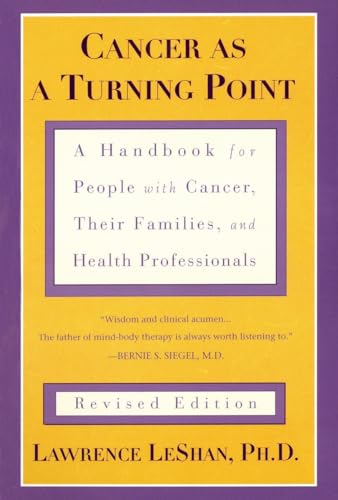
Cancer As a Turning Point: A Handbook for People with Cancer, Their Families, and Health Professionals - Revised Edition - Softcover
Inhaltsangabe
Psychotherapist Lawrence LeShan has worked with cancer patients for more than thirty-five years and his research has led people with cancer to find new, effective ways to fight for their lives. He has put his findings--full of meaning and purpose--into this revised edition that shows how psychological change, along with medical treatment, mobilizes a compromised immune system for healing. Included is a life-transforming workbook of hands-on exercises designed to help readers evaluate their inner selves and teach them how to get the most out of their immune systems by leading fuller, richer lives.
Die Inhaltsangabe kann sich auf eine andere Ausgabe dieses Titels beziehen.
Über die Autorin bzw. den Autor
Lawrence LeShan is a psychotherapist whose work has aided cancer patients for more than 35 years. He is the author of Cancer as a Turning Point, The Dilemma of Psychology, The Medium, the Mystic, and the Physicist, and You Can Fight for Your Life.
Auszug. © Genehmigter Nachdruck. Alle Rechte vorbehalten.
What kind of life would you be living if you adjusted the world to yourself instead of—as most patients generally have done—adjusting yourself to the world? What kind of life and lifestyle would make you glad to get up in the morning and glad to go to bed at night?
These are questions Dr. LeShan asks his patients in order to open their eyes, to make a difference in their lives—and their cancer treatment. His methods get impressive results: over the past thirty years, approximately half of his patients with poor prognoses have experienced long-term remission and are still alive. Nearly all dramatically improved their emotional state and quality of life. This revised edition of Dr. LeShan’s groundbreaking book shows how you can start to change your life for the better—right now.
LAWRENCE LESHAN, PH.D., has been a research and clinical psychologist for more than half a century. A graduate of William and Mary, he is the author of more than a dozen books, including You Can Fight for Your Life: Emotional Factors in the Treatment of Cancer and The Mechanic and the Gardener: How to Use the Holistic Revolution in Medicine.
ALSO BY LAWRENCE LESHAN
The Psychosomatic Aspects of Neoplastic Disease
(coedited with David Kissen)
Counseling the Dying
(with Jackson, Bowers, and Knight)
You Can Fight for Your Life: Emotional Factors
in the Treatment of Cancer
The Mechanic and the Gardener: How to Use
the Holistic Revolution in Medicine
How to Meditate
The Medium, the Mystic and the Physicist
Alternate Realities
The Science of the Paranormal:
The Last Frontier
Einstein’s Space and Van Gogh’s Sky
(with Henry Margenau)
The Dilemma of Psychology
The Psychology of War
LAWRENCE LESHAN, Ph.D.
CANCER
AS A
TURNING
POINT
A Handbook for People
with Cancer, Their Families,
and Health Professionals
REVISED EDITION
ACKNOWLEDGMENTS
I wish to express my deep gratitude to Frederick Ayer II for his long support of this work. Without him this book would not have been possible. I owe a profound debt to the people with cancer who taught me all that I know over these last thirty-five years. My appreciation also to the increasing number of therapists all over the world who are using this approach.
I’d also like to pay tribute to my wife, Eda LeShan, who shared the joys and pains of this adventure and whose contributions to this book are very great.
PREFACE TO THE
REVISED EDITION
The second edition of Cancer as a Turning Point has been revised to include a special section of paper and pencil exercises. These are ways to evaluate where you are now in your life and to find new ways in which you might wish to change. I suggest you read the first three chapters of the book, then the workbook and, as you read the rest of the book, start doing the workbook exercises according to their instructions. This has been a helpful process for many people. However, if you feel that a different procedure would be better for you (such as reading the entire book first), by all means follow it.
Little new material about research in the field has been added to this new edition. The reason for this is that the book’s primary purpose—to help individuals with cancer mobilize their own self-healing abilities and bring them to the aid of their medical program—is still as much on the cutting edge of our knowledge as it was when the book was first published in 1989. I have added a few new case histories that help to make clear that the critical change needed to stimulate the immune system is an inner change. There must be a change in one’s fundamental attitude toward oneself—toward a strong belief that you are worth fighting for and taking care of as a special, unique person with your own special ways of being, relating, and creating.
The best of the new research that has appeared in recent years has presented results pointing out that psychological factors do play a part in how and when people become sick and how their immune systems function when they are sick. Psychological factors are certainly only one part of the process—no one “makes themselves sick” by how they behave or feel. Other factors such as heredity and the physical environment play a major role as well. It is important to remember that you are not responsible for becoming ill, and you are not responsible for your recovery. What you are responsible for once you are ill is to do your best to get better. This means getting the best medical treatment possible and changing your life so that your inner healing abilities will be stimulated at the highest level possible. I wish you the best in this endeavor.
PREFACE
Those closely involved with cancer—patients, families, friends, health professionals—very rarely have information in one crucial area: how to mobilize the patient’s self-healing abilities and bring them to the aid of the medical program.
This state-of-the-art handbook gathers, for the first time in one place, the known information on this subject. The book comes out of a thirty-five-year research project involving several thousand people with cancer. It is designed to teach those with the illness and their families, friends, physicians, clergymen, and psychotherapists how to use psychological change to help heal the patient’s compromised immune system.
I believe a serious problem has arisen in recent years. Despite professional background in associated areas, some individuals have a very limited knowledge of the field and have interpreted this approach as one that blames the patient for the illness. They say that in addition to the anxiety and pain of cancer, a new guilt has been added—guilt arising from a false idea, guilt that is an intolerable load for the patient.
These critics talk complete nonsense. Thoughts and feelings do not cause cancer and cannot cure cancer. But they are one factor, and an important one, in the total ecology that makes up a human being. Feelings affect body chemistry (which affects the development or regression of a tumor), just as body chemistry affects feelings. The emerging science related to the nature of the immune system has merely reinforced the belief that certain kinds of stress lower the ability of the body’s chemistry to withstand disease. There is, as William James once remarked, no clear dividing line between a person’s philosophy and physiology, between mind and body. All the different aspects of a person interact with, and influence, each other.
What we have learned is that the immune system is strongly affected by feelings, and that taking certain kinds of psychological action can affect the immune system positively. Sometimes this makes a crucial difference in how well the medical program works. To put it in other words, there are certain psychological steps people with cancer can take to increase their self-healing and self-repair abilities and bring these more strongly to the aid of the medical program. Whether or not this will make a crucial difference in a patient’s return to health depends on the total situation, including such factors as genetic endowment and the life experiences the person has had since birth.
In this approach, the patient is not blamed in any way for the cancer. Anyone who even hints that the person with cancer is responsible for getting it and/or for not getting better is not only the rankest amateur and should be completely ignored, but is setting in motion confusion, anxiety, and anger at the self. And those who hint that this approach increases...
„Über diesen Titel“ kann sich auf eine andere Ausgabe dieses Titels beziehen.
Suchergebnisse für Cancer As a Turning Point: A Handbook for People with...

Beispielbild für diese ISBN
Cancer As a Turning Point: A H
Verlag:
Penguin Publishing Group, 1994
ISBN 10: 0452271371
ISBN 13: 9780452271371
Gebraucht
Softcover
Anbieter: World of Books (was SecondSale), Montgomery, IL, USA
Verkäuferbewertung 5 von 5 Sternen

Zustand: Good. Item in good condition. Textbooks may not include supplemental items i.e. CDs, access codes etc. Artikel-Nr. 00097745714
Gebraucht kaufen
EUR 3,89
Versand gratis
Versand innerhalb von USA
Versand innerhalb von USA
Anzahl: 6 verfügbar
Beispielbild für diese ISBN
Cancer As a Turning Point: A H
Verlag:
Penguin Publishing Group, 1994
ISBN 10: 0452271371
ISBN 13: 9780452271371
Gebraucht
Softcover
Anbieter: World of Books (was SecondSale), Montgomery, IL, USA
Verkäuferbewertung 5 von 5 Sternen
Zustand: Very Good. Item in very good condition! Textbooks may not include supplemental items i.e. CDs, access codes etc. Artikel-Nr. 00104698185
Gebraucht kaufen
EUR 3,89
Versand gratis
Versand innerhalb von USA
Versand innerhalb von USA
Anzahl: 4 verfügbar
Beispielbild für diese ISBN
Cancer As a Turning Point: A H
Verlag:
Penguin Publishing Group, 1994
ISBN 10: 0452271371
ISBN 13: 9780452271371
Gebraucht
Softcover
Anbieter: World of Books (was SecondSale), Montgomery, IL, USA
Verkäuferbewertung 5 von 5 Sternen
Zustand: Acceptable. Item in acceptable condition! Textbooks may not include supplemental items i.e. CDs, access codes etc. Artikel-Nr. 00106655396
Gebraucht kaufen
EUR 3,89
Versand gratis
Versand innerhalb von USA
Versand innerhalb von USA
Anzahl: 1 verfügbar
Beispielbild für diese ISBN
Cancer As a Turning Point: A Handbook for People with Cancer, Their Families, and Health Professionals - Revised Edition
Verlag:
Penguin Publishing Group, 1994
ISBN 10: 0452271371
ISBN 13: 9780452271371
Gebraucht
Paperback
Anbieter: ThriftBooks-Dallas, Dallas, TX, USA
Verkäuferbewertung 5 von 5 Sternen
Paperback. Zustand: Very Good. No Jacket. May have limited writing in cover pages. Pages are unmarked. ~ ThriftBooks: Read More, Spend Less. Artikel-Nr. G0452271371I4N00
Gebraucht kaufen
EUR 5,72
Versand gratis
Versand innerhalb von USA
Versand innerhalb von USA
Anzahl: 1 verfügbar
Beispielbild für diese ISBN
Cancer As a Turning Point: A Handbook for People with Cancer, Their Families, and Health Professionals - Revised Edition
Verlag:
Penguin Publishing Group, 1994
ISBN 10: 0452271371
ISBN 13: 9780452271371
Gebraucht
Paperback
Anbieter: ThriftBooks-Phoenix, Phoenix, AZ, USA
Verkäuferbewertung 5 von 5 Sternen
Paperback. Zustand: Very Good. No Jacket. May have limited writing in cover pages. Pages are unmarked. ~ ThriftBooks: Read More, Spend Less. Artikel-Nr. G0452271371I4N00
Gebraucht kaufen
EUR 5,72
Versand gratis
Versand innerhalb von USA
Versand innerhalb von USA
Anzahl: 1 verfügbar
Beispielbild für diese ISBN
Cancer As a Turning Point : A Handbook for People with Cancer, Their Families, and Health Professionals - Revised Edition
Verlag:
Penguin Publishing Group, 1994
ISBN 10: 0452271371
ISBN 13: 9780452271371
Gebraucht
Softcover
Anbieter: Better World Books: West, Reno, NV, USA
Verkäuferbewertung 5 von 5 Sternen
Zustand: Good. rev Edition. Pages intact with minimal writing/highlighting. The binding may be loose and creased. Dust jackets/supplements are not included. Stock photo provided. Product includes identifying sticker. Better World Books: Buy Books. Do Good. Artikel-Nr. GRP70581500
Gebraucht kaufen
EUR 5,93
Versand gratis
Versand innerhalb von USA
Versand innerhalb von USA
Anzahl: 1 verfügbar
Beispielbild für diese ISBN
Cancer As a Turning Point : A Handbook for People with Cancer, Their Families, and Health Professionals - Revised Edition
Verlag:
Penguin Publishing Group, 1994
ISBN 10: 0452271371
ISBN 13: 9780452271371
Gebraucht
Softcover
Anbieter: Better World Books, Mishawaka, IN, USA
Verkäuferbewertung 5 von 5 Sternen
Zustand: Good. rev Edition. Pages intact with minimal writing/highlighting. The binding may be loose and creased. Dust jackets/supplements are not included. Stock photo provided. Product includes identifying sticker. Better World Books: Buy Books. Do Good. Artikel-Nr. GRP70581500
Gebraucht kaufen
EUR 5,93
Versand gratis
Versand innerhalb von USA
Versand innerhalb von USA
Anzahl: 3 verfügbar
Beispielbild für diese ISBN
Cancer As a Turning Point: A Handbook for People with Cancer, Their Families, and Health Professionals
Verlag:
Penguin Publishing Group, 1994
ISBN 10: 0452271371
ISBN 13: 9780452271371
Gebraucht
Softcover
Anbieter: Wonder Book, Frederick, MD, USA
Verkäuferbewertung 5 von 5 Sternen
Zustand: Good. Good condition. Revised edition. With remainder mark. A copy that has been read but remains intact. May contain markings such as bookplates, stamps, limited notes and highlighting, or a few light stains. Artikel-Nr. E09L-00835
Gebraucht kaufen
EUR 6,16
Versand gratis
Versand innerhalb von USA
Versand innerhalb von USA
Anzahl: 2 verfügbar
Beispielbild für diese ISBN
Cancer As a Turning Point: A Handbook for People with Cancer, Their Families, and Health Professionals - Revised Edition
Verlag:
Penguin Publishing Group, 1994
ISBN 10: 0452271371
ISBN 13: 9780452271371
Gebraucht
paperback
Anbieter: Books From California, Simi Valley, CA, USA
Verkäuferbewertung 4 von 5 Sternen

paperback. Zustand: Very Good. Artikel-Nr. mon0004130483
Gebraucht kaufen
EUR 4,41
EUR 4,27 Versand
Versand innerhalb von USA
Versand innerhalb von USA
Anzahl: 1 verfügbar
Beispielbild für diese ISBN
Cancer As a Turning Point
Anbieter: AwesomeBooks, Wallingford, Vereinigtes Königreich
Verkäuferbewertung 5 von 5 Sternen
Paperback. Zustand: Very Good. Cancer As a Turning Point This book is in very good condition and will be shipped within 24 hours of ordering. The cover may have some limited signs of wear but the pages are clean, intact and the spine remains undamaged. This book has clearly been well maintained and looked after thus far. Money back guarantee if you are not satisfied. See all our books here, order more than 1 book and get discounted shipping. Artikel-Nr. 7719-9780452271371
Gebraucht kaufen
EUR 6,70
EUR 4,82 Versand
Versand von Vereinigtes Königreich nach USA
Versand von Vereinigtes Königreich nach USA
Anzahl: 2 verfügbar