
Inhaltsangabe
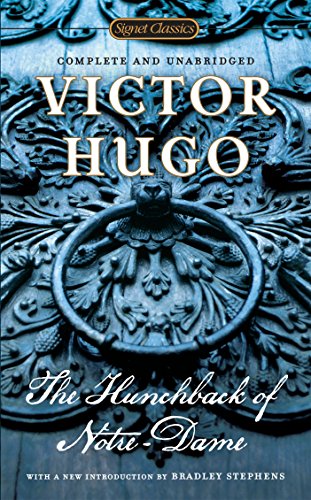
The complete and unabridged translation of Victor Hugo’s classic novel, The Hunchback of Notre Dame.
The setting of this extraordinary historical novel is medieval Paris: a city of vividly intermingled beauty and ugliness, surging with violent life under the two towers of its greatest structure and supreme symbol, the cathedral of Notre Dame.
Against this background, Victor Hugo unfolds the haunting drama of Quasimodo, the hunchback; Esmeralda, the gypsy dancer; and Claude Frollo, the priest tortured by the specter of his own damnation. Shaped by a profound sense of tragic irony, it is a work that gives full play to the author’s brilliant imagination and his remarkable powers of description.
Translated By Walter J. Cobb
With an Introduction by Bradley Stephens
And an Afterword by Graham Robb
Die Inhaltsangabe kann sich auf eine andere Ausgabe dieses Titels beziehen.
Über die Autorin bzw. den Autor
Born in 1802, the son of a high officer in Napoleon’s army, Victor Hugo spent his childhood against a background of military life in Elba, Corsica, Naples, and Madrid. After the Napoleonic defeat, the Hugo family settled in straitened circumstances in Paris, where, at the age of fifteen, Victor Hugo commenced his literary career with a poem submitted to a contest sponsored by the Académie Française. Twenty-four years later, Hugo was elected to the Académie, having helped revolutionize French literature with his poems, plays, and novels. Entering politics, he won a seat in the National Assembly in 1848; but in 1851, he was forced to flee the country because of his opposition to Louis Napoleon. In exile on the Isle of Guernsey, he became a symbol of French resistance to tyranny; upon his return to Paris after the Revolution of 1870, he was greeted as a national hero. He continued to serve in public life and to write with unabated vigor until his death in 1885. He was buried in the Pantheon with every honor the French nation could bestow.
Auszug. © Genehmigter Nachdruck. Alle Rechte vorbehalten.
Chapter One
The Great Hall of the Palace of Justice
ON JANUARY 6, 1482, the people of Paris were awakened by the tumultuous clanging of all the bells in the city. Yet history has kept no memory of this date, for there was nothing notable about the event which set in motion the bells and the citizens of Paris that morning. It was not an attack by the Picards or the Burgundians, a procession carrying the relics of some saint, an entry of "Our Most Dreaded Lord, Monsieur the King," nor even a good hanging of thieves.
Nor was it the arrival of some foreign ambassador and his train, all decked out in lace and feathers, a common sight in the fifteenth century. It had been scarcely two days since the latest cavalcade of this kind had paraded through the streets: the delegation of Flemish ambassadors sent to conclude the marriage between the Dauphin and Marguerite of Flanders. To his great annoyance, Cardinal de Bourbon, in order to please the king, had been obliged to give a gracious reception to that uncouth band of Flemish burgomasters and entertain them in his mansion.
The cause of all the commotion on the sixth of January was the double holiday of the Epiphany and the Festival of Fools, united since time immemorial. This year the celebration was to include a bonfire at the Place de Greve, a maypole dance at the Chapelle de Braque and the performance of a play in the Palace of Justice, all of which had been announced by public proclamation the day before. All shops were to remain closed for the holiday.
Early in the morning the crowd began streaming toward the three designated places, each person having decided on either the bonfire, the maypole or the play. It is a tribute to the ancient common sense of the people of Paris that the majority of the crowd went to either the bonfire, which was quite seasonable, or the play, which was to be performed in the shelter of the great hall of the palace, leaving the poor maypole to shiver beneath the January sky in the cemetery of the Chapelle de Braque.
The avenues leading to the Palace of Justice were particularly crowded because it was known that the Flemish ambassadors, who had arrived two days before, were planning to attend the play and the election of the Pope of Fools, which was also to be held in the palace.
It was not easy to get into the great hall that day, even though it was reputed at the time to be the largest single room in the world. To the spectators looking out of their windows, the square in front of the palace, packed solid with people, presented the appearance of a sea, with five or six streets flowing into it, constantly disgorging a stream of heads. The waves of this sea broke against the corners of the houses jutting out like promontories into the irregular basin of the square. Shouts, laughter and the shuffling of thousands of feet blended to produce a mighty uproar.
At the doors and windows and on the rooftops swarmed a myriad of sober, honest faces, looking at the palace and the crowd with placid contentment. Many Parisians still find deep satisfaction in watching people who are watching something; even a wall behind which something is happening is an object of great curiosity to them.
Let us now imagine that immense oblong hall inside the palace, illuminated by the pale light of a January day and invaded by a motley and noisy crowd pouring in along the walls and swirling around the seven great pillars. In the middle of the hall, high up and against one wall, an enclosed gallery had been erected for the Flemish ambassadors and the other important personages who had been invited to see the play. A private entrance opened into it through one of the windows.
At one end of the hall was the famous marble table, so long, wide and thick that "such a slab of marble has never been seen before on earth," as an old document puts it. The play was to be performed on this table, according to custom. It had been set up for that purpose early in the morning. A high wooden platform had been placed on it, the top of which was to serve as the stage. Tapestries hung around the sides formed a sort of dressing room for the actors underneath. A ladder, undisguisedly propped up against the outside of the platform, connected the dressing room and the stage and served for entrances and exits alike. Every actor, no matter how unexpected his appearance in the play, and every stage effect, had to come laboriously up that ladder in full view of the audience.
Four sergeants of the bailiff of the palace, whose duty was to keep order among the people at festivals as well as executions, stood at each corner of the huge marble table.
The play was not scheduled to begin until the great clock of the palace struck noon--quite late for a theatrical performance, but it had been necessary to arrange the hour to suit the convenience of the ambassadors.
Many of the people had been shivering before the steps of the palace since dawn and some declared they had spent the whole night huddled in the great doorway in order to make sure of being among the first to enter. The crowd was growing denser at every moment and, like a river overflowing its banks, it soon began to rise up the walls and spill over onto the cornices, architraves, window ledges and all other projecting features of the architecture. Discomfort, impatience, boredom, the freedom of a day of license, the quarrels constantly breaking out over a sharp elbow or a hobnailed shoe, the fatigue of a long wait--all this gave a tone of bitterness to the clamor of the people as they stood squeezed together, jostled, trampled on and almost smothered. The air was full of complaints and insults against the Flemings, Cardinal de Bourbon, the bailiff of the palace, the sergeants, the cold, the heat, the bad weather, the Bishop of Paris, the Pope of Fools, the pillars, the statues, this closed door, that open window; all to the great amusement of a band of students and lackeys who, scattered throughout the crowd, mixed in their jibes and sarcasm with all that dissatisfaction and thus goaded the general bad humor into becoming even worse.
Some of these merry demons had knocked the glass out of one of the windows and were boldly sitting in it. From there they were able to direct their bantering remarks both inside and outside, toward the crowd in the hall and the crowd in the square. From their mimicking gestures, their loud laughter and the ribald jokes they exchanged with their comrades from one end of the hall to the other, it was easy to see that they did not share the boredom and fatigue of the rest of the spectators and that they were able to extract enough entertainment from the scene spread out before their eyes to avoid being impatient for the scheduled performance to begin.
"My God, there's Jehan Frollo!" shouted one of them to a small blond young man with a handsome, mischievous face who was clinging to the carved foliage at the top of one of the pillars. "How long have you been here?"
"More than four hours, by the devil's mercy!" replied Jehan. "And I hope the time will be taken off my term in purgatory!"
Just then the clock struck noon.
"Ah!" said the whole crowd with satisfaction. The students became silent and there ensued a noisy shuffling of feet, a general craning of necks and a mighty explosion of coughing as each person stood up and placed himself in the best position to see the stage. Then there was silence. All heads were thrust forward, all mouths were open and all eyes were turned toward the great marble table. But nothing appeared on it. The four sergeants were still there, as stiff and motionless as four painted statues. The crowd looked up at the gallery reserved for the Flemish ambassadors. It was empty and the door leading into it remained...
„Über diesen Titel“ kann sich auf eine andere Ausgabe dieses Titels beziehen.
Weitere beliebte Ausgaben desselben Titels

Suchergebnisse für The Hunchback of Notre Dame

Beispielbild für diese ISBN
The Hunchback of Notre-Dame
Verlag:
Signet Book, 2010
ISBN 10: 0451531515
ISBN 13: 9780451531513
Gebraucht
Mass Market Paperback
Anbieter: ThriftBooks-Reno, Reno, NV, USA
Verkäuferbewertung 5 von 5 Sternen

Mass Market Paperback. Zustand: Good. No Jacket. Pages can have notes/highlighting. Spine may show signs of wear. ~ ThriftBooks: Read More, Spend Less. Artikel-Nr. G0451531515I3N00
Gebraucht kaufen
EUR 5,49
Versand gratis
Versand innerhalb von USA
Versand innerhalb von USA
Anzahl: 1 verfügbar
Beispielbild für diese ISBN
The Hunchback of Notre-Dame
Verlag:
Signet Book, 2010
ISBN 10: 0451531515
ISBN 13: 9780451531513
Gebraucht
Mass Market Paperback
Anbieter: ThriftBooks-Phoenix, Phoenix, AZ, USA
Verkäuferbewertung 5 von 5 Sternen
Mass Market Paperback. Zustand: Good. No Jacket. Pages can have notes/highlighting. Spine may show signs of wear. ~ ThriftBooks: Read More, Spend Less. Artikel-Nr. G0451531515I3N00
Gebraucht kaufen
EUR 5,49
Versand gratis
Versand innerhalb von USA
Versand innerhalb von USA
Anzahl: 1 verfügbar
Beispielbild für diese ISBN
The Hunchback of Notre-Dame
Verlag:
Signet Book, 2010
ISBN 10: 0451531515
ISBN 13: 9780451531513
Gebraucht
Mass Market Paperback
Anbieter: ThriftBooks-Dallas, Dallas, TX, USA
Verkäuferbewertung 5 von 5 Sternen
Mass Market Paperback. Zustand: Good. No Jacket. Former library book; Pages can have notes/highlighting. Spine may show signs of wear. ~ ThriftBooks: Read More, Spend Less. Artikel-Nr. G0451531515I3N10
Gebraucht kaufen
EUR 5,49
Versand gratis
Versand innerhalb von USA
Versand innerhalb von USA
Anzahl: 1 verfügbar
Beispielbild für diese ISBN
The Hunchback of Notre-Dame
Verlag:
Signet Book, 2010
ISBN 10: 0451531515
ISBN 13: 9780451531513
Gebraucht
Mass Market Paperback
Anbieter: ThriftBooks-Atlanta, AUSTELL, GA, USA
Verkäuferbewertung 5 von 5 Sternen
Mass Market Paperback. Zustand: Good. No Jacket. Pages can have notes/highlighting. Spine may show signs of wear. ~ ThriftBooks: Read More, Spend Less. Artikel-Nr. G0451531515I3N00
Gebraucht kaufen
EUR 5,49
Versand gratis
Versand innerhalb von USA
Versand innerhalb von USA
Anzahl: 2 verfügbar
Beispielbild für diese ISBN
The Hunchback of Notre-Dame
Verlag:
Signet Book, 2010
ISBN 10: 0451531515
ISBN 13: 9780451531513
Gebraucht
Mass Market Paperback
Anbieter: ThriftBooks-Dallas, Dallas, TX, USA
Verkäuferbewertung 5 von 5 Sternen
Mass Market Paperback. Zustand: Good. No Jacket. Pages can have notes/highlighting. Spine may show signs of wear. ~ ThriftBooks: Read More, Spend Less. Artikel-Nr. G0451531515I3N00
Gebraucht kaufen
EUR 5,49
Versand gratis
Versand innerhalb von USA
Versand innerhalb von USA
Anzahl: 2 verfügbar
Beispielbild für diese ISBN
The Hunchback of Notre Dame
Anbieter: World of Books (was SecondSale), Montgomery, IL, USA
Verkäuferbewertung 5 von 5 Sternen
Zustand: Good. Item in good condition. Textbooks may not include supplemental items i.e. CDs, access codes etc. Artikel-Nr. 00099702054
Gebraucht kaufen
EUR 5,62
Versand gratis
Versand innerhalb von USA
Versand innerhalb von USA
Anzahl: 3 verfügbar
Beispielbild für diese ISBN
The Hunchback of Notre Dame
Anbieter: World of Books (was SecondSale), Montgomery, IL, USA
Verkäuferbewertung 5 von 5 Sternen
Zustand: Acceptable. Item in acceptable condition! Textbooks may not include supplemental items i.e. CDs, access codes etc. Artikel-Nr. 00093926490
Gebraucht kaufen
EUR 5,62
Versand gratis
Versand innerhalb von USA
Versand innerhalb von USA
Anzahl: 1 verfügbar
Beispielbild für diese ISBN
The Hunchback of Notre Dame
Verlag:
Penguin Publishing Group, 2010
ISBN 10: 0451531515
ISBN 13: 9780451531513
Gebraucht
Softcover
Anbieter: Better World Books, Mishawaka, IN, USA
Verkäuferbewertung 5 von 5 Sternen
Zustand: Good. Pages intact with minimal writing/highlighting. The binding may be loose and creased. Dust jackets/supplements are not included. Stock photo provided. Product includes identifying sticker. Better World Books: Buy Books. Do Good. Artikel-Nr. 4019014-6
Gebraucht kaufen
EUR 7,40
Versand gratis
Versand innerhalb von USA
Versand innerhalb von USA
Anzahl: 1 verfügbar
Beispielbild für diese ISBN
The Hunchback of Notre Dame
Verlag:
Penguin Publishing Group, 2010
ISBN 10: 0451531515
ISBN 13: 9780451531513
Gebraucht
Softcover
Anbieter: Better World Books, Mishawaka, IN, USA
Verkäuferbewertung 5 von 5 Sternen
Zustand: Good. Former library copy. Pages intact with minimal writing/highlighting. The binding may be loose and creased. Dust jackets/supplements are not included. Includes library markings. Stock photo provided. Product includes identifying sticker. Better World Books: Buy Books. Do Good. Artikel-Nr. GRP102472089
Gebraucht kaufen
EUR 7,40
Versand gratis
Versand innerhalb von USA
Versand innerhalb von USA
Anzahl: 3 verfügbar
Beispielbild für diese ISBN
The Hunchback of Notre Dame
Anbieter: WorldofBooks, Goring-By-Sea, WS, Vereinigtes Königreich
Verkäuferbewertung 5 von 5 Sternen
Paperback. Zustand: Very Good. The book has been read, but is in excellent condition. Pages are intact and not marred by notes or highlighting. The spine remains undamaged. Artikel-Nr. GOR007631381
Gebraucht kaufen
EUR 3,03
EUR 9,01 Versand
Versand von Vereinigtes Königreich nach USA
Versand von Vereinigtes Königreich nach USA
Anzahl: 1 verfügbar