
Verwandte Artikel zu The Metamorphoses (Signet Classics)
Inhaltsangabe
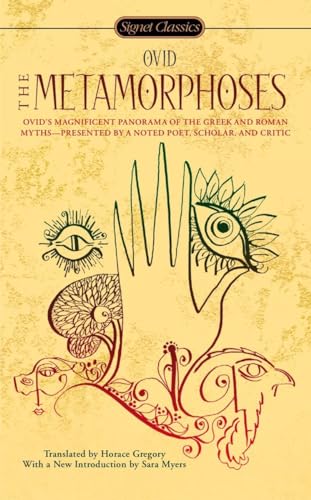
A masterpiece of Western culture, this is the first attempt to link all the Greek myths in a cohesive whole to the Roman myths of Ovid?s day. Horace Gregory, in this modern translation, turns his own poetic gifts toward a deft reconstruction of Ovid?s ancient themes.
Die Inhaltsangabe kann sich auf eine andere Ausgabe dieses Titels beziehen.
Über die Autorin bzw. den Autor
Ovid—Publius Ovidius Naso—(43 bce–ce 17 or 18) was born into a wealthy Roman family and became the most distinguished poet of his time. He died in exile on the Black Sea, far from Rome and his literary life.
Auszug. © Genehmigter Nachdruck. Alle Rechte vorbehalten.
Excerpted from the Introduction
THE POETRY OF THE AUGUSTAN AGE
Many periods in Rome’s long history produced great poets.From the end of the Republic in the mid-first century BC , we have Lucretius’s Epicurean masterpiece, On the Nature of Things, and the kaleidoscopic variety of Catullus’s oeuvre, ranging from the coarse obscenities of political epigram, through beautiful love lyrics, to the sophistication of epicizing mythological narrative. Nero (ruled AD 54 –68 ) had a high opinion of his own poetic talents, but they were quite eclipsed by the tragedies of his adviser, Seneca the Younger, and by the Civil War , the political epic of Seneca’s nephew, Lucan. The years before and after the richly deserved assassination of Domitian in AD 96 produced the stiletto wit of Martial’s epigrams and the powerful satires of Juvenal, as marvellously trenchant and memorable as they are intolerant and appalling. It is universally agreed, however, that the poetic achievements of no other period can stand comparison with those of the age of Augustus, the first emperor, who attained sole rule with his victory over Antony and Cleopatra at the Battle of Actium in 31 BC , and maintained it ever more firmly throughout his long reign – longer than that of any later emperor – eventually to die peacefully in his bed, a privilege enjoyed by very few of his rivals and enemies,
in AD 14 , at the age of seventy-five. In the 20 s BC , the literary salons controlled by Augustus’s chief political adviser, Maecenas, and by his military commander, Messalla Corvinus, provided a galaxy of great poets with a venue for the recitation of their latest works. Virgil had already established his reputation with his Eclogues , pastoral poetry in imitation of the third-century BC Sicilian Greek poet Theocritus, and with his Georgics , a didactic poem on farming in four books, modelled on theWorks and Days , composed in the eighth century BC by Hesiod, Greece’s earliest literate poet. He was now at work on his last and greatest poem, the Aeneid , an epic to rival both the Iliad and the Odyssey . Horace had published his Satires and Epodes in the 30 s, and was to publish the first three of his four books of Odes in 23 BC . Love elegy also flourished in this decade. The genre appears to have been invented by Cornelius Gallus, a friend of Virgil and one of Octavian/Augustus’s most trusted lieutenants. In the late 40 s and early 30 s, Gallus had written four books of elegies, now almost entirely lost. He is the only one of the great Augustan poets to suff er this misfortune, which must be connected to some extent with his fall from favour with Augustus as a resultof his arrogance as the first Roman governor of Egypt, behaviour which compelled him to commit suicide in 27 or 26 . Gallus’s genre, however, lived on and prospered, first with Tibullus and Propertius, both of whom will have started to compose at about the beginning of the decade, and then with Ovid, for it was with love elegy that he began his poetic career, perhaps in 26 or 25 BC , when he was seventeen or eighteen years old.
OVID’S OTHER POETRY
The Amores –Ovid’s earliest love poetry – follow the conventions laid down by his predecessors and older contemporaries, in that they are collections of poems recounting the vicissitudes of his relationship with his mistress. The elegies of both Tibullus and Propertius display a wide range of emotional levels, from the wittily whimsical to the passionately tragic, suggestive of the suff erings of the lover. Ovid, by contrast, achieves originality by narrowing the focus of his elegies very drastically, presenting
the misfortunes he endures in his persona as the elegiac lover in a consistently humorous manner that sometimes falls very little short of parody of the genre.
To give just one example of this approach: whereas Propertius tries to convince Cynthia that she has no need of expensive jewellery to enhance her natural charms, Ovid pushes this theme of beauty unadorned to ridiculous but logical limits: when Corinna quite unnecessarily dyes her gorgeous hair, the procedure goes wrong and now she is completely bald. Such exploitation of already established conventions was to be a hallmark of all of Ovid’s later poetry, and of the Metamorphoses in particular. One short elegy in the Amores might indeed be viewed as a prototype for the Metamorphoses . In 2 .15 , Ovid daydreams about how he would like to be transformed into the ring that he is sending as a gift to his mistress, for then he could always be with her. The fantasy ends abruptly when he says, with typical euphemism, that ‘if she wears me in the bath, my limbs will rise with lust’: Ovid the ring will react to the situation as if it were still Ovid the man. The Narcissus episode in Metamorphoses III is a nice illustration of the way in which he was to exploit these two typically Ovidian techniques, the deployment of conventional themes in unconventional contexts and the unusual perspective achieved, most often to witty effect, by splitting the personality and characteristics of the individual whose story is being narrated. Narcissus has fallen in love with his own reflection in a pool of water, and will remain at the water’s edge till he is transformed into the flower that bears his name. Ovid has adapted to the myth that most typical scenario in love elegy: the lover’s pleading for the door of his beloved’s house to be opened so that he may be with her. Narcissus is cast in the role not only of the lover, but also of the beloved, and the surface of the water represents the closed door. The same scenario recurs in the Metamorphoses in the tales of Pyramus and Thisbe, separated by the wall made famous by Shakespeare, and of Polyphemus and Galatea, separated by the sea. Love and the conventions of love elegy are never far away in the Metamorphoses .
There is little firm evidence about the chronology of Ovid’s poetry, but we should perhaps assume that he continued writing Amores poems for a decade or more, and that he was also engaged throughout much of this same period on his Heroides , letters from various mythological heroines to their absent husbands or lovers (e.g. Penelope to Ulysses, Dido to Aeneas), followed by a series of such pairs written between lovers (e.g. Paris and Helen). The Heroides transformed and extended the elegiac genre by casting mythological figures in the roles more familiarly played by the elegiac poets and their mistresses; for example, the exchange of letters between Helen and Paris focuses on the banquet given in Sparta in honour of Paris by Helen’s husband, Menelaus, reworking the scenario played out between the lover, his mistress, and her dull-witted husband in Amores 1 .4 and 2 .5 . The Amores generally make very little use of mythology, and it is the Heroides that foreshadow the wealth of such tales in the Metamorphoses .
Ovid devised a further development of the conventions of love elegy when he wrote his Art of Love , a didactic poem providing instructions on how to ensure success in love affairs; for example, the instructions which he gives to his mistress in Amores 1 .4 and 2 .5 on how to conduct herself at a banquet are turned into a general set of rules to be followed in such a context. The Art of Love would seem to have been planned initially as a two-book work, offering advice to men, but its success induced Ovid to add a third book, offering corresponding advice to women. He even managed yet another variation on the conventional themes of love elegy, when, as a corollary to the Art of Love , he...
„Über diesen Titel“ kann sich auf eine andere Ausgabe dieses Titels beziehen.
Suchergebnisse für The Metamorphoses (Signet Classics)

Beispielbild für diese ISBN
The Metamorphoses (Signet Classics)
Verlag:
Signet (edition Illustrated), 2009
ISBN 10: 0451531450
ISBN 13: 9780451531452
Gebraucht
Mass Market Paperback
Anbieter: BooksRun, Philadelphia, PA, USA
Verkäuferbewertung 5 von 5 Sternen

Mass Market Paperback. Zustand: Fair. Illustrated. The item might be beaten up but readable. May contain markings or highlighting, as well as stains, bent corners, or any other major defect, but the text is not obscured in any way. Artikel-Nr. 0451531450-7-1
Gebraucht kaufen
EUR 4,55
Versand gratis
Versand innerhalb von USA
Versand innerhalb von USA
Anzahl: 1 verfügbar
Beispielbild für diese ISBN
The Metamorphoses
Anbieter: World of Books (was SecondSale), Montgomery, IL, USA
Verkäuferbewertung 5 von 5 Sternen
Zustand: Fair. A masterpiece of Western culture, this is the first attempt to link all the Greek myths in a cohesive whole to the Roman myths of Ovid's day. Horace Gregory, in this modern translation, turns his own poetic gifts toward a deft reconstruction of Ovid's ancient themes. Artikel-Nr. 00094378455
Gebraucht kaufen
EUR 5,41
Versand gratis
Versand innerhalb von USA
Versand innerhalb von USA
Anzahl: 4 verfügbar
Beispielbild für diese ISBN
The Metamorphoses
Anbieter: World of Books (was SecondSale), Montgomery, IL, USA
Verkäuferbewertung 5 von 5 Sternen
Zustand: Good. A masterpiece of Western culture, this is the first attempt to link all the Greek myths in a cohesive whole to the Roman myths of Ovid's day. Horace Gregory, in this modern translation, turns his own poetic gifts toward a deft reconstruction of Ovid's ancient themes. Artikel-Nr. 00107808456
Gebraucht kaufen
EUR 5,41
Versand gratis
Versand innerhalb von USA
Versand innerhalb von USA
Anzahl: 2 verfügbar
Beispielbild für diese ISBN
The Metamorphoses
Verlag:
Signet Book, 2009
ISBN 10: 0451531450
ISBN 13: 9780451531452
Gebraucht
Mass Market Paperback
Anbieter: ThriftBooks-Reno, Reno, NV, USA
Verkäuferbewertung 5 von 5 Sternen
Mass Market Paperback. Zustand: Good. No Jacket. Pages can have notes/highlighting. Spine may show signs of wear. ~ ThriftBooks: Read More, Spend Less. Artikel-Nr. G0451531450I3N00
Gebraucht kaufen
EUR 6,03
Versand gratis
Versand innerhalb von USA
Versand innerhalb von USA
Anzahl: 1 verfügbar
Beispielbild für diese ISBN
The Metamorphoses
Verlag:
Signet Book, 2009
ISBN 10: 0451531450
ISBN 13: 9780451531452
Gebraucht
Mass Market Paperback
Anbieter: ThriftBooks-Atlanta, AUSTELL, GA, USA
Verkäuferbewertung 5 von 5 Sternen
Mass Market Paperback. Zustand: Good. No Jacket. Pages can have notes/highlighting. Spine may show signs of wear. ~ ThriftBooks: Read More, Spend Less. Artikel-Nr. G0451531450I3N00
Gebraucht kaufen
EUR 6,03
Versand gratis
Versand innerhalb von USA
Versand innerhalb von USA
Anzahl: 1 verfügbar
Beispielbild für diese ISBN
The Metamorphoses
Verlag:
Signet Book, 2009
ISBN 10: 0451531450
ISBN 13: 9780451531452
Gebraucht
Mass Market Paperback
Anbieter: ThriftBooks-Phoenix, Phoenix, AZ, USA
Verkäuferbewertung 5 von 5 Sternen
Mass Market Paperback. Zustand: Good. No Jacket. Former library book; Pages can have notes/highlighting. Spine may show signs of wear. ~ ThriftBooks: Read More, Spend Less. Artikel-Nr. G0451531450I3N10
Gebraucht kaufen
EUR 6,03
Versand gratis
Versand innerhalb von USA
Versand innerhalb von USA
Anzahl: 1 verfügbar
Beispielbild für diese ISBN
The Metamorphoses
Verlag:
Signet Book, 2009
ISBN 10: 0451531450
ISBN 13: 9780451531452
Gebraucht
Mass Market Paperback
Anbieter: ThriftBooks-Dallas, Dallas, TX, USA
Verkäuferbewertung 5 von 5 Sternen
Mass Market Paperback. Zustand: Good. No Jacket. Former library book; Pages can have notes/highlighting. Spine may show signs of wear. ~ ThriftBooks: Read More, Spend Less. Artikel-Nr. G0451531450I3N10
Gebraucht kaufen
EUR 6,03
Versand gratis
Versand innerhalb von USA
Versand innerhalb von USA
Anzahl: 1 verfügbar
Beispielbild für diese ISBN
The Metamorphoses
Verlag:
Signet Book, 2009
ISBN 10: 0451531450
ISBN 13: 9780451531452
Gebraucht
Mass Market Paperback
Anbieter: ThriftBooks-Dallas, Dallas, TX, USA
Verkäuferbewertung 5 von 5 Sternen
Mass Market Paperback. Zustand: Good. No Jacket. Pages can have notes/highlighting. Spine may show signs of wear. ~ ThriftBooks: Read More, Spend Less. Artikel-Nr. G0451531450I3N00
Gebraucht kaufen
EUR 6,03
Versand gratis
Versand innerhalb von USA
Versand innerhalb von USA
Anzahl: 1 verfügbar
Beispielbild für diese ISBN
The Metamorphoses
Verlag:
Signet Book, 2009
ISBN 10: 0451531450
ISBN 13: 9780451531452
Gebraucht
Mass Market Paperback
Anbieter: ThriftBooks-Dallas, Dallas, TX, USA
Verkäuferbewertung 5 von 5 Sternen
Mass Market Paperback. Zustand: Fair. No Jacket. Former library book; Readable copy. Pages may have considerable notes/highlighting. ~ ThriftBooks: Read More, Spend Less. Artikel-Nr. G0451531450I5N10
Gebraucht kaufen
EUR 6,03
Versand gratis
Versand innerhalb von USA
Versand innerhalb von USA
Anzahl: 1 verfügbar
Beispielbild für diese ISBN
The Metamorphoses
Verlag:
Signet Book, 2009
ISBN 10: 0451531450
ISBN 13: 9780451531452
Gebraucht
Mass Market Paperback
Anbieter: ThriftBooks-Atlanta, AUSTELL, GA, USA
Verkäuferbewertung 5 von 5 Sternen
Mass Market Paperback. Zustand: Fair. No Jacket. Readable copy. Pages may have considerable notes/highlighting. ~ ThriftBooks: Read More, Spend Less. Artikel-Nr. G0451531450I5N00
Gebraucht kaufen
EUR 6,03
Versand gratis
Versand innerhalb von USA
Versand innerhalb von USA
Anzahl: 1 verfügbar