
Verwandte Artikel zu Main Street (Signet Classics)
Inhaltsangabe
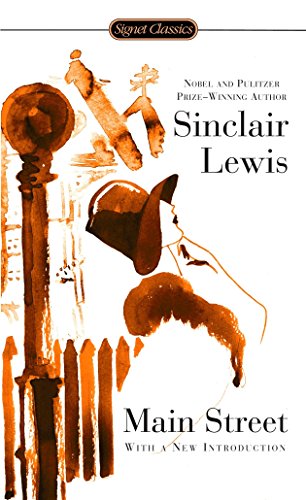
The first of Sinclair Lewis’s great successes, Main Street shattered the sentimental American myth of happy small-town life with its satire of narrow-minded provincialism. Reflecting his own unhappy childhood in Sauk Centre, Minnesota, Lewis’s sixth novel attacked the conformity and dullness he saw in midwestern village life. Young college graduate Carol Milford moves from the city to tiny Gopher Prairie after marrying the local doctor, and tries to bring culture to the small town. But her efforts to reform the prairie village are met by a wall of gossip, greed, conventionality, pitifully unambitious cultural endeavors, and—worst of all—the pettiness and bigotry of small-town minds.
Lewis’s portrayal of a marriage torn by disillusionment and a woman forced into compromises is at once devastating social satire and persuasive realism. His subtle characterizations and intimate details of small-town America make Main Street a complex and compelling work and established Lewis as an important figure in twentieth-century American literature.
Die Inhaltsangabe kann sich auf eine andere Ausgabe dieses Titels beziehen.
Über die Autorin bzw. den Autor
Sinclair Lewis was born in 1885 in Sauk Centre, Minnesota, and graduated from Yale University in 1908. His college career was interrupted by various part-time occupations, including a period working at the Helicon Home Colony, Upton Sinclair’s socialist experiment in New Jersey. He worked for some years as a free lance editor and journalist, during which time he published several minor novels. But with the publication of Main Street (1920), which sold half a million copies, he achieved wide recognition. This was followed by the two novels considered by many to be his finest, Babbitt (1922) and Arrowsmith (1925), which was awarded the Pulitzer Prize in 1926, but declined by Lewis. In 1930, following Elmer Gantry (1927) and Dodsworth (1929), Sinclair Lewis became the first American author to be awarded the Nobel Prize for distinction in world literature. This was the apogee of his literary career, and in the period from Ann Vickers (1933) to the posthumously published World So Wide (1951) Lewis wrote ten novels that reveal the progressive decline of his creative powers. From Main Street to Stockholm, a collection of his letters, was published in 1952, and The Man from Main Street, a collection of essays, in 1953. During his last years Sinclair Lewis wandered extensively in Europe, and after his death in Rome in 1951 his ashes were returned to his birthplace.
Auszug. © Genehmigter Nachdruck. Alle Rechte vorbehalten.
Chapter One
ON A hill by the Mississippi where Chippewas camped two generations ago, a girl stood in relief against the cornflower blue of Northern sky. She saw no Indians now; she saw flour-mills and the blinking windows of skyscrapers in Minneapolis and St. Paul. Nor was she thinking of squaws and portages, and the Yankee fur-traders whose shadows were all about her. She was meditating upon walnut fudge, the plays of Brieux, the reasons why heels run over, and the fact that the chemistry instructor had stared at the new coiffure which concealed her ears.
A breeze which had crossed a thousand miles of wheatlands bellied her taffeta skirt in a line so graceful, so full of animation and moving beauty, that the heart of a chance watcher on the lower road tightened to wistfulness over her quality of suspended freedom. She lifted her arms, she leaned back against the wind, her skirt dipped and flared, a lock blew wild. A girl on a hilltop; credulous, plastic, young; drinking the air as she longed to drink life. The eternal aching comedy of expectant youth.
It is Carol Milford, fleeing for an hour from Blodgett College.
The days of pioneering, of lassies in sunbonnets, and bears killed with axes in piney clearings, are deader now than Camelot; and a rebellious girl is the spirit of that bewildered empire called the American Middlewest.
Chapter Two
Blodgett College is on the edge of Minneapolis. It is a bulwark of sound religion. It is still combating the recent heresies of Voltaire, Darwin, and Robert Ingersoll. Pious families in Minnesota, Iowa, Wisconsin, the Dakotas send their children thither, and Blodgett protects them from the wickedness of the universities. But it secretes friendly girls, young men who sing, and one lady instructress who really likes Milton and Carlyle. So the four years which Carol spent at Blodgett were not altogether wasted. The smallness of the school, the fewness of rivals, permitted her to experiment with her perilous versatility. She played tennis, gave chafing-dish parties, took a graduate seminar in the drama, went “twosing,” and joined half a dozen societies for the practise of the arts or the tense stalking of a thing called General Culture.
In her class there were two or three prettier girls but none more eager. She was noticeable equally in the classroom grind and at dances, though out of the three hundred students of Blodgett, scores recited more accurately and dozens Bostoned more smoothly. Every cell of her body was alive—thin wrists, quince-blossom skin, ingénue eyes, black hair.
The other girls in her dormitory marveled at the slightness of her body when they saw her in sheer negligée, or darting out wet from a shower-bath. She seemed then but half as large as they had supposed; a fragile child who must be cloaked with understanding kindness. “Psychic,” the girls whispered, and “spiritual.” Yet so radioactive were her nerves, so adventurous her trust in rather vaguely conceived sweetness and light, that she was more energetic than any of the hulking young women who, with calves bulging in heavy-ribbed woolen stockings beneath decorous blue serge bloomers, thuddingly galloped across the floor of the “gym” in practice for the Blodgett Ladies’ Basket-Ball Team.
Even when she was tired her dark eyes were observant. She did not yet know the immense ability of the world to be casually cruel and proudly dull, but if she should ever learn those dismaying powers, her eyes would never become sullen or heavy or rheumily amorous.
For all her enthusiasms, for all the fondness and the “crushes” which she inspired, Carol’s acquaintances were shy of her. When she was most ardently singing hymns or planning deviltry she yet seemed gently aloof and critical. She was credulous, perhaps; a born hero-worshipper; yet she did question and examine unceasingly. Whatever she might become she would never be static.
Her versatility ensnared her. By turns she hoped to discover that she had an unusual voice, a talent for the piano, the ability to act, to write, to manage organizations. Always she was disappointed, but always she effervesced anew—over the Student Volunteers, who intended to become missionaries, over painting scenery for the dramatic club, over soliciting advertisements for the college magazine.
She was on the peak that Sunday afternoon when she played in chapel. Out of the dusk her violin took up the organ theme, and the candle-light revealed her in a straight golden frock, her arm arched to the bow, her lips serious. Every man fell in love then with religion and Carol.
Throughout Senior year she anxiously related all her experiments and partial successes to a career. Daily, on the library steps or in the hall of the Main Building, the co-eds talked of “What shall we do when we finish college?” Even the girls who knew that they were going to be married pretended to be considering important business positions; even they who knew that they would have to work hinted about fabulous suitors. As for Carol, she was an orphan; her only near relative was a vanilla-flavored sister married to an optician in St. Paul. She had used most of the money from her father’s estate. She was not in love—that is, not often, nor ever long at a time. She would earn her living.
But how she was to earn it, how she was to conquer the world—almost entirely for the world’s own good—she did not see. Most of the girls who were not betrothed meant to be teachers. Of these there were two sorts: careless young women who admitted that they intended to leave the “beastly classroom and grubby children” the minute they had a chance to marry; and studious, sometimes bulbous-browed and pop-eyed maidens who at class prayer-meetings requested God to “guide their feet along the paths of greatest usefulness.” Neither sort tempted Carol. The former seemed insincere (a favorite word of hers at this era). The earnest virgins were, she fancied, as likely to do harm as to do good by their faith in the value of parsing Caesar.
At various times during Senior year Carol finally decided upon studying law, writing motion-pictures scenarios, professional nursing, and marrying an unidentified hero.
Then she found a hobby in sociology.
The sociology instructor was new. He was married, and therefore taboo, but he had come from Boston, he had lived among poets and socialists and Jews and millionaire uplifters at the University Settlement in New York, and he had a beautiful white strong neck. He led a giggling class through the prisons, the charity bureaus, the employment agencies of Minneapolis and St. Paul. Trailing at the end of the line Carol was indignant at the prodding curiosity of the others, their manner of staring at the poor as at a Zoo. She felt herself a great liberator. She put her hand to her mouth, her forefinger and thumb quite painfully pinching her lower lip, and frowned, and enjoyed being aloof.
A classmate named Stewart Snyder, a competent bulky young man in a gray flannel shirt, a rusty black bow tie, and the green-and-purple class cap, grumbled to her as they walked behind the others in the muck of the South St. Paul stockyards, “These college chumps make me tired. They’re so top-lofty. They ought to of worked on the farm, the way I have. These workmen put it all over them.”
“I just love common workmen,” glowed Carol.
“Only you don’t want to forget that common workmen don’t think they’re common!”
“You’re right! I apologize!” Carol’s brows lifted in the astonishment of emotion, in a glory of abasement. Her eyes mothered the world. Stewart Snyder peered at her. He...
„Über diesen Titel“ kann sich auf eine andere Ausgabe dieses Titels beziehen.
Suchergebnisse für Main Street (Signet Classics)

Beispielbild für diese ISBN
Main Street
Anbieter: World of Books (was SecondSale), Montgomery, IL, USA
Verkäuferbewertung 5 von 5 Sternen

Zustand: Fair. The first of Sinclair Lewis's great successes, Main Street shattered the sentimental American myth of happy small-town life with its satire of narrow-minded provincialism. Reflecting his own unhappy childhood in Sauk Centre, Minnesota, Lewis's sixth novel attacked the conformity and dullness he saw in midwestern village life. Young college graduate Carol Milford moves from the city to tiny Gopher Prairie after marrying the local doctor, and tries to bring culture to the small town. But her efforts to reform the prairie village are met by a wall of gossip, greed, conventionality, pitifully unambitious cultural endeavors, and--worst of all--the pettiness and bigotry of small-town minds. Lewis's portrayal of a marriage torn by disillusionment and a woman forced into compromises is at once devastating social satire and persuasive realism. His subtle characterizations and intimate details of small-town America make Main Street a complex and compelling work and established Lewis as an important figure in twentieth-century American literature. Artikel-Nr. 00100960311
Gebraucht kaufen
EUR 5,20
Versand gratis
Versand innerhalb von USA
Versand innerhalb von USA
Anzahl: 1 verfügbar
Beispielbild für diese ISBN
Main Street
Verlag:
Signet Book, 2008
ISBN 10: 0451530985
ISBN 13: 9780451530981
Gebraucht
Mass Market Paperback
Anbieter: ThriftBooks-Phoenix, Phoenix, AZ, USA
Verkäuferbewertung 5 von 5 Sternen
Mass Market Paperback. Zustand: Fair. No Jacket. Readable copy. Pages may have considerable notes/highlighting. ~ ThriftBooks: Read More, Spend Less. Artikel-Nr. G0451530985I5N00
Gebraucht kaufen
EUR 5,96
Versand gratis
Versand innerhalb von USA
Versand innerhalb von USA
Anzahl: 1 verfügbar
Beispielbild für diese ISBN
Main Street
Verlag:
Signet Book, 2008
ISBN 10: 0451530985
ISBN 13: 9780451530981
Gebraucht
Mass Market Paperback
Anbieter: ThriftBooks-Atlanta, AUSTELL, GA, USA
Verkäuferbewertung 5 von 5 Sternen
Mass Market Paperback. Zustand: Fair. No Jacket. Former library book; Readable copy. Pages may have considerable notes/highlighting. ~ ThriftBooks: Read More, Spend Less. Artikel-Nr. G0451530985I5N10
Gebraucht kaufen
EUR 5,96
Versand gratis
Versand innerhalb von USA
Versand innerhalb von USA
Anzahl: 1 verfügbar
Beispielbild für diese ISBN
Main Street
Verlag:
Signet Book, 2008
ISBN 10: 0451530985
ISBN 13: 9780451530981
Gebraucht
Mass Market Paperback
Anbieter: ThriftBooks-Dallas, Dallas, TX, USA
Verkäuferbewertung 5 von 5 Sternen
Mass Market Paperback. Zustand: Fair. No Jacket. Readable copy. Pages may have considerable notes/highlighting. ~ ThriftBooks: Read More, Spend Less. Artikel-Nr. G0451530985I5N00
Gebraucht kaufen
EUR 5,96
Versand gratis
Versand innerhalb von USA
Versand innerhalb von USA
Anzahl: 1 verfügbar
Beispielbild für diese ISBN
Main Street
Verlag:
Signet Book, 2008
ISBN 10: 0451530985
ISBN 13: 9780451530981
Gebraucht
Mass Market Paperback
Anbieter: ThriftBooks-Reno, Reno, NV, USA
Verkäuferbewertung 5 von 5 Sternen
Mass Market Paperback. Zustand: Fair. No Jacket. Readable copy. Pages may have considerable notes/highlighting. ~ ThriftBooks: Read More, Spend Less. Artikel-Nr. G0451530985I5N00
Gebraucht kaufen
EUR 5,96
Versand gratis
Versand innerhalb von USA
Versand innerhalb von USA
Anzahl: 1 verfügbar
Beispielbild für diese ISBN
Main Street
Verlag:
Penguin Publishing Group, 2008
ISBN 10: 0451530985
ISBN 13: 9780451530981
Gebraucht
Softcover
Anbieter: Better World Books, Mishawaka, IN, USA
Verkäuferbewertung 5 von 5 Sternen
Zustand: Good. Pages intact with minimal writing/highlighting. The binding may be loose and creased. Dust jackets/supplements are not included. Stock photo provided. Product includes identifying sticker. Better World Books: Buy Books. Do Good. Artikel-Nr. 4773216-6
Gebraucht kaufen
EUR 8,35
Versand gratis
Versand innerhalb von USA
Versand innerhalb von USA
Anzahl: 3 verfügbar
Beispielbild für diese ISBN
Main Street
Verlag:
Penguin Publishing Group, 2008
ISBN 10: 0451530985
ISBN 13: 9780451530981
Gebraucht
Softcover
Anbieter: Better World Books: West, Reno, NV, USA
Verkäuferbewertung 5 von 5 Sternen
Zustand: Good. Former library copy. Pages intact with minimal writing/highlighting. The binding may be loose and creased. Dust jackets/supplements are not included. Includes library markings. Stock photo provided. Product includes identifying sticker. Better World Books: Buy Books. Do Good. Artikel-Nr. GRP91860098
Gebraucht kaufen
EUR 8,35
Versand gratis
Versand innerhalb von USA
Versand innerhalb von USA
Anzahl: 1 verfügbar
Beispielbild für diese ISBN
Main Street
Verlag:
Penguin Publishing Group, 2008
ISBN 10: 0451530985
ISBN 13: 9780451530981
Gebraucht
Softcover
Anbieter: Better World Books, Mishawaka, IN, USA
Verkäuferbewertung 5 von 5 Sternen
Zustand: Very Good. Former library copy. Pages intact with possible writing/highlighting. Binding strong with minor wear. Dust jackets/supplements may not be included. Includes library markings. Stock photo provided. Product includes identifying sticker. Better World Books: Buy Books. Do Good. Artikel-Nr. 8808794-6
Gebraucht kaufen
EUR 8,35
Versand gratis
Versand innerhalb von USA
Versand innerhalb von USA
Anzahl: 6 verfügbar
Beispielbild für diese ISBN
Main Street
Verlag:
Penguin Publishing Group, 2008
ISBN 10: 0451530985
ISBN 13: 9780451530981
Gebraucht
Softcover
Anbieter: Better World Books, Mishawaka, IN, USA
Verkäuferbewertung 5 von 5 Sternen
Zustand: Good. Former library copy. Pages intact with minimal writing/highlighting. The binding may be loose and creased. Dust jackets/supplements are not included. Includes library markings. Stock photo provided. Product includes identifying sticker. Better World Books: Buy Books. Do Good. Artikel-Nr. GRP91860098
Gebraucht kaufen
EUR 8,35
Versand gratis
Versand innerhalb von USA
Versand innerhalb von USA
Anzahl: 2 verfügbar
Beispielbild für diese ISBN
Main Street (Signet Classics)
Anbieter: Eagle Eye Books, Decatur, GA, USA
Verkäuferbewertung 4 von 5 Sternen

Trade. Zustand: New. Artikel-Nr. 864688