
Verwandte Artikel zu How to Think: A Survival Guide for a World at Odds
Inhaltsangabe
"Absolutely splendid . . . essential for understanding why there is so much bad thinking in political life right now." —David Brooks, New York Times
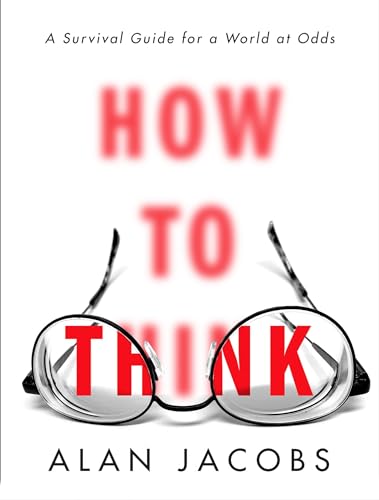
How to Think is a contrarian treatise on why we’re not as good at thinking as we assume—but how recovering this lost art can rescue our inner lives from the chaos of modern life.
As a celebrated cultural critic and a writer for national publications like The Atlantic and Harper’s, Alan Jacobs has spent his adult life belonging to communities that often clash in America’s culture wars. And in his years of confronting the big issues that divide us—political, social, religious—Jacobs has learned that many of our fiercest disputes occur not because we’re doomed to be divided, but because the people involved simply aren’t thinking.
Most of us don’t want to think. Thinking is trouble. Thinking can force us out of familiar, comforting habits, and it can complicate our relationships with like-minded friends. Finally, thinking is slow, and that’s a problem when our habits of consuming information (mostly online) leave us lost in the spin cycle of social media, partisan bickering, and confirmation bias.
In this smart, endlessly entertaining book, Jacobs diagnoses the many forces that act on us to prevent thinking—forces that have only worsened in the age of Twitter, “alternative facts,” and information overload—and he also dispels the many myths we hold about what it means to think well. (For example: It’s impossible to “think for yourself.”)
Drawing on sources as far-flung as novelist Marilynne Robinson, basketball legend Wilt Chamberlain, British philosopher John Stuart Mill, and Christian theologian C.S. Lewis, Jacobs digs into the nuts and bolts of the cognitive process, offering hope that each of us can reclaim our mental lives from the impediments that plague us all. Because if we can learn to think together, maybe we can learn to live together, too.
Die Inhaltsangabe kann sich auf eine andere Ausgabe dieses Titels beziehen.
Über die Autorin bzw. den Autor
Alan Jacobs is Distinguished Professor of the Humanities in the Honors Program of Baylor University. Before that, he taught for many years at Wheaton College in Illinois. He writes for publications like The Atlantic, Harper’s, First Things, Books & Culture, the Christian Century, and the Wall Street Journal, and maintains a blog at the New Atlantis.
Auszug. © Genehmigter Nachdruck. Alle Rechte vorbehalten.
One
Beginning to Think
Why it wouldn’t be a good idea to think for yourself, even if you could
A few years ago Megan Phelps-Roper, a member of Westboro Baptist Church in Topeka, Kansas, a church founded by her grandfather Fred Phelps, decided to start using Twitter to spread the Westboro message. That message might be summed up by the statement most closely associated with WBC: God Hates Fags. (The church registered the URL godhatesfags.com all the way back in 1994.) As Adrian Chen reports in his New Yorker profile of Phelps-Roper, Twitter was a perfect venue for getting this kind of message across, thus this typical Phelps-Roper tweet: “Thank God for AIDS! You won’t repent of your rebellion that brought His wrath on you in this incurable scourge, so expect more & worse!”
But there was something Phelps-Roper didn’t anticipate: on Twitter, people talk back to you. When she began tweeting at a Jewish web developer named David Abitbol—“Oh & @jewlicious? Your dead rote rituals == true repentance. We know the diff. Rev. 3:9 You keep promoting sin, which belies the ugly truth”—Abitbol responded with bemused humor. He would later comment that “I wanted to be like really nice so that they would have a hard time hating me.” This kind of response threw Phelps-Roper off-balance. As she later told Adrian Chen, “I knew he was evil, but he was friendly, so I was especially wary, because you don’t want to be seduced away from the truth by a crafty deceiver.”
We’re probably all subject to what the literary critic Gary Saul Morson calls “backshadowing”—“foreshadowing after the fact,” that is, the temptation to believe that we can look into the past and discern some point at which the present became inevitable. (“I should have seen it coming!”) But it’s hard not to think that by engaging with Abitbol in a friendly way Phelps-Roper had already set off down the road that would lead her away from Westboro Baptist Church. She started responding to others who shared Abitbol’s skepticism about her beliefs, and some of them also proved funny, or interesting, or kind. She told Chen, “I was beginning to see them as human,” instead of as the faceless RCO.
But it was the relationship with Abitbol—they even met in person, ironically enough, when Phelps-Roper picketed a gathering that Abitbol had helped to organize—that mattered more than any other. And that relationship became so decisive for Phelps-Roper largely because Abitbol took the trouble to look into what Westboro members believed and why they believed it. They claimed to base their views that homosexuality should be punished by death on the Bible, particularly Leviticus 20:13: “If a man lies with a male as with a woman, both of them have committed an abomination; they shall surely be put to death; their blood is upon them.” But wait a minute, Abitbol said: Didn’t Jesus say, when a woman was found to have committed adultery, that the “one without sin” should cast the first stone at her? And, by the way, didn’t Megan’s own mother have an illegitimate son, the product of an affair she had had in law school? Shouldn’t she “surely be put to death”?
Phelps-Roper knew, and deployed, the standard Westboro response: that gays and lesbians attended Gay Pride parades—they were proud of their sins—whereas her mother had repented. To which Abitbol replied: How can gays and lesbians ever repent if you kill them?
To this Phelps-Roper had no ready answer, and when she asked leaders of Westboro, they had none either. Phelps-Roper had already realized that believing in the Bible didn’t necessarily require her to perform the hostility that most members of Westboro exemplified. (When questioned about her friendliness to unbelievers she replied by citing Proverbs 25:15. “By long forbearing is a prince persuaded, and a soft tongue breaketh the bone.”) But now Abitbol was asking deeper and harder questions, not about whether the Bible was true, but rather about whether her community really bothered to discern and obey what they claimed was their supreme authority in all matters.
Phelps-Roper’s response to this crisis in her mental history is fascinating and extremely telling. She took two actions. First, while she continued to go picketing with other Westboro members, she stopped carrying the signs that read “DEATH PENALTY FOR FAGS”; and second, she ceased her correspondence with David Abitbol.
This twofold response perfectly embodies the mental state of the person who has begun to think. She didn’t leave the church, she didn’t stop picketing; but she drew a line in her own mind that had the inevitable effect of separating her, to some degree, from the community which until that point had given meaning to her whole life.
Which helps to explain why she took the second step: ending communication with Abitbol. On some level, if not consciously, Phelps-Roper had to have known that that one issue—DEATH PENALTY FOR FAGS—was unlikely to be the end of the story. If Westboro was wrong about that, then what else might they be wrong about? If the answer turned out to be “a lot,” then the result could be exile from the only world she had ever known, the only belonging she had ever experienced. So she closed the door from which she perceived the greatest threat.
But it was too late; and there were many other doors, as long as she engaged with different sorts of people online. In the end exile was Megan Phelps-Roper’s fate.
Losing a Place in the World
Stories of forbidden knowledge come in many varieties, but in our time this is one of the more common: the tale of a community that provides security in exchange for thought, and the courageous member of that community who, daring to think, sacrifices the security. It’s the Enlightenment—whose rallying cry is, Immanuel Kant said, Sapere aude!—dare to think, dare to be wise—writ small and writ in a hundred ways. Perhaps the canonical example today is Lois Lowry’s The Giver, that favorite of middle school teachers everywhere, with its rather blunt leading metaphor of moving from the monochromaticism of the protagonist’s little world to the Technicolor variety of the world outside. A more complex treatment of the theme may be found in Aldous Huxley’s Brave New World, where one of the major characters, Bernard Marx, sees through the stultifying conformity of his society but does so not through audacity but through psychological maladjustment.
But when I think of Megan Phelps-Roper, whose story isn’t finished yet, whose final verdict on her upbringing in Westboro Baptist Church has not been made and may never be made definitively, the story that comes to my mind is Ursula K. Le Guin’s “The Ones Who Walk Away from Omelas.” Le Guin tells us of a utopia built on a single (but perpetual) act of cruelty, and of those who, once they face that cruelty, find that they can no longer dwell within their perfect city. But Le Guin does not tell us of the beautiful Technicolor world that they enter when they leave Omelas; nor does she describe anything like the Savage Reservation that Huxley offers as a radical counterpart to the mainstream society of his drug-fueled “brave new world.” Rather, she gives us this:
They leave Omelas, they walk ahead into the darkness, and they do not come back. The place they go towards is a place even less imaginable to most of us than the...
„Über diesen Titel“ kann sich auf eine andere Ausgabe dieses Titels beziehen.
Suchergebnisse für How to Think: A Survival Guide for a World at Odds

Beispielbild für diese ISBN
How to Think: A Survival Guide for a World at Odds
Anbieter: World of Books (was SecondSale), Montgomery, IL, USA
Verkäuferbewertung 5 von 5 Sternen

Hardback. Zustand: Good. "Absolutely splendid . . . essential for understanding why there is so much bad thinking in political life right now." --David Brooks, New York Times How to Think is a contrarian treatise on why we're not as good at thinking as we assume--but how recovering this lost art can rescue our inner lives from the chaos of modern life. As a celebrated cultural critic and a writer for national publications like The Atlantic and Harper's, Alan Jacobs has spent his adult life belonging to communities that often clash in America's culture wars. And in his years of confronting the big issues that divide us--political, social, religious--Jacobs has learned that many of our fiercest disputes occur not because we're doomed to be divided, but because the people involved simply aren't thinking. Most of us don't want to think. Thinking is trouble. Thinking can force us out of familiar, comforting habits, and it can complicate our relationships with like-minded friends. Finally, thinking is slow, and that's a problem when our habits of consuming information (mostly online) leave us lost in the spin cycle of social media, partisan bickering, and confirmation bias. In this smart, endlessly entertaining book, Jacobs diagnoses the many forces that act on us to prevent thinking--forces that have only worsened in the age of Twitter, "alternative facts," and information overload--and he also dispels the many myths we hold about what it means to think well. (For example: It's impossible to "think for yourself.") Drawing on sources as far-flung as novelist Marilynne Robinson, basketball legend Wilt Chamberlain, British philosopher John Stuart Mill, and Christian theologian C.S. Lewis, Jacobs digs into the nuts and bolts of the cognitive process, offering hope that each of us can reclaim our mental lives from the impediments that plague us all. Because if we can learn to think together, maybe we can learn to live together, too. Artikel-Nr. 00109078991
Gebraucht kaufen
EUR 6,04
Versand gratis
Versand innerhalb von USA
Versand innerhalb von USA
Anzahl: 8 verfügbar
Beispielbild für diese ISBN
How to Think: A Survival Guide for a World at Odds
Anbieter: World of Books (was SecondSale), Montgomery, IL, USA
Verkäuferbewertung 5 von 5 Sternen
Hardback. Zustand: Very Good. "Absolutely splendid . . . essential for understanding why there is so much bad thinking in political life right now." --David Brooks, New York Times How to Think is a contrarian treatise on why we're not as good at thinking as we assume--but how recovering this lost art can rescue our inner lives from the chaos of modern life. As a celebrated cultural critic and a writer for national publications like The Atlantic and Harper's, Alan Jacobs has spent his adult life belonging to communities that often clash in America's culture wars. And in his years of confronting the big issues that divide us--political, social, religious--Jacobs has learned that many of our fiercest disputes occur not because we're doomed to be divided, but because the people involved simply aren't thinking. Most of us don't want to think. Thinking is trouble. Thinking can force us out of familiar, comforting habits, and it can complicate our relationships with like-minded friends. Finally, thinking is slow, and that's a problem when our habits of consuming information (mostly online) leave us lost in the spin cycle of social media, partisan bickering, and confirmation bias. In this smart, endlessly entertaining book, Jacobs diagnoses the many forces that act on us to prevent thinking--forces that have only worsened in the age of Twitter, "alternative facts," and information overload--and he also dispels the many myths we hold about what it means to think well. (For example: It's impossible to "think for yourself.") Drawing on sources as far-flung as novelist Marilynne Robinson, basketball legend Wilt Chamberlain, British philosopher John Stuart Mill, and Christian theologian C.S. Lewis, Jacobs digs into the nuts and bolts of the cognitive process, offering hope that each of us can reclaim our mental lives from the impediments that plague us all. Because if we can learn to think together, maybe we can learn to live together, too. Artikel-Nr. 00109994567
Gebraucht kaufen
EUR 6,04
Versand gratis
Versand innerhalb von USA
Versand innerhalb von USA
Anzahl: 5 verfügbar
Beispielbild für diese ISBN
How to Think : A Survival Guide for a World at Odds
Verlag:
Crown Publishing Group, The, 2017
ISBN 10: 0451499603
ISBN 13: 9780451499608
Gebraucht
Hardcover
Anbieter: Better World Books, Mishawaka, IN, USA
Verkäuferbewertung 5 von 5 Sternen
Zustand: Good. Pages intact with minimal writing/highlighting. The binding may be loose and creased. Dust jackets/supplements are not included. Stock photo provided. Product includes identifying sticker. Better World Books: Buy Books. Do Good. Artikel-Nr. 14394798-6
Gebraucht kaufen
EUR 6,50
Versand gratis
Versand innerhalb von USA
Versand innerhalb von USA
Anzahl: 4 verfügbar
Beispielbild für diese ISBN
How to Think : A Survival Guide for a World at Odds
Verlag:
Crown Publishing Group, The, 2017
ISBN 10: 0451499603
ISBN 13: 9780451499608
Gebraucht
Hardcover
Anbieter: Better World Books, Mishawaka, IN, USA
Verkäuferbewertung 5 von 5 Sternen
Zustand: Very Good. Pages intact with possible writing/highlighting. Binding strong with minor wear. Dust jackets/supplements may not be included. Stock photo provided. Product includes identifying sticker. Better World Books: Buy Books. Do Good. Artikel-Nr. 14543187-6
Gebraucht kaufen
EUR 6,50
Versand gratis
Versand innerhalb von USA
Versand innerhalb von USA
Anzahl: 3 verfügbar
Beispielbild für diese ISBN
How to Think : A Survival Guide for a World at Odds
Verlag:
Crown Publishing Group, The, 2017
ISBN 10: 0451499603
ISBN 13: 9780451499608
Gebraucht
Hardcover
Anbieter: Better World Books, Mishawaka, IN, USA
Verkäuferbewertung 5 von 5 Sternen
Zustand: Very Good. Former library copy. Pages intact with possible writing/highlighting. Binding strong with minor wear. Dust jackets/supplements may not be included. Includes library markings. Stock photo provided. Product includes identifying sticker. Better World Books: Buy Books. Do Good. Artikel-Nr. 14618566-75
Gebraucht kaufen
EUR 6,50
Versand gratis
Versand innerhalb von USA
Versand innerhalb von USA
Anzahl: 5 verfügbar
Beispielbild für diese ISBN
How to Think : A Survival Guide for a World at Odds
Verlag:
Crown Publishing Group, The, 2017
ISBN 10: 0451499603
ISBN 13: 9780451499608
Gebraucht
Hardcover
Anbieter: Better World Books: West, Reno, NV, USA
Verkäuferbewertung 5 von 5 Sternen
Zustand: Good. Former library copy. Pages intact with minimal writing/highlighting. The binding may be loose and creased. Dust jackets/supplements are not included. Includes library markings. Stock photo provided. Product includes identifying sticker. Better World Books: Buy Books. Do Good. Artikel-Nr. 38100434-75
Gebraucht kaufen
EUR 6,50
Versand gratis
Versand innerhalb von USA
Versand innerhalb von USA
Anzahl: 2 verfügbar
Beispielbild für diese ISBN
How to Think : A Survival Guide for a World at Odds
Verlag:
Crown Publishing Group, The, 2017
ISBN 10: 0451499603
ISBN 13: 9780451499608
Gebraucht
Hardcover
Anbieter: Better World Books, Mishawaka, IN, USA
Verkäuferbewertung 5 von 5 Sternen
Zustand: Good. Former library copy. Pages intact with minimal writing/highlighting. The binding may be loose and creased. Dust jackets/supplements are not included. Includes library markings. Stock photo provided. Product includes identifying sticker. Better World Books: Buy Books. Do Good. Artikel-Nr. 38100434-75
Gebraucht kaufen
EUR 6,50
Versand gratis
Versand innerhalb von USA
Versand innerhalb von USA
Anzahl: 11 verfügbar
Beispielbild für diese ISBN
How to Think: A Survival Guide for a World at Odds
Anbieter: ThriftBooks-Phoenix, Phoenix, AZ, USA
Verkäuferbewertung 5 von 5 Sternen
Hardcover. Zustand: Very Good. No Jacket. May have limited writing in cover pages. Pages are unmarked. ~ ThriftBooks: Read More, Spend Less. Artikel-Nr. G0451499603I4N00
Gebraucht kaufen
EUR 7,33
Versand gratis
Versand innerhalb von USA
Versand innerhalb von USA
Anzahl: 1 verfügbar
Beispielbild für diese ISBN
How to Think: A Survival Guide for a World at Odds
Anbieter: ThriftBooks-Reno, Reno, NV, USA
Verkäuferbewertung 5 von 5 Sternen
Hardcover. Zustand: Very Good. No Jacket. May have limited writing in cover pages. Pages are unmarked. ~ ThriftBooks: Read More, Spend Less. Artikel-Nr. G0451499603I4N00
Gebraucht kaufen
EUR 7,33
Versand gratis
Versand innerhalb von USA
Versand innerhalb von USA
Anzahl: 1 verfügbar
Beispielbild für diese ISBN
How to Think: A Survival Guide for a World at Odds
Anbieter: ThriftBooks-Dallas, Dallas, TX, USA
Verkäuferbewertung 5 von 5 Sternen
Hardcover. Zustand: Fair. No Jacket. Missing dust jacket; Readable copy. Pages may have considerable notes/highlighting. ~ ThriftBooks: Read More, Spend Less. Artikel-Nr. G0451499603I5N01
Gebraucht kaufen
EUR 7,35
Versand gratis
Versand innerhalb von USA
Versand innerhalb von USA
Anzahl: 1 verfügbar