
Verwandte Artikel zu Lorena Garcia's New Taco Classics
Inhaltsangabe
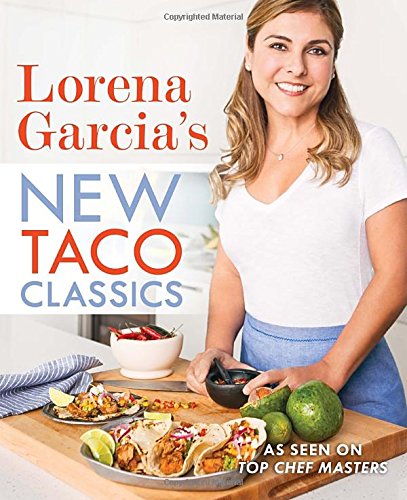
One of America’s favorite chefs gives a healthy and exciting twist on the best street foods of Latin America.
The taco. The arepa. The empanada. The tamale. From the streets of Mexico and Venezuela to Ecuador, Puerto Rico and Cuba, these comfort foods represent something that’s shared across our Latin cultures: the concept of food in a vessel. Food embraced!
Breaking down each new-style taco into its elements, Lorena shows you how to create each delicious layer—from the shell to the fillings to the toppings, including slaws, salads, and sauces. You’ll give a Southern Hoppin’ John a new name and a Latin accent. You’ll top the sweetest of plantains with the tangiest of pickled onions. And you’ll learn how to make extraordinary side dishes like creamy Peruvian corn gratin, a flavorful succotash with a trio of beans, and avocado fries.
These flavor-packed recipes are made for pairing and sharing, depending on your craving or occasion. Master the elements, and your mix-and-match possibilities will be endless. You’ll find yourself easily cooking, eating, and swooning your way through a dizzying new world of crowd-pleasing Latin fare.
Die Inhaltsangabe kann sich auf eine andere Ausgabe dieses Titels beziehen.
Über die Autorinnen und Autoren
Venezuelan-born restaurateur, TV personality, and cookbook author Lorena Garcia is currently one of the country’s leading chefs. She is well known for numerous TV series (Top Chef Masters, Top Chef Estrellas, Sazon con Lorena Garcia, Lorena en Su Salsa, and El Mejor De Los Peores to name a few), a successful chain of restaurants, and her cookbook, Lorena Garcia’s New Latin Classics. She was the creator of the Cantina Bell menu at Taco Bell, and has her own cookware line, Lorena Bella Kitchen Collection for HSN.
Venezuelan-born restaurateur, TV personality, and cookbook author Lorena Garcia is currently one of the country’s leading chefs. She is well known for numerous TV series (Top Chef Masters, Top Chef Estrellas, Sazon con Lorena Garcia, Lorena en Su Salsa, and El Mejor De Los Peores to name a few), a successful chain of restaurants, and her cookbook,Lorena Garcia’s New Latin Classics. She is the face of Taco Bell and the creator of their Cantina Bell menu, as well as of her own cookware line Lorena Bella Kitchen Collection for HSN.
Auszug. © Genehmigter Nachdruck. Alle Rechte vorbehalten.
Chicken Churrasco Tacos, see recipe here
INTRODUCTION
Like its people, the street foods of Latin America welcome you with a warm hug. Our stories may be different, our intonations unique, our rhythms purely regional, but one way or another our most beloved dishes come cradled in corn.
These dishes offer bites within bites, sublime pops of flavor contained within earthy corn wrappings. As simple as a taco, an arepa or a tamal may seem, they enfold more than a set of ingredients. They carry the great intangibles that distinguish our stories, the flavor notes of a particular city, the cooking methods of a region, not to mention the shared memories of a family.
Like tiny declarations of identity, each bite spells out the nuances between Mexico and Venezuela, Ecuador and Puerto Rico, Peru and Cuba.
Dishes tell stories. Sometimes those stories echo the beats of a particular place or culture, and sometimes they echo a mix of beats.
And when we explore the culinary beats we share in Latin America and the Caribbean, we must pay homage to the taco.
Allow me to use this term loosely here. I’m not referring to the literal taco shell and taco filling that may come to mind, but rather a concept that’s shared across our Latin cultures: the concept of food in a vessel. Food embraced.
So what if we take that vessel as a way to showcase the broader Latin cuisine? What if we were to expand the concept of the humble taco and build a new taco template?
We build this template by first deconstructing the concept: There is the vessel that’s most often made of corn masa, the filling, the toppings and the techniques that bring those elements together.
That vessel can take the form of a taco, an arepa, a sope, an empanada, even a tamal. It can carry any number of fillings and toppings, and be paired with any number of sides. Master the elements and your mix-and-match possibilities are endless.
I see this book as a wonderful interactive meal in which you can bring your own pairing options to the table. I present you with scores of recipes, but you can combine them any way you’d like. And even though it’s a taco book, you can skip the tortilla (or whatever vessel is specified in the recipe) entirely. That’s the beauty of these recipes: They’re made for pairing and sharing, depending on your craving or occasion.
You may notice, however, that these New Taco Classics recipes have a recurring theme in how they are constructed. For the most part, they are built in layers: vessel, filling, crunch and sauce.
• Your vessel can be crispy like a hard-shell taco or soft like a tamal.
• Your fillings—meats, seafood and/or veggies—give you the flavor centerpiece of your dish.
• Then there’s the crunchy aspect: the slaws and salads that add textural contrast to the dish.
• Add a creamy or saucy element to help connect the flavors and you’ve got a deliciously complex bite.
The key to success is in developing layers of flavor that complement one another. It’s all about balance and contrast.
It’s also about freshness. I’m often reminded of the stellar fish tacos I’ve had in Playa del Carmen, Mexico. These are simple tacos made with simple ingredients by street food cooks. But the quality of ingredients elevates them to greatness. The fish is fresh-caught, the tortillas fresh-made, the toppings a study of contrasts—as in battered fish brightened by lime and cilantro notes dancing on fresh, creamy avocado. This is a bite that tells the story of its seaside city.
In my native Venezuela, the stories echo from little food carts that dot the streets. These are not like the hip food trucks that roam Los Angeles or Miami, but mobile stoves that turn out hot, fresh corn cakes stuffed with meats, cheese, beans, whatever your choice of filling may be.
What remains constant in these arepas is the undeniable essence of corn. Corn, from the sweet elote to the more rigid maiz, is the sturdy common thread that runs through the nuances of our cultures. It’s an ingredient beloved throughout Latin America. But the type of corn that we choose, the way we cook it and the way we eat it—these change from culture to culture.
In my Venezuela, corn flour was one of the first ingredients I reached for as a child experimenting in my mother’s kitchen. The aroma of masa harina wafting up from a hot comal, a searing griddle or a steaming pot of tamales still sends me back to one Caracas morning many years ago when I made my very first attempt at cooking. I was six years old and determined to make tamales for my mother and brother.
I slipped into the kitchen, scooped up some of my mother’s precooked corn flour and mixed it into a masa paste, just as I had watched her do so many times. I spooned my tamale batter into ragged pieces of aluminum foil and dropped the foil packets into boiling water. Then I made some scrambled eggs to serve with these little tamalitos. Desayuno!
I set a small table in the middle of the living room and invited my mother and brother to come for breakfast. (My poor mother—what a mess I left in her kitchen!)
Still today, if you ask me to describe my favorite breakfast, I’d have to answer like a born and raised Venezuelan: arepas and eggs.
Breakfast is not breakfast in my homeland without a thick corn arepa, one that is so fluffy it can be split with a fork and filled. Fresh and ever so lightly sweet, it’s our bread. Arepas in Venezuela are like morning biscuits in the American South.
In neighboring Colombia, the arepa is a bit thinner, but still flavorful and equally revered.
Travel the Andean highlands from Chile to Ecuador and find hearty wedges of pastel de choclo.
In Brazil, corn flour lends earthy goodness to the bolo de fubá corn cake that’s so loved with morning coffee.
Travel north to Central America and you’ll find a range of hand-patted tortillas, thick, thin and filled. In Nicaragua and Honduras, tortillas tend to be thinner and more pliable, perfect for wrapping grilled meats in. Salvadorans, who like their tortillas smaller and thicker, nosh on hearty pupusas, thick corn tortillas stuffed with everything from ground chorizo to chicharrón.
In Mexico, masa handling is more than an art—it’s a culinary science. The hard maíz dough, made more pliable, healthful and flavorful by an ancient alkalizing process known as nixtamalization, takes on a staggering number of forms: tacos, sopes, huaraches, tostadas, and others.
In Cuba, cornmeal that’s studded with pork and aromatics is wrapped into a corn husk and simmered in water to make tamales.
So, how did we go from tacos to tamales? Trace the route from masa to filling to topping and you may be surprised at just how many “taco template” dishes you’ll find.
As chefs, our art is the food we explore, cook and serve. This is how we connect with the world and why we always want to “say” something with our dishes. For me there is nothing better than to create a meal with my hands—a meal that comes from my heart—and feed others.
While I take inspiration from classic renditions of favorite Latin American dishes, I make them my own by experimenting with savory and sweet notes, with contrasting elements, with flavors that brazenly cross culinary and geographical borders. I encourage you to do the same. This is what New Taco Classics is all about.
We’ll get creative with our ingredients. We’ll use herbs and veggies and beans to flavor the corn masa. We’ll...
„Über diesen Titel“ kann sich auf eine andere Ausgabe dieses Titels beziehen.
Suchergebnisse für Lorena Garcia's New Taco Classics

Beispielbild für diese ISBN
Lorena Garcia's New Taco Classics
Anbieter: ThriftBooks-Reno, Reno, NV, USA
Verkäuferbewertung 5 von 5 Sternen

Hardcover. Zustand: Fair. No Jacket. Readable copy. Pages may have considerable notes/highlighting. ~ ThriftBooks: Read More, Spend Less. Artikel-Nr. G0451476913I5N00
Gebraucht kaufen
EUR 6,70
Versand gratis
Versand innerhalb von USA
Versand innerhalb von USA
Anzahl: 1 verfügbar
Beispielbild für diese ISBN
Lorena Garcia's New Taco Classics
Anbieter: ThriftBooks-Phoenix, Phoenix, AZ, USA
Verkäuferbewertung 5 von 5 Sternen
Hardcover. Zustand: Good. No Jacket. Pages can have notes/highlighting. Spine may show signs of wear. ~ ThriftBooks: Read More, Spend Less. Artikel-Nr. G0451476913I3N00
Gebraucht kaufen
EUR 6,70
Versand gratis
Versand innerhalb von USA
Versand innerhalb von USA
Anzahl: 1 verfügbar
Beispielbild für diese ISBN
Lorena Garcia's New Taco Classics
Anbieter: ThriftBooks-Phoenix, Phoenix, AZ, USA
Verkäuferbewertung 5 von 5 Sternen
Hardcover. Zustand: Very Good. No Jacket. Former library book; May have limited writing in cover pages. Pages are unmarked. ~ ThriftBooks: Read More, Spend Less. Artikel-Nr. G0451476913I4N10
Gebraucht kaufen
EUR 6,70
Versand gratis
Versand innerhalb von USA
Versand innerhalb von USA
Anzahl: 1 verfügbar
Beispielbild für diese ISBN
Lorena Garcia's New Taco Classics
Anbieter: ThriftBooks-Reno, Reno, NV, USA
Verkäuferbewertung 5 von 5 Sternen
Hardcover. Zustand: Very Good. No Jacket. May have limited writing in cover pages. Pages are unmarked. ~ ThriftBooks: Read More, Spend Less. Artikel-Nr. G0451476913I4N00
Gebraucht kaufen
EUR 6,70
Versand gratis
Versand innerhalb von USA
Versand innerhalb von USA
Anzahl: 1 verfügbar
Beispielbild für diese ISBN
Lorena Garcia's New Taco Classics
Anbieter: ThriftBooks-Reno, Reno, NV, USA
Verkäuferbewertung 5 von 5 Sternen
Hardcover. Zustand: Good. No Jacket. Pages can have notes/highlighting. Spine may show signs of wear. ~ ThriftBooks: Read More, Spend Less. Artikel-Nr. G0451476913I3N00
Gebraucht kaufen
EUR 6,70
Versand gratis
Versand innerhalb von USA
Versand innerhalb von USA
Anzahl: 1 verfügbar
Beispielbild für diese ISBN
Lorena Garcia's New Taco Classics
Anbieter: ThriftBooks-Phoenix, Phoenix, AZ, USA
Verkäuferbewertung 5 von 5 Sternen
Hardcover. Zustand: Very Good. No Jacket. Missing dust jacket; May have limited writing in cover pages. Pages are unmarked. ~ ThriftBooks: Read More, Spend Less. Artikel-Nr. G0451476913I4N01
Gebraucht kaufen
EUR 6,70
Versand gratis
Versand innerhalb von USA
Versand innerhalb von USA
Anzahl: 2 verfügbar
Beispielbild für diese ISBN
Lorena Garcia's New Taco Classics
Anbieter: ThriftBooks-Atlanta, AUSTELL, GA, USA
Verkäuferbewertung 5 von 5 Sternen
Hardcover. Zustand: Very Good. No Jacket. Missing dust jacket; May have limited writing in cover pages. Pages are unmarked. ~ ThriftBooks: Read More, Spend Less. Artikel-Nr. G0451476913I4N01
Gebraucht kaufen
EUR 6,72
Versand gratis
Versand innerhalb von USA
Versand innerhalb von USA
Anzahl: 2 verfügbar
Beispielbild für diese ISBN
Lorena Garcia's New Taco Classics
Anbieter: ThriftBooks-Atlanta, AUSTELL, GA, USA
Verkäuferbewertung 5 von 5 Sternen
Hardcover. Zustand: Good. No Jacket. Missing dust jacket; Pages can have notes/highlighting. Spine may show signs of wear. ~ ThriftBooks: Read More, Spend Less. Artikel-Nr. G0451476913I3N01
Gebraucht kaufen
EUR 6,72
Versand gratis
Versand innerhalb von USA
Versand innerhalb von USA
Anzahl: 1 verfügbar
Beispielbild für diese ISBN
Lorena Garcia's New Taco Classics
Anbieter: ThriftBooks-Dallas, Dallas, TX, USA
Verkäuferbewertung 5 von 5 Sternen
Hardcover. Zustand: Very Good. No Jacket. May have limited writing in cover pages. Pages are unmarked. ~ ThriftBooks: Read More, Spend Less. Artikel-Nr. G0451476913I4N00
Gebraucht kaufen
EUR 6,72
Versand gratis
Versand innerhalb von USA
Versand innerhalb von USA
Anzahl: 1 verfügbar
Beispielbild für diese ISBN
Lorena Garcia's New Taco Classics
Anbieter: ThriftBooks-Dallas, Dallas, TX, USA
Verkäuferbewertung 5 von 5 Sternen
Hardcover. Zustand: Good. No Jacket. Former library book; Pages can have notes/highlighting. Spine may show signs of wear. ~ ThriftBooks: Read More, Spend Less. Artikel-Nr. G0451476913I3N10
Gebraucht kaufen
EUR 6,72
Versand gratis
Versand innerhalb von USA
Versand innerhalb von USA
Anzahl: 1 verfügbar