
Verwandte Artikel zu The Time Machine: Introd. by Greg Bear. With a new...
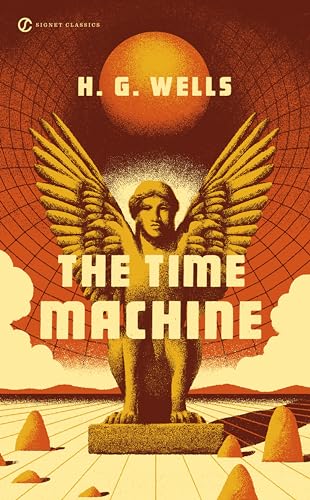
The Time Machine: Introd. by Greg Bear. With a new afterword by Simon J. James (Signet Classics) - Softcover
Inhaltsangabe
The revolutionary novel that catapulted readers into the future, from the father of science fiction, H.G. Wells.
“I’ve had a most amazing time....”
So begins the Time Traveller’s astonishing firsthand account of his journey eight hundred thousand years beyond his own era—and the story that launched H. G. Wells’s successful career. With a speculative leap that still fires the imagination, Wells sends his brave explorer to face a future burdened with our greatest hopes...and our darkest fears. A pull of the Time Machine’s lever propels him to the age of a slowly dying Earth. There he discovers two bizarre races—the ethereal Eloi and the subterranean Morlocks—who not only symbolize the duality of human nature, but offer a terrifying portrait of tomorrow as well.
Published in 1895, this masterpiece of invention captivated readers on the threshold of a new century. Thanks to Wells’s expert storytelling and provocative insight, The Time Machine will continue to enthrall readers for generations to come.
With an Introduction by Greg Bear
and an Afterword by Simon J. James
Die Inhaltsangabe kann sich auf eine andere Ausgabe dieses Titels beziehen.
Über die Autorin bzw. den Autor
Herbert George Wells was born in Bromley, Kent, England, on September 21, 1866. His father was a professional cricketer and sometime shopkeeper, his mother a former lady’s maid. Although “Bertie” left school at fourteen to become a draper’s apprentice (a life he detested), he later won a scholarship to the Normal School of Science in London, where he studied with the famous Thomas Henry Huxley. He began to sell articles and short stories regularly in 1893. In 1895, his immediately successful novel The Time Machine rescued him from a life of penury on a schoolteacher’s salary. His other “scientific romances”—The Island of Dr. Moreau (1896), The Invisible Man (1897), The War of the Worlds (1898), The First Men in the Moon (1901), and The War in the Air (1908)—won him distinction as the father of science fiction. Henry James saw in Wells the most gifted writer of the age, but Wells, having coined the phrase “the war that will end war” to describe World War I, became increasingly disillusioned and focused his attention on educating mankind with his bestselling Outline of History (1920) and his later utopian works. Living until 1946, Wells witnessed a world more terrible than any of his imaginative visions, and he bitterly observed: “Reality has taken a leaf from my book and set itself to supercede me.”
Greg Bear’s novels and stories have appeared in more than twenty languages worldwide and have won numerous prizes, including two Hugos, five Nebulas, and the Prix Apollo. His novels include Darwin’s Radio (winner of the Nebula and Endeavor awards), Darwin’s Children, Vitals, Blood Music, Eon, Queen of Angels, and Moving Mars. He has served as a consultant and a lecturer on space and defense policy, biotechnology and bioterrorism, multimedia entertainment, and Internet issues.
Simon J. James is Professor of Victorian Literature at the Department of English Studies, Durham University. He is the editor of The Wellsian, the peer-reviewed scholarly journal of the H.G. Wells Society. He has edited four H.G. Wells novels for the Penguin Classics, as well as George Gissing’s Charles Dickens: A Critical Study. James is the author of Maps of Utopia: H.G. Wells, Modernity and the End of Culture and Unsettled Accounts: Money and Narrative Form in the Novels of George Gissing.
Auszug. © Genehmigter Nachdruck. Alle Rechte vorbehalten.
Table of Contents
About the Author
Title Page
Copyright Page
Introduction
Chapter 1
Chapter 2
Chapter 3
Chapter 4
Chapter 5
Chapter 6
Chapter 7
Chapter 8
Chapter 9
Chapter 10
Chapter 11
Chapter 12
Epilogue
Appendix
14
Afterword
Selected Bibliography
Introduction
BEFORE AIRPLANES, SPACE travel, and atomic energy, before freeways and traffic jams, poison gas and tanks, and just before the dawn of the twentieth century, a nameless inventor in London discovered a way to travel in time, using a mysterious machine assembled in a small private shop.
And an unknown journalist named Herbert George Wells (1866-1946) leaped in a few short years to fame and fortune.
If this is the first time you’ve read The Time Machine, then stop right here. Skip over this introduction, for now, and get right to the story. When you’re done, if you wish, come back and join the discussion. It’s bound to be heated.
To this day, H. G. Wells is controversial, and I doubt he would have had it any other way!
Welcome back. Now how do you feel about time travel? Perplexed, skeptical, excited, a little sad?
By 1895, when The Time Machine was first published in book form, H. G. Wells had lived through years of ill health, married and parted, and tried on a career of teaching, then moved on to journalism and writing reviews. He did not seem very successful at anything, but he was enormously intelligent and ambitious. And he knew he had one story, one idea, one card up his sleeve that could possibly trump all of his disadvantages.
A man, traveling in time, using a machine.
A Time Traveller.
Judging from many drafts and redrafts over at least seven years, Wells knew that he had something big—something that could launch his career very nicely indeed, if he only got it right.
He finally got it right. After its serialization in William Ernest Henley’s The New Review in early 1895, The Time Machine became a sensation. In an age intrigued by all the possibilities of science and mathematics, Wells’s first work of fiction was like a brisk slap in the face. The future will be marvelous, the young Wells told his audience—and also tragic, even horrible. All things biological must end, or give way to new forms, he suggested, following the dour lead of his most influential teacher, Darwin’s “Bulldog,” T. H. Huxley.
For Victorian England, the picture of humanity divided into the diminutive, weak, and sun-dwelling Eloi and those technological dwellers in underground darkness, the Morlocks, must have seemed particularly grotesque—mirroring as it did the tottering class system: quite literally, Upstairs and Downstairs.
In this bleak picture of distant futurity, Wells gives us a final glimmer of human love, innocent and childlike, in the outstretched hand of the tiny Eloi Weena . . . love, however, too weak to withstand the brutal forces of evolution and necessity, and far too swiftly destroyed. As a final fillip, Wells shows us that eventually even the necessity of biological evolution will give way, as the sun swells and reddens, life reverts to the crustacean and then to the (possibly) molluscan or protozoan, and the Earth finally freezes over.
It is an utterly chilling message, mixing as it does human sentiment, contemporary scientific knowledge, unwavering pessimism, and a sense of cosmic wonder and discovery, with the realization of the limited condition of the human race. As a novelistic tour de force, nothing like it had ever been published.
Coming on the heels of decades of speculation about both evolution and geometry, and bringing together recent theories in astronomy and geology, The Time Machine hit the Victorian intellect squarely between the eyes. It was the first modern science fiction novel.
Within nine years, H. G. Wells would write seven more novels—The Island of Doctor Moreau (1896), The Invisible Man (1897), The War of the Worlds (1898), When the Sleeper Wakes (1899), The First Men in the Moon (1901), The Food of the Gods (1904), In the Days of the Comet (1906)—and numerous short stories that would shape and define twentieth-century science fiction. By 1914 and the beginning of World War I, Wells was one of the bestselling authors in the English language.
He became the twentieth-century prototype of the angry young man, brilliant and full of contradictions. Throughout his life, Wells promoted his changeable brand of socialism yet toyed with (early on, at least) a belief in God, called for equality of the sexes yet was a flagrant womanizer, decried class distinctions yet sought the approval of the rich, the powerful, and the famous—and then, just as quickly, denounced them!
In the 1920s, his Outline of History would sell millions of copies. He would become so famous and so influential that authors seeking a reputation—or at least some intellectual balance—would cock their hats and shy stones at his overwhelming success and his pugnacious attitudes.
C. S. Lewis parodied Wells’s brand of evolution and rationalism from a theist perspective in his science fiction novels Out of the Silent Planet, Perelandra, and That Hideous Strength. Lewis built an intellectually confused, villainous character named Weston on the frame of a number of scientific acquaintances, possibly including J.B.S. Haldane and Wells. Even as late as 1955, William Golding would reply to Wells’s portrait (in An Outline of History) of low, bestial Neanderthals with his own depiction of them as scions of a kinder nature, brutalized by modern humans, in The Inheritors.
Wells was a marvelous sounding board, and there’s evidence he enjoyed this kind of hurly-burly. What he did not enjoy was a bad review or being ignored.
Above all, he hated being ignored.
All of Wells’s early scientific romances are accessible to a person of average education. They are clearly and elegantly written, not very heavy on the character bits (but convincing in what is shown), realistic despite their fantastic elements, clear-eyed about animal nature—and highly imaginative. They are also thoroughly satirical, though often written with a straight face or at most a wry grimace.
These early novels are far more than just adventurous dives into the deep canyons of fantasy. They are more like mountain climbs to the edge of space. They can be disturbing, and intentionally so. Wells knew early on that his audiences enjoyed a good scare; and he enjoyed, in those prewar years of growing tension, placing human folly in cosmic perspective.
In writing The Time Machine, Wells claimed to draw his inspiration from Nathaniel Hawthorne, but there is also a touch of Poe in early drafts. Wells was fond of Voltaire, the French philosopher and satirist; he respected but found little useful comparison with Jules Verne, whose own satiric elements are often overlooked. Most often, Wells likened himself to Jonathan Swift, the sardonic Irish author of Gulliver’s Travels.
The Time Machine was compared favorably in one review to Robert Louis Stevenson’s Dr. Jekyll and Mr. Hyde, a masterpiece of psychological horror. The Time Machine’s horrors are less moral than neutral, however. Its plan is not so much darkly psychological as biological and physical. Whatever our psychology, our class, our politics, Wells says, the laws of...
„Über diesen Titel“ kann sich auf eine andere Ausgabe dieses Titels beziehen.
Suchergebnisse für The Time Machine: Introd. by Greg Bear. With a new...

Beispielbild für diese ISBN
The Time Machine
Anbieter: World of Books (was SecondSale), Montgomery, IL, USA
Verkäuferbewertung 5 von 5 Sternen

Zustand: Good. The revolutionary novel that catapulted readersinto the future, from the father of science fiction, H.G. Wells. "I've had a most amazing time." So begins the Time Traveller's astonishing firsthand account of his journey eight hundred thousand years beyond his own era-and the story that launched H. G. Wells's successful career. With a speculative leap that still fires the imagination, Wells sends his brave explorer to face a future burdened with our greatest hopes.and our darkest fears. A pull of the Time Machine's lever propels him to the age of a slowly dying Earth. There he discovers two bizarre races-the ethereal Eloi and the subterranean Morlocks-who not only symbolize the duality of human nature, but offer a terrifying portrait of tomorrow as well. Published in 1895, this masterpiece of invention captivated readers on the threshold of a new century. Thanks to Wells's expert storytelling and provocative insight, The Time Machine will continue to enthrall readers for generations to come. With an Introduction by Greg Bear and an Afterword by Simon J. James. Artikel-Nr. 00109736953
Gebraucht kaufen
EUR 4,56
Versand gratis
Versand innerhalb von USA
Versand innerhalb von USA
Anzahl: 5 verfügbar
Beispielbild für diese ISBN
The Time Machine (Signet Classics)
Verlag:
Signet (edition Reissue), 2014
ISBN 10: 0451470702
ISBN 13: 9780451470706
Gebraucht
Mass Market Paperback
Anbieter: BooksRun, Philadelphia, PA, USA
Verkäuferbewertung 5 von 5 Sternen
Mass Market Paperback. Zustand: Very Good. Reissue. It's a well-cared-for item that has seen limited use. The item may show minor signs of wear. All the text is legible, with all pages included. It may have slight markings and/or highlighting. Artikel-Nr. 0451470702-11-1
Gebraucht kaufen
EUR 4,57
Versand gratis
Versand innerhalb von USA
Versand innerhalb von USA
Anzahl: 1 verfügbar
Beispielbild für diese ISBN
The Time Machine
Verlag:
Penguin Publishing Group, 2014
ISBN 10: 0451470702
ISBN 13: 9780451470706
Gebraucht
Mass Market Paperback
Anbieter: ThriftBooks-Phoenix, Phoenix, AZ, USA
Verkäuferbewertung 5 von 5 Sternen
Mass Market Paperback. Zustand: Good. No Jacket. Pages can have notes/highlighting. Spine may show signs of wear. ~ ThriftBooks: Read More, Spend Less. Artikel-Nr. G0451470702I3N00
Gebraucht kaufen
EUR 5,89
Versand gratis
Versand innerhalb von USA
Versand innerhalb von USA
Anzahl: 2 verfügbar
Beispielbild für diese ISBN
The Time Machine
Verlag:
Penguin Publishing Group, 2014
ISBN 10: 0451470702
ISBN 13: 9780451470706
Gebraucht
Mass Market Paperback
Anbieter: ThriftBooks-Dallas, Dallas, TX, USA
Verkäuferbewertung 5 von 5 Sternen
Mass Market Paperback. Zustand: Good. No Jacket. Pages can have notes/highlighting. Spine may show signs of wear. ~ ThriftBooks: Read More, Spend Less. Artikel-Nr. G0451470702I3N00
Gebraucht kaufen
EUR 5,89
Versand gratis
Versand innerhalb von USA
Versand innerhalb von USA
Anzahl: 2 verfügbar
Beispielbild für diese ISBN
The Time Machine
Verlag:
Penguin Publishing Group, 2014
ISBN 10: 0451470702
ISBN 13: 9780451470706
Gebraucht
Mass Market Paperback
Anbieter: ThriftBooks-Reno, Reno, NV, USA
Verkäuferbewertung 5 von 5 Sternen
Mass Market Paperback. Zustand: Good. No Jacket. Pages can have notes/highlighting. Spine may show signs of wear. ~ ThriftBooks: Read More, Spend Less. Artikel-Nr. G0451470702I3N00
Gebraucht kaufen
EUR 5,89
Versand gratis
Versand innerhalb von USA
Versand innerhalb von USA
Anzahl: 2 verfügbar
Beispielbild für diese ISBN
The Time Machine
Verlag:
Penguin Publishing Group, 2014
ISBN 10: 0451470702
ISBN 13: 9780451470706
Gebraucht
Mass Market Paperback
Anbieter: ThriftBooks-Atlanta, AUSTELL, GA, USA
Verkäuferbewertung 5 von 5 Sternen
Mass Market Paperback. Zustand: Good. No Jacket. Pages can have notes/highlighting. Spine may show signs of wear. ~ ThriftBooks: Read More, Spend Less. Artikel-Nr. G0451470702I3N00
Gebraucht kaufen
EUR 5,89
Versand gratis
Versand innerhalb von USA
Versand innerhalb von USA
Anzahl: 3 verfügbar
Beispielbild für diese ISBN
The Time Machine (Signet Classics)
Anbieter: Wonder Book, Frederick, MD, USA
Verkäuferbewertung 5 von 5 Sternen
Zustand: Very Good. Very Good condition. A copy that may have a few cosmetic defects. May also contain light spine creasing or a few markings such as an owner's name, short gifter's inscription or light stamp. Artikel-Nr. I01D-04810
Gebraucht kaufen
EUR 6,41
Versand gratis
Versand innerhalb von USA
Versand innerhalb von USA
Anzahl: 1 verfügbar
Beispielbild für diese ISBN
The Time Machine
Verlag:
Penguin Publishing Group, 2014
ISBN 10: 0451470702
ISBN 13: 9780451470706
Gebraucht
Softcover
Anbieter: Better World Books, Mishawaka, IN, USA
Verkäuferbewertung 5 von 5 Sternen
Zustand: Good. Pages intact with minimal writing/highlighting. The binding may be loose and creased. Dust jackets/supplements are not included. Stock photo provided. Product includes identifying sticker. Better World Books: Buy Books. Do Good. Artikel-Nr. 13195044-6
Gebraucht kaufen
EUR 7,00
Versand gratis
Versand innerhalb von USA
Versand innerhalb von USA
Anzahl: 1 verfügbar
Beispielbild für diese ISBN
The Time Machine (Signet Classics)
Anbieter: Majestic Books, Hounslow, Vereinigtes Königreich
Verkäuferbewertung 4 von 5 Sternen

Zustand: New. pp. 160. Artikel-Nr. 104161913
Neu kaufen
EUR 7,61
EUR 7,72 Versand
Versand von Vereinigtes Königreich nach USA
Versand von Vereinigtes Königreich nach USA
Anzahl: 1 verfügbar
Beispielbild für diese ISBN
The Time Machine
Anbieter: Revaluation Books, Exeter, Vereinigtes Königreich
Verkäuferbewertung 5 von 5 Sternen
Mass Market Paperback. Zustand: Brand New. reprint edition. 133 pages. 6.75x4.50x0.25 inches. In Stock. Artikel-Nr. xr0451470702
Neu kaufen
EUR 7,50
EUR 11,88 Versand
Versand von Vereinigtes Königreich nach USA
Versand von Vereinigtes Königreich nach USA
Anzahl: 2 verfügbar