
Verwandte Artikel zu Patton at the Battle of the Bulge: How the General's...
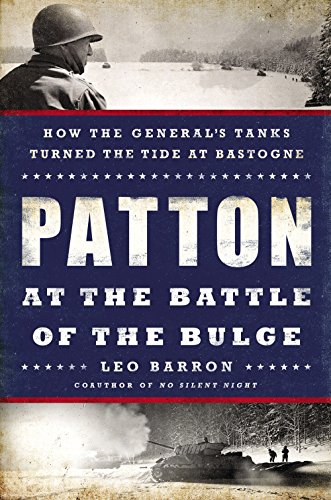
Patton at the Battle of the Bulge: How the General's Tanks Turned the Tide at Bastogne: How the Genral's Tanks Turned the Tide at Bastogne - Hardcover
Inhaltsangabe
December 1944. For the besieged American defenders of Bastogne, time was running out....
Hitler’s forces had pressed in on the small Belgian town in a desperate offensive designed to push back the Allies, starting the Battle of the Bulge. So far the U.S. soldiers had managed to repel waves of attackers and even a panzer onslaught. But as their ammunition dwindled, the weary paratroopers of the 101st Airborne could only hope for a miracle—a miracle in the form of General George S. Patton and his Third Army.
More than a hundred miles away, Patton, ordered to race his men to Bastogne, was already putting in motion the most crucial charge of his career. Tapped to spearhead his counterstrike against the Wehrmacht was the 4th Armored Division, a bloodied but experienced unit that had fought and slogged its way across France. But blazing a trail into Belgium meant going up against some of the best infantry and tank units in the German Army. Failure to reach Bastogne in time could result in the overrunning of the 101st—a catastrophic defeat that could turn the tide of the war and secure victory for the Nazis.
In Patton at the Battle of the Bulge, Army veteran and historian Leo Barron explores one of the most famous yet little told clashes of the war, a vitally important chapter in one of history’s most legendary battles.
Die Inhaltsangabe kann sich auf eine andere Ausgabe dieses Titels beziehen.
Über die Autorin bzw. den Autor
Leo Barron works for General Dynamics as an instructor of military intelligence officers for the U.S. Army. He holds undergraduate and graduate degrees in history and has served with the 101st Airborne. Barron has seen two tours of active duty in Iraq as an infantry and intelligence officer. His articles about Bastogne and other WWII-related military topics have appeared in Infantry Magazine, Military Intelligence Professional Bulletin, WWII History Magazine, and WWII Magazine. He has used some of his research on Bastogne and the Christmas battle to teach his students about intelligence preparation of the battlefield. He is also the author of No Silent Night: The Christmas Battle for Bastogne.
Auszug. © Genehmigter Nachdruck. Alle Rechte vorbehalten.
PREFACE
The Battle of the Bulge, fought between December 16, 1944, and January 25, 1945, was the bloodiest month in the United States Army’s history. The U.S. Army in Europe sustained 77,726 casualties in December, and incurred a further 69,119 casualties in January. In December, 15,333 soldiers and airmen lost their lives, and January was not much better: An additional 12,190 soldiers and airmen perished. In total, in those two months our country sustained 146,845 casualties, and of those, 27,523 were deaths. Most of those occurred in that forty-day period when Germany and the United States were locked in the largest battle of the Western Front.
In contrast, in July 1863, the month of Gettysburg and Vicksburg, our country, both North and South, suffered 120,426 casualties combined. In fifty-one days, from May through June 1864, when the battles of the Wilderness, Spotsylvania Courthouse, and Cold Harbor raged, the butcher’s bill was 146,046 casualties. The only other bloodletting that came close to the Bulge’s total was during the forty-seven days of the Meuse-Argonne Offensive in October and November 1918, when the U.S. Army Expeditionary Force lost 122,063 men, and of those, 26,277 were deaths.
In short, the Battle of the Bulge was truly a national sacrifice, on par with the battles of Gettysburg and the Meuse-Argonne. Citizens of Belgium and Luxembourg still remember our sacrifice and annually commemorate the events of those dark days.Yet many of our own students know little about the Bulge. Their lack of historical appreciation is the number one reason why I chose this subject.
Yet it is not the only reason. The Bulge and the Siege of Bastogne are also compelling stories. When Don Cygan and I decided to publish No Silent Night: The Christmas Battle for Bastogne, I already had planned to write the sequel, because the story about Bastogne is a two-part saga. The most popular is the account about the 101st Airborne Division and its epic defense of the city. However, every story about a besieged force usually has two armies involved: the besieged and the forces sent to relieve them. Now is the time to tell the tale of Patton’s 4th Armored Division and their race to relieve the paratroopers and glider men of the 101st.
Like No Silent Night, Patton at the Battle of the Bulge provides a German viewpoint to contrast with the American perspective. This story follows several German soldiers who fought with the 5th Fallschirmjäger Division. Contrary to popular myth, not all German soldiers were monsters. In this book are several examples where German soldiers showed remarkable kindness and mercy toward their sworn enemies, the American army. Sadly, there are also examples of brutality, where German soldiers executed innocent Belgian civilians.
True, Belgian civilians did perish as a result of American bombs, but those bombs were not meant for the hapless civilians hiding in houses and huddling in cellars. Surgical strikes did not exist in 1944 and 1945, because bombings were far less accurate in World War II than they are today. My research revealed several incidents where Allied aircraft even strafed and bombed American tanks instead of German panzers. In the cloud of war, good intentions did not always result in accurate targeting. On the other hand, the Germans did intend to execute civilians.
Furthermore, this work provides a civilian point of view. For those living in the path of these armies, the days around Christmas were harrowing ones. In many cases, they exhibited as much amazing courage and selfless sacrifice as the soldiers and tankers who fought among them. This book is also a story about them.
In addition, I dramatize the German operational briefings, turning them into dialogues. I know some purists might balk at that technique, but I want to present an enthralling story, not a dry account. The words in the briefings are almost entirely verbatim from the sources. In many instances, all I added were quotation marks.
Patton at the Battle of the Bulge, like all good books, was a collaborative effort. I made use of several German and local accounts, for which I would like to thank Roland Gaul, who provided them, including several valuable video interviews and letters; Guy Ries and his website on Bigonville. Jürg Herzig also gave me the lengthy account of Conrad Klemment, which proved indispensable in this story. I would like to thank Ivan Steenkiste, who was crucial in supplying me with information about the battles around Chaumont. His website is a treasure trove of information.
On the American side, I would like to offer my gratitude to several individuals. Jamie Leach, the son of Jimmie Leach, was an excellent resource in regard to his father. His father’s 37th Tank Battalion radio logs, complete with notations, were a wealth of information. Rochelle Dwight gave me great material on her father, William Dwight. She still sends me hilarious daily e-mails that make me laugh. I would like to thank Robert T. Murrell, an 80th Infantry Division veteran, who helped me find information on the 318th Infantry Regiment. Andrew Adkins, the archivist for the 80th Infantry Division website, was hugely instrumental in assisting me with personnel records and personal stories from the 318th. I would like to extend my thanks to Chris Bucholtz and Lynn Gamma, who helped me with finding records concerning the 362nd Fighter Group. I would like to thank Doris Davis, an executive officer for the Veterans of the Battle of the Bulge Association. Without her help, I would have never been able to contact countless veterans and their families.
Most important are the veterans and their families who provided me their accounts via questionnaires, letters, or interviews. The following accounts were invaluable to the story of the 4th Armored Division and their support elements: Roscoe M. Mulvey Jr., Armand Poirier, Bob Shaw, Jim Sanders, William Leaphart, Howard Lipscomb, Irving Heath, George Whitten, Robert Calvert, Matteo Damiano, Michael George, Eugene Wright, John P. Tvrdovsky, the family of Jack Holmes, Albert Gaydos and the Gaydos family, and Raymond Green. A special thanks goes out to Irving Heath, who provided me his personal photo album from the war. In addition to Irving Heath, another special thanks goes out to Robert Riley’s family, especially his daughter, Linda Riggs, who provided me several written accounts about his wartime experiences. Of course, one of the most valuable interviews was with retired brigadier general Albin F. Irzyk. I spent several hours speaking with him about his experiences. His memory was as sharp as a tack, and it was a wonderful experience providing him with information on the Germans who fought his unit at Chaumont. His autobiography was also an amazing source of information about the 4th Armored Division.
In addition to veterans’ interviews, several researchers and archivists also supported me in this endeavor. I would like to thank Dieter Stenger, who once again translated dozens of German documents into English. I would like to thank Susan Strange and Tim Frank, who spent innumerable hours poring over documents in the National Archives at College Park, Maryland. Without them, I would not have had thousands of valuable primary sources to examine. William Murray was my researcher at the Army Historical Education Center and helped me with the Oscar W. Koch collection, which was essential to the 4th Armored Division story. Megan Harris was my contact at the Library of Congress’s Veterans Oral History Project. Her assistance was instrumental in my success. Javier Tome, a specialist on the 653rd Schwere Panzerjäger Battalion, sent to me some interesting information on the whereabouts of the 653rd, and his contribution helped me answer the...
„Über diesen Titel“ kann sich auf eine andere Ausgabe dieses Titels beziehen.
Suchergebnisse für Patton at the Battle of the Bulge: How the General's...

Beispielbild für diese ISBN
Patton at the Battle of the Bulge: How the General's Tanks Turned the Tide at Bastogne
Anbieter: ThriftBooks-Reno, Reno, NV, USA
Verkäuferbewertung 5 von 5 Sternen

Hardcover. Zustand: Very Good. No Jacket. Former library book; May have limited writing in cover pages. Pages are unmarked. ~ ThriftBooks: Read More, Spend Less. Artikel-Nr. G0451467876I4N10
Gebraucht kaufen
EUR 7,27
Versand gratis
Versand innerhalb von USA
Versand innerhalb von USA
Anzahl: 1 verfügbar
Beispielbild für diese ISBN
Patton at the Battle of the Bulge: How the General's Tanks Turned the Tide at Bastogne
Anbieter: ThriftBooks-Reno, Reno, NV, USA
Verkäuferbewertung 5 von 5 Sternen
Hardcover. Zustand: Very Good. No Jacket. Missing dust jacket; May have limited writing in cover pages. Pages are unmarked. ~ ThriftBooks: Read More, Spend Less. Artikel-Nr. G0451467876I4N01
Gebraucht kaufen
EUR 7,27
Versand gratis
Versand innerhalb von USA
Versand innerhalb von USA
Anzahl: 1 verfügbar
Beispielbild für diese ISBN
Patton at the Battle of the Bulge: How the General's Tanks Turned the Tide at Bastogne
Anbieter: ThriftBooks-Reno, Reno, NV, USA
Verkäuferbewertung 5 von 5 Sternen
Hardcover. Zustand: Good. No Jacket. Pages can have notes/highlighting. Spine may show signs of wear. ~ ThriftBooks: Read More, Spend Less. Artikel-Nr. G0451467876I3N00
Gebraucht kaufen
EUR 7,27
Versand gratis
Versand innerhalb von USA
Versand innerhalb von USA
Anzahl: 1 verfügbar
Beispielbild für diese ISBN
Patton At The Battle Of The Bulge: How the Genral's Tanks Turned the Tide at Bastogne
Anbieter: World of Books (was SecondSale), Montgomery, IL, USA
Verkäuferbewertung 5 von 5 Sternen
Hardback. Zustand: Good. December 1944. For the besieged American defenders of Bastogne, time was running out. Hitler's forces had pressed in on the small Belgian town in a offensive designed to push back the Allies, starting the Battle of the Bulge. So far the U.S. soldiers had managed to repel waves of attackers and even a panzer onslaught. But as their ammunition dwindled, the weary paratroopers of the 101st Airborne could only hope for a miracle in the form of General Patton and his Third Army. More than 100 miles away, Patton, ordered to race his men to Bastogne and make the charge. Artikel-Nr. 00105141039
Gebraucht kaufen
EUR 7,28
Versand gratis
Versand innerhalb von USA
Versand innerhalb von USA
Anzahl: 2 verfügbar
Beispielbild für diese ISBN
Patton At The Battle Of The Bulge: How the Genral's Tanks Turned the Tide at Bastogne
Anbieter: World of Books (was SecondSale), Montgomery, IL, USA
Verkäuferbewertung 5 von 5 Sternen
Hardback. Zustand: Very Good. December 1944. For the besieged American defenders of Bastogne, time was running out. Hitler's forces had pressed in on the small Belgian town in a offensive designed to push back the Allies, starting the Battle of the Bulge. So far the U.S. soldiers had managed to repel waves of attackers and even a panzer onslaught. But as their ammunition dwindled, the weary paratroopers of the 101st Airborne could only hope for a miracle in the form of General Patton and his Third Army. More than 100 miles away, Patton, ordered to race his men to Bastogne and make the charge. Artikel-Nr. CIN0451467876VG
Gebraucht kaufen
EUR 7,28
Versand gratis
Versand innerhalb von USA
Versand innerhalb von USA
Anzahl: 1 verfügbar
Beispielbild für diese ISBN
Patton at the Battle of the Bulge: How the General's Tanks Turned the Tide at Bastogne
Anbieter: ThriftBooks-Atlanta, AUSTELL, GA, USA
Verkäuferbewertung 5 von 5 Sternen
Hardcover. Zustand: Fair. No Jacket. Former library book; Readable copy. Pages may have considerable notes/highlighting. ~ ThriftBooks: Read More, Spend Less. Artikel-Nr. G0451467876I5N10
Gebraucht kaufen
EUR 7,29
Versand gratis
Versand innerhalb von USA
Versand innerhalb von USA
Anzahl: 1 verfügbar
Beispielbild für diese ISBN
Patton at the Battle of the Bulge: How the General's Tanks Turned the Tide at Bastogne
Anbieter: ThriftBooks-Dallas, Dallas, TX, USA
Verkäuferbewertung 5 von 5 Sternen
Hardcover. Zustand: Good. No Jacket. Pages can have notes/highlighting. Spine may show signs of wear. ~ ThriftBooks: Read More, Spend Less. Artikel-Nr. G0451467876I3N00
Gebraucht kaufen
EUR 7,29
Versand gratis
Versand innerhalb von USA
Versand innerhalb von USA
Anzahl: 1 verfügbar
Beispielbild für diese ISBN
Patton at the Battle of the Bulge: How the General's Tanks Turned the Tide at Bastogne
Anbieter: ThriftBooks-Dallas, Dallas, TX, USA
Verkäuferbewertung 5 von 5 Sternen
Hardcover. Zustand: Very Good. No Jacket. May have limited writing in cover pages. Pages are unmarked. ~ ThriftBooks: Read More, Spend Less. Artikel-Nr. G0451467876I4N00
Gebraucht kaufen
EUR 7,29
Versand gratis
Versand innerhalb von USA
Versand innerhalb von USA
Anzahl: 1 verfügbar
Beispielbild für diese ISBN
Patton at the Battle of the Bulge: How the General's Tanks Turned the Tide at Bastogne
Anbieter: ThriftBooks-Atlanta, AUSTELL, GA, USA
Verkäuferbewertung 5 von 5 Sternen
Hardcover. Zustand: Good. No Jacket. Pages can have notes/highlighting. Spine may show signs of wear. ~ ThriftBooks: Read More, Spend Less. Artikel-Nr. G0451467876I3N00
Gebraucht kaufen
EUR 7,29
Versand gratis
Versand innerhalb von USA
Versand innerhalb von USA
Anzahl: 1 verfügbar
Beispielbild für diese ISBN
Patton at the Battle of the Bulge: How the General's Tanks Turned the Tide at Bastogne
Anbieter: ThriftBooks-Atlanta, AUSTELL, GA, USA
Verkäuferbewertung 5 von 5 Sternen
Hardcover. Zustand: Fair. No Jacket. Readable copy. Pages may have considerable notes/highlighting. ~ ThriftBooks: Read More, Spend Less. Artikel-Nr. G0451467876I5N00
Gebraucht kaufen
EUR 7,29
Versand gratis
Versand innerhalb von USA
Versand innerhalb von USA
Anzahl: 1 verfügbar