
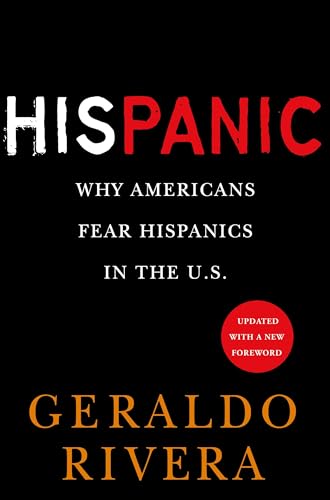
Verwandte Artikel zu His Panic: Why Americans Fear Hispanics in The U.S.
Inhaltsangabe
An account of the Hispanic population’s growth and the changing face of America from world-renowned journalist Geraldo Rivera—now updated with a new Foreword.
Since his infamous confrontation with Bill O’Reilly on The O’Reilly Factor, Emmy® award winner Geraldo Rivera has examined what makes the issue of illegal Hispanic immigration so complex. With widespread fury and frustration directed at Hispanics, the nation’s largest minority, this may be the single most divisive issue in America today—with some citizens blaming illegal immigrants for everything from terrorism to the spread of disease and the loss of jobs.
With unbiased analysis, Rivera exposes the hypocrisy, racism, and ignorance behind anti-immigration sentiments, from both extremists and otherwise ordinary Americans.
An unflinching look at one of today’s biggest issues—and a vital contribution to the ongoing debate—His Panic is destined to reshape the way Americans view the future of this country.
Die Inhaltsangabe kann sich auf eine andere Ausgabe dieses Titels beziehen.
Über die Autorin bzw. den Autor
Geraldo Rivera
Auszug. © Genehmigter Nachdruck. Alle Rechte vorbehalten.
Proud to Be an American
First, let me tell you my family's story, just one Hispanic family among millions. Like the overwhelming majority of immigrants, Hispanic or otherwise, the Riveras of Puerto Rico worked hard, served our country in many different ways, and made enormous efforts to assimilate, despite the obstacle of prejudice.
My dad always wanted to fit into America, his “new” country. Well, technically the country wasn't new, because U.S. citizenship had been bestowed on him and all current and future Puerto Ricans by legislation called the Jones Act of 1917. The United States had been in possession of the lovely tropical island it had conquered and won from Spain for only twenty years, and Cruz Rivera was just two years old, the sixth of seventeen children born to Juan and Tomasa Rivera of Bayamon, Puerto Rico.
“How could you have so many children?” I remember asking my grandmother, a woman of enormous patience and good humor who wore her snow-white hair pulled back, contrasting dramatically with her angular, chocolate-colored face made leathery by the sun. “Times were different then,” she replied in fabulous understatement, referring to their modest agrarian lifestyle in the sugarcane and coffee economy that dominated the island in the days before the commonwealth. My grandfather helped manage one small operation, and each child became another income earner, cutting and stacking cane, watched over by a slightly older sibling.
With citizenship bestowed, the new Americans were free to roam and the Puerto Rican diaspora began, with island residents leaving their then largely rural society for the far-flung corners of the industrialized mainland United States. Most, like my dad, came to New York City.
When the now twenty-one-year-old Cruz arrived on board one of the New York and Porto Rico Steamship Company's “banana boats” in 1937, more than fifty thousand of his fellow islanders arrived here. The number had been higher, nearly double in the earlier decade, but the Great Depression had unleashed a torrent of bitter racism toward the newcomers, who, like the immigrants of today, were thought to be stealing jobs from “real” Americans. So thousands had gone home to the island. My dad and several of his siblings were determined to stay.
He met my mom, Lilly Friedman, at Stewart's Cafeteria on Sixth Avenue and 42nd Street. He was a counterman there; she was a pretty brunette from Jersey City who cleared dishes and waited tables. She is Jewish, he was Catholic, but he spoke English fluently, having learned as the valedictorian of his Bayamon high school. He proposed marriage, promised to convert to Judaism (which as a lay deacon of the church he never got around to doing). He had been on the mainland for only three years and was keen on assimilating, becoming even more American.
To that end, and to ease the angst of my mom's parents over their daughter marrying a man whose name, Cruz, translates into “Cross,” he adopted the name of Allen, becoming Allen C. Rivera when he married. “Why Allen?” I asked my mother. “When he came here he was ridiculed and put down. He was called Chico or Pancho and it really upset him. He just wanted to be an American. And he spoke English perfectly, with no accent at all, except when he was on the phone. So he never wanted to speak on the phone.” My parents went so far as to give my older sister, Irene, and me the last name Riviera, as in the French or Buick Riviera, to further disguise our roots. It was the only thing they ever did that I'm still mad at. No one was fooled. All it did was confuse our school records, and by the time my brother Wilfredo arrived from Puerto Rico and my sister Sharon and brother Craig were born, the artifice was dropped.
Dad and Mom worked hard and we moved from Orchard Street near the main thoroughfare of Houston Street on the Lower East Side of Manhattan to a small apartment in the Williamsburg section of Brooklyn. It was a perfect neighborhood for our blended family. It was divided by Broadway, the teeming boulevard under the elevated subway that sliced through two radically different neighborhoods. One side of the street was nearly all Puerto Rican, the other was almost all Orthodox Jewish. The family joke was that we were the only ones who could cross the street with impunity. Then in 1944, Pop got drafted.
Like many Puerto Ricans during World War II, he served honorably in the army, restricted as many Hispanics were in those days of military segregation to kitchen duties. “He was stationed out in Sacramento,” Mom told me. “When his unit was being shipped out to Okinawa, the people running the Officers Club where he worked wouldn't let him go. They loved his spicy cooking. Otherwise the army food was so bland.”
After the war, Dad drove a New York City taxi until, with the benefits of the G.I. Bill, my parents were able to buy a modest home for $8,000 in a blue collar neighborhood in West Babylon, Long Island. With his own extended family, Wilfredo still lives in the old house our family bought in 1950.
On Long Island, Dad got the job that helped him ease us into the upper working or lower middle class, supervising the largely Puerto Rican kitchen staff of the cafeteria concession of the Republic Aviation Corporation in the town of Farmingdale. Now defunct, it was where they built the F-84 Thunderjets used in the Korean War and later the F-105 Thunderchiefs that saw service in Vietnam.
During the booming postwar economy of the 1940s and early 1950s, the Puerto Rican population in the States recovered dramatically, skyrocketing to well over a half million, still mostly living in New York. Puerto Ricans were on the traditional immigrant track to assimilation. But as the community grew, because of factors largely out of its control, so did economic and social tensions. While many people had been gainfully employed in the expanding postwar economy—women mainly in the garment industry, men like my father in hotel and restaurant kitchens—the accelerating shift of manufacturing jobs out of the inner cities displaced and impoverished many Puerto Rican and other immigrant families.
Ironically, an equal but opposite phenomenon was unfolding back on the island. There a government program called Operation Bootstrap was moving agrarian families off farms and sugar plantation and into cities, where they were lured by jobs in newly subsidized industries. While there are obviously widespread and sometimes spectacular exceptions, in some ways the inner-city segment of both communities never recovered, many falling into a trap of welfare dependency, broken families, and drug and alcohol abuse.
Still, despite income levels lower than those in the States (median family income for 2006 was measured at $20,045 in Puerto Rico while the lowest state was Mississippi at $42,805), and an economy far too dependant on public jobs, there is enormous pride of place. We call our band of brothers and sisters Boricua, which derives from Boriken, the pre-Columbian, Taino Indian name for the island. Visited by Christopher Columbus during his second New World voyage in 1493, the lush, mountainous, and now crowded little island's heart is her capital, major port, and the oldest city under the U.S. flag, San Juan. On its modern outskirts, there is the usual collection of tourist hotels lining the beautiful Atlantic beaches, although curiously lacking are the kind of supercasinos that are remaking cities like Las Vegas and Atlantic City. The heart of the old city, though, is unmatched by those synthetic meccas. It is a charming, 465-year-old neighborhood within the old walled section built to withstand invasion. There, with cobblestone streets, elegant government buildings, and hundreds of carefully...
„Über diesen Titel“ kann sich auf eine andere Ausgabe dieses Titels beziehen.
Suchergebnisse für His Panic: Why Americans Fear Hispanics in The U.S.

Beispielbild für diese ISBN
His Panic Why Americans Fear H
Verlag:
Penguin Publishing Group, 2009
ISBN 10: 0451226097
ISBN 13: 9780451226099
Gebraucht
Softcover
Anbieter: World of Books (was SecondSale), Montgomery, IL, USA
Verkäuferbewertung 5 von 5 Sternen

Zustand: Very Good. Item in very good condition! Textbooks may not include supplemental items i.e. CDs, access codes etc. Artikel-Nr. 00089355362
Gebraucht kaufen
EUR 3,11
Versand gratis
Versand innerhalb von USA
Versand innerhalb von USA
Anzahl: 1 verfügbar
Beispielbild für diese ISBN
His Panic Why Americans Fear H
Verlag:
Penguin Publishing Group, 2009
ISBN 10: 0451226097
ISBN 13: 9780451226099
Gebraucht
Softcover
Anbieter: World of Books (was SecondSale), Montgomery, IL, USA
Verkäuferbewertung 5 von 5 Sternen
Zustand: Good. Item in good condition. Textbooks may not include supplemental items i.e. CDs, access codes etc. Artikel-Nr. 00088039311
Gebraucht kaufen
EUR 3,11
Versand gratis
Versand innerhalb von USA
Versand innerhalb von USA
Anzahl: 1 verfügbar
Beispielbild für diese ISBN
His Panic : Why Americans Fear Hispanics in the U. S.
Verlag:
Penguin Publishing Group, 2009
ISBN 10: 0451226097
ISBN 13: 9780451226099
Gebraucht
Softcover
Anbieter: Better World Books, Mishawaka, IN, USA
Verkäuferbewertung 5 von 5 Sternen
Zustand: Good. Reprint. Pages intact with minimal writing/highlighting. The binding may be loose and creased. Dust jackets/supplements are not included. Stock photo provided. Product includes identifying sticker. Better World Books: Buy Books. Do Good. Artikel-Nr. 3289786-6
Gebraucht kaufen
EUR 6,35
Versand gratis
Versand innerhalb von USA
Versand innerhalb von USA
Anzahl: 2 verfügbar
Beispielbild für diese ISBN
His Panic: Why Americans Fear Hispanics in The U.S.
Anbieter: ThriftBooks-Atlanta, AUSTELL, GA, USA
Verkäuferbewertung 5 von 5 Sternen
Paperback. Zustand: Good. No Jacket. Pages can have notes/highlighting. Spine may show signs of wear. ~ ThriftBooks: Read More, Spend Less. Artikel-Nr. G0451226097I3N00
Gebraucht kaufen
EUR 7,52
Versand gratis
Versand innerhalb von USA
Versand innerhalb von USA
Anzahl: 1 verfügbar
Foto des Verkäufers
His Panic: Why Americans Fear Hispanics in The U.S.
Anbieter: WeBuyBooks, Rossendale, LANCS, Vereinigtes Königreich
Verkäuferbewertung 5 von 5 Sternen
Zustand: Good. Most items will be dispatched the same or the next working day. A copy that has been read but remains in clean condition. All of the pages are intact and the cover is intact and the spine may show signs of wear. The book may have minor markings which are not specifically mentioned. Artikel-Nr. wbb0022457824
Gebraucht kaufen
EUR 13,75
EUR 9,15 Versand
Versand von Vereinigtes Königreich nach USA
Versand von Vereinigtes Königreich nach USA
Anzahl: 1 verfügbar
Beispielbild für diese ISBN
His Panic
Anbieter: PBShop.store UK, Fairford, GLOS, Vereinigtes Königreich
Verkäuferbewertung 5 von 5 Sternen
PAP. Zustand: New. New Book. Shipped from UK. Established seller since 2000. Artikel-Nr. L2-9780451226099
Neu kaufen
EUR 25,24
EUR 4,85 Versand
Versand von Vereinigtes Königreich nach USA
Versand von Vereinigtes Königreich nach USA
Anzahl: Mehr als 20 verfügbar
Beispielbild für diese ISBN
His Panic: Why Americans Fear Hispanics in The U.S.
Anbieter: Revaluation Books, Exeter, Vereinigtes Königreich
Verkäuferbewertung 5 von 5 Sternen
Paperback. Zustand: Brand New. reprint edition. 288 pages. 9.25x6.25x0.50 inches. In Stock. Artikel-Nr. x-0451226097
Neu kaufen
EUR 26,37
EUR 11,66 Versand
Versand von Vereinigtes Königreich nach USA
Versand von Vereinigtes Königreich nach USA
Anzahl: 2 verfügbar