
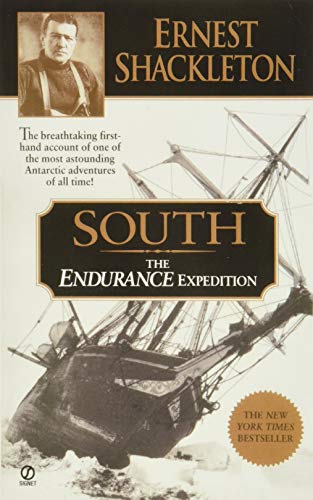
South: The Endurance Expedition -- The breathtaking first-hand account of one of the most astounding Antarctic adventures of all time - Softcover
Inhaltsangabe
In 1914, a party led by veteran explorer Sir Ernest Shackleton sets out to become the first to traverse the continent of Antarctica. Their initial optimism is short-lived, however, as the ice field slowly thickens, encasing the ship Endurance in a death-grip, crushing their craft, and marooning 28 men on a polar ice floe....
In an epic struggle of man versus the elements, Shackleton leads his team on a harrowing quest for survival over some of the most unforgiving terrain in the world. Icy, tempestuous seas full of gargantuan waves, mountainous glaciers and icebergs, unending brutal cold, and ever-looming starvation are their mortal foes as Shackleton and his men struggle to stay alive.
What happened to those brave men forever stands as a testament to their strength of will and the power of human endurance.
This is their story, as told by the man who led them.
Die Inhaltsangabe kann sich auf eine andere Ausgabe dieses Titels beziehen.
Über die Autorin bzw. den Autor
Sir Ernest Shackleton, C.V.O. (1874-1922) is regarded as perhaps the greatest of all Antarctic explorers. He was a member of Captain Scott's 1901-1903 expedition to the South Pole, and in 1907 led his own expedition on the whaler Nimrod, coming within ninety-seven miles of the South Pole, the feat for which he was knighted. The events of that expedition are chronicled in his first book, The Heart of the Antarctic. He is considered one of England's greatest heroes for his actions during the ill-fated Endurance expedition, leading all of his men to safety after being marooned for two years on the polar ice. South is his recounting of this expedition. He died at age forty-seven during his final expedition, and was buried in the whaler's cemetary on South Georgia Island in the South Atlantic.
Auszug. © Genehmigter Nachdruck. Alle Rechte vorbehalten.
South
The Endurance ExpeditionBy Ernest Henry ShackletonSignet Book
Copyright © 1999 Ernest Henry ShackletonAll right reserved.
ISBN: 0451198808
Chapter One
CROSSING THE SOUTH POLE
INTO THE WEDDELL SEA
I had decided to leave South Georgia about December 5, and inthe intervals of final preparation scanned again the plans for thevoyage to winter quarters. What welcome was the Weddell Seapreparing for us? The whaling captains at South Georgia weregenerously ready to share with me their knowledge of the watersin which they pursued their trade, and, while confirming earlierinformation as to the extreme severity of the ice conditions in thissector of the Antarctic, they were able to give advice that was worthattention.
It will be convenient to state here briefly some of the considerationsthat weighed with me at that time and in the weeks thatfollowed. I knew that the ice had come far north that season,and, after listening to the suggestions of the whaling captains, haddecided to steer to the South Sandwich Group, round UltimaThule, and work as far to the eastward as the fifteenth meridianwest longitude before pushing south. The whalers emphasizedthe difficulty of getting through the ice in the neighbourhood ofthe South Sandwich Group. They told me they had often seenthe floes come right up to the Group in the summer-time, and theythought the Expedition would have to push through heavy pack inorder to reach the Weddell Sea. Probably the best time to getinto the Weddell Sea would be the end of February or the beginningof March. The whalers had gone right round the SouthSandwich Group and they were familiar with the conditions.The predictions they made had induced me to take the deck-load ofcoal, for if we had to fight our way through to Coats' Land wewould need every ton of fuel the ship could carry.
I hoped that by first moving to the east as far as the fifteenthmeridian west we would be able to go south through looser ice,pick up Coats' Land and finally reach Vahsel Bay, where Filchnermade his attempt at landing in 1912. Two considerations wereoccupying my mind at this juncture. I was anxious for certainreasons to winter the Endurance in the Weddell Sea, but thedifficulty of finding a safe harbour might be very great. If no safeharbour could be found, the ship must winter at South Georgia.It seemed to me hopeless now to think of making the journey acrossthe continent in the first summer, as the season was far advancedand the ice conditions were likely to prove unfavourable. Inview of the possibility of wintering the ship in the ice, we tookextra clothing from the stores at the various stations in SouthGeorgia.
The other question that was giving me anxious thought was thesize of the shore party. If the ship had to go out during thewinter, or if she broke away from winter quarters, it would bepreferable to have only a small, carefully selected party of menashore after the hut had been built and the stores landed. Thesemen could proceed to lay out depots by man-haulage and makeshort journeys with the dogs, training them for the long earlymarch in the following spring. The majority of the scientificmen would live aboard the ship, where they could do their workunder good conditions. They would be able to make short journeys,if required, using the Endurance as a base. All these planswere based on an expectation that the finding of winter quarterswas likely to be difficult. If a really safe base could be establishedon the continent, I would adhere to the original programme ofsending one party to the south, one to the west round the head ofthe Weddell Sea towards Graham Land, and one to the east towardsEnderby Land.
We had worked out details of distances, courses, stores required,and so forth. Our sledging ration, the result of experience as wellas close study, was perfect. The dogs gave promise, after training,of being able to cover fifteen to twenty miles a day withloaded sledges. The trans-continental journey, at this rate, shouldbe completed in 120 days unless some unforeseen obstacle intervened.We longed keenly for the day when we could begin thismarch, the last great adventure in the history of South Polarexploration, but a knowledge of the obstacles that lay between usand our starting-point served as a curb on impatience. Everythingdepended upon the landing. If we could land at Filchner'sbase there was no reason why a band of experienced men shouldnot winter there in safety. But the Weddell Sea was notoriouslyinhospitable, and already we knew that its sternest face was turnedtowards us. All the conditions in the Weddell Sea are unfavourablefrom the navigator's point of view. The winds are comparativelylight, and consequently new ice can form even in the summer-time.The absence of strong winds has the additional effectof allowing the ice to accumulate in masses, undisturbed. Thengreat quantities of ice sweep along the coast from the east underthe influence of the prevailing current, and fill up the bight of theWeddell Sea as they move north in a great semicircle. Some ofthis ice doubtless describes almost a complete circle, and is held upeventually, in bad seasons, against the South Sandwich Islands.The strong currents, pressing the ice masses against the coasts,create heavier pressure than is found in any other part of theAntarctic. This pressure must be at least as severe as the pressureexperienced in the congested North Polar basin, and I aminclined to think that a comparison would be to the advantage ofthe Arctic. All these considerations naturally had a bearingupon our immediate problem, the penetration of the pack and thefinding of a safe harbour on the continental coast.
The day of departure arrived. I gave the order to heaveanchor at 8.45 a.m. on December 5, 1914, and the clanking of thewindlass broke for us the last link with civilization. The morningwas dull and overcast, with occasional gusts of snow andsleet, but hearts were light aboard the Endurance. The long daysof preparation were over and the adventure lay ahead.
We had hoped that some steamer from the north would bringnews of the war and perhaps letters from home before our departure.A ship did arrive on the evening of the 4th, but she carriedno letters, and nothing useful in the way of informationcould be gleaned from her. The captain and crew were all stoutlypro-German, and the "news" they had to give took the unsatisfyingform of accounts of British and French reverses. Wewould have been glad to have had the latest tidings from a friendliersource. A year and a half later we were to learn that theHarpoon, the steamer which tends the Grytviken station, had arrivedwith mall for us not more than two hours after the Endurancehad proceeded down the coast.
The bows of the Endurance were turned to the south, and thegood ship dipped to the south-westerly swell, Misty rain fellduring the forenoon, but the weather cleared later in the day, andwe had a good view of the coast of South Georgia as we movedunder steam and sail to the south-east. The course was laid tocarry us clear of the island and then south of South Thule, SandwichGroup. The wind freshened during the day, and all squaresail was set, with the foresail reefed in order to give the look-outa clear view ahead; for we did not wish to risk contact with a"growler," one of those treacherous fragments of ice that floatwith surface awash. The ship...
„Über diesen Titel“ kann sich auf eine andere Ausgabe dieses Titels beziehen.
Weitere beliebte Ausgaben desselben Titels

Suchergebnisse für South: The Endurance Expedition -- The breathtaking...

Beispielbild für diese ISBN
South The Endurance Expedition
Anbieter: World of Books (was SecondSale), Montgomery, IL, USA
Verkäuferbewertung 5 von 5 Sternen

Zustand: Good. Item in good condition. Textbooks may not include supplemental items i.e. CDs, access codes etc. Artikel-Nr. 00102970284
Gebraucht kaufen
EUR 5,32
Versand gratis
Versand innerhalb von USA
Versand innerhalb von USA
Anzahl: 2 verfügbar
Beispielbild für diese ISBN
South The Endurance Expedition
Anbieter: World of Books (was SecondSale), Montgomery, IL, USA
Verkäuferbewertung 5 von 5 Sternen
Zustand: Acceptable. Item in acceptable condition! Textbooks may not include supplemental items i.e. CDs, access codes etc. Artikel-Nr. 00080286158
Gebraucht kaufen
EUR 5,32
Versand gratis
Versand innerhalb von USA
Versand innerhalb von USA
Anzahl: 8 verfügbar
Beispielbild für diese ISBN
South: The Endurance Expedition -- The Breathtaking First-Hand Account of One of the Most Astounding Antarctic Adventures of
Verlag:
Berkley Books, 1999
ISBN 10: 0451198808
ISBN 13: 9780451198808
Gebraucht
Mass Market Paperback
Anbieter: ThriftBooks-Phoenix, Phoenix, AZ, USA
Verkäuferbewertung 5 von 5 Sternen
Mass Market Paperback. Zustand: Good. No Jacket. Pages can have notes/highlighting. Spine may show signs of wear. ~ ThriftBooks: Read More, Spend Less. Artikel-Nr. G0451198808I3N00
Gebraucht kaufen
EUR 5,96
Versand gratis
Versand innerhalb von USA
Versand innerhalb von USA
Anzahl: 4 verfügbar
Beispielbild für diese ISBN
South: The Endurance Expedition -- The Breathtaking First-Hand Account of One of the Most Astounding Antarctic Adventures of
Verlag:
Berkley Books, 1999
ISBN 10: 0451198808
ISBN 13: 9780451198808
Gebraucht
Mass Market Paperback
Anbieter: ThriftBooks-Dallas, Dallas, TX, USA
Verkäuferbewertung 5 von 5 Sternen
Mass Market Paperback. Zustand: Good. No Jacket. Pages can have notes/highlighting. Spine may show signs of wear. ~ ThriftBooks: Read More, Spend Less. Artikel-Nr. G0451198808I3N00
Gebraucht kaufen
EUR 5,96
Versand gratis
Versand innerhalb von USA
Versand innerhalb von USA
Anzahl: 5 verfügbar
Beispielbild für diese ISBN
South: The Endurance Expedition -- The Breathtaking First-Hand Account of One of the Most Astounding Antarctic Adventures of
Verlag:
Berkley Books, 1999
ISBN 10: 0451198808
ISBN 13: 9780451198808
Gebraucht
Mass Market Paperback
Anbieter: ThriftBooks-Reno, Reno, NV, USA
Verkäuferbewertung 5 von 5 Sternen
Mass Market Paperback. Zustand: Good. No Jacket. Pages can have notes/highlighting. Spine may show signs of wear. ~ ThriftBooks: Read More, Spend Less. Artikel-Nr. G0451198808I3N00
Gebraucht kaufen
EUR 5,96
Versand gratis
Versand innerhalb von USA
Versand innerhalb von USA
Anzahl: 4 verfügbar
Beispielbild für diese ISBN
South: The Endurance Expedition -- The Breathtaking First-Hand Account of One of the Most Astounding Antarctic Adventures of
Verlag:
Berkley Books, 1999
ISBN 10: 0451198808
ISBN 13: 9780451198808
Gebraucht
Mass Market Paperback
Anbieter: ThriftBooks-Atlanta, AUSTELL, GA, USA
Verkäuferbewertung 5 von 5 Sternen
Mass Market Paperback. Zustand: Good. No Jacket. Former library book; Pages can have notes/highlighting. Spine may show signs of wear. ~ ThriftBooks: Read More, Spend Less. Artikel-Nr. G0451198808I3N10
Gebraucht kaufen
EUR 5,96
Versand gratis
Versand innerhalb von USA
Versand innerhalb von USA
Anzahl: 1 verfügbar
Beispielbild für diese ISBN
South: The Endurance Expedition -- The Breathtaking First-Hand Account of One of the Most Astounding Antarctic Adventures of
Verlag:
Berkley Books, 1999
ISBN 10: 0451198808
ISBN 13: 9780451198808
Gebraucht
Mass Market Paperback
Anbieter: ThriftBooks-Atlanta, AUSTELL, GA, USA
Verkäuferbewertung 5 von 5 Sternen
Mass Market Paperback. Zustand: Good. No Jacket. Pages can have notes/highlighting. Spine may show signs of wear. ~ ThriftBooks: Read More, Spend Less. Artikel-Nr. G0451198808I3N00
Gebraucht kaufen
EUR 5,96
Versand gratis
Versand innerhalb von USA
Versand innerhalb von USA
Anzahl: 5 verfügbar
Beispielbild für diese ISBN
South: The ENDURANCE Expedition
Anbieter: Redux Books, Grand Rapids, MI, USA
Verkäuferbewertung 5 von 5 Sternen
Mass market. Zustand: Good. Paperback. Pages are clean and unmarked. Covers show light edge wear.; 100% Satisfaction Guaranteed! Ships same or next business day! Artikel-Nr. 132504020041
Gebraucht kaufen
EUR 6,00
Versand gratis
Versand innerhalb von USA
Versand innerhalb von USA
Anzahl: 1 verfügbar
Beispielbild für diese ISBN
South: The ENDURANCE Expedition
Anbieter: Wonder Book, Frederick, MD, USA
Verkäuferbewertung 5 von 5 Sternen
Zustand: Very Good. Very Good condition. A copy that may have a few cosmetic defects. May also contain light spine creasing or a few markings such as an owner's name, short gifter's inscription or light stamp. Artikel-Nr. C03A-08855
Gebraucht kaufen
EUR 6,33
Versand gratis
Versand innerhalb von USA
Versand innerhalb von USA
Anzahl: 1 verfügbar
Beispielbild für diese ISBN
South : The Endurance Expedition -- the Breathtaking First-Hand Account of One of the Most Astounding Antarctic Adventures of All Time
Verlag:
Penguin Publishing Group, 1999
ISBN 10: 0451198808
ISBN 13: 9780451198808
Gebraucht
Softcover
Anbieter: Better World Books, Mishawaka, IN, USA
Verkäuferbewertung 5 von 5 Sternen
Zustand: Good. Pages intact with minimal writing/highlighting. The binding may be loose and creased. Dust jackets/supplements are not included. Stock photo provided. Product includes identifying sticker. Better World Books: Buy Books. Do Good. Artikel-Nr. GRP76931955
Gebraucht kaufen
EUR 6,47
Versand gratis
Versand innerhalb von USA
Versand innerhalb von USA
Anzahl: 6 verfügbar