
Verwandte Artikel zu The Start Here Diet: Three Simple Steps That Helped...
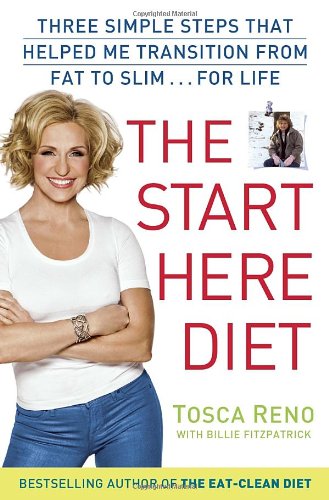
The Start Here Diet: Three Simple Steps That Helped Me Transition from Fat to Slim . . . for Life - Hardcover
Inhaltsangabe
In this life-changing book, bestselling author Tosca Reno, delivers an approachable plan designed to help you gently lose your problem pounds without a big lifestyle change. Her three simple steps help you isolate your emotional barriers to weight loss, identify the "hidden foods" that literally weigh you down, and encourage you to move a little every day--offering 50 small movements to choose from--without drastically changing your routine. Tosca also offers 28 days of suggested meal plans and 30 easy and absolutely delicious recipes that are simple to make at home.
Die Inhaltsangabe kann sich auf eine andere Ausgabe dieses Titels beziehen.
Über die Autorin bzw. den Autor
TOSCA RENO is an internationally-known nutritionist, weightloss specialist, fitness trainer, motivational speaker, and bestselling author. Her Eat-Clean Diet book series has sold over two million copies. Tosca tours 250 days out of every year. She speaks approximately ten times per month all across North America and additionally appears at book and health events, bookstore signings, and school events several times a year. BILLIE FITZPATRICK has co-authored numerous books, including several New York Times Bestsellers, specializing in mind-body health, nutrition, and diet and fitness.
Auszug. © Genehmigter Nachdruck. Alle Rechte vorbehalten.
PART ONE
Coming Out of Hiding
1
My Prison
Many of us think we are being honest when we say to ourselves, “I’m happy.” We think we are being honest when we tell ourselves and those we love, “I’m fine” or “Don’t worry, everything is all right.”
But often we are lying. Not on purpose. Not because we want to mislead others. But because we are in such pain, or feel so uncomfortable with how we look or how we feel, that we hide. We hide from our families, our friends, our doctors, our co-workers. We hide from ourselves. We hide because we feel ashamed. We tell everyone that we feel fine because how could we possibly admit that we are not?
For years, I lived my life in hiding, and coming out of hiding took some painful reckoning. When others asked how I was doing, I would reply in a defensive tone, “I’m fine!” The message I clearly sent with that response was “Don’t dig any deeper. Leave me alone.”
When I was seventy-five pounds overweight, I was heavy emotionally as well as physically. I gained the weight because I was out of touch with my inner needs and voice; remaining heavy was a way to continue hiding. Admitting and recognizing the power of that inner place is where my journey to permanent weight loss and health began. And it will be the same for you. Not the same story, but the same reaching inward to the place where you’ve been hiding.
To understand my weight loss journey you need to also understand what else I had to lose—small step by small step—before I could shed pounds and find my true self.
I grew up in Kingston, Ontario, Canada, with three siblings, one sister and two brothers. We had a happy home and my parents were loving and supportive. My dad was resourceful, reliable, and sturdy. But it was my mom who was in charge of things. She was strict and she set high standards for me and my siblings; she wanted the best for us all and pushed us to achieve.
I was always a strong-willed young girl. I loved the challenge of competition. I was an athlete—I ran, swam, and played soccer. I loved horses. I was always on the move, rarely looking behind me as I forged ahead into my next new adventure. Always in a rush, I sometimes didn’t look ahead either. I had more than a few run-ins with telephone wires and bushes and tree roots!
At university I studied science. I also fell in love hard and fast when I was just twenty years old. Since my then-love was a couple of years ahead of me academically, I interrupted my studies when he graduated and together we went out west. I believed in his dreams for our success and for our future together. We were married when I was twenty-three—not unusually young for the time, but definitely an age when I was only just beginning to understand myself.
I didn’t question giving up further education for my husband’s career: it seemed natural, something I could do to show him the depth of my love and commitment. Besides, didn’t I have the rest of my life to figure out what I wanted to do?
But very early into my marriage, my connection to myself began to disappear. I cannot tell you about one specific moment, or even one particular event that triggered my separation from myself. It was a slow build. But day by day, month by month, I began to lose a sense of my own importance. It probably began with the very simple act of giving up what had been important to me—studying science—for someone else’s dream.
Even as I was thrilled to have children, I think I really let go of the real Tosca when I became a mother. Like many women (of all ages), I jumped into parenthood and all its responsibilities and quickly became absorbed in making other people happy. What I can see now is that when I focused so completely on caring for my kids, I stopped knowing how to care for myself. But that wasn’t the only reason I began hiding.
Early in my marriage, we moved a lot for my husband’s job. The moves were necessary for his career, but they were also disruptive and I was more or less solely responsible for the logistics of each move and for helping the kids adjust each time. I loved my husband; the heavy lifting was a way of showing my support. But each move was stressful and each one took a lot out of me. It should have been goodwill that was building in our partnership, but instead there was mounting tension, and I felt I had to walk on eggshells. A lot of the time, especially at home, I felt nervous and vulnerable. This emotional environment made me withdraw from myself even more. It didn’t feel safe to simply be me. Even now as I describe it to you, the reader, I realize I was then and am still afraid to admit that my relationship was transitioning from love to routine, and ultimately to something very different from love; it was abuse.
When I was twenty-six, I gave birth to our third beautiful daughter. Soon thereafter, we moved yet again, the seventh time in ten years. Again, I felt enormous joy bringing forth this new life into the world. But I was beginning to realize that there was a darkness creeping in and around me. I was busy, busy, busy and yet never made time for myself. My movements kept me out of my head and out of my heart. I scurried around for others. I wanted to think everything was perfect. I began to tell myself, “Everything is fine.” “You should be grateful.” But somewhere deep inside me I knew these words were just not true. And on the surface life was indeed grand. I loved our house, our great community, our pretty little suburban neighborhood. I got wonderfully lost in being a mom. I loved being with my girls and teaching them about school, life, and themselves. Isn’t this what I needed to make my life meaningful, my heart feel safe and purposeful?
The surface never tells the whole story. In reality, with each passing day, month, and year, I was becoming less happy, less relaxed, more stressed, and more sad. I found myself relying on destructive ways of covering my anxiety and dulling my own yearnings. “Time for myself” was time spent eating. I had a warped sense of what it meant to indulge my own needs!
My bad habits consumed me. Some of these habits may even seem familiar to you. I stayed up late after everyone went to bed, made myself comfortable on the living room sofa, and lost myself in a quart of ice cream or a jar of peanut butter. Swallowing one spoonful after another, I no longer tasted the food or felt the pleasure of its sweetness. Rather, I shoveled in food to obliterate my own feelings of sadness. My husband and I had drifted far apart—he busy with work and I busy managing the house and family to a self-imposed perfection. I berated myself if the house was messy or if there were things left undone at the end of a busy day. These late night feed-fests were a way of battling back the feeling that I was a loser. I was desperate to block out the constant, gnawing fear that something was terribly wrong with me, with my life. One of the most basic human needs, according to Tony Robbins, master life coach, is the need to feel significant. Caring for everyone else was meaningful work and had my marriage been happy, I might have felt differently, but all I knew then is that the care and feeding of other souls didn’t satisfy my own soul’s need for significance.
When I got married, I weighed about 127 pounds—thin for a woman of my height (5'8"). But ten years later, the number on the scale had reached two hundred and four pounds. I was a bloated and obscured version of my former self.
At two hundred plus pounds, I avoided mirrors and cameras. I hid...
„Über diesen Titel“ kann sich auf eine andere Ausgabe dieses Titels beziehen.
Suchergebnisse für The Start Here Diet: Three Simple Steps That Helped...

Beispielbild für diese ISBN
The Start Here Diet: Three Simple Steps That Helped Me Transition from Fat to Slim . . . for Life
Verlag:
Appetite by Random House, 2013
ISBN 10: 0449016099
ISBN 13: 9780449016091
Gebraucht
Hardcover
Anbieter: ThriftBooks-Dallas, Dallas, TX, USA
Verkäuferbewertung 5 von 5 Sternen

Hardcover. Zustand: Good. No Jacket. Pages can have notes/highlighting. Spine may show signs of wear. ~ ThriftBooks: Read More, Spend Less. Artikel-Nr. G0449016099I3N00
Gebraucht kaufen
EUR 23,04
Versand gratis
Versand innerhalb von USA
Versand innerhalb von USA
Anzahl: 1 verfügbar