
Inhaltsangabe
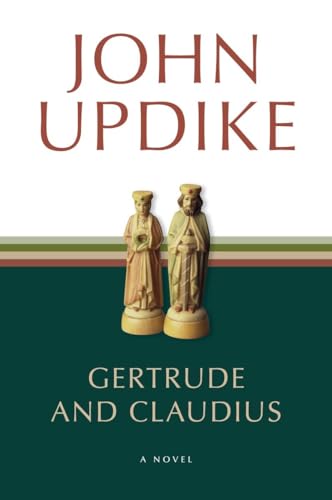
Gertrude and Claudius are the “villains” of Hamlet: he the killer of Hamlet’s father and usurper of the Danish throne; she his lusty consort, who marries Claudius before her late husband’s body is cold. But in this imaginative “prequel” to the play, John Updike makes a case for the royal couple that Shakespeare only hinted at. Gertrude and Claudius are seen afresh against a background of fond intentions and family dysfunction, on a stage darkened by the ominous shadow of a sullen, erratic, disaffected prince. “I hoped to keep the texture light,” Updike said of this novel, “to move from the mists of Scandinavian legend into the daylight atmosphere of the Globe. I sought to narrate the romance that preceded the tragedy.”
Die Inhaltsangabe kann sich auf eine andere Ausgabe dieses Titels beziehen.
Über die Autorin bzw. den Autor
John Updike was born in Shillington, Pennsylvania, in 1932. He graduated from Harvard College in 1954 and spent a year in Oxford, England, at the Ruskin School of Drawing and Fine Art. From 1955 to 1957 he was a member of the staff of The New Yorker. His novels have won the Pulitzer Prize, the National Book Award, the National Book Critics Circle Award, the Rosenthal Foundation Award, and the William Dean Howells Medal. In 2007 he received the Gold Medal for Fiction from the American Academy of Arts and Letters. John Updike died in January 2009.
Von der hinteren Coverseite
AL BESTSELLER
“A LIVING, POWERFULLY PHYSICAL WORK . . . UPDIKE IS A SUPERBLY SKILLFUL WRITER.”
–The Wall Street Journal
“WHAT A PIECE OF WORK IS UPDIKE! Our own king of erudition has gone back to the Hamlet story to imagine its inception: its offstage pre-story, when Claudius fell in love with his brother’s queen and that first dastardly deed in the garden was set in motion. Wickedly replete with allusions, weaving the history of ideas with the lustier possibilities of adulterous coupling. . . . There is something delightful about following Updike down this path, seeing his sentiments and sympathies unfold.”
–The Boston Globe
“WITTY . . . FRESH AND MOVING . . . Engrossing enough on its own terms to stand independently of Shakespeare’s play.”
–Time
“[UPDIKE] HAS MANAGED TO CREATE
Aus dem Klappentext
AL BESTSELLER
A LIVING, POWERFULLY PHYSICAL WORK . . . UPDIKE IS A SUPERBLY SKILLFUL WRITER.
The Wall Street Journal
WHAT A PIECE OF WORK IS UPDIKE! Our own king of erudition has gone back to the Hamlet story to imagine its inception: its offstage pre-story, when Claudius fell in love with his brother s queen and that first dastardly deed in the garden was set in motion. Wickedly replete with allusions, weaving the history of ideas with the lustier possibilities of adulterous coupling. . . . There is something delightful about following Updike down this path, seeing his sentiments and sympathies unfold.
The Boston Globe
WITTY . . . FRESH AND MOVING . . . Engrossing enough on its own terms to stand independently of Shakespeare s play.
Time
[UPDIKE] HAS MANAGED TO CREATE
Auszug. © Genehmigter Nachdruck. Alle Rechte vorbehalten.
THE KING was irate. His daughter, Gerutha, though but a plump sixteen, had voiced reluctance to marry the nobleman of his choice, Horwen- dil the Jute, a beefy warrior in every way suitable, if Jutes could ever suit in marriage a Zealand maiden born and reared in the royal castle of Elsinore. “To disobey the King is treason,” Rorik admonished his child, the roses in whose thin-skinned cheeks flared with defiance and distress. “When the culprit is the realm’s only princess,” he went on, “the crime becomes incestuous and self-injuring.”
“In every way suitable to you,” Gerutha said, pursuing her own instincts, shadows chased into the far corners of her mind by the regal glare her father cast. “But I found him unsubtle.”
“Unsubtle! He has all the warrior wit a loyal Dane needs! Horwendil slew the tormentor of our coasts, King Koll of Norway, by taking his long sword in two hands, thus baring his own chest; but, before he could be stabbed there, he shattered Koll’s shield and cut off the Norseman’s foot so the blood poured clean out of him! As he lay turning the sands beneath him into mud, Koll bargained the terms of his funeral, which his young slayer granted graciously.”
“I suppose that could pass for nicety,” said Gerutha, “in the dark old days, when the deeds of the sagas were being wrought, and men and gods and natural forces were all as one.”
Rorik protested, “Horwendil is a thoroughly modern man—my battle-mate Gerwindil’s worthy son. He has proven a most apt co-governor of Jutland, with his rather less prepossessing brother, Feng. An apt governor solus, I might say, since Feng is forever off in the south, fighting on behalf of the Holy Roman Emperor or whoever else trusts his arm and his agile tongue. Fighting and whoring, it is said. The people love him. Horwendil. They do not love Feng.”
“The very qualities that make for public love,” Gerutha responded, her rosy blush slowly subsiding as the moment of most heated opposition between father and daughter passed, “may impede love in private. In our fleeting contacts, Horwendil has treated me with an unfeeling, standard courtesy—as a court ornament whose real worth derives from my kinship with you. Or else he has looked through me entirely, with eyes that see only the rivalrous doings of other men. This is the gallant who, having laid Koll and sufficient gold on the buried black ship to the next life, pursued and butchered the slain man’s sister, Sela, with no merciful allowance for the frailty of her sex.”
“Sela was a warrior, a rover, to equal a man. She deserved a man’s death.”
The phrase piqued Gerutha. “Is a woman’s death less than a man’s, I wonder? I think death for both is exactly as big as it must be, like the moon when it blackens the sun, to eclipse life completely, even to the last breath, which perhaps will be a sigh over opportunities wasted and happiness missed. Sela was a rover, but no woman wants to be a mere piece of furniture, to be bartered for and then sat upon.”
So defiant a formula, emerging from his fair daughter’s flushed face, lifted Rorik’s tangled half-gray eyebrows in synchrony with his upper lip, from which a long limp mustache drooped. His lip stopped lifting as his instinctive indulgent laugh was checked and hardened, by the pressure of royal policy, into a snarl. He was reminding himself to be stern. His mouth looked meaty and twisty and red between his mustache and his uncombed, grizzled beard. He would have been ugly, had he not been her father. “Since your mother’s untimely death, my dear child, your happiness has been my supreme concern. But I have pledged you to Horwendil, and if a king’s word is broken, the kingdom cracks. All the three years when Horwendil roved, seizing trophies from Koll’s hoard and Sela’s palace and a dozen or more fat ports of Sweathland and Rus, he allowed me as his liege-lord the pick of the plunder.”
“And I am to be the plunder in exchange,” Gerutha observed. She was an ample, serene, dewy, and sensible girl. Had her beauty a flaw, it was a small gap between her front teeth, as if too broad a smile had once pulled the space forever open. Her hair, unbound as became a virgin, was the red of copper diluted by the tin of sunlight. A warmth surrounded her, an aura noticeable since infancy; her nurses in the icy straw-floored chambers of Elsinore had loved to clasp the resilient little body to their breasts. Bracelets of twisted bronze, brooches worked into a maze of interlaced ribbons, and a heavy necklace of thin-beaten silver scales bespoke a father’s lavishing love. Her mother, Ona, had died on the farthest verge of memory, when the child was three and feverish with the same ague that carried off the frail mother while sparing the sturdy child. Ona had been dark, a Wendish captive. An unsmiling face with lowered lids and thick brows, a melody sung with an accent even a toddler could recognize as strange, and a touch of tender but chilly fingers formed the bulk of maternal treasure Gerutha held in her memory. She was pleased now to hear, in her father’s mention of Sela, that women can be warriors. She felt warrior blood within her—warrior pride, warrior daring. There was a time, three or four years after her mother’s death, when she thought that she and the children whom, in the absence of broth- ers and sisters, she played with—the children of courtiers and retainers, of ladies-in-waiting, even of the kitchen thralls, in the informal rustic arrangements of Elsinore—were of the same status. Then she became aware, long before puberty had awoken any urge to mate, of her father’s blood regal within her. In the absence of a brother, she stood nearest the throne, this nearness to be assumed by the man whom she would marry. So some of the power of state was hers, in this mismatched struggle of wills.
Her father asked her, “What distinct fault have you found in Horwendil?”
“None—which is perhaps a fault in itself. I am told that a wife completes a man. Horwendil feels himself complete already.”
“No unwived man feels so, though he may not proclaim it,” said Rorik, himself unwived, in a grave voice.
Was this meant to soften her, so she could be bent more easily to his command? That she would eventually yield, both knew. He was a king, all substance, in essence immortal, and she of an evanescent loveliness, negligible amid the historical imperatives of dynasty and alliance. “Truly,” Rorik pleaded, “is there no chance of Horwendil pleasing you? Have you already such strict notions of what a husband should be? Believe me, Gerutha, in the rough world of men, he is a more than fine specimen. He sees his duties and keeps his vows. Since your veins carry kingship in them, I have chosen for you a man fit to be king.” He dropped his voice, with its cunning political range of threat and entreaty, into a register of irresistible gentleness. “My dear daughter: love is so natural a condition for men and women that, given normal health and an approximate parity of endowment, it will all but inevitably follow upon cohabitation and the many shared incidents of married life. You and Horwendil are fine specimens of our northern vigor—blond beasts, one could say, as solid as runestones in an upland pasture. Your sons will be giants, and conquerors of giants!
“You did not live long enough to know your mother,” Rorik went on without a pause, as if all this were a single story in aid of his pleading, “but you in your glowing ripeness bear testimony to our love....
„Über diesen Titel“ kann sich auf eine andere Ausgabe dieses Titels beziehen.
Suchergebnisse für Gertrude and Claudius: A Novel

Beispielbild für diese ISBN
Gertrude and Claudius A Novel
Verlag:
Random House Publishing Group, 2001
ISBN 10: 0449006972
ISBN 13: 9780449006979
Gebraucht
Softcover
Anbieter: World of Books (was SecondSale), Montgomery, IL, USA
Verkäuferbewertung 5 von 5 Sternen

Zustand: Good. Item in good condition. Textbooks may not include supplemental items i.e. CDs, access codes etc. Artikel-Nr. 00067414637
Gebraucht kaufen
EUR 3,61
Versand gratis
Versand innerhalb von USA
Versand innerhalb von USA
Anzahl: 16 verfügbar
Beispielbild für diese ISBN
Gertrude and Claudius A Novel
Verlag:
Random House Publishing Group, 2001
ISBN 10: 0449006972
ISBN 13: 9780449006979
Gebraucht
Softcover
Anbieter: World of Books (was SecondSale), Montgomery, IL, USA
Verkäuferbewertung 5 von 5 Sternen
Zustand: Very Good. Item in very good condition! Textbooks may not include supplemental items i.e. CDs, access codes etc. Artikel-Nr. 00101307416
Gebraucht kaufen
EUR 3,61
Versand gratis
Versand innerhalb von USA
Versand innerhalb von USA
Anzahl: 3 verfügbar
Beispielbild für diese ISBN
Gertrude and Claudius: A Novel
Verlag:
Random House Publishing Group (edition 6.3.2001), 2001
ISBN 10: 0449006972
ISBN 13: 9780449006979
Gebraucht
Paperback
Anbieter: BooksRun, Philadelphia, PA, USA
Verkäuferbewertung 5 von 5 Sternen
Paperback. Zustand: Fair. 6.3.2001. The item might be beaten up but readable. May contain markings or highlighting, as well as stains, bent corners, or any other major defect, but the text is not obscured in any way. Artikel-Nr. 0449006972-7-1
Gebraucht kaufen
EUR 4,72
Versand gratis
Versand innerhalb von USA
Versand innerhalb von USA
Anzahl: 1 verfügbar
Beispielbild für diese ISBN
Gertrude and Claudius
Verlag:
Random House Publishing Group, 2001
ISBN 10: 0449006972
ISBN 13: 9780449006979
Gebraucht
Paperback
Anbieter: ThriftBooks-Atlanta, AUSTELL, GA, USA
Verkäuferbewertung 5 von 5 Sternen
Paperback. Zustand: Very Good. No Jacket. May have limited writing in cover pages. Pages are unmarked. ~ ThriftBooks: Read More, Spend Less. Artikel-Nr. G0449006972I4N00
Gebraucht kaufen
EUR 5,71
Versand gratis
Versand innerhalb von USA
Versand innerhalb von USA
Anzahl: 2 verfügbar
Beispielbild für diese ISBN
Gertrude and Claudius
Verlag:
Random House Publishing Group, 2001
ISBN 10: 0449006972
ISBN 13: 9780449006979
Gebraucht
Paperback
Anbieter: ThriftBooks-Dallas, Dallas, TX, USA
Verkäuferbewertung 5 von 5 Sternen
Paperback. Zustand: Very Good. No Jacket. May have limited writing in cover pages. Pages are unmarked. ~ ThriftBooks: Read More, Spend Less. Artikel-Nr. G0449006972I4N00
Gebraucht kaufen
EUR 5,71
Versand gratis
Versand innerhalb von USA
Versand innerhalb von USA
Anzahl: 1 verfügbar
Beispielbild für diese ISBN
Gertrude and Claudius
Verlag:
Random House Publishing Group, 2001
ISBN 10: 0449006972
ISBN 13: 9780449006979
Gebraucht
Paperback
Anbieter: ThriftBooks-Reno, Reno, NV, USA
Verkäuferbewertung 5 von 5 Sternen
Paperback. Zustand: Very Good. No Jacket. May have limited writing in cover pages. Pages are unmarked. ~ ThriftBooks: Read More, Spend Less. Artikel-Nr. G0449006972I4N00
Gebraucht kaufen
EUR 5,72
Versand gratis
Versand innerhalb von USA
Versand innerhalb von USA
Anzahl: 1 verfügbar
Beispielbild für diese ISBN
Gertrude and Claudius
Verlag:
Random House Publishing Group, 2001
ISBN 10: 0449006972
ISBN 13: 9780449006979
Gebraucht
Paperback
Anbieter: ThriftBooks-Phoenix, Phoenix, AZ, USA
Verkäuferbewertung 5 von 5 Sternen
Paperback. Zustand: Very Good. No Jacket. May have limited writing in cover pages. Pages are unmarked. ~ ThriftBooks: Read More, Spend Less. Artikel-Nr. G0449006972I4N00
Gebraucht kaufen
EUR 5,72
Versand gratis
Versand innerhalb von USA
Versand innerhalb von USA
Anzahl: 1 verfügbar
Beispielbild für diese ISBN
Gertrude and Claudius : A Novel
Verlag:
Random House Publishing Group, 2001
ISBN 10: 0449006972
ISBN 13: 9780449006979
Gebraucht
Softcover
Anbieter: Better World Books, Mishawaka, IN, USA
Verkäuferbewertung 5 von 5 Sternen
Zustand: Good. Pages intact with minimal writing/highlighting. The binding may be loose and creased. Dust jackets/supplements are not included. Stock photo provided. Product includes identifying sticker. Better World Books: Buy Books. Do Good. Artikel-Nr. 561455-6
Gebraucht kaufen
EUR 6,20
Versand gratis
Versand innerhalb von USA
Versand innerhalb von USA
Anzahl: 3 verfügbar
Beispielbild für diese ISBN
Gertrude and Claudius: A Novel
Verlag:
Random House Publishing Group, 2001
ISBN 10: 0449006972
ISBN 13: 9780449006979
Gebraucht
Softcover
Anbieter: Wonder Book, Frederick, MD, USA
Verkäuferbewertung 5 von 5 Sternen
Zustand: Good. Good condition. A copy that has been read but remains intact. May contain markings such as bookplates, stamps, limited notes and highlighting, or a few light stains. Artikel-Nr. Q14A-02724
Gebraucht kaufen
EUR 6,79
Versand gratis
Versand innerhalb von USA
Versand innerhalb von USA
Anzahl: 2 verfügbar
Beispielbild für diese ISBN
Gertrude and Claudius: A Novel
Verlag:
Random House Publishing Group, 2001
ISBN 10: 0449006972
ISBN 13: 9780449006979
Gebraucht
Softcover
Anbieter: Wonder Book, Frederick, MD, USA
Verkäuferbewertung 5 von 5 Sternen
Zustand: Very Good. Very Good condition. A copy that may have a few cosmetic defects. May also contain light spine creasing or a few markings such as an owner's name, short gifter's inscription or light stamp. Artikel-Nr. T05A-05465
Gebraucht kaufen
EUR 6,79
Versand gratis
Versand innerhalb von USA
Versand innerhalb von USA
Anzahl: 2 verfügbar