
Verwandte Artikel zu Death Rounds
Inhaltsangabe
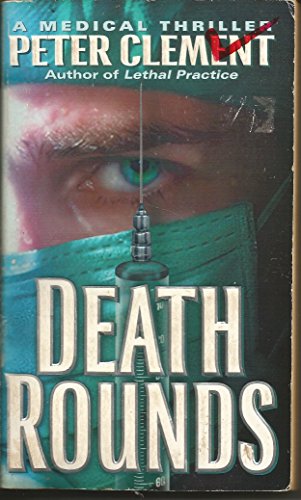
The author, a former emergency room physician in a big-city hospital, pits Dr. Earl Garnet against a madman among his own colleagues who threatens to infect the inmates of University Hospital with a deadly, ultra-resistant bacterium. Original.
Die Inhaltsangabe kann sich auf eine andere Ausgabe dieses Titels beziehen.
Über die Autorin bzw. den Autor
Peter Clement, M.D., is a physician who headed an emergency room at a major metropolitan hospital and now maintains a private practice. He is also the author of Lethal Practice. He is married to a physician and has two sons.
Aus dem Klappentext
BREEDING GROUND
When a nurse in Buffalo dies at St. Paul's Hospital of a once-treatable bacteria, Dr. Earl Garnet and his colleagues try to remain calm. They track the origin of the sickness to University Hospital. But as the infection rages out of control there and more people fall gravely ill--including Garnet's own wife--Earl uncovers a shocking connection between the victims.
KILLING GROUND
Throughout the community, panic and paranoia spread as wildly as the outbreak itself, and the entire University Hospital staff is quarantined. Yet the mastermind who created this deadly superresistant strain may be someone they know, someone locked within the barricades. Now the sociopath has threatened to infect fifty more people. And that will be only the beginning. . . .
DEATH ROUNDS
No one captures the complex workings of an urban hospital like former ER physician Dr. Peter Clement. His new medical thriller ranges from the realm of microbiology to raw, human rage--in a plot so chillingly authentic it could be happening right now. . . .
Auszug. © Genehmigter Nachdruck. Alle Rechte vorbehalten.
10:00 A.M., Tuesday, October 21
She looked dead. Her flesh was mottled purple and white from not enough oxygen and loss of circulation. But as I stepped up to the stretcher where she was lying, I could hear her breathing--gurgling noises, each ending with a whimper--and I could see the muscles between her ribs suck in and out as she struggled for air. Her skin felt warm despite its ghastly appearance and had a sour acrid smell, the aroma of sweat saturated with lactic acid. Brown fingertips betrayed years of smoking. At the touch of my hands she half opened her eyes and stared about her with quick darting movements. Her pupils were wide with terror, dilated by the flood of adrenaline that goes with dying, and her gray hair splayed out wild and tangled over the pillow. The worst was when those black eyes glared at me. Even in her agony, gasping and unable to move or speak, her expression seemed to say, You sent me home.
I smothered a rising wave of alarm and guilt as I placed two fingers at the right side of her neck. "Pressure?" I asked, trying to sound in control. I could barely palpate a pulse in her carotid artery.
"Eighty over zip, Doctor," replied the nurse who was at the patient's head. She was applying a translucent green oxygen mask and attaching the tube to a hissing wall outlet. "I just took it. And the pulse is one-twenty and irregular." She'd already wired the woman to a cardiac monitor. The erratic beeping accompanying the rapid squiggle on the screen above me was far from reassuring. "I think it's atrial fib," she added, as she watched me study the tracing. She was right.
When I didn't reply, she asked, "Aren't you going to cardiovert it?"
Her tone made it clear she thought I should try to shock the heart back into a normal rhythm. I shook my head. "It may be the result of the shock and not the cause." I forced myself to concentrate to keep thinking this through.
Two other nurses trying to start IVs in the woman's arms crouched at opposite sides of the table. Bags of saline had been suspended in readiness from overhead poles. "Got it," announced Susanne Roberts at my elbow. She was the head nurse and, like me, a twenty-year veteran of these desperate struggles. Without waiting for instructions, she reached up and adjusted the valve in the clear tubing that dangled from one of the bags of fluid. She then stepped around the foot of the bed and came to the aid of her much younger colleague, who'd just muttered, "Damn!"
The nurse at the head of the table reached past me to clip an oxygen monitor to the tip of one of the patient's fingers. Yet another machine began beeping behind me. "O2 sat's only eighty percent," she commented grimly, meaning the blood oxygen level was dangerously low.
"The first person free," I said, "get me a twelve-lead cardiogram, and I want a portable chest stat. Get someone else in here to draw bloods and catheterize her."
"Routine bloods are drawn and gone, Dr. Garnet," Susanne informed me as she started the second IV, "and X ray's been called." Then she nudged her flustered helper and quipped, "Even if he is chief of ER, I hope he knows enough to want blood cultures because I ordered them as well."
This time I barely managed a curt nod as I quickly slipped my stethoscope into my ears and listened to the woman's heart sounds. Susanne gave me a puzzled little glance.
Normally I welcomed her sassy wisecracks and joined in the fun. It was how we kept the rookies relaxed.
I moved the stethoscope to the lower right side of the woman's chest. Barely any air moved in her lungs. What little flow there was wheezed and crackled as it passed through--what? Fluid? Pus? Both? A listen on the left revealed more of the same. She was in warm shock, probably caused by sepsis--an overwhelming infection spread into the blood stream--with pneumonia being the most likely primary source. Yet I continued to check elsewhere. Stepping around the tangle of ECG wires Susanne was hooking up, I palpated the abdomen and examined the lower extremities. Nothing. But when I moved back up to the patient's head and flexed her neck, checking for stiffness and evidence of meningitis, her eyes still followed me and I had to endure that stare again. Look at what you've done to me!
I shuddered but kept myself focused on treating her. "Okay, everyone, this is an infectious case, septic shock, probably from overwhelming pneumonia of some kind, and isolation is in force." We were already wearing masks and gloves as a general precaution. Isolation meant donning surgical gowns for additional protection against bodily fluids and discarding all this protective gear in a bin at the door whenever we left the room. Such measures were intended to protect us and the other patients in the rest of the hospital. Hopefully. The circus I was about to create wasn't conducive to the confinement of deadly microbes.
People were running in, fumbling with back ties on their half-done-up masks and gowns.
I kept giving orders. "Keep the IVs open, raise her legs, but give me vitals every few minutes. We don't want to overload her. And get me an inhalation therapist fast. We need to intubate this lady and help her breathe now!"
But my words sounded hollow. When I turned to speak specifically to Susanne, I found it hard to look her in the eye. "When whoever you called to take blood cultures gets down here, have him culture and Gram-stain everything else as well--sputum, urine, CSF, even stool--and repeat the blood cultures again in thirty minutes if we get that far." While talking, I was already struggling into a green OR gown I'd gotten from one of the racks where we kept gear for dirty cases. "Get one of our residents to do the LP," I added, praying that no one would see through my phony show of calm.
The lab tech arrived with a basket of tubes and swabs.
I stepped to the top of the bed behind the woman's head and flipped off her oxygen mask. She'd started to cough, and yellow foam was seeping out between her lips. Mercifully her eyes were now closed. "Get whoever's on call for ICU and ID," I said over the rising voices. I grabbed a rigid suction catheter from the wall beside me and opened the valve that activated it. "And tell ID if they don't get here fast, we'll choose their antibiotics for them." Infectious disease consultants, by definition, never liked our choice of treatment, even when we got it right. Today I knew I needed their help.
I put my gloved fingers into the pus streaked with blood flowing from her mouth and scissored open her teeth. Through the thin latex I could feel the debris was thick and warm. How could I have allowed her to get like this? Whatever I thought of her, she was one of our own. With the recriminations, I broke into a sweat.
"Let me culture that gunk before you suction it out," ordered the lab tech who'd just finished drawing off the bloods. He pushed by me, took a sterile cup and gingerly scooped up a glob of the stuff as it rolled out the corner of her mouth. He'd mount a dab of this sample on a glass slide and color it with violet and iodine solutions, the ingredients of a Gram stain. In twenty minutes he'd have it under a microscope and know what was killing her. He then plunged several long Q-Tips into the pool of secretions welling up at the back of her throat. Her whole body bucked as she gagged and choked while he poked about. Small yellow droplets flew onto the front of my glasses. When he withdrew, thick strands of the purulent sputum dripped from the ends of the swabs. These specimens would be plated onto various types of agar in which the organism would be grown to determine...
„Über diesen Titel“ kann sich auf eine andere Ausgabe dieses Titels beziehen.
Suchergebnisse für Death Rounds

Beispielbild für diese ISBN
Death Rounds
Anbieter: World of Books (was SecondSale), Montgomery, IL, USA
Verkäuferbewertung 5 von 5 Sternen

Zustand: Acceptable. Item in good condition. Textbooks may not include supplemental items i.e. CDs, access codes etc. Artikel-Nr. 00045476652
Gebraucht kaufen
EUR 4,73
Versand gratis
Versand innerhalb von USA
Versand innerhalb von USA
Anzahl: 1 verfügbar
Beispielbild für diese ISBN
Death Rounds
Anbieter: World of Books (was SecondSale), Montgomery, IL, USA
Verkäuferbewertung 5 von 5 Sternen
Zustand: Good. Item in good condition. Textbooks may not include supplemental items i.e. CDs, access codes etc. Artikel-Nr. 00110139678
Gebraucht kaufen
EUR 4,73
Versand gratis
Versand innerhalb von USA
Versand innerhalb von USA
Anzahl: 1 verfügbar
Beispielbild für diese ISBN
Death Rounds
Verlag:
Fawcett (edition ), 1999
ISBN 10: 0449004503
ISBN 13: 9780449004500
Gebraucht
Mass Market Paperback
Anbieter: BooksRun, Philadelphia, PA, USA
Verkäuferbewertung 5 von 5 Sternen
Mass Market Paperback. Zustand: Fair. The item might be beaten up but readable. May contain markings or highlighting, as well as stains, bent corners, or any other major defect, but the text is not obscured in any way. Artikel-Nr. 0449004503-7-1-13
Gebraucht kaufen
EUR 4,73
Versand gratis
Versand innerhalb von USA
Versand innerhalb von USA
Anzahl: 1 verfügbar
Beispielbild für diese ISBN
Death Rounds
Verlag:
Random House Publishing Group, 1999
ISBN 10: 0449004503
ISBN 13: 9780449004500
Gebraucht
Softcover
Anbieter: Better World Books, Mishawaka, IN, USA
Verkäuferbewertung 5 von 5 Sternen
Zustand: Good. Pages intact with minimal writing/highlighting. The binding may be loose and creased. Dust jackets/supplements are not included. Stock photo provided. Product includes identifying sticker. Better World Books: Buy Books. Do Good. Artikel-Nr. 18892781-6
Gebraucht kaufen
EUR 6,05
Versand gratis
Versand innerhalb von USA
Versand innerhalb von USA
Anzahl: 2 verfügbar
Beispielbild für diese ISBN
Death Rounds
Anbieter: ThriftBooks-Dallas, Dallas, TX, USA
Verkäuferbewertung 5 von 5 Sternen
Unknown. Zustand: Fair. No Jacket. Readable copy. Pages may have considerable notes/highlighting. ~ ThriftBooks: Read More, Spend Less. Artikel-Nr. G0449004503I5N00
Gebraucht kaufen
EUR 6,06
Versand gratis
Versand innerhalb von USA
Versand innerhalb von USA
Anzahl: 1 verfügbar
Beispielbild für diese ISBN
Death Rounds
Anbieter: The Yard Sale Store, Narrowsburg, NY, USA
Verkäuferbewertung 5 von 5 Sternen
Paperback. Zustand: Good. POCKET BOOK STYLE PAPERBACK in clean presentable condition. Tight binding. Just a bit of shelf wear to the covers. Enjoy the convenience of this EASY TO CARRY paperback edition for your home, library and travel needs. Artikel-Nr. 119492020941330
Gebraucht kaufen
EUR 2,06
EUR 5,21 Versand
Versand innerhalb von USA
Versand innerhalb von USA
Anzahl: 1 verfügbar
Beispielbild für diese ISBN
Death Rounds
Anbieter: Robinson Street Books, IOBA, Binghamton, NY, USA
Verkäuferbewertung 4 von 5 Sternen

Mass Market Paperback. Zustand: Good. Prompt Shipment, shipped in Boxes, Tracking PROVIDEDgood clean copy some creasing. Artikel-Nr. ware306xrm9935
Gebraucht kaufen
EUR 12,15
EUR 8,30 Versand
Versand innerhalb von USA
Versand innerhalb von USA
Anzahl: 1 verfügbar