
Verwandte Artikel zu The Children
Inhaltsangabe
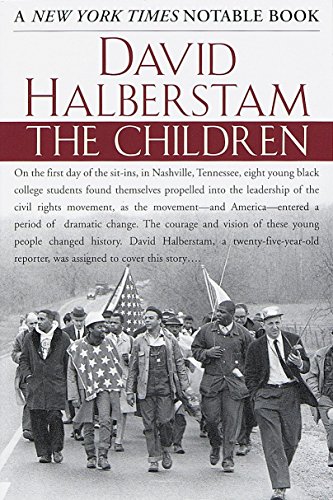
A remarkable true story of heroism, courage, and faith
Die Inhaltsangabe kann sich auf eine andere Ausgabe dieses Titels beziehen.
Über die Autorin bzw. den Autor
DAVID HALBERSTAM graduated from Harvard, where he had served as managing editor of the daily Harvard Crimson. It was 1955, a year after the Supreme Court outlawed segregation in public schools. Halberstam went south and began his career as the one reporter on the West Point, Mississippi, Daily Times Leader. He was fired after ten months there and went to work for The Nashville Tennessean. When the sit-ins broke out in Nashville in February 1960, he was assigned to the story as principal reporter. He joined The New York Times later that year, winning the Pulitzer Prize in 1964 for his early reports from Vietnam. He has received every other major journalistic award, and is a member of the Society of American Historians. His previous nine books have all been bestsellers.
David Halberstam has been called "this generation's equivalent of Theodore White and John Gunther" by The Boston Globe. Of David Halberstam's books, the critics have said about The Best and the Brightest, "a rich, entertaining and profound reading experience" (The New York Times); about The Powers That Be, "moves with all the speed and grace of a fine novel" (Chicago Tribune); about The Reckoning, "Halberstam manages to write business history with an investigator's skill and a novelist's flair" (The Washington Post); about The Fifties, "sinfully entertaining" (Newsweek); about The Breaks of the Game, "the best book [he] has written" (The Washington Post); about The Amateurs, "one of the best books ever written about a sport" (Newsweek); about Summer of '49, "dazzling...a celebration of a heroic age" (The New York Times); about October 1964, "masterful...memorable" (The Washington Post).
Von der hinteren Coverseite
A remarkable true story of heroism, courage, and faith
Aus dem Klappentext
true story of heroism, courage, and faith
Auszug. © Genehmigter Nachdruck. Alle Rechte vorbehalten.
The Children
By David HalberstamBallantine Books
Copyright © 1999 David HalberstamAll right reserved.
ISBN: 9780449004395
Chapter One
The events which were just about to take place first inNashville and then throughout the Deep South had been set in motion some three years earlier in February 1957, when two talented young black ministers, both of them strongly affected by the teachings of Mohandas Gandhi, had met in Oberlin, Ohio. One of them, Martin Luther King, Jr., was already world famous, having led the successful Montgomery bus boycott which had begun in December 1955, thereby emerging as the best-known leader of a new generation of black ministers; a year earlier he had been named the head of a new organization, the Southern Christian Leadership Conference, a group of young activist black ministers who intended to use the techniques of Christian nonviolence to challenge segregation throughout the South. The other minister, Jim Lawson, was unknown not only to the country at large but to the other leaders of what was already becoming known as the Movement, Jim Lawson had entered Oberlin College a few months earlier in order to get his master's degree in religious studies. His more traditional academic and ministerial career had beeninterrupted for the past four years, first by nearly a year spent in a federalprison as a conscientious objector, a young black ministerial student who had rejected his government's rationale for the Korean War and had refused to register for the draft; and then, after he had been released from the federal penitentiary, by three years studying and teaching as a Methodist missionary in India.
India had been a rich experience for Jim Lawson and had strengthenedhis belief in nonviolence as an instrument for social change, to be used eventually in the emerging civil rights struggle in the United States. Jim Lawson, son of a distinguished minister, was determined to be not just a minister but an activist minister, a man who used thechurch not merely to comfort the members of his congregation but tospread a social and political gospel as well.
In his last two years overseas Jim Lawson had felt a growing pull toreturn to the United States, a pull which began the moment he read in the Indian papers of developments in Montgomery, Alabama, where ordinary black citizens, led by a sophisticated, well-educated young minister named Martin Luther King, Jr., were putting nonviolent resistance to the most practical application imaginable. The more Jim Lawson read about the Montgomery bus strike, the more excited he became. The specific issue was the desegregation of the city's bus lines, but Jim Lawson understood immediately that it was not just the bus lines which were being challenged but the entire structure of segregation--in Montgomery and in every other city and town in the South. What was happening in Montgomery, he believed, was merely the first stage of what was going to be a long and difficult struggle. Reading about it in Nagpur, he knew it was time to go home.
What Martin King and his people had done in Montgomery representeda new and critical increment of change in what he viewed as a long historical process of the black struggle for equal rights in America. It was something Jim Lawson had long expected. Back when he had been in college and studying about Gandhi for the first time, he had read about the great Indian leader's meeting with Howard Thurman, probably the most distinguished black minister of his time. Thurman had always been fascinated by what was happening in India. He had written a short book called Jesus and the Disinherited, which was a reflection on Christ and racism in America. As their talks were ending Thurman had asked Gandhi what message he should take back to America, and the Indian had said that one of his great regrets was that he had not made nonviolence more visible throughout the world. But perhaps, he had suggested, some American black man would succeed where he had failed, because America offered such a formidable platform for the world. There it sat, Gandhi had said, apowerful modern nation, and yet it had its own domestic colonialoppression within. For the first time, reading about Martin Luther King in Nagpur, Lawson had sensed that this young minister in Montgomery was the black American whose coming Gandhi had first prophesied. (In that sense his views paralleled those of Glenn Smiley, who was to become one of Lawson's foremost mentors in a groupcalled the Fellowship of Reconciliation, and who on meeting King inMontgomery had written of his chance of becoming a "Negro Gandhi.") Gandhi, Lawson came to believe, had shown in those talks with Thurman that he understood America better than America understood itself.
Martin Luther King and the men around him, Lawson believed,symbolized the rise of a new generation of black religious leaders. They were better educated than their predecessors, and more confident than them as well, because they were backed now by the moral authority of the Supreme Court of the United States, which in 1954 had ruled in Brown v. Board of Education. Theirs was nothing less than an appeal to the nation's white Christian conscience to redress age-old grievances. More, they were using the tactics employed by Gandhi himself in attaining independence for India, the very tactics which Lawson himself believed in.
As Jim Lawson readied himself to leave Nagpur and return to the United States he believed he saw his own future quite clearly. The three years in India had been everything he had wanted, and he had often felt that he was walking in Gandhi's footsteps. But there was also no doubt that because of his time there and his time in prison, he was in danger of falling behind his own schedule for getting both his advanced degrees as well as his pastorate. He would start by getting his master's at Oberlin in Ohio, a famous school with an unusually liberal faculty and a strong department of religion that was not far from his home in Massillon, Ohio. After Oberlin he intended to go on to Yale Divinity School for his doctoral studies. Then, properly credentialed, he would go to the South, where he could become an important part of the movement which had sprung up in Montgomery.
By chance, a few months after Jim Lawson had arrived at Oberlin in the fall of 1956, Martin Luther King was invited to speak there. The man behind the invitation was a young professor named Harvey Cox, himself at the beginning of a distinguished theological career and at the time the director of religious activities at Oberlin. Cox had heard King speak in Nashville a year earlier and had immediately decided that he ought to bring this remarkable man to the Oberlin campus. He had scheduled him for three appearances in one day: a noon assembly on "The Montgomery Story"; a second speech on Gandhiantechniques, "Justice Without Violence," in the midafternoon; and finally a panel that night on "The New Negro in the New South." Despite (or because of) the fact that Oberlin was an extremely liberal place, there had been some debate over where King should speak; some faculty members were supportive of King's presence, but only as long as he spoke in a specifically religious setting; if too secular a setting were chosen it might imply that the school was inflicting religion on its students. In time a decision was made: King would make two of his three appearances at First Church, a local Congregational church. That seemed to be a worthy compromise and the liberal opposition soon died down. Still, Cox was utterly unprepared for what happened next. All morning chartered buses arrived from...
„Über diesen Titel“ kann sich auf eine andere Ausgabe dieses Titels beziehen.
Suchergebnisse für The Children

Beispielbild für diese ISBN
The Children
Anbieter: World of Books (was SecondSale), Montgomery, IL, USA
Verkäuferbewertung 5 von 5 Sternen

Paperback. Zustand: Fair. A NEW YORK TIMES NOTABLE BOOK . The "compelling and intimate" (Chicago Tribune) true story of the early days of the civil rights movement and the young people who led the revolution, including John Lewis, Diane Nash, and Bernard Lafayette "A remarkable and rewarding testament to the bravery and idealism of people who forever changed relations between blacks and whites in America."-People Magisterial in scope, The Children is a powerful book about one of the most dramatic movements in American history as seen through the story of the young people-the Children-who met in the 1960s and went on to lead the civil rights movement. They came together as part of Reverend James Lawson's workshops on nonviolence, eight idealistic black students whose families had sacrificed much so that they could go to college. And they risked it all, and their lives besides, when they joined the growing civil rights movement. David Halberstam shows how Martin Luther King, Jr. recruited Lawson to come to Nashville to train students in Gandhian techniques of nonviolence. We see the strength of the families the Children came from, moving portraits of several generations of the black experience in America. We feel Diane Nash's fear before the first sit-in to protest segregation of Nashville lunch counters, and then we see how Nash and others-John Lewis, Gloria Johnson, Bernard Lafayette, Marion Barry, Curtis Murphy, James Bevel, Rodney Powell-persevered until they ultimately accomplished that goal. After the sit-ins, when the Freedom Rides to desegregate interstate buses were in danger of being stopped because of violence, it was these same young people who led the bitter battle into the Deep South. Halberstam takes us into those buses and lets us witness the violence the students encountered in Montgomery, Birmingham, Selma. And he shows what has happened to the Children since the 1960s as they have gone on with their lives. Brilliant, moving, and personal, The Children is a magnificent portrait of a unique period in America, and of the lives of the ordinary people whose courage and vision changed history. Artikel-Nr. CIN0449004392A
Gebraucht kaufen
EUR 4,08
Versand gratis
Versand innerhalb von USA
Versand innerhalb von USA
Anzahl: 1 verfügbar
Beispielbild für diese ISBN
The Children
Anbieter: World of Books (was SecondSale), Montgomery, IL, USA
Verkäuferbewertung 5 von 5 Sternen
Paperback. Zustand: Good. A NEW YORK TIMES NOTABLE BOOK . The "compelling and intimate" (Chicago Tribune) true story of the early days of the civil rights movement and the young people who led the revolution, including John Lewis, Diane Nash, and Bernard Lafayette "A remarkable and rewarding testament to the bravery and idealism of people who forever changed relations between blacks and whites in America."-People Magisterial in scope, The Children is a powerful book about one of the most dramatic movements in American history as seen through the story of the young people-the Children-who met in the 1960s and went on to lead the civil rights movement. They came together as part of Reverend James Lawson's workshops on nonviolence, eight idealistic black students whose families had sacrificed much so that they could go to college. And they risked it all, and their lives besides, when they joined the growing civil rights movement. David Halberstam shows how Martin Luther King, Jr. recruited Lawson to come to Nashville to train students in Gandhian techniques of nonviolence. We see the strength of the families the Children came from, moving portraits of several generations of the black experience in America. We feel Diane Nash's fear before the first sit-in to protest segregation of Nashville lunch counters, and then we see how Nash and others-John Lewis, Gloria Johnson, Bernard Lafayette, Marion Barry, Curtis Murphy, James Bevel, Rodney Powell-persevered until they ultimately accomplished that goal. After the sit-ins, when the Freedom Rides to desegregate interstate buses were in danger of being stopped because of violence, it was these same young people who led the bitter battle into the Deep South. Halberstam takes us into those buses and lets us witness the violence the students encountered in Montgomery, Birmingham, Selma. And he shows what has happened to the Children since the 1960s as they have gone on with their lives. Brilliant, moving, and personal, The Children is a magnificent portrait of a unique period in America, and of the lives of the ordinary people whose courage and vision changed history. Artikel-Nr. 00105193542
Gebraucht kaufen
EUR 4,08
Versand gratis
Versand innerhalb von USA
Versand innerhalb von USA
Anzahl: 4 verfügbar
Foto des Verkäufers
The Children
Anbieter: Dream Books Co., Denver, CO, USA
Verkäuferbewertung 5 von 5 Sternen
Zustand: acceptable. This copy has clearly been enjoyedâ"expect noticeable shelf wear and some minor creases to the cover. Binding is strong, and all pages are legible. May contain previous library markings or stamps. Artikel-Nr. DBV.0449004392.A
Gebraucht kaufen
EUR 4,09
Versand gratis
Versand innerhalb von USA
Versand innerhalb von USA
Anzahl: 1 verfügbar
Beispielbild für diese ISBN
The Children
Anbieter: ThriftBooks-Phoenix, Phoenix, AZ, USA
Verkäuferbewertung 5 von 5 Sternen
Paperback. Zustand: Very Good. No Jacket. May have limited writing in cover pages. Pages are unmarked. ~ ThriftBooks: Read More, Spend Less. Artikel-Nr. G0449004392I4N00
Gebraucht kaufen
EUR 6,02
Versand gratis
Versand innerhalb von USA
Versand innerhalb von USA
Anzahl: 1 verfügbar
Beispielbild für diese ISBN
The Children
Anbieter: ThriftBooks-Reno, Reno, NV, USA
Verkäuferbewertung 5 von 5 Sternen
Paperback. Zustand: Fair. No Jacket. Readable copy. Pages may have considerable notes/highlighting. ~ ThriftBooks: Read More, Spend Less. Artikel-Nr. G0449004392I5N00
Gebraucht kaufen
EUR 6,02
Versand gratis
Versand innerhalb von USA
Versand innerhalb von USA
Anzahl: 1 verfügbar
Beispielbild für diese ISBN
The Children
Anbieter: ThriftBooks-Atlanta, AUSTELL, GA, USA
Verkäuferbewertung 5 von 5 Sternen
Paperback. Zustand: Good. No Jacket. Pages can have notes/highlighting. Spine may show signs of wear. ~ ThriftBooks: Read More, Spend Less. Artikel-Nr. G0449004392I3N00
Gebraucht kaufen
EUR 6,02
Versand gratis
Versand innerhalb von USA
Versand innerhalb von USA
Anzahl: 4 verfügbar
Beispielbild für diese ISBN
The Children
Anbieter: ThriftBooks-Reno, Reno, NV, USA
Verkäuferbewertung 5 von 5 Sternen
Paperback. Zustand: Very Good. No Jacket. May have limited writing in cover pages. Pages are unmarked. ~ ThriftBooks: Read More, Spend Less. Artikel-Nr. G0449004392I4N00
Gebraucht kaufen
EUR 6,02
Versand gratis
Versand innerhalb von USA
Versand innerhalb von USA
Anzahl: 1 verfügbar
Beispielbild für diese ISBN
The Children
Anbieter: ThriftBooks-Atlanta, AUSTELL, GA, USA
Verkäuferbewertung 5 von 5 Sternen
Paperback. Zustand: Fair. No Jacket. Former library book; Readable copy. Pages may have considerable notes/highlighting. ~ ThriftBooks: Read More, Spend Less. Artikel-Nr. G0449004392I5N10
Gebraucht kaufen
EUR 6,02
Versand gratis
Versand innerhalb von USA
Versand innerhalb von USA
Anzahl: 1 verfügbar
Beispielbild für diese ISBN
The Children
Anbieter: ThriftBooks-Dallas, Dallas, TX, USA
Verkäuferbewertung 5 von 5 Sternen
Paperback. Zustand: Very Good. No Jacket. May have limited writing in cover pages. Pages are unmarked. ~ ThriftBooks: Read More, Spend Less. Artikel-Nr. G0449004392I4N00
Gebraucht kaufen
EUR 6,02
Versand gratis
Versand innerhalb von USA
Versand innerhalb von USA
Anzahl: 1 verfügbar
Beispielbild für diese ISBN
The Children
Anbieter: ThriftBooks-Atlanta, AUSTELL, GA, USA
Verkäuferbewertung 5 von 5 Sternen
Paperback. Zustand: Fair. No Jacket. Readable copy. Pages may have considerable notes/highlighting. ~ ThriftBooks: Read More, Spend Less. Artikel-Nr. G0449004392I5N00
Gebraucht kaufen
EUR 6,02
Versand gratis
Versand innerhalb von USA
Versand innerhalb von USA
Anzahl: 2 verfügbar