
Verwandte Artikel zu Seven Weeks to Sobriety: The Proven Program to Fight...
Inhaltsangabe
"Comprehensive, rational and personal. It suppplies much of what is missing in traditional approaches to alcoholic rehabilitation. I believe that this book can save lives."
Leo Galland, M.D.
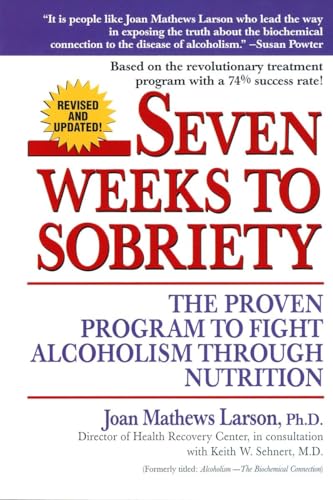
Open this book and you will embark on a groundbreaking seven-week journey that will change your life. You will learn how to break your addiction to alcohol and end your cravings--and do it under your own power. Here, step-by-step, is a proven, seven-week program developed by Dr. Joan Matthews Larson at the innovative Health Recovery Center in Minneapolis, that subdues your body's addictive chemistry and puts you on the path to full recovery.
Die Inhaltsangabe kann sich auf eine andere Ausgabe dieses Titels beziehen.
Über die Autorin bzw. den Autor
Joan Mathews Larson, Ph.D., is the author of the national bestseller Seven Weeks to Sobriety. She holds a doctorate in nutrition and is the founder and executive director of the highly esteemed Health Recovery Center in Minneapolis. It was the loss of her seventeen-year-old son to suicide that fueled her search for more effective solutions to emotional healing. Her clinic has now successfully treated several thousand people over a twenty-year period. She lives in Minneapolis.
Von der hinteren Coverseite
"Comprehensive, rational and personal. It suppplies much of what is missing in traditional approaches to alcoholic rehabilitation. I believe that this book can save lives."
Leo Galland, M.D.
Open this book and you will embark on a groundbreaking seven-week journey that will change your life. You will learn how to break your addiction to alcohol and end your cravings--and do it under your own power. Here, step-by-step, is a proven, seven-week program developed by Dr. Joan Matthews Larson at the innovative Health Recovery Center in Minneapolis, that subdues your body's addictive chemistry and puts you on the path to full recovery.
Aus dem Klappentext
hensive, rational and personal. It suppplies much of what is missing in traditional approaches to alcoholic rehabilitation. I believe that this book can save lives."
Leo Galland, M.D.
Open this book and you will embark on a groundbreaking seven-week journey that will change your life. You will learn how to break your addiction to alcohol and end your cravings--and do it under your own power. Here, step-by-step, is a proven, seven-week program developed by Dr. Joan Matthews Larson at the innovative Health Recovery Center in Minneapolis, that subdues your body's addictive chemistry and puts you on the path to full recovery.
Auszug. © Genehmigter Nachdruck. Alle Rechte vorbehalten.
One
Loss of a Son,
Birth of a Concept
I know you want to recover from alcoholism. I have met few alcoholics who were not desperate to stop drinking. Many try and most fail. If you are one of them, I expect you to be somewhat skeptical of the very idea of a treatment breakthrough that can lead to permanent recovery. You may not believe that any treatment can banish the overpowering craving for alcohol that has defeated all your past efforts. You may not even want to believe it.
But permanent recovery is possible. The break through I describe in this book can liberate you from alcoholism, free you from cravings, restore your health, and help you overcome depression or other emotional problems underlying your drinking. I know those are bold promises, and I would not make them if I wasn’t very sure that this program can help you. For the past ten years I have tested, retested, and fine-tuned this approach. It works. It has worked for more than one thousand alcoholics. And it will work for you.
The program itself is based on solid scientific research that challenges all the old assumptions about the very nature of alcoholism. This research conclusively demonstrates that alcoholism is a physical disease, rooted in the genes and activated by the effect of alcohol on the biochemistry of the brain and body. An enormous number of well-controlled scientific studies by distinguished researchers the world over has shown that alcohol undermines physical health and mental stability by destroying the vital nutrients responsible for their maintenance. Additional studies have shown that alcoholism can be conquered by undoing this damage.
And that, in a nutshell, is the concept that underlies this plan. In seven short weeks I will help you fix what alcohol has broken. Unlike other treatment programs, this plan is based on physical repair. As you read the pages ahead, you will learn a lot about the natural chemistry that governs your body and your brain. I’m certain that you will be impressed by the weight of scientific evidence and will quickly come to appreciate the importance of repairing the damage alcohol can inflict on your delicate internal chemistry.
Once you begin the program you’ll notice a difference in the way you feel almost immediately. You’ll be delighted at how easy it is to stop drinking with the aid of the nutrient-packed detoxification formula that blocks cravings for alcohol. Then, I’ll show you how to individualize a repair program to restore your physical and emotional health.
I have been using this program to treat alcoholics since 1981, when I founded Health Recovery Center to test my theory that physical rehabilitation was the missing link in the treatment of alcoholism. Since then, I have teated more than one thousand alcoholics and drug addicts. More than three-quarters remain successfully rehabilitated and abstinent. You may not realize it, but a 75 percent recovery rate is unheard of in this field. Elsewhere, success rates are a dismal 25 percent. Our success has attracted attention from all over the world. Almost daily I receive calls from treatment directors and counselors anxious to learn about our methods. I can’t take full credit for this breakthrough, which is based on the work of many respected researchers. I simply took their findings and put them into practice.
I didn’t set out to find a new way to treat alcoholism; the events of my life led me to it. Twenty years ago, my husband had a heart attack and died at age forty. Suddenly, I was a single parent with nothing more practical than a degree in art with which to support my three children. Rob, my middle child, was thirteen at the time. He seemed most affected by the devastating change in our lives. “We just don’t feel like a family anymore,” he told me again and again.
Rob had always been an active boy with a wide range of interests. Before his father’s death, his grades were excellent, he won leading roles in school plays, and played halfback for Tait’s Tigers, a neighborhood football team. He was also notably softhearted and fair-minded. He championed the civil rights of the few minority students in his nearly all-white suburban elementary school and volunteered to help youngsters in the lower grades with their reading.
After the shock of my husband’s death wore off, Rob’s mood swings became more noticeable. So did his love for junk food and colas. Of course, we didn’t use the term “junk food” back in 1972. Americans were still relatively naïve about nutrition, and the slogan “you are what you eat” conjured up images of the radical fringes of the fruit and nut bunch in California.
I had more on my mind at the time than the amount of cola my kids were drinking. I realized that I would have to go back to school for another, more useful degree in order to support my family. Rob was fifteen when I returned to college to study psychology. Following my classroom work I served two counseling internships in alcohol- and drug-dependency treatment programs. By then, Rob was a high school student developing a liking for “keggers,” outdoor beer parties popular among teenagers in our area. His frequent partying coincided with my growing interest in chemical dependency. Ironically, as he moved farther and farther down the path of alcohol abuse, he was teaching me my life’s work.
During my internships, I read some fascinating research by the endocrinologist John Tintera, M.D., a charter member of the New York State Commission on Alcoholism. Tintera’s work focused on the relationship between low blood sugar (hypoglycemia) and alcohol abuse. The symptoms he described—shakiness, mood swings, irritability, emotional instability, sudden fatigue, mental confusion—sounded a lot like what Rob had been experiencing. Tintera explained that blood sugar, or glucose, is the brain’s only fuel; when brain glucose levels drop, these uncomfortable symptoms develop. In a hypoglycemic person, a sudden infusion of glucose (in the form of sugars contained in candy bars, high-sugar colas, or alcoholic drinks) taken to relieve these symptoms triggers an abnormally large response of insulin, which counteracts the effects of glucose and creates a mild insulin shock. Tintera was the first to suggest that habitual alcohol consumption can actually create hypoglycemia by continually triggering insulin reactions.
I wondered whether Rob was in the grips of this feast-or-famine problem. Eventually, I decided to stop guessing and took him for a six-hour glucose tolerance test. The results showed that Rob was seriously hypoglycemic. At the time, much of his life revolved around ingesting sugars, particularly alcohol, a sugar that reaches the brain quite rapidly. Drinking gave him energy and made him feel great, and he never followed the doctor’s advice to cut down on alcohol, or on colas and sweets.
I knew Rob needed help. His mood swings were becoming more marked and his grades were declining. I enrolled him in a highly recommended hospital inpatient alcohol treatment program for adolescents. I felt enormous relief when he was admitted. I had turned my worries over to the experts. Surely they could help.
The program focused on identifying the underlying psychological reasons for Rob’s drinking. The counselors fixed on his relationship with his father and assumed that Rob’s drinking problems stemmed from feelings of guilt—all the things he had or hadn’t said to his father in the months before my husband’s death. In retrospect, I can see that Rob eventually came to believe that he felt guilty and that his...
„Über diesen Titel“ kann sich auf eine andere Ausgabe dieses Titels beziehen.
Suchergebnisse für Seven Weeks to Sobriety: The Proven Program to Fight...

Beispielbild für diese ISBN
Seven Weeks to Sobriety: The Proven Program to Fight Alcoholism through Nutrition
Anbieter: World of Books (was SecondSale), Montgomery, IL, USA
Verkäuferbewertung 5 von 5 Sternen

Paperback. Zustand: Fair. "Comprehensive, rational and personal. It suppplies much of what is missing in traditional approaches to alcoholic rehabilitation. I believe that this book can save lives." Leo Galland, M.D. Open this book and you will embark on a groundbreaking seven-week journey that will change your life. You will learn how to break your addiction to alcohol and end your cravings--and do it under your own power. Here, step-by-step, is a proven, seven-week program developed by Dr. Joan Matthews Larson at the innovative Health Recovery Center in Minneapolis, that subdues your body's addictive chemistry and puts you on the path to full recovery. Artikel-Nr. 00095998914
Gebraucht kaufen
EUR 3,73
Versand gratis
Versand innerhalb von USA
Versand innerhalb von USA
Anzahl: 5 verfügbar
Beispielbild für diese ISBN
Seven Weeks to Sobriety: The P
Anbieter: World of Books (was SecondSale), Montgomery, IL, USA
Verkäuferbewertung 5 von 5 Sternen
Zustand: Good. Item in good condition. Textbooks may not include supplemental items i.e. CDs, access codes etc. Artikel-Nr. 00098941361
Gebraucht kaufen
EUR 3,73
Versand gratis
Versand innerhalb von USA
Versand innerhalb von USA
Anzahl: 18 verfügbar
Foto des Verkäufers
Seven Weeks to Sobriety: The Proven Program to Fight Alcoholism through Nutrition
Verlag:
Random House Publishing Group, 1997
ISBN 10: 0449002594
ISBN 13: 9780449002599
Gebraucht
Softcover
Anbieter: Dream Books Co., Denver, CO, USA
Verkäuferbewertung 5 von 5 Sternen
Zustand: good. Gently used with minimal wear on the corners and cover. A few pages may contain light highlighting or writing, but the text remains fully legible. Dust jacket may be missing, and supplemental materials like CDs or codes may not be included. May be ex-library with library markings. Ships promptly! Artikel-Nr. DBV.0449002594.G
Gebraucht kaufen
EUR 3,74
Versand gratis
Versand innerhalb von USA
Versand innerhalb von USA
Anzahl: 1 verfügbar
Beispielbild für diese ISBN
Seven Weeks to Sobriety: The Proven Program to Fight Alcoholism through Nutrition
Verlag:
Random House Publishing Group, 1997
ISBN 10: 0449002594
ISBN 13: 9780449002599
Gebraucht
Paperback
Anbieter: ThriftBooks-Atlanta, AUSTELL, GA, USA
Verkäuferbewertung 5 von 5 Sternen
Paperback. Zustand: Very Good. No Jacket. May have limited writing in cover pages. Pages are unmarked. ~ ThriftBooks: Read More, Spend Less. Artikel-Nr. G0449002594I4N00
Gebraucht kaufen
EUR 5,87
Versand gratis
Versand innerhalb von USA
Versand innerhalb von USA
Anzahl: 1 verfügbar
Beispielbild für diese ISBN
Seven Weeks to Sobriety: The Proven Program to Fight Alcoholism through Nutrition
Verlag:
Random House Publishing Group, 1997
ISBN 10: 0449002594
ISBN 13: 9780449002599
Gebraucht
Paperback
Anbieter: ThriftBooks-Dallas, Dallas, TX, USA
Verkäuferbewertung 5 von 5 Sternen
Paperback. Zustand: Very Good. No Jacket. May have limited writing in cover pages. Pages are unmarked. ~ ThriftBooks: Read More, Spend Less. Artikel-Nr. G0449002594I4N00
Gebraucht kaufen
EUR 5,87
Versand gratis
Versand innerhalb von USA
Versand innerhalb von USA
Anzahl: 1 verfügbar
Beispielbild für diese ISBN
Seven Weeks to Sobriety: The Proven Program to Fight Alcoholism through Nutrition
Verlag:
Random House Publishing Group, 1997
ISBN 10: 0449002594
ISBN 13: 9780449002599
Gebraucht
Paperback
Anbieter: ThriftBooks-Dallas, Dallas, TX, USA
Verkäuferbewertung 5 von 5 Sternen
Paperback. Zustand: Good. No Jacket. Pages can have notes/highlighting. Spine may show signs of wear. ~ ThriftBooks: Read More, Spend Less. Artikel-Nr. G0449002594I3N00
Gebraucht kaufen
EUR 5,87
Versand gratis
Versand innerhalb von USA
Versand innerhalb von USA
Anzahl: 1 verfügbar
Beispielbild für diese ISBN
Seven Weeks to Sobriety: The Proven Program to Fight Alcoholism through Nutrition
Verlag:
Random House Publishing Group, 1997
ISBN 10: 0449002594
ISBN 13: 9780449002599
Gebraucht
Paperback
Anbieter: ThriftBooks-Atlanta, AUSTELL, GA, USA
Verkäuferbewertung 5 von 5 Sternen
Paperback. Zustand: Good. No Jacket. Pages can have notes/highlighting. Spine may show signs of wear. ~ ThriftBooks: Read More, Spend Less. Artikel-Nr. G0449002594I3N00
Gebraucht kaufen
EUR 5,87
Versand gratis
Versand innerhalb von USA
Versand innerhalb von USA
Anzahl: 1 verfügbar
Beispielbild für diese ISBN
Seven Weeks to Sobriety : The Proven Program to Fight Alcoholism Through Nutrition
Verlag:
Random House Publishing Group, 1997
ISBN 10: 0449002594
ISBN 13: 9780449002599
Gebraucht
Softcover
Anbieter: Better World Books, Mishawaka, IN, USA
Verkäuferbewertung 5 von 5 Sternen
Zustand: Good. Revised. Pages intact with minimal writing/highlighting. The binding may be loose and creased. Dust jackets/supplements are not included. Stock photo provided. Product includes identifying sticker. Better World Books: Buy Books. Do Good. Artikel-Nr. 4055254-6
Gebraucht kaufen
EUR 6,09
Versand gratis
Versand innerhalb von USA
Versand innerhalb von USA
Anzahl: 4 verfügbar
Beispielbild für diese ISBN
Seven Weeks to Sobriety : The Proven Program to Fight Alcoholism Through Nutrition
Verlag:
Random House Publishing Group, 1997
ISBN 10: 0449002594
ISBN 13: 9780449002599
Gebraucht
Softcover
Anbieter: Better World Books, Mishawaka, IN, USA
Verkäuferbewertung 5 von 5 Sternen
Zustand: Very Good. Revised. Pages intact with possible writing/highlighting. Binding strong with minor wear. Dust jackets/supplements may not be included. Stock photo provided. Product includes identifying sticker. Better World Books: Buy Books. Do Good. Artikel-Nr. 5278489-6
Gebraucht kaufen
EUR 6,09
Versand gratis
Versand innerhalb von USA
Versand innerhalb von USA
Anzahl: 1 verfügbar
Beispielbild für diese ISBN
Seven Weeks to Sobriety : The Proven Program to Fight Alcoholism Through Nutrition
Verlag:
Random House Publishing Group, 1997
ISBN 10: 0449002594
ISBN 13: 9780449002599
Gebraucht
Softcover
Anbieter: Better World Books: West, Reno, NV, USA
Verkäuferbewertung 5 von 5 Sternen
Zustand: Good. Revised. Pages intact with minimal writing/highlighting. The binding may be loose and creased. Dust jackets/supplements are not included. Stock photo provided. Product includes identifying sticker. Better World Books: Buy Books. Do Good. Artikel-Nr. 4055254-6
Gebraucht kaufen
EUR 6,09
Versand gratis
Versand innerhalb von USA
Versand innerhalb von USA
Anzahl: 1 verfügbar