
Verwandte Artikel zu Absolute Power
Inhaltsangabe
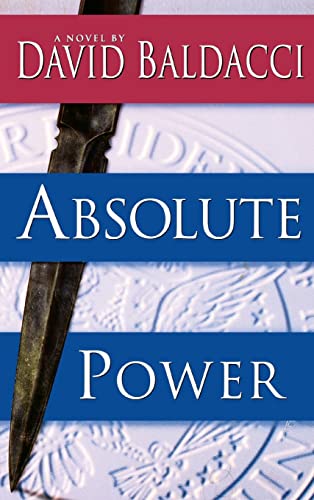
In this #1 New York Times bestselling thriller, a burglar, Luther Whitney, breaks into a Virginia mansion, and witnesses a brutal crime involving the president—a man who believes he can get away with anything.
In a heavily guarded mansion in the Virginia countryside, professional burglar and break-in artist Luther Whitney is trapped behind a two-way mirror. What he witnesses destroys his faith not only in justice, but in all he holds dear.
What follows is an unthinkable abuse of power and criminal conspiracy, as a breathtaking cover-up is set in motion by those appointed to work for one of the most important people in the world -- the President of the United States.
In a heavily guarded mansion in the Virginia countryside, professional burglar and break-in artist Luther Whitney is trapped behind a two-way mirror. What he witnesses destroys his faith not only in justice, but in all he holds dear.
What follows is an unthinkable abuse of power and criminal conspiracy, as a breathtaking cover-up is set in motion by those appointed to work for one of the most important people in the world -- the President of the United States.
Die Inhaltsangabe kann sich auf eine andere Ausgabe dieses Titels beziehen.
Über die Autorin bzw. den Autor
DAVID BALDACCI is a global #1 bestselling author, and one of the world's favorite storytellers. His books are published in over forty-five languages and in more than eighty countries, with 150 million copies sold worldwide. His works have been adapted for both feature film and television. David Baldacci is also the cofounder, along with his wife, of the Wish You Well Foundation, a nonprofit organization dedicated to supporting literacy efforts across America. Still a resident of his native Virginia, he invites you to visit him at DavidBaldacci.com and his foundation at WishYouWellFoundation.org.
Von der hinteren Coverseite
Can the President of the United States get away with murder? The fictional answer to this question has set the literary world on fire and transformed David Baldacci into a household name and overnight success. Going beyond the classic works of John Grisham and Robert Ludlum, Absolute Power combines the highest levels of political intrigue with big-money law, cutting-edge forensics, and the riveting search for a truth hidden within the power of the Oval Office.
Auszug. © Genehmigter Nachdruck. Alle Rechte vorbehalten.
Absolute Power
By David BaldacciWarner Books
Copyright ©1996 David BaldacciAll right reserved.
ISBN: 9780446519960
Chapter One
He gripped the steering wheel loosely as the car, its lights out,drifted slowly to a stop. A few last scraps of gravel kicked out ofthe tire treads and then silence enveloped him. He took a moment toadjust to the surroundings and then pulled out a pair of worn butstill effective night-vision binoculars. The house slowly came intofocus. He shifted easily, confidently in his seat. A duffel bag layon the front seat beside him. The car's interior was faded butclean.The car was also stolen. And from a very unlikely source.
A pair of miniature palm trees hung from the rearview mirror. Hesmiled grimly as he looked at them. Soon he might be going to theland of palms. Quiet, blue, see-through water, powderysalmon-colored sunsets and late mornings. He had to get out. It wastime. For all the occasions he had said that to himself, this timehe felt sure.
Sixty-six years old, Luther Whitney was eligible to collect SocialSecurity, and was a card-carrying member of AARP. At that age mostmen had settled down into second careers as grandfathers, part-timeraisers of their children's children, when weary joints were easeddown into familiar recliners and arteries finished closing up withthe clutter of a lifetime.
Luther had had only one career his entire life. It involved breakingand entering into other people's homes and places of business,usually in the nighttime, as now, and taking away as much of theirproperty as he could feasibly carry.
Though clearly on the wrong side of the law, Luther had never fireda gun or hurled a knife in anger or fear, except for his part in alargely confusing war fought where South and North Korea were joinedat the hip. And the only punches he had ever thrown were in bars,and those only in self-defense as the suds made men braver than theyshould have been.
Luther only had one criterion in choosing his targets: he took onlyfrom those who could well afford to lose it. He considered himselfno different from the armies of people who routinely coddled thewealthy, constantly persuading them to buy things they did not need.
A good many of his sixty-odd years had been spent in assortedmedium- and then maximum-security correctional facilities along theEast Coast. Like blocks of granite around his neck, three priorfelony convictions stood to his credit in three different states.Years had been carved out of his life. Important years. But he coulddo nothing to change that now.
He had refined his skills to where he had high hopes that a fourthconviction would never materialize. There was absolutely nothingmysterious about the ramifications of another bust: he would belooking at the full twenty years. And at his age, twenty years was adeath penalty. They might as well fry him, which was the way theCommonwealth of Virginia used to handle its particularly bad people.The citizens of this vastly historic state were by and large aGod-fearing people, and religion premised upon the notion of equalretribution consistently demanded the ultimate payback. Thecommonwealth succeeded in disposing of more death row criminals thanall but two states, and the leaders, Texas and Florida, shared themoral sentiments of their Southern sister. But not for simpleburglary; even the good Virginians had their limits.
Yet with all that at risk he couldn't take his eyes off thehome-mansion, of course, one would be compelled to call it. It hadengrossed him for several months now. Tonight that fascination wouldend.
Middleton, Virginia. A forty-five-minute drive west on a slingshotpath from Washington, D.C. Home to vast estates, obligatory Jaguars,and horses whose price tags could feed the residents of an entireinner-city apartment building for a year. Homes in this areasprawled across enough earth with enough splendor to qualify fortheir own appellation. The irony of his target's name, the Coppers,was not lost upon him.
The adrenaline rush that accompanied each job was absolutely unique.He imagined it was somewhat like how the batter felt as henonchalantly trotted the bases, taking all the time in the world,after newly bruised leather had landed somewhere in the street. Thecrowd on its feet, fifty thousand pairs of eyes on one human being,all the air in the world seemingly sucked into one space, and thensuddenly displaced by the arc of one man's glorious swing of thewood.
Luther took a long sweep of the area with his still sharp eyes. Anoccasional firefly winked back at him. Otherwise he was alone. Helistened for a moment to the rise and fall of the cicadas and thenthat chorus faded into the background, so omnipresent was it toevery person who had lived long in the area.
He pulled the car further down the blacktop road and backed onto ashort dirt road that ended in a mass of thick trees. His iron-grayhair was covered with a black ski hat. His leathery face was smearedblack with camouflage cream; calm, green eyes hovered above a cinderblock jaw. The flesh carried on his spare frame was as tight asever. He looked like the Army Ranger he had once been. Luther gotout of the car.
Crouching behind a tree, Luther surveyed his target. The Coppers,like many country estates that were not true working farms orstables, had a huge and ornate wrought iron gate set on twin brickcolumns but had no fencing. The grounds were accessible directlyfrom the road or the nearby woods. Luther entered from the woods.
It took Luther two minutes to reach the edge of the cornfieldadjacent to the house. The owner obviously had no need forhome-grown vegetables but had apparently taken the country squirerole to heart. Luther wasn't complaining, since it afforded him ahidden path almost to the front door.
He waited a few moments and then disappeared into the embracingthickness of the corn stalks.
The ground was mostly clear of debris and his tennis shoes made nosound, which was important, for any noise carried easily here. Hekept his eyes straight ahead; his feet, after much practice,carefully picked their way through the slender rows, compensatingfor the slight unevenness of the ground. The night air was coolafter the debilitating heat of another stagnant summer, but notnearly cool enough for breath to be transformed into the tiny cloudsthat could be seen from a distance by restless or insomniac eyes.
Luther had timed this operation several times over the past month,always stopping at the edge of the field before stepping into thefront grounds and past no-man's-land. In his head, every detail hadbeen worked and reworked hundreds of times until a precise script ofmovement, waiting, followed by more movement was firmly entrenchedin his mind.
He crouched down at the edge of the front grounds and took one morelong look around; no need to rush. No dogs to worry about, which wasgood. A human, no matter how young and fleet, simply could notoutrun a dog. But it was the noise they made that stopped men likeLuther cold. There was also no perimeter security system, probablybecause of the innumerable false alarms that would be caused by thelarge populations of deer, squirrel and raccoon roaming over thearea. However, Luther would shortly be faced with a highlysophisticated defense package that he would have thirty-threeseconds to disarm-and that included the ten seconds it would takehim to remove the control panel.
The private security patrol had passed through the area thirtyminutes earlier. The cop clones were supposed to vary theirroutines, making sweeps through their surveillance sectors everyhour. But after a month of observations, Luther had easily discerneda pattern. He had at least three hours...
„Über diesen Titel“ kann sich auf eine andere Ausgabe dieses Titels beziehen.
Suchergebnisse für Absolute Power

Beispielbild für diese ISBN
Absolute Power
Verlag:
Time Warner Trade Publishing, 1996
ISBN 10: 0446519960
ISBN 13: 9780446519960
Gebraucht
Hardcover
Anbieter: World of Books (was SecondSale), Montgomery, IL, USA
Verkäuferbewertung 5 von 5 Sternen

Hardback. Zustand: Fair. When burglar Luther Whitney breaks into a Virginia mansion, he witnesses a brutal crime involving the president -- a man who believes he can get away with anything -- and now, Luther may be the only one who can stop him in this #1 New York Times bestselling thriller. In a heavily guarded mansion in the Virginia countryside, professional burglar and break-in artist Luther Whitney is trapped behind a two-way mirror. What he witnesses destroys his faith not only in justice, but in all he holds dear. What follows is an unthinkable abuse of power and criminal conspiracy, as a breathtaking cover-up is set in motion by those appointed to work for one of the most important people in the world -- the President of the United States. Artikel-Nr. 00094199255
Gebraucht kaufen
EUR 4,23
Versand gratis
Versand innerhalb von USA
Versand innerhalb von USA
Anzahl: Mehr als 20 verfügbar
Beispielbild für diese ISBN
Absolute Power
Verlag:
Time Warner Trade Publishing, 1996
ISBN 10: 0446519960
ISBN 13: 9780446519960
Gebraucht
Hardcover
Anbieter: World of Books (was SecondSale), Montgomery, IL, USA
Verkäuferbewertung 5 von 5 Sternen
Hardback. Zustand: Good. When burglar Luther Whitney breaks into a Virginia mansion, he witnesses a brutal crime involving the president -- a man who believes he can get away with anything -- and now, Luther may be the only one who can stop him in this #1 New York Times bestselling thriller. In a heavily guarded mansion in the Virginia countryside, professional burglar and break-in artist Luther Whitney is trapped behind a two-way mirror. What he witnesses destroys his faith not only in justice, but in all he holds dear. What follows is an unthinkable abuse of power and criminal conspiracy, as a breathtaking cover-up is set in motion by those appointed to work for one of the most important people in the world -- the President of the United States. Artikel-Nr. 00103933637
Gebraucht kaufen
EUR 4,23
Versand gratis
Versand innerhalb von USA
Versand innerhalb von USA
Anzahl: Mehr als 20 verfügbar
Beispielbild für diese ISBN
Absolute Power
Anbieter: ThriftBooks-Dallas, Dallas, TX, USA
Verkäuferbewertung 5 von 5 Sternen
Hardcover. Zustand: Fair. No Jacket. Readable copy. Pages may have considerable notes/highlighting. ~ ThriftBooks: Read More, Spend Less. Artikel-Nr. G0446519960I5N00
Gebraucht kaufen
EUR 5,96
Versand gratis
Versand innerhalb von USA
Versand innerhalb von USA
Anzahl: 1 verfügbar
Beispielbild für diese ISBN
Absolute Power
Anbieter: ThriftBooks-Atlanta, AUSTELL, GA, USA
Verkäuferbewertung 5 von 5 Sternen
Hardcover. Zustand: Fair. No Jacket. Missing dust jacket; Readable copy. Pages may have considerable notes/highlighting. ~ ThriftBooks: Read More, Spend Less. Artikel-Nr. G0446519960I5N01
Gebraucht kaufen
EUR 5,96
Versand gratis
Versand innerhalb von USA
Versand innerhalb von USA
Anzahl: 2 verfügbar
Beispielbild für diese ISBN
Absolute Power
Anbieter: ThriftBooks-Atlanta, AUSTELL, GA, USA
Verkäuferbewertung 5 von 5 Sternen
Hardcover. Zustand: Good. No Jacket. Missing dust jacket; Pages can have notes/highlighting. Spine may show signs of wear. ~ ThriftBooks: Read More, Spend Less. Artikel-Nr. G0446519960I3N01
Gebraucht kaufen
EUR 5,96
Versand gratis
Versand innerhalb von USA
Versand innerhalb von USA
Anzahl: Mehr als 20 verfügbar
Beispielbild für diese ISBN
Absolute Power
Anbieter: ThriftBooks-Dallas, Dallas, TX, USA
Verkäuferbewertung 5 von 5 Sternen
Hardcover. Zustand: Very Good. No Jacket. Former library book; May have limited writing in cover pages. Pages are unmarked. ~ ThriftBooks: Read More, Spend Less. Artikel-Nr. G0446519960I4N10
Gebraucht kaufen
EUR 5,96
Versand gratis
Versand innerhalb von USA
Versand innerhalb von USA
Anzahl: 1 verfügbar
Beispielbild für diese ISBN
Absolute Power
Anbieter: ThriftBooks-Dallas, Dallas, TX, USA
Verkäuferbewertung 5 von 5 Sternen
Hardcover. Zustand: Good. No Jacket. Pages can have notes/highlighting. Spine may show signs of wear. ~ ThriftBooks: Read More, Spend Less. Artikel-Nr. G0446519960I3N00
Gebraucht kaufen
EUR 5,96
Versand gratis
Versand innerhalb von USA
Versand innerhalb von USA
Anzahl: 6 verfügbar
Beispielbild für diese ISBN
Absolute Power
Anbieter: ThriftBooks-Atlanta, AUSTELL, GA, USA
Verkäuferbewertung 5 von 5 Sternen
Hardcover. Zustand: Very Good. No Jacket. Missing dust jacket; May have limited writing in cover pages. Pages are unmarked. ~ ThriftBooks: Read More, Spend Less. Artikel-Nr. G0446519960I4N01
Gebraucht kaufen
EUR 5,96
Versand gratis
Versand innerhalb von USA
Versand innerhalb von USA
Anzahl: 1 verfügbar
Beispielbild für diese ISBN
Absolute Power
Anbieter: ThriftBooks-Reno, Reno, NV, USA
Verkäuferbewertung 5 von 5 Sternen
Hardcover. Zustand: Good. No Jacket. Pages can have notes/highlighting. Spine may show signs of wear. ~ ThriftBooks: Read More, Spend Less. Artikel-Nr. G0446519960I3N00
Gebraucht kaufen
EUR 6,04
Versand gratis
Versand innerhalb von USA
Versand innerhalb von USA
Anzahl: 5 verfügbar
Beispielbild für diese ISBN
Absolute Power
Anbieter: ThriftBooks-Phoenix, Phoenix, AZ, USA
Verkäuferbewertung 5 von 5 Sternen
Hardcover. Zustand: Good. No Jacket. Former library book; Pages can have notes/highlighting. Spine may show signs of wear. ~ ThriftBooks: Read More, Spend Less. Artikel-Nr. G0446519960I3N10
Gebraucht kaufen
EUR 6,04
Versand gratis
Versand innerhalb von USA
Versand innerhalb von USA
Anzahl: 4 verfügbar