
Verwandte Artikel zu Spindle's End
Inhaltsangabe
“We will keep her safe.”
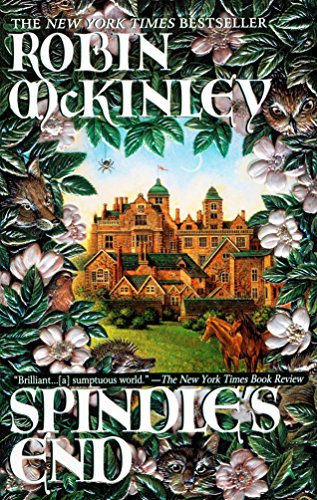
All the creatures of the forest and field and riverbank knew the infant was special. She was the princess, spirited away from the evil fairy Pernicia on her name-day. But the curse was cast: Rosie was fated to prick her finger on the spindle of a spinning wheel and fall into a poisoned sleep—a slumber from which no one would be able to rouse her…
In the tradition of Beauty and Rose Daughter, Robin McKinley “lends a fresh perspective to a classic fairy tale, developing the story of ‘Sleeping Beauty’ into a richly imagined, vividly depicted novel.” (School Library Journal
Die Inhaltsangabe kann sich auf eine andere Ausgabe dieses Titels beziehen.
Über die Autorin bzw. den Autor
Robin McKinley has won various awards and citations for her writing, including the Newbery Medal for The Hero and the Crown and a Newbery Honor for The Blue Sword. Her other books include Sunshine; the New York Times bestseller Spindle's End; two novel-length retellings of the fairy tale Beauty and the Beast, Beauty and Rose Daughter; and a retelling of the Robin Hood legend, The Outlaws of Sherwood. She lives with her husband, the English writer Peter Dickinson.
Auszug. © Genehmigter Nachdruck. Alle Rechte vorbehalten.
Chapter I
The magic in that country was so thick and tenacious that it settled over the land like chalk-dust and over floors and shelves like slightly sticky plaster-dust. (Housecleaners in that country earned unusually good wages.) If you lived in that country, you had to de-scale your kettle of its encrustation of magic at least once a week, because if you didn’t, you might find yourself pouring hissing snakes or pond slime into your teapot instead of water. (It didn’t have to be anything scary or unpleasant, like snakes or slime, especially in a cheerful household—magic tended to reflect the atmosphere of the place in which it found itself—but if you want a cup of tea, a cup of lavender-and-gold pansies or ivory thimbles is unsatisfactory. And while the pansies—put dry in a vase—would probably last a day, looking like ordinary pansies, before they went greyish-dun and collapsed into magic dust, something like an ivory thimble would begin to smudge and crumble as soon as you picked it up.)
The best way to do it was to have a fairy as a member of your household, because she (it was usually a she) could lay a finger on the kettle just as it came to a boil (absentminded fairies could often be recognised by a pad of scar-tissue on the finger they favoured for kettle-cleaning) and murmur a few counter-magical words. There would be a tiny inaudible thock, like a seed-pod bursting, and the water would stay water for another week or (maybe) ten days.
De-magicking a kettle was much too little and fussy and frequent a job for any professional fairy to be willing to be hired to do it, so if you weren’t related to one you had to dig up a root of the dja vine, and dry it, and grate it, producing a white powder rather like plaster dust or magic, and add a pinch of that to your kettle once a week. More often than that would give everyone in the household cramp. You could tell the households that didn’t have a fairy by the dja vines growing over them. Possibly because they were always having their roots disturbed, djas developed a reputation for being tricky to grow, and prone to sudden collapse; fortunately they rerooted easily from cuttings. “She’d give me her last dja root” was a common saying about a good friend.
People either loved that country and couldn’t imagine living anywhere else, or hated it, left it as soon as they could, and never came back. If you loved it, you loved coming over the last hill before your village one day in early autumn and hearing the corn-field singing madrigals, and that day became a story you told your grandchildren, the way in other countries other grandparents told the story of the day they won the betting pool at the pub, or their applecake won first place at the local fete. If you lived there, you learned what you had to do, like putting a pinch of dried dja vine in your kettle once a week, like asking your loaf of bread to remain a loaf of bread before you struck it with a knife. (The people of this country had developed a reputation among outsiders for being unusually pious, because of the number of things they appeared to mutter a blessing over before they did them; but in most cases this was merely the asking of things it was safer to ask to remain nonmagical first, while work or play or food preparation or whatever was being got on with. Nobody had ever heard of a loaf of bread turning into a flock of starlings for anyone they knew, but the nursery tale was well known, and in that country it didn’t pay to take chances. The muttered words were usually only some phrase such as “Bread, stay bread” or, in upper-class households, “Bread, please oblige me,” which was a less wise form, since an especially impish gust of magic could choose to translate “oblige” just as it chose.)
Births were very closely attended, because the request that things stay what they were had to be got in quickly, birth being a very great magic, and, in that country, likely to be teased into mischief. It was so common an occurrence as to occasion no remark when a new-sown field began coming up quit obviously as something other than what was planted, and by a week later to have reverted to what the farmer had put in. But while, like the pansies and the thimbles, this kind of magic was only a temporary aberration, it could be very embarrassing and onerous while it lasted. Farmers in that country worried more about falling asleep during the birthing times of their stock than they worried about the weather; the destruction a litter of baby taralians caused remained, even after it had revered to piglets. No one knew how the wild birds and beasts negotiated this, but human parents-to-be would go to extreme lengths to ensure a fairy was on hand to say the birth-words over their new little one.
Generally speaking the more mobile and water-dependent something was, the more likely magic was to get at it. This meant animals—and, of course, humans—were the most vulnerable. Rocks were pretty reliably rocks, except of course when they were something else that had been turned into rocks. But rocks themselves sort of slept through magic attacks, and even if some especially wild and erratic bit of magic decided to deck out a drystone wall as a marble fountain, you could still feel the drystone wall if you closed your eyes and touched the fountain, and the water would not make you wet. The lichen that grew on the rock, however, could be turned into daisies quite convincing enough to make you sneeze if real daisies did so; and the insects and small creatures that crept over the lichen were more susceptible yet.
(There was an idea much beloved and written about by this country’s philosophers that magic had to do with negotiating the balance between earth and air and water; which is to say that things with legs or wings were out of balance with their earth element by walking around on feet or, worse, flying above the earth in the thin substance of air, obviously entirely unsuitable for the support of solid flesh. The momentum all this inappropriate motion set up in their liquid element unbalanced them further. Spirit, in this system, was equated with the fourth element, fire. All this was generally felt to be a load of rubbish among the people who had to work in the ordinary world for a living, unlike philosophers living in academies. But it was true that a favourite magical trick at fetes was for theatrically-minded fairies to throw bits of chaff or seed-pods or conkers in the air and turn them into things before they struck the ground, and that the trick worked better if the bits of chaff or seed-pods or conkers were wet.)
Slower creatures were less susceptible to the whims of wild magic than faster creatures, and creatures that flew were the most susceptible of all. Every sparrow had a delicious memory of having once been a hawk, and while magic didn’t take much interest in caterpillars, butterflies spent so much time being magicked that it was a rare event to see ordinary butterflies without at least an extra set of wings or a few extra frills and iridescences, or bodies like tiny human beings dressed in flower petals. (Fish, which flew through that most dangerous element, water, were believed not to exist. Fishy-looking beings in pools and streams were either hallucinations or other things under some kind of spell, and interfering with, catching, or—most especially—eating fish was strictly forbidden. All swimming was considered magical. Animals seen doing it were assumed to be favourites of a local water-sprite or dangerously insane; humans never tried.)
There did seem to be one positive effect to living involuntarily steeped in magic; everyone lived longer. More humans made their century than didn’t; birds and animals often lived to thirty, and fifty was not unheard of. The breeders...
„Über diesen Titel“ kann sich auf eine andere Ausgabe dieses Titels beziehen.
Suchergebnisse für Spindle's End

Beispielbild für diese ISBN
Spindle's End
Verlag:
Ace (edition ), 2001
ISBN 10: 0441008658
ISBN 13: 9780441008650
Gebraucht
Mass Market Paperback
Anbieter: BooksRun, Philadelphia, PA, USA
Verkäuferbewertung 5 von 5 Sternen

Mass Market Paperback. Zustand: Fair. The item might be beaten up but readable. May contain markings or highlighting, as well as stains, bent corners, or any other major defect, but the text is not obscured in any way. Artikel-Nr. 0441008658-7-1
Gebraucht kaufen
EUR 4,41
Versand gratis
Versand innerhalb von USA
Versand innerhalb von USA
Anzahl: 1 verfügbar
Beispielbild für diese ISBN
Spindle's End
Anbieter: World of Books (was SecondSale), Montgomery, IL, USA
Verkäuferbewertung 5 von 5 Sternen
Zustand: Good. We will keep her safe.All the creatures of the forest and field and riverbank knew the infant was special. She was the princess, spirited away from the evil fairy Pernicia on her name-day. But the curse was cast: Rosie was fated to prick her finger on the spindle of a spinning wheel and fall into a poisoned sleep--a slumber from which no one would be able to rouse her.In the tradition of Beauty and Rose Daughter, Robin McKinley lends a fresh perspective to a classic fairy tale, developing the story of 'Sleeping Beauty' into a richly imagined, vividly depicted novel. (School Library Journal. Artikel-Nr. CIN0441008658G
Gebraucht kaufen
EUR 4,80
Versand gratis
Versand innerhalb von USA
Versand innerhalb von USA
Anzahl: 1 verfügbar
Beispielbild für diese ISBN
Spindle's End
Anbieter: World of Books (was SecondSale), Montgomery, IL, USA
Verkäuferbewertung 5 von 5 Sternen
Zustand: Acceptable. Item in acceptable condition! Textbooks may not include supplemental items i.e. CDs, access codes etc. Artikel-Nr. 00110120615
Gebraucht kaufen
EUR 5,50
Versand gratis
Versand innerhalb von USA
Versand innerhalb von USA
Anzahl: 1 verfügbar
Beispielbild für diese ISBN
Spindle's End
Anbieter: ThriftBooks-Phoenix, Phoenix, AZ, USA
Verkäuferbewertung 5 von 5 Sternen
Mass Market Paperback. Zustand: Good. No Jacket. Pages can have notes/highlighting. Spine may show signs of wear. ~ ThriftBooks: Read More, Spend Less. Artikel-Nr. G0441008658I3N00
Gebraucht kaufen
EUR 6,13
Versand gratis
Versand innerhalb von USA
Versand innerhalb von USA
Anzahl: 1 verfügbar
Beispielbild für diese ISBN
Spindle's End
Anbieter: ThriftBooks-Atlanta, AUSTELL, GA, USA
Verkäuferbewertung 5 von 5 Sternen
Mass Market Paperback. Zustand: Good. No Jacket. Former library book; Pages can have notes/highlighting. Spine may show signs of wear. ~ ThriftBooks: Read More, Spend Less. Artikel-Nr. G0441008658I3N10
Gebraucht kaufen
EUR 6,13
Versand gratis
Versand innerhalb von USA
Versand innerhalb von USA
Anzahl: 1 verfügbar
Beispielbild für diese ISBN
Spindle's End
Anbieter: ThriftBooks-Atlanta, AUSTELL, GA, USA
Verkäuferbewertung 5 von 5 Sternen
Mass Market Paperback. Zustand: Good. No Jacket. Pages can have notes/highlighting. Spine may show signs of wear. ~ ThriftBooks: Read More, Spend Less. Artikel-Nr. G0441008658I3N00
Gebraucht kaufen
EUR 6,13
Versand gratis
Versand innerhalb von USA
Versand innerhalb von USA
Anzahl: 1 verfügbar
Beispielbild für diese ISBN
Spindle's End
Anbieter: ThriftBooks-Atlanta, AUSTELL, GA, USA
Verkäuferbewertung 5 von 5 Sternen
Mass Market Paperback. Zustand: Very Good. No Jacket. May have limited writing in cover pages. Pages are unmarked. ~ ThriftBooks: Read More, Spend Less. Artikel-Nr. G0441008658I4N00
Gebraucht kaufen
EUR 6,13
Versand gratis
Versand innerhalb von USA
Versand innerhalb von USA
Anzahl: 1 verfügbar
Beispielbild für diese ISBN
Spindle's End
Verlag:
Penguin Publishing Group, 2001
ISBN 10: 0441008658
ISBN 13: 9780441008650
Gebraucht
Softcover
Anbieter: Better World Books: West, Reno, NV, USA
Verkäuferbewertung 5 von 5 Sternen
Zustand: Very Good. Pages intact with possible writing/highlighting. Binding strong with minor wear. Dust jackets/supplements may not be included. Stock photo provided. Product includes identifying sticker. Better World Books: Buy Books. Do Good. Artikel-Nr. 8112925-6
Gebraucht kaufen
EUR 6,18
Versand gratis
Versand innerhalb von USA
Versand innerhalb von USA
Anzahl: 1 verfügbar
Beispielbild für diese ISBN
Spindle's End
Verlag:
Penguin Publishing Group, 2001
ISBN 10: 0441008658
ISBN 13: 9780441008650
Gebraucht
Softcover
Anbieter: Better World Books: West, Reno, NV, USA
Verkäuferbewertung 5 von 5 Sternen
Zustand: Good. Pages intact with minimal writing/highlighting. The binding may be loose and creased. Dust jackets/supplements are not included. Stock photo provided. Product includes identifying sticker. Better World Books: Buy Books. Do Good. Artikel-Nr. 2333608-6
Gebraucht kaufen
EUR 6,18
Versand gratis
Versand innerhalb von USA
Versand innerhalb von USA
Anzahl: 2 verfügbar
Beispielbild für diese ISBN
Spindle's End
Verlag:
Penguin Publishing Group, 2001
ISBN 10: 0441008658
ISBN 13: 9780441008650
Gebraucht
Softcover
Anbieter: Better World Books, Mishawaka, IN, USA
Verkäuferbewertung 5 von 5 Sternen
Zustand: Good. Former library copy. Pages intact with minimal writing/highlighting. The binding may be loose and creased. Dust jackets/supplements are not included. Includes library markings. Stock photo provided. Product includes identifying sticker. Better World Books: Buy Books. Do Good. Artikel-Nr. 7794759-75
Gebraucht kaufen
EUR 6,18
Versand gratis
Versand innerhalb von USA
Versand innerhalb von USA
Anzahl: 1 verfügbar