
Verwandte Artikel zu Type Talk at Work: How the 16 Personality Types Determine...
Inhaltsangabe
What’s Your Type at Work?
Are you one of those organized people who always complete your projects before they are due? Or do you put off getting the job done until the very last possible moment? Is your boss someone who readily lets you know how you are doing? Or does she always leave you unsure of precisely where you stand? Do you find that a few people on your team are incredibly creative but can never seem to get to a meeting on time? Do others require a specific agenda at the meeting in order to focus on the job at hand?
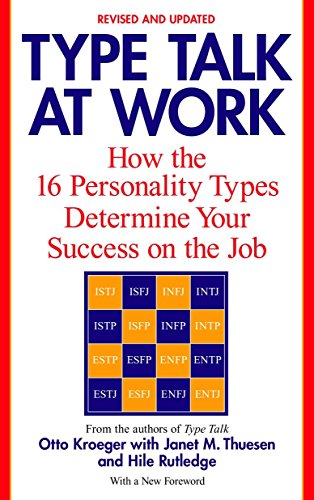
Bestselling authors Otto Kroeger and Janet Thuesen make it easy to recognize your own type and those of your co-workers in Type Talk at Work, a revolutionary guide to understanding your workplace and thriving in it. fully revised and updated for its 10th anniversary, this popular classic now features a new chapter on leadership, showing you how to be more effective on the job. Get the most out of your employees—and employers—using the authors’ renowned expertise on typology. With Type Talk at Work, you’ll never look at the office the same way again!
Die Inhaltsangabe kann sich auf eine andere Ausgabe dieses Titels beziehen.
Über die Autorin bzw. den Autor
Otto Kroeger, ENFJ, is the founder of Otto Kroeger Associates, a consulting firm based in Fairfax, Virginia, working exclusively with the Myers-Briggs Type Indicator. A former Lutheran clergyman, he has been working in organizational development and the behavioral sciences for more than two decades. He has lectured on Typewatching extensively throughout the United States, and in Europe and Asia, and has worked with hundreds of corporations, including AT&T, Xerox, IBM, Marine Midland Bank, Ford, Exxon, and the World Bank. He has worked extensively with the Defense Department, presenting Typewatching for all four major branches of the military; his seminars are now required course work at many military schools and training facilities.
Janet M. Thuesen, INFP, president of Otto Kroeger Associates, has had an extensive career in education, business, and counseling. She has taught at grade levels from preschool through college and has worked with emotionally disturbed adolescents and chemically dependent women. She also served as assistant director of Organizational Development at the White House and at the Department of Education in executive and management development. She has trained hundreds of professionals in administering and interpreting typewatching skills and has spoken extensively on the subject.
Hile Rutledge is the president of the training, consulting, and publishing firm OKA, as well as one of the United States' most renowned trainers in the Myers-Briggs Type Indicator and the EQ-i (Emotional Intelligence) assessment instruments. He is also a co-author of the bestselling Type Talk at Work. Rutledge lives with his family in Falls Church, Virginia.
Von der hinteren Coverseite
What’s Your Type at Work?
Are you one of those organized people who always complete your projects before they are due? Or do you put off getting the job done until the very last possible moment? Is your boss someone who readily lets you know how you are doing? Or does she always leave you unsure of precisely where you stand? Do you find that a few people on your team are incredibly creative but can never seem to get to a meeting on time? Do others require a specific agenda at the meeting in order to focus on the job at hand?
Bestselling authors Otto Kroeger and Janet Thuesen make it easy to recognize your own type and those of your co-workers in Type Talk at Work, a revolutionary guide to understanding your workplace and thriving in it. fully revised and updated for its 10th anniversary, this popular classic now features a new chapter on leadership, showing you how to be more effective on the job. Get the most out of your employees—and employers--using the authors’ renowned expertise on typology. With Type Talk at Work, you’ll never look at the office the same way again!
Auszug. © Genehmigter Nachdruck. Alle Rechte vorbehalten.
The Importance of People
"Would you mind doing this our way?"
We are so well intentioned. Nearly everyone, it seems, talks a good game when it comes to being open, accepting others' differences, and staying on top of our fast-changing world. If we were to ask you, "Will you be open with us?" or "Would you do this our way?" you'd probably respond, "Of course!" And you'd most likely mean it.
But life, as we know all too well, just isn't that simple.
Accepting others' differences is a difficult thing to do for even the most open-minded individual. One way that we deal with differences-in looks, behavior, attitudes, or anything else-is through name-calling: "He's such an eager beaver." "She's kind of a motor mouth." "He's as skinny as a bean pole." And on and on. Name-calling is a convenient way of cataloging or labeling an individual's characteristics. It's one of the most natural things we do.
Nowhere does name-calling have more impact than at work. Our co-workers, bosses, subordinates, and customers provide a wealth of material for name-calling, whether we think these things or actually say them. That colleague down the hall who insists on bursting into your office every time he's got something to say, regardless of how little you may welcome the intrusion, is dubbed a chatterbox. That customer who insists on reading every word of every document-twice-is known as a nitpicker. The employee who always wants to do things her own way is called a rebel. And the superior who never gives you praise no matter how hard you work is referred to as a coldhearted jerk. And it isn't even time for your morning coffee break!
The fact is each of us has his own style, his own preferences, and his own ways of facing life's challenges. One person's laid-back style is another person's lack of motivation. Your thinking out loud is our annoying distraction. Someone's need to keep up with change is someone else's conviction to not fix what ain't broken. Those differences in style can lead to a great deal of misunderstanding, miscommunication, and resentment. And in the process feelings get hurt, communication channels break down, and a host of organizational illnesses proliferate, from absenteeism to alcoholism. Left unchecked, productivity and profits, to say nothing of morale, will inevitably plummet.
At work our good intentions are further tested by the increasingly diverse nature of our jobs and workplaces. Almost every imaginable culture and gender truth is being challenged. It's rare these days that someone stays with a company for more than a few years; we're almost expected to jump from job to job, and even career to career, over the course of our work lives. Everything about the workplace seems to be in flux; the technology, the language, our job descriptions, our ethics, and sometimes our very selves. Wherever you sit in your organization-at the top, middle, or bottom-the challenges are greater, the pace is quicker, and "the future" is closer than ever before.
The ability of some companies to survive and even thrive amid all this turmoil is directly linked to the degree with which employees and management communicate effectively with one another. We're not talking necessarily about an open and frank exchange of views, or about becoming best friends with your bosses, colleagues, and subordinates. We're talking about turning the many differences among us into powerful tools instead of divisive intrusions. We're talking about putting our good intentions to work in a way in which everybody wins.
We're talking about Typewatching.
Typewatching is a constructive response to the inevitability of name-calling. Labels are perfectly natural; that's how we distinguish one thing or person from another. Typewatching is based on the notion that as long as we're going to label one another, we might as well do it as skillfully, objectively, and constructively as possible. It is an organized, scientifically validated system that has been used for more than forty years by individuals and organizations that want to communicate better. It can be used in any workplace of any size and can be applied to a wide range of organizational activities, from hiring and firing to marketing and sales. With only moderate practice it can help bosses boss, workers work, managers manage, and salespeople sell. Best of all, Typewatching can be fun.
The more you learn about Typewatching, the more you will see that its application by no means ends when you leave work. Indeed Typewatching can be as varied and as useful as the people you encounter every day: friends, lovers, spouses, parents, children, neighbors, and veritable strangers. (Our previous book, Type Talk, an introduction to Typewatching, offers a broad range of everyday situations in which Typewatching can increase understanding and communication.) In our counseling, training, and seminars we have helped people make career changes, settle old scores with their parents (or children), straighten out their finances, even gain control of their eating habits. We apply Typewatching to everything, including friends, associates, children, pets, and the plans for our own wedding.
You needn't do that, of course, but there is a reasonable possibility that the more you Typewatch, the more ways you will find to use it. In fact some people find it mildly addicting, although such an addiction isn't something to be concerned about. One of the great advantages of Typewatching, as we've learned over the years, is that it is a judgment-free psychological system, a way of explaining "normal" rather than abnormal behavior. There are no good or bad "types" in Typewatching; there are only differences. Typewatching celebrates those differences, using them constructively rather than to create strife. It enables us to view objectively actions that we might otherwise take personally. With Typewatching, the tendency for someone to be constantly late to meetings or appointments, for example, might be viewed as a typological characteristic rather than a personal affront or a character defect. Someone for whom following detailed instructions doesn't come naturally can be viewed in a more positive, constructive light. In short, Typewatching elevates name-calling from a negative, "put-down" tactic that mainly produces distance and distrust to a positive, healthy exercise with the potential for producing not just harmony but synergy at work as well as at home.
The Importance of People
The positive, people-oriented nature of Typewatching makes it an especially appropriate technique for the workplace of the 1990s and beyond, an environment in which human capital-people-is being increasingly recognized as one of the key ingredients for organizational success. Harnessing the power of that human-capital investment means relying more than ever before on relationships with customers, suppliers, employees, and oneself. These relationships are the building blocks of today's successful companies.
Take a look around your organization. Chances are it relies more than ever on manipulating information and providing personal services. To do these things effectively requires good work relations, teamwork, and employees who are motivated and cooperative. This relationship-centered workplace requires that you understand those around you-those above and below you as well as your colleagues, customers, and suppliers-so that you may connect quickly and intensely with them to solve the problems at hand. Success at any level requires that you must rely heavily on others and be tuned in to each individual's needs, preferences, and styles. Simply put, you must become a people expert.
Our failure to do this in the past can be directly...
„Über diesen Titel“ kann sich auf eine andere Ausgabe dieses Titels beziehen.
Suchergebnisse für Type Talk at Work: How the 16 Personality Types Determine...

Beispielbild für diese ISBN
Type Talk at Work (Revised): H
Anbieter: World of Books (was SecondSale), Montgomery, IL, USA
Verkäuferbewertung 5 von 5 Sternen

Zustand: Good. Item in good condition. Textbooks may not include supplemental items i.e. CDs, access codes etc. Artikel-Nr. 00077051391
Gebraucht kaufen
EUR 3,48
Versand gratis
Versand innerhalb von USA
Versand innerhalb von USA
Anzahl: Mehr als 20 verfügbar
Beispielbild für diese ISBN
Type Talk at Work (Revised): H
Anbieter: World of Books (was SecondSale), Montgomery, IL, USA
Verkäuferbewertung 5 von 5 Sternen
Zustand: Acceptable. Item in acceptable condition! Textbooks may not include supplemental items i.e. CDs, access codes etc. Artikel-Nr. 00094818107
Gebraucht kaufen
EUR 3,48
Versand gratis
Versand innerhalb von USA
Versand innerhalb von USA
Anzahl: 8 verfügbar
Beispielbild für diese ISBN
Type Talk at Work (Revised): H
Anbieter: World of Books (was SecondSale), Montgomery, IL, USA
Verkäuferbewertung 5 von 5 Sternen
Zustand: Very Good. Item in very good condition! Textbooks may not include supplemental items i.e. CDs, access codes etc. Artikel-Nr. 00087715560
Gebraucht kaufen
EUR 3,48
Versand gratis
Versand innerhalb von USA
Versand innerhalb von USA
Anzahl: Mehr als 20 verfügbar
Beispielbild für diese ISBN
Type Talk at Work (Revised): How the 16 Personality Types Determine Your Success on the Job
Verlag:
Delta (edition Revised), 2002
ISBN 10: 0440509289
ISBN 13: 9780440509288
Gebraucht
Paperback
Anbieter: BooksRun, Philadelphia, PA, USA
Verkäuferbewertung 5 von 5 Sternen
Paperback. Zustand: Very Good. Revised. It's a well-cared-for item that has seen limited use. The item may show minor signs of wear. All the text is legible, with all pages included. It may have slight markings and/or highlighting. Artikel-Nr. 0440509289-11-1
Gebraucht kaufen
EUR 4,59
Versand gratis
Versand innerhalb von USA
Versand innerhalb von USA
Anzahl: 1 verfügbar
Beispielbild für diese ISBN
Type Talk at Work (Revised): How the 16 Personality Types Determine Your Success on the Job
Verlag:
Delta (edition Revised), 2002
ISBN 10: 0440509289
ISBN 13: 9780440509288
Gebraucht
Paperback
Anbieter: BooksRun, Philadelphia, PA, USA
Verkäuferbewertung 5 von 5 Sternen
Paperback. Zustand: Very Good. Revised. It's a well-cared-for item that has seen limited use. The item may show minor signs of wear. All the text is legible, with all pages included. It may have slight markings and/or highlighting. Artikel-Nr. 0440509289-11-18
Gebraucht kaufen
EUR 4,96
Versand gratis
Versand innerhalb von USA
Versand innerhalb von USA
Anzahl: 1 verfügbar
Beispielbild für diese ISBN
Type Talk at Work (Revised): How the 16 Personality Types Determine Your Success on the Job
Anbieter: ThriftBooks-Dallas, Dallas, TX, USA
Verkäuferbewertung 5 von 5 Sternen
Paperback. Zustand: Good. No Jacket. Pages can have notes/highlighting. Spine may show signs of wear. ~ ThriftBooks: Read More, Spend Less. Artikel-Nr. G0440509289I3N00
Gebraucht kaufen
EUR 5,84
Versand gratis
Versand innerhalb von USA
Versand innerhalb von USA
Anzahl: 1 verfügbar
Beispielbild für diese ISBN
Type Talk at Work (Revised) : How the 16 Personality Types Determine Your Success on the Job
Verlag:
Random House Publishing Group, 2002
ISBN 10: 0440509289
ISBN 13: 9780440509288
Gebraucht
Softcover
Anbieter: Better World Books, Mishawaka, IN, USA
Verkäuferbewertung 5 von 5 Sternen
Zustand: Good. rev Edition. Pages intact with minimal writing/highlighting. The binding may be loose and creased. Dust jackets/supplements are not included. Stock photo provided. Product includes identifying sticker. Better World Books: Buy Books. Do Good. Artikel-Nr. GRP8774573
Gebraucht kaufen
EUR 6,03
Versand gratis
Versand innerhalb von USA
Versand innerhalb von USA
Anzahl: 3 verfügbar
Beispielbild für diese ISBN
Type Talk at Work (Revised) : How the 16 Personality Types Determine Your Success on the Job
Verlag:
Random House Publishing Group, 2002
ISBN 10: 0440509289
ISBN 13: 9780440509288
Gebraucht
Softcover
Anbieter: Better World Books: West, Reno, NV, USA
Verkäuferbewertung 5 von 5 Sternen
Zustand: Very Good. rev Edition. Pages intact with possible writing/highlighting. Binding strong with minor wear. Dust jackets/supplements may not be included. Stock photo provided. Product includes identifying sticker. Better World Books: Buy Books. Do Good. Artikel-Nr. 4310054-6
Gebraucht kaufen
EUR 6,03
Versand gratis
Versand innerhalb von USA
Versand innerhalb von USA
Anzahl: 1 verfügbar
Beispielbild für diese ISBN
Type Talk at Work (Revised) : How the 16 Personality Types Determine Your Success on the Job
Verlag:
Random House Publishing Group, 2002
ISBN 10: 0440509289
ISBN 13: 9780440509288
Gebraucht
Softcover
Anbieter: Better World Books, Mishawaka, IN, USA
Verkäuferbewertung 5 von 5 Sternen
Zustand: Very Good. rev Edition. Former library copy. Pages intact with possible writing/highlighting. Binding strong with minor wear. Dust jackets/supplements may not be included. Includes library markings. Stock photo provided. Product includes identifying sticker. Better World Books: Buy Books. Do Good. Artikel-Nr. GRP89304710
Gebraucht kaufen
EUR 6,03
Versand gratis
Versand innerhalb von USA
Versand innerhalb von USA
Anzahl: 1 verfügbar
Beispielbild für diese ISBN
Type Talk at Work (Revised) : How the 16 Personality Types Determine Your Success on the Job
Verlag:
Random House Publishing Group, 2002
ISBN 10: 0440509289
ISBN 13: 9780440509288
Gebraucht
Softcover
Anbieter: Better World Books, Mishawaka, IN, USA
Verkäuferbewertung 5 von 5 Sternen
Zustand: Very Good. rev Edition. Pages intact with possible writing/highlighting. Binding strong with minor wear. Dust jackets/supplements may not be included. Stock photo provided. Product includes identifying sticker. Better World Books: Buy Books. Do Good. Artikel-Nr. 4310054-6
Gebraucht kaufen
EUR 6,03
Versand gratis
Versand innerhalb von USA
Versand innerhalb von USA
Anzahl: 2 verfügbar