
Inhaltsangabe
Explore the marvelous complexity of Lovecraft's writing—including his use of literary allusions, biographical details, and obscure references in this rich, in-depth exploration of great horror fiction from the acknowledged master of the weird, including the stories "Herbert West—Reanimator", "Pickman's Model", "The Call of Cthulhu", "The Thing on the Doorstep", "The Horror at Red Hook" and more.
Did Lovecraft believe in ghosts or paranormal phenomena? In what story does the narrator fear riding the Boston T?
A pathfinder in the literary territory of the macabre, H.P. Lovecraft is one of America's giants of the horror genre. Now, in this second volume of annotated tales, Lovecraft scholars S. T. Joshi and Peter Cannon provide another rare opportunity to look into the mind of a genius. Their extensive notes lift the veil between real events in the writer's life—such as the death of his father—and the words that spill out onto the page in magnificent grotesquerie. Mansions, universities, laboratories, and dank New England boneyards appear also as the haunts where Lovecraft's characters confront the fabulous and fantastic, or—like the narrator in "Herbert West—Reanimator"—dig up fresh corpses.
Richly illustrated and scrupulously researched, this extraordinary work adds exciting levels of meaning to Lovecraft's chilling tales . . . and increases our wonder at the magic that transforms life into a great writer's art.
Die Inhaltsangabe kann sich auf eine andere Ausgabe dieses Titels beziehen.
Über die Autorin bzw. den Autor
Almost completely ignored by the mainstream press during his lifetime, H.P. Lovecraft (1890-1937) has since come to be recognized as one of the greatest writers of classic horror, on a par with Edgar Allan Poe, Lovecraft's mentor. H. P. Lovecraft's work has been translated into more than a dozen languages, his tales adapted for film, television, and comic books, and he has been the subject of more scholarly study than any other writer of horror fiction save Poe.
Von der hinteren Coverseite
Now readers have an opportunity to scrutinize and further appreciate the greatness of Lovecraft's strange genius as Lovecraft scholar S. T. Joshi annotates, for the first time, some of Lovecraft's most famous tales. S. T. Joshi's text illuminates the more obscure references throughout Lovecraft's writing, from an explanation of the chemicals referred to in "The Dunwich Horror" to the definition of one of his favorite adjectives, "eldritch". Readers will also discover which story details are wholly fabricated by H. P. Lovecraft and which are taken from real life, such as the "Moodus Noises" and "Garden of the Gods".
Aus dem Klappentext
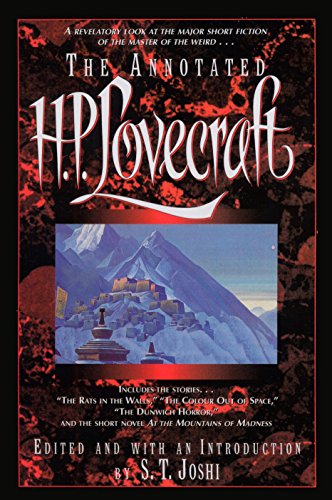
Stephen King wrote that H.P. Lovecraft "has yet to be surpassed as the twentieth century's greatest practitioner of the classic horror tale." Now enthusiasts and newcomers alike have the opportunity to enjoy five of Lovecraft's best tales in a unique package. Included are four short stories of unrivaled terror--"The Rats in the Walls," "Herbert West--Reanimator," "The Colour Out of Space," and "The Dunwich Horror"--as well as the complete text of his eerie novella of ancient alien life in the Arctic, "At the Mountains of Madness."
Augmented by hundreds of fascinating annotations by scholar S.T. Joshi, and illustrated with photographs and artwork depicting Lovecraft's life and work, this rich and varied volume is destined to become, like its author, a classic.
Auszug. © Genehmigter Nachdruck. Alle Rechte vorbehalten.
Introduction
In 1917, prompted by W. Paul Cook and other amateur journalists who had been impressed by two youthful excursions into the weird, "The Beast in the Cave" (l905) and "The Alchemist" (1908), H. P. Lovecraft wrote "The Tomb" and "Dagon," the tales that mark the start of his career as an author of horror fiction. Over the next few years he would circulate in the amateur press some three dozen stories, none of them longer than a few thousand words. Ranging from Poe-esque narratives of madness and obsession to dreamlike fantasies in the manner of Lord Dunsany, they show Lovecraft, like any apprentice writer, imitating certain favorite authors on his way to finding his own voice.
Perhaps because of his great fondness for New England, its natural landscape and colonial architecture in particular, Lovecraft did not immediately recognize its suitability as a setting for supernatural horror. Eventually, though, he was able to rise above his literary influences and find inspiration, as Nathaniel Hawthorne had nearly a century earlier, in the history and folklore of New England.
Sad to say, Lovecraft's prejudices mar his initial efforts in this direction. His first tale with a distinct New England setting, "The Terrible Old Man" (1920), amounts to little more than a polemic against the intrusion of people he regarded as "foreigners," that is, the non-English immigrants who came in the nineteenth century as cheap labor to fill the factories of an increasingly industrialized America. His disavowed sketch, "The Street" (1920), is even more tainted by bigotry.
It would take these two false starts before he produced "The Picture in the House" (1920), his first story effectively to employ local New England color. Its opening paragraph amounts to a kind of aesthetic manifesto, with its declaration that "the true epicure in the terrible . . . esteems most of all the ancient, lonely farmhouses of backwoods New England." Here Lovecraft serves notice that he will rely less on stock Gothic trappings and more on his native region as a source for horror.
In a letter dating to 1930, Lovecraft explained to Robert E. Howard, his fellow Weird Tales writer, the psychological underpinnings of the tale:
It is the night-black Massachusetts legendry which packs the really macabre "kick". Here is material for a really profound study in group-neuroticism; for certainly, no one can deny the existence of a profoundly morbid streak in the Puritan imagination. What you say of the dark Saxon-Scandinavian heritage as a possible source of the atavistic impulses brought out by emotional repression, isolation, climactic rigour, and the nearness of the vast unknown forest with its coppery savages, is of vast interest to me, insomuch as I have often both said and written exactly the same thing! Have you seen my old story "The Picture in the House"? If not, I must send you a copy. The introductory paragraph virtually sums up the idea you advance. (Selected Letters III, 174-75)
"The Picture in the House" is also significant for the introduction of what would evolve into Lovecraft's quintessential fictional town, Arkham, Massachusetts. The origin of this name has been a matter of some debate among Lovecraft scholars, but it is all but certain that he had no specific New England town or location in mind at the time he composed "The Picture in the House."
Lovecraft's next Arkham tale happens also to be his first professional work of fiction, the six-part serial "Herbert West--Reanimator" (1921-22). Commissioned by his amateur friend George Julian Houtain for a humor magazine Houtain was starting called Home Brew, it appeared serially under the generic title "Grewsome Tales" in the first six issues of that magazine (February-June 1922). While the local color is perfunctory at best, it is the story in which Miskatonic University makes its debut.
Lovecraft always considered "Herbert West—Reanimator" the worst of his tales because it was written to order and, in its following Houtain's requirement for a startling climax at the end of each segment, violated his emphasis (derived from Poe) for "singleness of impression" (Selected Letters I, 158) in a short story. "In this enforced, laboured, and artificial sort of composition there is nothing of art or natural gracefulness; for of necessity there must be a superfluity of strainings and repetitions in order to make each history compleat. My sole inducement is the monetary reward, which is a guinea [i.e., $5.00] per tale" (Selected Letters I, 157).
At the time Lovecraft began to write "Herbert West," in the fall of 1921, he was unemployed (except for sporadic work as a literary revisionist), with no prospects for work, and with his family inheritance slowly but inexorably dwindling. Five dollars (or about a quarter of a cent per word) was, even then, a very low rate for original fiction, but Lovecraft could ill afford to turn down any means of bringing in a few dollars. Although Home Brew therefore became the first venue for Lovecraft's professionally published fiction, he was no doubt relieved when that "vile rag" (Selected Letters IV, 170), folded sometime in 1924.
Despite such self-criticism Lovecraft did take considerable care in the tale's construction. The plot builds in neat, logical increments from one section to the next. It may in fact be a virtue that Herbert West's grotesque antics are more likely to raise a smile than a shudder. Readers of those first six issues of Houtain's humor magazine should not have been disappointed by this blackly comic farce of a horror story.
The wild exuberance of "Herbert West" continues in "The Hound" (1922), which Lovecraft would years later dismiss as "a piece of junk" (Selected Letters III, 192). Again, in a mood of severe self-assessment, he seems to have forgotten that he could only have written this extravagant narrative with tongue at least partly in cheek. Like the earlier tale, "The Hound" has a kind of naive charm, not least because the anonymous narrator and his pal St. John, for all their "decadent" pursuits, never indulge in any sexual escapades. It would remain for Poppy Z. Brite in her story "Thy Tongue Shall Taste of Wormwood," an obvious homage to "The Hound," to lay on the eroticism so conspicuously lacking in Lovecraft's tale.
In early October, 1924, the prospect of viewing some colonial-era buildings drew Lovecraft from New York, where he had been living since his marriage to Sonia Greene the previous March, to Elizabeth, New Jersey. There he was captivated by an old house (alas, no longer standing), because it reminded him of a house on Benefit Street in Providence where his aunt Lillian Clark once resided. Later that month he wrote "The Shunned House," his first tale to make use of an actual New England locale, undisguised. It is a heartfelt exercise, but after a lyrical and leisurely opening this lengthy story bogs down in a welter of data concerning births, marriages, and deaths. The horror ultimately unearthed is inert and despatched with relative ease.
As in "The Hound," the most important relationship in "The Shunned House" is between two men, the unnamed narrator and his beloved "antiquarian uncle," Elihu Whipple. Whipple is probably a composite portrait of Lovecraft's two learned uncles-in-law and maternal grandfather, all of whom were long gone by the 1920s. The tale's dominant mood is wistful and nostalgic—fear scarcely enters the equation—hinting at the homesickness that Lovecraft was...
„Über diesen Titel“ kann sich auf eine andere Ausgabe dieses Titels beziehen.
Suchergebnisse für The Annotated H.P. Lovecraft

Foto des Verkäufers
The Annotated H.P. Lovecraft
Verlag:
Random House Publishing Group, 1997
ISBN 10: 0440506603
ISBN 13: 9780440506607
Gebraucht
Softcover
Anbieter: Dream Books Co., Denver, CO, USA
Verkäuferbewertung 5 von 5 Sternen

Zustand: good. Gently used with minimal wear on the corners and cover. A few pages may contain light highlighting or writing, but the text remains fully legible. Dust jacket may be missing, and supplemental materials like CDs or codes may not be included. May be ex-library with library markings. Ships promptly! Artikel-Nr. DBV.0440506603.G
Gebraucht kaufen
EUR 4,55
Versand gratis
Versand innerhalb von USA
Versand innerhalb von USA
Anzahl: 1 verfügbar
Beispielbild für diese ISBN
The Annotated H. P. Lovecraft
Verlag:
Random House Publishing Group, 1997
ISBN 10: 0440506603
ISBN 13: 9780440506607
Gebraucht
Softcover
Anbieter: Better World Books, Mishawaka, IN, USA
Verkäuferbewertung 5 von 5 Sternen
Zustand: Good. Pages intact with minimal writing/highlighting. The binding may be loose and creased. Dust jackets/supplements are not included. Stock photo provided. Product includes identifying sticker. Better World Books: Buy Books. Do Good. Artikel-Nr. 4258214-75
Gebraucht kaufen
EUR 5,72
Versand gratis
Versand innerhalb von USA
Versand innerhalb von USA
Anzahl: 1 verfügbar
Beispielbild für diese ISBN
The Annotated H.P. Lovecraft
Anbieter: ThriftBooks-Reno, Reno, NV, USA
Verkäuferbewertung 5 von 5 Sternen
Paperback. Zustand: Good. No Jacket. Pages can have notes/highlighting. Spine may show signs of wear. ~ ThriftBooks: Read More, Spend Less. Artikel-Nr. G0440506603I3N00
Gebraucht kaufen
EUR 6,16
Versand gratis
Versand innerhalb von USA
Versand innerhalb von USA
Anzahl: 1 verfügbar
Beispielbild für diese ISBN
The Annotated H.P. Lovecraft
Anbieter: ThriftBooks-Reno, Reno, NV, USA
Verkäuferbewertung 5 von 5 Sternen
Paperback. Zustand: Fair. No Jacket. Former library book; Readable copy. Pages may have considerable notes/highlighting. ~ ThriftBooks: Read More, Spend Less. Artikel-Nr. G0440506603I5N10
Gebraucht kaufen
EUR 6,16
Versand gratis
Versand innerhalb von USA
Versand innerhalb von USA
Anzahl: 1 verfügbar
Beispielbild für diese ISBN
The Annotated H.P. Lovecraft
Anbieter: ThriftBooks-Phoenix, Phoenix, AZ, USA
Verkäuferbewertung 5 von 5 Sternen
Paperback. Zustand: Good. No Jacket. Pages can have notes/highlighting. Spine may show signs of wear. ~ ThriftBooks: Read More, Spend Less. Artikel-Nr. G0440506603I3N00
Gebraucht kaufen
EUR 6,16
Versand gratis
Versand innerhalb von USA
Versand innerhalb von USA
Anzahl: 1 verfügbar
Beispielbild für diese ISBN
The Annotated H.P. Lovecraft
Anbieter: ThriftBooks-Atlanta, AUSTELL, GA, USA
Verkäuferbewertung 5 von 5 Sternen
Paperback. Zustand: Good. No Jacket. Pages can have notes/highlighting. Spine may show signs of wear. ~ ThriftBooks: Read More, Spend Less. Artikel-Nr. G0440506603I3N00
Gebraucht kaufen
EUR 6,21
Versand gratis
Versand innerhalb von USA
Versand innerhalb von USA
Anzahl: 1 verfügbar
Beispielbild für diese ISBN
The Annotated H.P. Lovecraft
Anbieter: ThriftBooks-Dallas, Dallas, TX, USA
Verkäuferbewertung 5 von 5 Sternen
Paperback. Zustand: Good. No Jacket. Pages can have notes/highlighting. Spine may show signs of wear. ~ ThriftBooks: Read More, Spend Less. Artikel-Nr. G0440506603I3N00
Gebraucht kaufen
EUR 6,21
Versand gratis
Versand innerhalb von USA
Versand innerhalb von USA
Anzahl: 2 verfügbar
Beispielbild für diese ISBN
The Annotated H.P. Lovecraft
Anbieter: ThriftBooks-Dallas, Dallas, TX, USA
Verkäuferbewertung 5 von 5 Sternen
Paperback. Zustand: Fair. No Jacket. Former library book; Readable copy. Pages may have considerable notes/highlighting. ~ ThriftBooks: Read More, Spend Less. Artikel-Nr. G0440506603I5N10
Gebraucht kaufen
EUR 6,26
Versand gratis
Versand innerhalb von USA
Versand innerhalb von USA
Anzahl: 1 verfügbar
Beispielbild für diese ISBN
The Annotated H.P. Lovecraft
Anbieter: ThriftBooks-Atlanta, AUSTELL, GA, USA
Verkäuferbewertung 5 von 5 Sternen
Paperback. Zustand: Fair. No Jacket. Former library book; Readable copy. Pages may have considerable notes/highlighting. ~ ThriftBooks: Read More, Spend Less. Artikel-Nr. G0440506603I5N10
Gebraucht kaufen
EUR 6,26
Versand gratis
Versand innerhalb von USA
Versand innerhalb von USA
Anzahl: 1 verfügbar
Beispielbild für diese ISBN
The Annotated H.P. Lovecraft
Anbieter: ThriftBooks-Dallas, Dallas, TX, USA
Verkäuferbewertung 5 von 5 Sternen
Paperback. Zustand: Fair. No Jacket. Readable copy. Pages may have considerable notes/highlighting. ~ ThriftBooks: Read More, Spend Less. Artikel-Nr. G0440506603I5N00
Gebraucht kaufen
EUR 6,26
Versand gratis
Versand innerhalb von USA
Versand innerhalb von USA
Anzahl: 1 verfügbar