
Verwandte Artikel zu The Uninvited: An Expose of the Alien Abduction Phenomenon
Inhaltsangabe
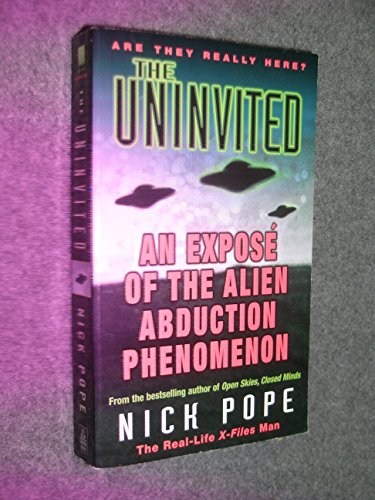
The uncensored findings of a real-life British UFO expert includes eye-opening facts about who has been abducted by non-human beings, what happened to them, and the author's own chilling speculations about why they were taken. Reprint.
Die Inhaltsangabe kann sich auf eine andere Ausgabe dieses Titels beziehen.
Über die Autorin bzw. den Autor
From 1991 to 1994 Nick Pope investigated UFO sightings for the British government's Ministry of Defence. He continues to research and investigate UFO sightings and alien abductions in a private capacity. He writes for various magazines and is in constant demand on the lecture circuit.
Aus dem Klappentext
lly here?<br><br>Non-human encounters . . . Shocking abductions . . . Bizarre medical experiments . . . At last--an exposé of the alien abduction phenomenon from a government expert.<br><br>A New Yorker is pulled from her apartment building by a beam of light--an event witnessed by security guards and a world-famous statesman . . . Two tough Mississippi shipyard workers are snatched up by a UFO for an involuntary medical exam . . . a Brazilian law student is spirited away to impregnate an alien female . . . <br><br>Alien abductions--are they hysteria, hoaxes, dreams . . . or the real thing? UFO expert Nick Pope, assigned by the British government's Ministry of Defense to find out, began his investigation as a skeptic. He ended up a believer. Now the real-life version of the X-Files agent Fox Mulder presents his shocking findings. Uncensored and unexpurgated, Agent Pope gives you the eye-opening facts: Who was abducted? What happened to them? And finally, Pope's own chilling spec
Auszug. © Genehmigter Nachdruck. Alle Rechte vorbehalten.
The Little People
How can we begin to define the alien abduction phenomenon when ufologists are unable to reach any consensus on the subject, while conventional science refuses to accept it at all? We do, however, need to start somewhere, and it is worth looking at the definition of an abductee that has been drawn up by the leading American UFO group, the Center for UFO Studies (CUFOS). They define an abductee as follows:
A person who was taken against his or her will from terrestrial surroundings by non-human beings. The beings must take the person to an enclosed space not terrestrial in appearance which the person assumes or knows to be a spacecraft. In this place the person must either be subjected to an examination, engage in communication (verbal or telepathic) or both. These experiences may be remembered consciously or through methods of focused concentration (e.g. hypnosis).
Although this is probably as good a definition as any that I have seen, it seems to me that any formal criteria are self-evidently limiting. Such rules are likely to exclude experiences that fail to fit in with the belief system of the investigator, even though the experiences themselves may be real. Central to this is the issue of consent. Does an abduction occur only when somebody is taken against their will? What of someone who gives consent out of fear or curiosity? What if someone is tricked into participating in an experience? For these reasons, I prefer to talk about a phenomenon that I define as "Human encounters with non-human intelligences." This rather wider definition avoids the limiting criteria of the CUFOS definition, and also ensures that I am not tied to the acceptance that the abductors are necessarily extraterrestrials. Far more importantly, it removes the requirement that the experience involves a spacecraft. This is crucial, because the concept of a spacecraft has existed only for a century or so, starting with the science fiction works of Jules Verne and H. G. Wells, while human encounters with non-human intelligences have been going on, I believe, throughout history. In other words, any definition of abduction that is couched in modern terms probably excludes ninety-nine percent of the phenomenon.
While it is tempting to think of the alien abduction phenomenon as something very new, I believe the opposite to be the case. Far from being the recent, American phenomenon that many believe it to be, it is my view that such events have been occurring for as long as humans have inhabited this planet. Although the frequency of these occurrences may be increasing, and although the phenomenon itself may be evolving, if we are to place abductions in their proper historical context, we need to go back in time. But in doing so, we must tread outside the bounds of our recorded history. History is biased. It is inevitably written by the victors of conflicts, or by those who seek to perpetuate their own social, economic, political or religious views. History has also tended to be written by members of the ruling classes within any society, largely because the working classes have so seldom had the educational opportunities that might have given them the literacy required to write their own histories.
There is, however, a body of recorded history that is in many ways more honest than the more formal accounts that we learn, parrot fashion, at school. There is a way in which information has been handed on, orally, from generation to generation over the years, in a way that bypassed the control of the ruling oligarchies. We call this folklore.
Folklore consists of the traditional beliefs and tales of communities; is found in all cultures of the world; and is not dependent upon literacy. A key point about folklore is that while it is so frequently told as fiction, it often has its roots in fact.
One of the most common and enduring themes running throughout folklore is that of encounters between humans and non-human intelligences. So at the beginning of our quest for the truth about alien abductions, we need to return to the folklore, and especially to accounts of the little people, who have always been key players in folkloric history.
Fairy, dwarf, goblin, hobgoblin, pixie, elf, sprite, abatwa, sidhe. These are just a few of the words used to describe the little people. These accounts come from all around the world, and one of the most likely explanations when an account of something is found in such a cross-cultural pattern is that what is being described genuinely exists, in some form. In other words, the little people are real. Modern science may scoff at such ideas, but contemporary, industrialized, Western society is just about the only culture in human history not to have what I call a corporate belief in such things. And even within this agnostic culture, one only has to scratch the surface to find the old beliefs alive and well. Go beyond the cities, and out into the rural communities, and you will soon find places in which these beliefs still thrive. Celtic folklore is particularly rich, and in Ireland, belief in the little people (sometimes known as The Gentry) is widespread, even to this day. An Irish friend of mine has told me how during her childhood it was common practice to leave food out for the fairies.
Much of the research into the links between folkloric encounters with the little people and modern encounters with aliens has been carried out by the French astrophysicist Jacques Vallée, whose book Dimensions draws together a wealth of historical reports from cultures all over the world. It is readily apparent that there are huge similarities between the old and the new accounts; the only thing that changes is the language. Vallée believes that these creatures--whatever name we give them--are fellow inhabitants of what he calls the Multiverse. As we shall see, this is but one of many theories about these other intelligences.
Further work on the relationship between folklore and abduction reports has been done by the American scholar Thomas E. Bullard, who holds a Ph.D. in folklore. Bullard has argued that where folklore derives purely from the imagination, there is a huge variety in the tales told, as each storyteller adds their own embellishments. But Bullard draws a distinction with modern abduction reports, which are, as we shall see, remarkably similar to one another. He believes this uniformity in abduction accounts differentiates them from the purely fictitious folklore.
So if we apply this principle to the various disparate myths about the little people, perhaps we can identify the common features, and thus isolate the core phenomenon.
The most significant physical characteristic is of course the small size of many of these strange beings. Straight away one sees a link between these folkloric descriptions and more modern accounts of the small, gray beings often reported as being responsible for alien abductions. We will be meeting these so-called Greys later, but first we must familiarize ourselves with their precursors.
A theme that runs through many accounts of the little people is their interaction with humans, and this is particularly true of the fairy folk. Such entities are commonly described as being highly intelligent, and prone to taking mortals away to fairyland. Most fairy activity occurs at night, and often includes abducting a human baby and replacing it with a replica, known as a changeling. Fairies from Welsh mythology--known as the Tylwyth Teg--are famed for this, and children taken by the Tylwyth Teg, if recovered, will have only vague memories of their experiences. (As we shall see, this amnesia is another key feature in the modern abduction accounts.) These cross-cultural folkloric beliefs about the taking of babies, and about changelings, are mirrored in accounts...
„Über diesen Titel“ kann sich auf eine andere Ausgabe dieses Titels beziehen.
Suchergebnisse für The Uninvited: An Expose of the Alien Abduction Phenomenon

Beispielbild für diese ISBN
The Uninvited : An Expose of the Alien Abduction Phenomenon
Verlag:
Random House Publishing Group, 1999
ISBN 10: 0440234875
ISBN 13: 9780440234876
Gebraucht
Softcover
Anbieter: Better World Books: West, Reno, NV, USA
Verkäuferbewertung 5 von 5 Sternen

Zustand: Very Good. Pages intact with possible writing/highlighting. Binding strong with minor wear. Dust jackets/supplements may not be included. Stock photo provided. Product includes identifying sticker. Better World Books: Buy Books. Do Good. Artikel-Nr. 2020022-6
Gebraucht kaufen
EUR 9,27
Versand gratis
Versand innerhalb von USA
Versand innerhalb von USA
Anzahl: 1 verfügbar
Beispielbild für diese ISBN
The Uninvited
Anbieter: ThriftBooks-Dallas, Dallas, TX, USA
Verkäuferbewertung 5 von 5 Sternen
Unknown. Zustand: Very Good. No Jacket. Former library book; May have limited writing in cover pages. Pages are unmarked. ~ ThriftBooks: Read More, Spend Less. Artikel-Nr. G0440234875I4N10
Gebraucht kaufen
EUR 11,67
Versand gratis
Versand innerhalb von USA
Versand innerhalb von USA
Anzahl: 1 verfügbar
Beispielbild für diese ISBN
The Uninvited
Anbieter: ThriftBooks-Dallas, Dallas, TX, USA
Verkäuferbewertung 5 von 5 Sternen
Unknown. Zustand: Good. No Jacket. Pages can have notes/highlighting. Spine may show signs of wear. ~ ThriftBooks: Read More, Spend Less. Artikel-Nr. G0440234875I3N00
Gebraucht kaufen
EUR 11,67
Versand gratis
Versand innerhalb von USA
Versand innerhalb von USA
Anzahl: 1 verfügbar
Beispielbild für diese ISBN
The Uninvited
Anbieter: ThriftBooks-Atlanta, AUSTELL, GA, USA
Verkäuferbewertung 5 von 5 Sternen
Unknown. Zustand: Good. No Jacket. Pages can have notes/highlighting. Spine may show signs of wear. ~ ThriftBooks: Read More, Spend Less. Artikel-Nr. G0440234875I3N00
Gebraucht kaufen
EUR 11,67
Versand gratis
Versand innerhalb von USA
Versand innerhalb von USA
Anzahl: 1 verfügbar
Beispielbild für diese ISBN
The Uninvited
Anbieter: ThriftBooks-Reno, Reno, NV, USA
Verkäuferbewertung 5 von 5 Sternen
Unknown. Zustand: Good. No Jacket. Pages can have notes/highlighting. Spine may show signs of wear. ~ ThriftBooks: Read More, Spend Less. Artikel-Nr. G0440234875I3N00
Gebraucht kaufen
EUR 11,67
Versand gratis
Versand innerhalb von USA
Versand innerhalb von USA
Anzahl: 1 verfügbar
Beispielbild für diese ISBN
The Uninvited
Anbieter: The Book Garden, Bountiful, UT, USA
Verkäuferbewertung 5 von 5 Sternen
Paperback. Zustand: Very Good - Cash. Minor rubbing and edge wear to cover, with light reader wear to pages. Still great condition. Stock photos may not look exactly like the book. Artikel-Nr. 992024
Gebraucht kaufen
EUR 6,46
EUR 6,50 Versand
Versand innerhalb von USA
Versand innerhalb von USA
Anzahl: 1 verfügbar
Beispielbild für diese ISBN
The Uninvited
Anbieter: The Book Garden, Bountiful, UT, USA
Verkäuferbewertung 4 von 5 Sternen

Paperback. Zustand: Very Good - Cash. Minor rubbing and edge wear to cover, with light reader wear to pages. Still great condition. Light crease to the spine. Stock photos may not look exactly like the book. Artikel-Nr. 965171
Gebraucht kaufen
EUR 18,46
EUR 6,50 Versand
Versand innerhalb von USA
Versand innerhalb von USA
Anzahl: 1 verfügbar