
Verwandte Artikel zu Random Winds: A Novel
Inhaltsangabe
A tragedy on a cold Adirondack day robbed country doctor Enoch Farrell of his three oldest children. Then all his hopes rested with his son, Martin, who dreamed of becoming a doctor too. Intelligent, gifted Martin could have a brilliant future. All that stood in his way was his family's poverty—until he met wealthy, beautiful Mary Fern Meig and her sister, Jessie, and everything changed forever. Moving from a teeming New York hospital to the elite operating theaters of London, Martin Farrell is about to learn the price of success—a secret bargain with the Meigs that could resonate into the next generation . . . and test the strength of a man and a woman's passion across the coming years . . .
Praise for Random Winds
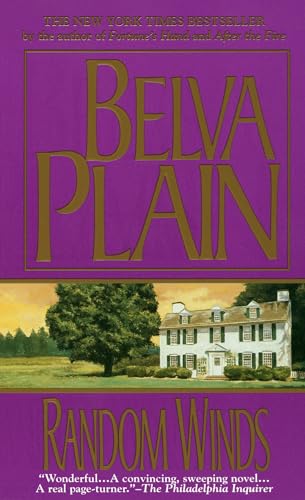
“Wonderful . . . A convincing, sweeping novel . . . A real page-turner.”—The Philadelphia Inquirer
“Impossible to put down.”—South Bend Tribune
“Engrossing.”—Publishers Weekly
“Richly woven. . . . A twisting and complex story that touches the lives of everyone.”—UPI
Die Inhaltsangabe kann sich auf eine andere Ausgabe dieses Titels beziehen.
Über die Autorin bzw. den Autor
Belva Plain is the New York Times bestselling author of Evergreen, Random Winds, Eden Burning, Crescent City, The Golden Cup, Tapestry, Blessings, Harvest, Treasures, Whispers, Daybreak, The Carousel, Promises, Secrecy, Homecoming, Legacy of Silence, Fortune’s Hand, After the Fire, Looking Back, Her Father’s House, The Sight of the Stars, Crossroads, and Heartwood. A Barnard College graduate who majored in history, Belva Plain lived in Millburn, New Jersey, where she and her husband raised three children. She died in 2010.
Von der hinteren Coverseite
turn-of-the-century village in upstate New York to war-torn London, from the bedsides of the rural poor to the life-and-death urgency of a great New York City hospital, this is a powerful epic of three generations of doctors in one magnificent family. The Farrells-dedicated, brilliant.. and driven to the edge of destruction by a love no human force could suppress.
Aus dem Klappentext
turn-of-the-century village in upstate New York to war-torn London, from the bedsides of the rural poor to the life-and-death urgency of a great New York City hospital, this is a powerful epic of three generations of doctors in one magnificent family. The Farrells-dedicated, brilliant.. and driven to the edge of destruction by a love no human force could suppress.
Auszug. © Genehmigter Nachdruck. Alle Rechte vorbehalten.
Chapter 1
At the top of the long rise, Pa guided the horse toward the shade and drew in the reins. He pulled off his woolen jacket and laid it on the seat next to Martin.
“Professional dignity be darned!” he said. “The next patient will have to look at me in my shirt-sleeves whether he likes it or not.”
The sun was ahead of the season, Ma had remarked that morning. Shadbush was still in bloom, and barn swallows were barely back from the south in time for Decoration Day.
“We’ll just wait a minute here,” Pa said, “and give the mare a rest.”
The sweating animal stamped, slapping her tail. She had been making a strange sound for the last half hour, more like a plaint than a whinny.
“Something’s bothering her, Martin.”
“Black flies, do you think?”
“Don’t see any, do you?” Pa climbed down to examine the mare. He pulled the harness aside and swore. “Damn! Damn, look at this!”
The flesh along the horse’s back was rubbed bloody raw in a line as long as three fingers put end to end.
“Laid open with a whip,” Martin said.
“No doubt, and left to suppurate.”
Martin nodded, feeling a twinge deep inside at sight of the wound, feeling also a certain pride at being the only boy in the fourth grade who knew the meaning of words like “suppurate” or who, for that matter, had a father like his.
“Poor little livery stable hack!” Pa cried. “At the mercy of every drunken lout who has the money for its hire. Reach in my bag for the salve, will you?”
The little mare quivered, her muscular back rippling and twitching.
“Now a wad of gauze, a thick one.”
When he was finished, Pa got the water bucket. The mare drank gratefully. Martin gave her an apple. Then the two stood watching, pleased with themselves, while the mare chewed, salivating in a long, thick rope.
“She’s a nice little thing,” Pa said. “Wish I had the money to buy her and give her a decent home.”
“But we’ve got Star, and she’ll be ready to take out again as soon as her foal’s a month old, won’t she?”
“You’re right. I daresay the man would want thirty dollars for her.” Pa sighed. “Well, might as well start. One more call at Bechtold’s and then home in time for the parade.”
They moved on again. “Just look up there, Martin, at the side of that far mountain! You can gauge the height by the kind of trees you see. At the bottom there’s oak, but oak won’t grow more than twelve or thirteen hundred feet up. After that, you get balsam. Way up top there’s spruce, all that bluish-green stuff.” He leaned over Martin, pointing with outthrust finger. “Those are the oldest mountains in the United States, you know that? See how the tops are rounded? Worn away, that’s why. And I’ll tell you something else.” He pointed to the left. “Down there, all that level land was once buried underwater. Can you believe that?”
“You mean the ocean was here once?”
“Yes sir, that’s just what I do mean.”
“When the ocean came, what happened to the people? Did they all drown?”
“No, no. That was millions of years before there were any people here.”
At the foot of the hill, making a wide S-curve, lay the river.
“Pa, is that the river that overflowed and drowned Enoch Junior and Susan and May?” Martin knew quite well that it was, yet he always asked.
His father answered patiently, “That’s it.”
“Then I was born, and you had me instead of Enoch Junior as your boy. Do I look like him?” To that too, he knew the answer.
“No, he was small and sandy, like me. You’re going to be tall, I think, and of course you’re darker, like your mother’s family.”
“Do you like me more than you liked him?”
“The same. A man’s children are the same to him, like his own ten fingers.”
They drew into the Bechtolds’ yard.
“Wait out here, Martin,” Pa said.
“Can’t I come in and watch?”
“I have to change a dressing. It might make you feel bad to see the cut.”
“No it won’t, Pa. Honestly, it won’t.”
What his father didn’t know was that Martin had already seen much blood, having peered many a time through the shutters of a first floor window when he was supposed to be amusing himself outdoors. He had watched Pa set a compound fracture. (The little gray tip of bone pierces the flesh; the ether cone silences the screams.) He had seen the mangled stomach of a man gored by a bull. He had also seen his father wrestle down another man who had been beating his wife, and this last had impressed him most of all, although he had known it would be wise not to mention having seen it.
“All right then, come in.”
A scythe propped carelessly in a dark corner of the barn had sliced Jake Bechtold’s leg to the bone. Pa pulled the nightshirt up. Carefully he unwound the bandage, revealing a long, blood-encrusted gash, black and crisscrossed with stitches. He studied it for a moment.
“It’s doing well. Better than I expected, to tell the truth. No infection, thanks be.”
“We’re grateful to you, Doc.” Mrs. Bechtold wrung her clasped hands. “You always seen us through.”
“Not every time, Mrs. Bechtold,” Pa said seriously.
“Oh, that! That was in God’s hands. There wasn’t nothing you could’ve done more than you did do, Doc.”
“When they go back in the buggy, Pa sat in silence for a while. And then he broke out. “Oh, it’s hard, it can be so hard! Sometimes such awful things happen, you can’t put them out of your mind as long as you live!”
“What awful things, Pa?”
His father paused, as if the telling would be too difficult Then he said, “It was in my second year here, almost into the third. I never go to Bechtold’s without living it all over again the way I did just now.”
“Was it anything you did?”
“No, it was something I didn’t do. I wasn’t able. Jake had the flu. While I was in the bedroom examining him, their little girl, just three years old she was, pulled a wash-tub full of boiling water off the stove while her mother’s back was turned. We laid her on the kitchen table. I can still hear how she screamed. Once in my life I’d ordered a lobster. It was when I first came to this country and stayed those three days in New York City. A lobster is bright red when it’s boiled, you know, and I remember I couldn’t bring myself to eat it The child looked like that. I thought, ‘I don’t know what to do. I’m supposed to know and I don’t.’ A lot of people came running in, wailing and crying. They poured cold water on the child. I didn’t think to tell them not to, although really it wouldn’t have made any difference what they did. The child was sure to die. Finally I found something to do. I got a scissors and began to cut her clothes off.
“Her body was one terrible blister. I couldn’t even look at the face. When I pulled off the stockings, the skin came with them in long strips, like tissue paper. I took some salve out of my bag. It had gone liquid from the hot sun, so I dribbled it all over the child’s body. Everybody was looking at me, just standing there watching, as if there were some magic in the jar of melted salve.
“The child lay moaning on the kitchen table all that afternoon. Someone asked, ‘Why not put her in a bed?’ ‘No,’ I said. ‘Best not to lift her.’ We put a little pillow under her head. Her pulse was so faint, I don’t think she felt anything. At least I hope not. We waited. Nobody talked. I heard the cows lowing, wanting to be milked. I’ll never forget the sounds they made, they and the child’s moaning. All the neighbor women came. Shortly before dusk the little girl died. I pulled the cover over her face. I still hadn’t looked at it.”
Martin shivered. Pa’s tales always made him feel he had been there when they happened. He had been in that kitchen with him and the dying girl; he had been on the deck with him when he sailed away from Ulster to America, out past the breakwater and the headlands, out to sea.
“I shouldn’t be telling you this, should I?” Pa asked. “Your mother would be angry. She’d say you’re too young to know how hard life can be.”
“I’m not too young. I’m nine.”
“You’re a lot older than nine in many ways.” His father’s arm, which had been resting on the back of the seat, slipped to Martin’s shoulders. His father’s hand felt warm and firm, making a union between the two of them.
“Pa,” he said, “I want to be a doctor.”
Pa looked at him carefully. “Are you saying so because you think I’d like to hear it? Is that it?”
“No. I really mean it.”
“You may change your mind.”
“I won’t change my mind.”
Pa had a little twist at the corner of his mouth, not a real smile, only the start of one, the way he did when he was pleased about something, or when he and Ma had a secret.
“Well, you’re smart enough,” he said now. “Alice is smarter.”
“Maybe so. But she’s not going to be a doctor, that’s for sure. There were a couple of women in my class at medical school, and they were pretty bright too, but if you ask me, I don’t think it’s decent. There’s man’s work and there’s woman’s work. Doctoring, to my way of thinking, is man’s work.”
“You always say it’s God’s work,” Martin said shyly.
“Well, of course it is that. Take Bechtold’s leg, now. It’s true, we’ve learned a lot about sterilization; twenty years ago you’d thread a needle and stick it in your coat lapel. But even so, you can still have infection. With all our knowledge, we must remember to be humble. Never give way to pride in your skill. Another time you might not be as lucky.”
„Über diesen Titel“ kann sich auf eine andere Ausgabe dieses Titels beziehen.
Suchergebnisse für Random Winds: A Novel

Beispielbild für diese ISBN
Random Winds
Anbieter: World of Books (was SecondSale), Montgomery, IL, USA
Verkäuferbewertung 5 von 5 Sternen

Zustand: Acceptable. Item in acceptable condition! Textbooks may not include supplemental items i.e. CDs, access codes etc. Artikel-Nr. 00101965286
Gebraucht kaufen
EUR 3,64
Versand gratis
Versand innerhalb von USA
Versand innerhalb von USA
Anzahl: 7 verfügbar
Beispielbild für diese ISBN
Random Winds: A Novel
Verlag:
Dell (edition First Edition), 1987
ISBN 10: 0440175623
ISBN 13: 9780440175629
Gebraucht
Mass Market Paperback
Erstausgabe
Anbieter: BooksRun, Philadelphia, PA, USA
Verkäuferbewertung 5 von 5 Sternen
Mass Market Paperback. Zustand: Fair. First Edition. The item might be beaten up but readable. May contain markings or highlighting, as well as stains, bent corners, or any other major defect, but the text is not obscured in any way. Artikel-Nr. 0440175623-7-1
Gebraucht kaufen
EUR 4,22
Versand gratis
Versand innerhalb von USA
Versand innerhalb von USA
Anzahl: 1 verfügbar
Beispielbild für diese ISBN
Random Winds: A Novel
Verlag:
Dell (edition First Edition), 1987
ISBN 10: 0440175623
ISBN 13: 9780440175629
Gebraucht
Mass Market Paperback
Erstausgabe
Anbieter: BooksRun, Philadelphia, PA, USA
Verkäuferbewertung 5 von 5 Sternen
Mass Market Paperback. Zustand: Fair. First Edition. The item might be beaten up but readable. May contain markings or highlighting, as well as stains, bent corners, or any other major defect, but the text is not obscured in any way. Artikel-Nr. 0440175623-7-1-13
Gebraucht kaufen
EUR 4,81
Versand gratis
Versand innerhalb von USA
Versand innerhalb von USA
Anzahl: 1 verfügbar
Beispielbild für diese ISBN
Random Winds
Anbieter: ThriftBooks-Dallas, Dallas, TX, USA
Verkäuferbewertung 5 von 5 Sternen
Mass Market Paperback. Zustand: Very Good. No Jacket. May have limited writing in cover pages. Pages are unmarked. ~ ThriftBooks: Read More, Spend Less. Artikel-Nr. G0440175623I4N00
Gebraucht kaufen
EUR 5,84
Versand gratis
Versand innerhalb von USA
Versand innerhalb von USA
Anzahl: 1 verfügbar
Beispielbild für diese ISBN
Random Winds
Anbieter: ThriftBooks-Atlanta, AUSTELL, GA, USA
Verkäuferbewertung 5 von 5 Sternen
Mass Market Paperback. Zustand: Good. No Jacket. Pages can have notes/highlighting. Spine may show signs of wear. ~ ThriftBooks: Read More, Spend Less. Artikel-Nr. G0440175623I3N00
Gebraucht kaufen
EUR 5,84
Versand gratis
Versand innerhalb von USA
Versand innerhalb von USA
Anzahl: 1 verfügbar
Beispielbild für diese ISBN
Random Winds
Anbieter: ThriftBooks-Phoenix, Phoenix, AZ, USA
Verkäuferbewertung 5 von 5 Sternen
Mass Market Paperback. Zustand: Very Good. No Jacket. May have limited writing in cover pages. Pages are unmarked. ~ ThriftBooks: Read More, Spend Less. Artikel-Nr. G0440175623I4N00
Gebraucht kaufen
EUR 5,84
Versand gratis
Versand innerhalb von USA
Versand innerhalb von USA
Anzahl: 1 verfügbar
Beispielbild für diese ISBN
Random Winds: A Novel
Anbieter: Redux Books, Grand Rapids, MI, USA
Verkäuferbewertung 5 von 5 Sternen
Mass market. Zustand: Good. COVER MAY NOT MATCH THE PICTURE ON THIS SITE. Paperback. Pages are clean and unmarked. Covers show light edge wear. AN EXCELLENT READING OR REFERENCE COPY!; 100% Satisfaction Guaranteed! Ships same or next business day! Artikel-Nr. 142504250039
Gebraucht kaufen
EUR 5,98
Versand gratis
Versand innerhalb von USA
Versand innerhalb von USA
Anzahl: 1 verfügbar
Beispielbild für diese ISBN
Random Winds : A Novel
Verlag:
Random House Publishing Group, 1987
ISBN 10: 0440175623
ISBN 13: 9780440175629
Gebraucht
Softcover
Anbieter: Better World Books, Mishawaka, IN, USA
Verkäuferbewertung 5 von 5 Sternen
Zustand: Good. Reissue. Pages intact with minimal writing/highlighting. The binding may be loose and creased. Dust jackets/supplements are not included. Stock photo provided. Product includes identifying sticker. Better World Books: Buy Books. Do Good. Artikel-Nr. 3274424-6
Gebraucht kaufen
EUR 6,43
Versand gratis
Versand innerhalb von USA
Versand innerhalb von USA
Anzahl: 4 verfügbar
Beispielbild für diese ISBN
Random Winds
Verlag:
Bantam Books November 1998, 1998
ISBN 10: 0440175623
ISBN 13: 9780440175629
Gebraucht
Paperback
Anbieter: The Book Garden, Bountiful, UT, USA
Verkäuferbewertung 5 von 5 Sternen
Paperback. Zustand: Good - Trade. Stock photos may not look exactly like the book. Artikel-Nr. 1064375
Gebraucht kaufen
EUR 3,60
EUR 6,33 Versand
Versand innerhalb von USA
Versand innerhalb von USA
Anzahl: 1 verfügbar
Beispielbild für diese ISBN
Random Winds
Anbieter: WorldofBooks, Goring-By-Sea, WS, Vereinigtes Königreich
Verkäuferbewertung 5 von 5 Sternen
Paperback. Zustand: Very Good. The book has been read, but is in excellent condition. Pages are intact and not marred by notes or highlighting. The spine remains undamaged. Artikel-Nr. GOR009021141
Gebraucht kaufen
EUR 3,60
EUR 6,53 Versand
Versand von Vereinigtes Königreich nach USA
Versand von Vereinigtes Königreich nach USA
Anzahl: 1 verfügbar