
Verwandte Artikel zu Such Troops as These: The Genius and Leadership of...
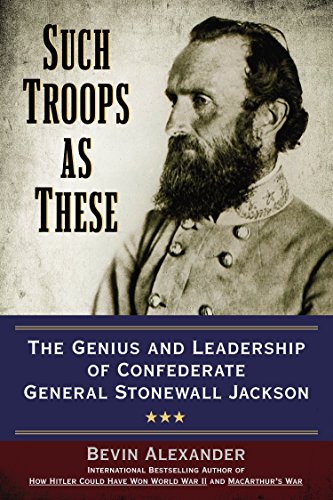
Such Troops as These: The Genius and Leadership of Confederate General Stonewall Jackson - Softcover
Inhaltsangabe
Acclaimed military historian Bevin Alexander offers a provocative analysis of Stonewall Jackson’s military genius and reveals how the Civil War might have ended differently if Jackson’s strategies had been adopted.
The Civil War pitted the industrial North against the agricultural South, and remains one of the most catastrophic conflicts in American history. With triple the population and eleven times the industry, the Union had a decided advantage over the Confederacy. But one general had a vision that could win the War for the South—Thomas J. “Stonewall” Jackson.
Jackson believed invading the eastern states from Baltimore to Maine could divide and cripple the Union, forcing surrender, but failed to convince Confederate president Jefferson Davis or General Robert E. Lee.
In Such Troops as These, Bevin Alexander presents a compelling case for Jackson as the greatest general in American history. Fiercely dedicated to the cause of Southern independence, Jackson would not live to see the end of the War. But his military legacy lives on and finds fitting tribute in this book.
Die Inhaltsangabe kann sich auf eine andere Ausgabe dieses Titels beziehen.
Über die Autorin bzw. den Autor
Bevin Alexander has published numerous works of military history, including the international bestseller How Hitler Could Have Won World War II and MacArthur’s War. With honor degrees from The Citadel and Northwestern University, Alexander was awarded the Commendation Medal for his service as a combat historian in the Korean War, where he also won three battle stars for action at the front. He has appeared often on the History, Discovery, and Military channels. He has provided testimony before the House Committee on International Relations, advised the Rand Corporation on military strategy, and taken part in a war game at the Army War College.
Auszug. © Genehmigter Nachdruck. Alle Rechte vorbehalten.
MAPS
ACKNOWLEDGMENTS
I am extremely grateful to Natalee Rosenstein, vice president and senior executive editor of the Berkley Publishing Group, for her splendid, insightful, and discerning support of this project. It has been a pleasure working with her and with Robin Barletta, editorial assistant at Berkley. Robin is a most remarkably sensitive, understanding, and efficient person who expedited the project most wonderfully. She corrected all my errors, removed all roadblocks, and turned the entire endeavor into an adventure.
Richard Hasselberger produced a superb cover design that conveys the content of the book most effectively. Laura K. Corless conceived a tasteful and truly beautiful design for the interior text. My longtime cartographer, Jeffrey L. Ward, drew the exceptionally accurate maps that allow the reader to follow exactly where the actions took place. Clear and comprehensible maps are mandatory for understanding military operations, and Jeffrey, in my opinion, draws the best maps in America today.
I have relied for a long time on my agent, Agnes Birnbaum, for her friendship, sage advice, and surpassing knowledge of the publishing industry, but mostly for the inspiring example she presents of a caring and considerate human being.
Finally, I am most honored that my sons Bevin Jr., Troy, and David, and my daughters-in-law, Mary and Kim, have always supported me steadfastly in my long and exhausting writing ventures.
INTRODUCTION
Jackson’s Recipes for Victory
Thomas J. (Stonewall) Jackson was a unique, incredibly complicated figure. He was committed to his Presbyterian religious faith, devoted to his second wife, so reserved that even his close friends seldom knew what he was thinking, dedicated to duty and the cause of Southern independence, and by far the greatest general ever produced by the American people.
Very early, Jackson discerned a way for the South to win the Civil War with speed and few losses. He recognized that the North, with three times the population of the South and eleven times its industry, was so sure of victory that it had sent practically all of its military forces into the South and had left the North almost entirely undefended. The only thing the South had to do to win, Jackson saw, was to invade the eastern states of the Union, where the vast majority of Northern industry was located and where most of its population resided. Before any Union armies could be extricated from the South, Confederate troops could cut the single railway corridor connecting Washington with Northern states, force the Abraham Lincoln administration to abandon the capital, and, by threatening the railroads, factories, farms, and mines along the great industrial corridor from Baltimore to southern Maine, compel the Northern people to give up the struggle.
A similar assault on Southern economic prosperity was precisely the strategy that Lincoln was using to conquer the South. But the Confederate president, Jefferson Davis, was a decidedly third-rate leader who possessed extremely little vision or imagination. He was committed to passive defense of the South, despite the fact that it was guaranteed to fail.1 Davis refused to endorse Jackson’s strategy, although he pressed it on Davis four times.
Once Jackson realized that Davis was never going to authorize a decisive invasion of the North, he developed another method of winning the war. He saw that two new weapons had made attacks against defended positions almost certain to fail. The first weapon was the single-shot Minié-ball rifle, with a range four times that of the old standard infantry weapon, the smoothbore musket. The second was the lightweight “Napoleon” cannon (named after Napoleon III, not the emperor) that could be rolled up to the firing line and could spew out clouds of deadly metal fragments called canister into the faces of advancing enemy troops. Jackson saw that the South could be victorious if it induced Northern armies to attack well-emplaced Confederate positions. The Union armies would inevitably be defeated, and the Confederates could swing around the flank of the demoralized Northerners and force them into retreat or surrender.
None of the other commanders on either side identified the revolutionary implications of these two weapons, however, and Jackson had an extremely difficult time trying to convince the senior Confederate commander in the East, Robert E. Lee, to follow his new system.
Jackson recognized that there is only one fundamental principle of military strategy, or the successful conduct of war. It is to attack the enemy where he is not. That is, to exert force where there is little or no opposition. All the other axioms of warfare can be reduced to variations on this single elementary theme. The ancient Chinese military sage Sun Tzu encapsulated the idea in a single sentence around 400 B.C.: “The way to avoid what is strong is to strike what is weak.”2 Jackson knew nothing of Sun Tzu, but he developed the same understanding on his own.
This is an extremely difficult concept to get across, however. Warfare to most people does not seem to be so simple. They view it through the lens of very different experiences. Human beings built their concept of warfare in the Stone Age. The small bands and tribes into which the human race was divided found that direct confrontation was the most likely way to deter opposing bands and tribes from encroaching on their safe havens and hunting grounds.3 We have carried this concept of frontal challenge forward into modern times. It is deeply ingrained in the human psyche. We label persons who act otherwise as sly and shifty; we say that they blindside other people, that they stab them in the back. We revile and despise such people, while we admire people who act in a direct, straightforward manner.
Over the aeons, highly observant individuals have occasionally seen, however, that indirection is the most effective way to achieve success, in military and in other matters, and they have attacked their opponent’s weakness. But these have been rare occurrences. In times of stress we usually revert to the instinctive response we learned in the Stone Age. We challenge the opponent right in front of us.
Therefore it is the extraordinary person who can avoid straight confrontation and can recognize the wisdom of Sun Tzu, who said: “All warfare is based on deception.”4 Stonewall Jackson was such an extraordinary person. And he saw clearly ways to win by going around the enemy, not confronting him headlong.
The Civil War of 1861–65 was the greatest crisis ever to befall the American Union. This war pitted the industrial North against the agricultural South. Though the population of the United States in 1860 was only 31.5 million people, less than a tenth of what it is today, 600,000 men were killed in the war, far more than in any other war in American history, including World War II.
The primary fact about the South was that it was an overwhelmingly agrarian, preindustrial society within a larger society that was rapidly industrializing. Because of the railroad, this larger industrial society was spreading its influence and power over the entire country. Until the coming of the railroads in the 1840s, North and South had been able to maintain radically different economies without great conflict because they interacted with each other largely at the peripheries.
For example, New England was developing a textile industry that used Southern cotton as its main feedstock. But, because roads were atrocious, it was easier to import cotton from the South and to export finished textiles to the South by ship rather than by land. Therefore, New England competed directly with Britain for the South’s raw cotton and for the...
„Über diesen Titel“ kann sich auf eine andere Ausgabe dieses Titels beziehen.
Suchergebnisse für Such Troops as These: The Genius and Leadership of...

Beispielbild für diese ISBN
Such Troops as These: The Genius and Leadership of Confederate General Stonewall Jackson
Verlag:
Penguin Publishing Group, 2015
ISBN 10: 0425271307
ISBN 13: 9780425271308
Gebraucht
Softcover
Anbieter: World of Books (was SecondSale), Montgomery, IL, USA
Verkäuferbewertung 5 von 5 Sternen

Zustand: Acceptable. Item in acceptable condition! Textbooks may not include supplemental items i.e. CDs, access codes etc. Artikel-Nr. 00106166437
Gebraucht kaufen
EUR 4,95
Versand gratis
Versand innerhalb von USA
Versand innerhalb von USA
Anzahl: 1 verfügbar
Beispielbild für diese ISBN
Such Troops as These: The Geni
Verlag:
Penguin Publishing Group, 2015
ISBN 10: 0425271307
ISBN 13: 9780425271308
Gebraucht
Softcover
Anbieter: World of Books (was SecondSale), Montgomery, IL, USA
Verkäuferbewertung 5 von 5 Sternen
Zustand: Good. Item in good condition. Textbooks may not include supplemental items i.e. CDs, access codes etc. Artikel-Nr. 00095990992
Gebraucht kaufen
EUR 4,95
Versand gratis
Versand innerhalb von USA
Versand innerhalb von USA
Anzahl: 3 verfügbar
Beispielbild für diese ISBN
Such Troops as These: The Genius and Leadership of Confederate General Stonewall Jackson
Verlag:
Penguin Publishing Group, 2015
ISBN 10: 0425271307
ISBN 13: 9780425271308
Gebraucht
Softcover
Anbieter: World of Books (was SecondSale), Montgomery, IL, USA
Verkäuferbewertung 5 von 5 Sternen
Zustand: Very Good. Item in very good condition! Textbooks may not include supplemental items i.e. CDs, access codes etc. Artikel-Nr. 00104042306
Gebraucht kaufen
EUR 4,95
Versand gratis
Versand innerhalb von USA
Versand innerhalb von USA
Anzahl: 2 verfügbar
Beispielbild für diese ISBN
Such Troops as These: The Genius and Leadership of Confederate General Stonewall Jackson
Verlag:
Penguin Publishing Group, 2015
ISBN 10: 0425271307
ISBN 13: 9780425271308
Gebraucht
Paperback
Anbieter: ThriftBooks-Dallas, Dallas, TX, USA
Verkäuferbewertung 5 von 5 Sternen
Paperback. Zustand: Fair. No Jacket. Readable copy. Pages may have considerable notes/highlighting. ~ ThriftBooks: Read More, Spend Less. Artikel-Nr. G0425271307I5N00
Gebraucht kaufen
EUR 5,83
Versand gratis
Versand innerhalb von USA
Versand innerhalb von USA
Anzahl: 1 verfügbar
Beispielbild für diese ISBN
Such Troops as These: The Genius and Leadership of Confederate General Stonewall Jackson
Verlag:
Penguin Publishing Group, 2015
ISBN 10: 0425271307
ISBN 13: 9780425271308
Gebraucht
Paperback
Anbieter: ThriftBooks-Atlanta, AUSTELL, GA, USA
Verkäuferbewertung 5 von 5 Sternen
Paperback. Zustand: Fair. No Jacket. Readable copy. Pages may have considerable notes/highlighting. ~ ThriftBooks: Read More, Spend Less. Artikel-Nr. G0425271307I5N00
Gebraucht kaufen
EUR 5,83
Versand gratis
Versand innerhalb von USA
Versand innerhalb von USA
Anzahl: 1 verfügbar
Beispielbild für diese ISBN
Such Troops as These: The Genius and Leadership of Confederate General Stonewall Jackson
Verlag:
Penguin Publishing Group, 2015
ISBN 10: 0425271307
ISBN 13: 9780425271308
Gebraucht
Paperback
Anbieter: ThriftBooks-Dallas, Dallas, TX, USA
Verkäuferbewertung 5 von 5 Sternen
Paperback. Zustand: Good. No Jacket. Pages can have notes/highlighting. Spine may show signs of wear. ~ ThriftBooks: Read More, Spend Less. Artikel-Nr. G0425271307I3N00
Gebraucht kaufen
EUR 5,83
Versand gratis
Versand innerhalb von USA
Versand innerhalb von USA
Anzahl: 1 verfügbar
Beispielbild für diese ISBN
Such Troops as These: The Genius and Leadership of Confederate General Stonewall Jackson
Verlag:
Penguin Publishing Group, 2015
ISBN 10: 0425271307
ISBN 13: 9780425271308
Gebraucht
Paperback
Anbieter: ThriftBooks-Reno, Reno, NV, USA
Verkäuferbewertung 5 von 5 Sternen
Paperback. Zustand: Good. No Jacket. Pages can have notes/highlighting. Spine may show signs of wear. ~ ThriftBooks: Read More, Spend Less. Artikel-Nr. G0425271307I3N00
Gebraucht kaufen
EUR 5,83
Versand gratis
Versand innerhalb von USA
Versand innerhalb von USA
Anzahl: 1 verfügbar
Beispielbild für diese ISBN
Such Troops as These: The Genius and Leadership of Confederate General Stonewall Jackson
Verlag:
Penguin Publishing Group, 2015
ISBN 10: 0425271307
ISBN 13: 9780425271308
Gebraucht
Paperback
Anbieter: ThriftBooks-Atlanta, AUSTELL, GA, USA
Verkäuferbewertung 5 von 5 Sternen
Paperback. Zustand: Good. No Jacket. Pages can have notes/highlighting. Spine may show signs of wear. ~ ThriftBooks: Read More, Spend Less. Artikel-Nr. G0425271307I3N00
Gebraucht kaufen
EUR 5,83
Versand gratis
Versand innerhalb von USA
Versand innerhalb von USA
Anzahl: 1 verfügbar
Beispielbild für diese ISBN
Such Troops As These : The Genius and Leadership of Confederate General Stonewall Jackson
Verlag:
Penguin Publishing Group, 2015
ISBN 10: 0425271307
ISBN 13: 9780425271308
Gebraucht
Softcover
Anbieter: Better World Books, Mishawaka, IN, USA
Verkäuferbewertung 5 von 5 Sternen
Zustand: Good. Pages intact with minimal writing/highlighting. The binding may be loose and creased. Dust jackets/supplements are not included. Stock photo provided. Product includes identifying sticker. Better World Books: Buy Books. Do Good. Artikel-Nr. 6135317-6
Gebraucht kaufen
EUR 6,30
Versand gratis
Versand innerhalb von USA
Versand innerhalb von USA
Anzahl: 2 verfügbar
Beispielbild für diese ISBN
Such Troops As These : The Genius and Leadership of Confederate General Stonewall Jackson
Verlag:
Penguin Publishing Group, 2015
ISBN 10: 0425271307
ISBN 13: 9780425271308
Gebraucht
Softcover
Anbieter: Better World Books, Mishawaka, IN, USA
Verkäuferbewertung 5 von 5 Sternen
Zustand: Very Good. Pages intact with possible writing/highlighting. Binding strong with minor wear. Dust jackets/supplements may not be included. Stock photo provided. Product includes identifying sticker. Better World Books: Buy Books. Do Good. Artikel-Nr. 38907542-6
Gebraucht kaufen
EUR 6,30
Versand gratis
Versand innerhalb von USA
Versand innerhalb von USA
Anzahl: 2 verfügbar