
Verwandte Artikel zu Siege Line (Shadow Ops: Reawakening, Band 3)
Inhaltsangabe
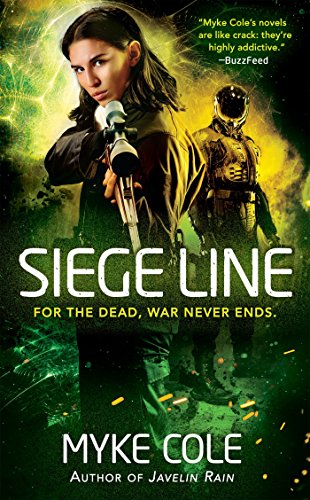
In Myke Cole’s latest high-octane, action-packed military fantasy, the fate of undead Navy SEAL James Schweitzer will be decided—one way or another...
The Gemini Cell took everything from Jim Schweitzer: his family, his career as a Navy SEAL, even his life. Hounded across the country, Schweitzer knows the only way he can ever stop running, the only way his son can ever be safe, is to take the fight to the enemy and annihilate the Cell once and for all.
But the Cell won’t be easily destroyed. Out of control and fighting a secret war with the government it once served, it has dispatched its shadowy Director to the far reaches of the subarctic in search of a secret magic that could tip the balance of power in its favor. Schweitzer must join with the elite warriors of both America and Canada in a desperate bid to get there first—and avert a disaster that could put the Cell in control.
Die Inhaltsangabe kann sich auf eine andere Ausgabe dieses Titels beziehen.
Über die Autorin bzw. den Autor
As a security contractor, government civilian, and military officer, Myke Cole’s career has run the gamut from counterterrorism to cyber warfare to federal law enforcement. He’s done three tours in Iraq and was recalled to serve during the Deepwater Horizon oil spill. He recently joined the cast of the TV show Hunted on CBS as part of an elite team of fugitive hunters. All that conflict can wear a guy out. Thank goodness for fantasy novels, comic books, late-night games of Dungeons & Dragons, and lots of angst-fueled writing. Myke is the author of Javelin Rain and Gemini Cell, prequels to his Shadow Ops series, which includes Breach Zone, Fortress Frontier, and Control Point.
Auszug. © Genehmigter Nachdruck. Alle Rechte vorbehalten.
Chapter 1
Public Servant
One Week Earlier
James Schweitzer fled into the darkness and the city of Des Moines roused itself to action.
Senator Don Hodges bounced on his shoulder, grunting with each jostling step. His suit was rumpled along with his elder-statesman dignity; only his hair remained perfect. Schweitzer's magically heightened sense of smell was nearly overwhelmed by the generously applied spray that held it in place.
"Put me down, damn it!" Hodges managed winded gasps between bumps. "I can walk."
"If you can walk, you can run," Schweitzer said, "and if you can run, you can run away."
"I know I can't outrun you," Hodges choked. "I'm not stupid!"
"You're a politician," Schweitzer replied. "It's a job requirement."
The explosions and gunfire in Hodges' office had drawn the attention of the police. Schweitzer could see the dancing colors of police car lights reflecting off the undersides of the thick clouds that hung low and close over the city. A living man wouldn't have noticed anything, but death and reanimation had made Schweitzer's senses more powerful. He knew how he would look to a passerby, a ragged corpse, missing an arm, running as fast as a speeding car, as silent as a stalking cat.
Or he would have been if it hadn't been for the man flopping on his shoulder. Hodges wheezed. "Where are you taking me?"
"Somewhere we can talk."
"We can talk right here."
The lights may have been faint, but the sirens were loud enough to be heard by anyone. It sounded like every cop in the world was converging on the building Schweitzer had just fled.
"Nice try," Schweitzer said. "I don't think the cops would take too kindly to a zombie kidnapping a Senator. I'll put you down as soon as it's safe."
"I'll call them off," Hodges said.
"Do you think I'm stupid?" Schweitzer asked.
Hodges went silent for a moment, and Schweitzer could almost hear the gears turning in his head as he tried to figure a way out of this. But it was just a moment. The man thought fast. "I just watched you take out my entire security detail in the blink of an eye. Surely, you can handle a few cops."
"Surely, I can," Schweitzer agreed, "but you're forgetting that I'm one of the good guys here. I don't want to hurt other good guys."
"Well, you're hurting me now."
"I'd hardly call you one of the good guys, and I'm not hurting you. Not yet."
Hodges went quiet again. Schweitzer's real gut had stopped churning the moment he died, but his spiritual gut more than made up for it, his anxiety's phantom limb. He hated threatening Hodges, even if it would secure his cooperation. Schweitzer's death and resurrection had made him into a horror-movie monster, but those changes were physical. His heart and soul were still his own, and he had fought like a lion to keep it that way. He wasn't a man who bullied others. Life in the SEALs had made him no stranger to the utility of violence, but that didn't mean he liked it. Stealth was key to his former role, but he had always preferred a stand-up fight, facing the enemy, showing the world who and what he was.
He thought of his wife, Sarah, and his son, Patrick, both gone now, one to the afterlife, the other to the care of his former enemy. He remembered how they'd looked at him as they'd fled through the woods from the Gemini Cell. Sarah, eyes forced wide so as not to betray her disgust; Patrick showing his naked fear of what his father had become.
Hodges might be his prisoner, but he hadn't taken the Senator to punish him. Eldredge had said that Hodges was the man who knew about the Cell and authorized its funding, which meant he was the man who could help Schweitzer shut it down. But that was nothing compared to the fact that threatening Hodges made Schweitzer feel like the monster he knew he looked like. His spiritual gut churned with the worry that if he acted that part often enough, it would eventually become a distinction in search of a difference.
Schweitzer raced for an unlit alley snaking its way between two office buildings, windows dark at this time of night. His augmented hearing brought him the sharp intakes of breath and mutters of every nearby security guard, street sweeper, or couple out for a late-night stroll. There were precious few of these in Des Moines. It was a city that truly died after dark.
He could smell the metallic tang of the Des Moines River, the soft stink of garbage and motor oil. He shouldered a Dumpster aside, careful to keep Hodges' head clear, then burst out into the streetlights, speeding toward the railing that separated the asphalt from the dark water flowing beneath it.
Hodges, seeing what was about to happen, began to thrash. "Wait! What are you . . ."
Schweitzer leapt the railing and yanked Hodges' body off his shoulder, locking the Senator close to him and arrowing him into as graceful a dive as he could manage. Despite his best effort, there was still quite a splash, and then all sound was swallowed by the river water enveloping them.
Hodges flailed, but he might as well have been a child, for all the good it did him against Schweitzer's magical strength. Schweitzer pinned him easily in place, his single arm as unyielding as an iron bar.
He kicked his legs, righting them and preparing to swim to the surface if Hodges panicked and swallowed water. But the Senator kept his cool, and Schweitzer could feel the muscles in Hodges' throat constricting as he pushed the air down out of his neck in an effort to keep his lungs inflated.
Schweitzer swallowed his surprise and took advantage of the reprieve. He kicked along, moving them underwater for about thirty seconds. Schweitzer could easily hear the rapid beating of the Senator's heart. When the oxygen starvation made the beats come slower, Schweitzer kicked off again, this time up to the surface.
"Don't screa . . ." Schweitzer was whispering in Hodges' ear, but he needn't have bothered. Hodges wasn't screaming, wasn't even gasping. He was taking short, shallow breaths, hyperventilating like a rabbit. That was good. They had taught Schweitzer to do that in training, a little trick that would help them stay down longer.
Schweitzer kicked off again, dragging them underwater until he heard the slowing of Hodges' heartbeat, then surfaced so he could take a breath. "Just relax," Schweitzer said. "I'm not going to drown you." But above the water, Schweitzer had a good scent of the blood in Hodges' carotid. He was frightened, to be sure. Excited, but not panicked. Not by a long shot. Hodges ignored him, taking one deep breath, then hyperventilating again.
Schweitzer could hear the whirring of helicopters, the screaming of sirens, but they were much fainter now, the response focusing on the Senator's office. Schweitzer moved down the river, away from the sounds.
At last, he dragged the Senator up onto the rocky shore under a bridge overpass, the tons of metal and concrete above them occasionally vibrating beneath a passing truck. Hodges lay on his back, gasping freely now, giving full rein to his lungs' desperate scramble for air. He coughed.
"You okay?" Schweitzer asked.
Hodges waved a hand weakly.
"I told you I wasn't going to drown you."
"I figured . . . I figured if you wanted me dead, you would've done it...
„Über diesen Titel“ kann sich auf eine andere Ausgabe dieses Titels beziehen.
Suchergebnisse für Siege Line (Shadow Ops: Reawakening, Band 3)

Beispielbild für diese ISBN
Siege Line
Anbieter: World of Books (was SecondSale), Montgomery, IL, USA
Verkäuferbewertung 5 von 5 Sternen

Zustand: Fair. In Myke Cole's latest high-octane, action-packed military fantasy, the fate of undead Navy SEAL James Schweitzer will be decided--one way or another. The Gemini Cell took everything from Jim Schweitzer: his family, his career as a Navy SEAL, even his life. Hounded across the country, Schweitzer knows the only way he can ever stop running, the only way his son can ever be safe, is to take the fight to the enemy and annihilate the Cell once and for all. But the Cell won't be easily destroyed. Out of control and fighting a secret war with the government it once served, it has dispatched its shadowy Director to the far reaches of the subarctic in search of a secret magic that could tip the balance of power in its favor. Schweitzer must join with the elite warriors of both America and Canada in a desperate bid to get there first--and avert a disaster that could put the Cell in control. Artikel-Nr. 00095888771
Gebraucht kaufen
EUR 3,95
Versand gratis
Versand innerhalb von USA
Versand innerhalb von USA
Anzahl: 1 verfügbar
Beispielbild für diese ISBN
Siege Line
Anbieter: World of Books (was SecondSale), Montgomery, IL, USA
Verkäuferbewertung 5 von 5 Sternen
Zustand: Good. In Myke Cole's latest high-octane, action-packed military fantasy, the fate of undead Navy SEAL James Schweitzer will be decided--one way or another. The Gemini Cell took everything from Jim Schweitzer: his family, his career as a Navy SEAL, even his life. Hounded across the country, Schweitzer knows the only way he can ever stop running, the only way his son can ever be safe, is to take the fight to the enemy and annihilate the Cell once and for all. But the Cell won't be easily destroyed. Out of control and fighting a secret war with the government it once served, it has dispatched its shadowy Director to the far reaches of the subarctic in search of a secret magic that could tip the balance of power in its favor. Schweitzer must join with the elite warriors of both America and Canada in a desperate bid to get there first--and avert a disaster that could put the Cell in control. Artikel-Nr. 00101643618
Gebraucht kaufen
EUR 3,95
Versand gratis
Versand innerhalb von USA
Versand innerhalb von USA
Anzahl: 2 verfügbar
Beispielbild für diese ISBN
Siege Line
Anbieter: World of Books (was SecondSale), Montgomery, IL, USA
Verkäuferbewertung 5 von 5 Sternen
Zustand: Very Good. In Myke Cole's latest high-octane, action-packed military fantasy, the fate of undead Navy SEAL James Schweitzer will be decided--one way or another. The Gemini Cell took everything from Jim Schweitzer: his family, his career as a Navy SEAL, even his life. Hounded across the country, Schweitzer knows the only way he can ever stop running, the only way his son can ever be safe, is to take the fight to the enemy and annihilate the Cell once and for all. But the Cell won't be easily destroyed. Out of control and fighting a secret war with the government it once served, it has dispatched its shadowy Director to the far reaches of the subarctic in search of a secret magic that could tip the balance of power in its favor. Schweitzer must join with the elite warriors of both America and Canada in a desperate bid to get there first--and avert a disaster that could put the Cell in control. Artikel-Nr. 00104246577
Gebraucht kaufen
EUR 3,95
Versand gratis
Versand innerhalb von USA
Versand innerhalb von USA
Anzahl: 2 verfügbar
Beispielbild für diese ISBN
Siege Line (Shadow Ops: Reawakening)
Verlag:
Ace (edition ), 2017
ISBN 10: 0425269663
ISBN 13: 9780425269664
Gebraucht
Mass Market Paperback
Anbieter: BooksRun, Philadelphia, PA, USA
Verkäuferbewertung 5 von 5 Sternen
Mass Market Paperback. Zustand: Very Good. It's a well-cared-for item that has seen limited use. The item may show minor signs of wear. All the text is legible, with all pages included. It may have slight markings and/or highlighting. Artikel-Nr. 0425269663-8-1
Gebraucht kaufen
EUR 6,65
Versand gratis
Versand innerhalb von USA
Versand innerhalb von USA
Anzahl: 1 verfügbar
Beispielbild für diese ISBN
Siege Line
Verlag:
Penguin Publishing Group, 2017
ISBN 10: 0425269663
ISBN 13: 9780425269664
Gebraucht
Softcover
Anbieter: Better World Books, Mishawaka, IN, USA
Verkäuferbewertung 5 von 5 Sternen
Zustand: Good. Former library copy. Pages intact with minimal writing/highlighting. The binding may be loose and creased. Dust jackets/supplements are not included. Includes library markings. Stock photo provided. Product includes identifying sticker. Better World Books: Buy Books. Do Good. Artikel-Nr. 16447655-6
Gebraucht kaufen
EUR 6,90
Versand gratis
Versand innerhalb von USA
Versand innerhalb von USA
Anzahl: 1 verfügbar
Beispielbild für diese ISBN
Siege Line
Verlag:
Penguin Publishing Group, 2017
ISBN 10: 0425269663
ISBN 13: 9780425269664
Gebraucht
Softcover
Anbieter: Better World Books, Mishawaka, IN, USA
Verkäuferbewertung 5 von 5 Sternen
Zustand: Very Good. Former library copy. Pages intact with possible writing/highlighting. Binding strong with minor wear. Dust jackets/supplements may not be included. Includes library markings. Stock photo provided. Product includes identifying sticker. Better World Books: Buy Books. Do Good. Artikel-Nr. 13838028-6
Gebraucht kaufen
EUR 6,90
Versand gratis
Versand innerhalb von USA
Versand innerhalb von USA
Anzahl: 1 verfügbar
Beispielbild für diese ISBN
Siege Line
Anbieter: ThriftBooks-Dallas, Dallas, TX, USA
Verkäuferbewertung 5 von 5 Sternen
Mass Market Paperback. Zustand: Very Good. No Jacket. May have limited writing in cover pages. Pages are unmarked. ~ ThriftBooks: Read More, Spend Less. Artikel-Nr. G0425269663I4N00
Gebraucht kaufen
EUR 8,10
Versand gratis
Versand innerhalb von USA
Versand innerhalb von USA
Anzahl: 1 verfügbar
Beispielbild für diese ISBN
Siege Line
Anbieter: ThriftBooks-Atlanta, AUSTELL, GA, USA
Verkäuferbewertung 5 von 5 Sternen
Mass Market Paperback. Zustand: Very Good. No Jacket. May have limited writing in cover pages. Pages are unmarked. ~ ThriftBooks: Read More, Spend Less. Artikel-Nr. G0425269663I4N00
Gebraucht kaufen
EUR 8,10
Versand gratis
Versand innerhalb von USA
Versand innerhalb von USA
Anzahl: 1 verfügbar
Beispielbild für diese ISBN
Siege Line (Shadow Ops: Reawakening, Band 3)
Anbieter: medimops, Berlin, Deutschland
Verkäuferbewertung 5 von 5 Sternen
Zustand: very good. Gut/Very good: Buch bzw. Schutzumschlag mit wenigen Gebrauchsspuren an Einband, Schutzumschlag oder Seiten. / Describes a book or dust jacket that does show some signs of wear on either the binding, dust jacket or pages. Artikel-Nr. M00425269663-V
Gebraucht kaufen
EUR 5,73
EUR 10,00 Versand
Versand von Deutschland nach USA
Versand von Deutschland nach USA
Anzahl: 1 verfügbar