
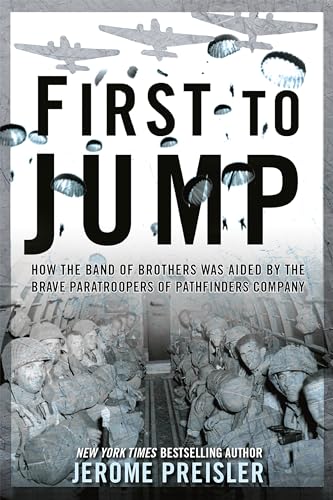
First to Jump: How the Band of Brothers was Aided by the Brave Paratroopers of Pathfinders Company - Softcover
Inhaltsangabe
With firsthand accounts of WWII heroism from the US Army Pathfinders, New York Times bestselling author Jerome Priesler chronicles their escapades scouting behind enemy lines ahead of the Band of Brothers.
“When you land in Normandy, you will have only one friend: God.”
—General “Jumpin’” Jim Gavin to the Pathfinders of the 82nd and 101st Airborne divisions before D-Day, June 1944
When the invasion of Sicily almost ended in disaster, General Jim Gavin was determined to form a unit of special operations commandos who would jump ahead of the airborne forces—including the now legendary Easy Company—stealing across enemy terrain to scout and mark out drop zones with a unique array of homing equipment. The first into combat and the last out, their advance jumps were considered suicide missions by those who sent them into action.
Sporting Mohawk haircuts and war paint, they were the best of the best. Their heroic feats behind enemy lines were critical to nearly all of the Allies’ major victories from Normandy to Bastogne—where they saved the day for thousands of American troops in an operation almost forgotten by history—to the attack on the Ruhr Valley in Germany.
This is the story of the U.S. Army Pathfinders—their training, bonding, and battlefield exploits—told from the perspectives of the men who jumped, and those who risked everything to fly them into action.
INCLUDES PHOTOS
Die Inhaltsangabe kann sich auf eine andere Ausgabe dieses Titels beziehen.
Über die Autorin bzw. den Autor
Jerome Preisler is the author of thirty books including the New York Times bestselling series Tom Clancy’s Power Plays. His most recent nonfiction includes All Hands Down: The True Story of the Soviet Attack on the USS Scorpion, Code Name Caesar: The Secret Hunt for U-Boat 864 During World War II, and Daniel’s Music: One Family’s Journey from Tragedy to Empowerment Through Faith, Medicine, and the Healing Power of Music.
Auszug. © Genehmigter Nachdruck. Alle Rechte vorbehalten.
FOREWORD
They were considered mavericks, insubordinates, and undesirables, and they’d done plenty to earn the reputation. Their commanding officers were glad, not to say overjoyed, to see them ship out to train for their special missions—glad just to be rid of them, never mind that those missions were thought to be suicidal.
They were the U.S. Army Pathfinders of the IX Troop Carrier Command. The first paratroopers to jump into combat.
And they were heroes to a man.
I spent two years chronicling their story to fill a significant gap in the history of the U.S. airborne military effort during World War Two—and in the much broader history of special operations commandos in the U.S. armed services.
While there is some excellent literature about the 101st “Screaming Eagles” and 82nd Airborne Divisions, not much has been said of their Pathfinder units, perhaps because a lot of information about their covert actions, tactics, and equipment remained classified for decades after the war, and also possibly because they were relatively small in number—fewer than three hundred of them jumped into Normandy in June 1944, and only about two dozen into the frigid, snow-blanketed heart of Bastogne later that year, on the third and arguably most daring mission for which their unique expertise was required. If not for the Pathfinders’ heroic pinpoint drop into a German siege ring consisting of a quarter million infantry troops and more than a thousand tanks, the Christmas airlift of vital supplies and ammunition to the city’s encircled U.S. forces might have failed or never gotten underway. Without it Bastogne would have been lost, the cost in American lives would have soared, and the Allied cause would have been severely damaged—or worse.
The Pathfinders were by definition special advance teams. Their job, put succinctly, was to jump behind enemy lines and mark the drop zones and landing zones for the main waves of airborne troops to follow. This alone made their existence a military innovation. But as conceived and refined by Acting Lieutenant Colonel Joel L. Crouch and Acting Sergeant Jake McNiece, the Pathfinders’ jump into Bastogne helped lay the blueprint for the sort of surgical strikes that would gain subsequent elite units widespread—and well-deserved—public recognition.
My intent here isn’t to subtract from the accomplishments of any of those other groups. Rather, it’s to enrich the story of their conceptual and tactical development and give the Pathfinders their full due as trailblazers in every sense of the word.
The brainchild of Lieutenant Crouch and the 82nd Airborne’s General James M. Gavin, the Pathfinders were created as a result of—and antidote to—the confusion that beset Gavin’s airborne jump into Sicily during the 1943 Allied invasion of the island. As his 505th Parachute Regiment troops had flown there across the Mediterranean, German flak, friendly fire, and windblown combat smoke forced many of his paratroopers to evacuate their beleaguered C-47 transport planes and become scattered behind enemy lines.
Hiking toward the beachhead with only his compass and the sounds of battle to guide him, Gavin had assembled stray groups of wounded and disoriented paratroopers into a ragtag fighting band. Before all was said and done, his parachute infantrymen would become involved in several important—and bloody—clashes with the enemy. But as a result of their chaotic drop, they sustained terrible losses and accomplished few of their intended objectives.
After Sicily, Gavin consulted with several American and British Air Force generals about how to avoid similar disasters in the future. He then turned to Lieutenant Crouch, a pioneer in civilian air transport and ace troop carrier pilot, to develop the tactics and training methods for commando-style teams that would jump ahead of the main waves of paratroopers without support, stealing across enemy terrain to scout and mark out drop zones with an array of top secret homing and guidance equipment.
In early 1944, Crouch established the Pathfinder School at RAF North Witham in Lincolnshire, England. Sheer nerve and soldiering ability were absolute requirements for a trooper to make the final grade. But so dangerous were the planned missions—there was an anticipated fatality rate of 80 or 90 percent—that most of the men enticed to take the all-volunteer training were considered troublemakers by their COs and had been persuaded it was a way to rehabilitate their tarnished service records or even avoid the brig. It is arguable, however, that the same maverick qualities that made them what Jake McNiece called bad “garrison” soldiers gave them the adaptivity needed to survive and carry out their goals under conditions their training had only approximated. The book on Pathfinding was in a real sense written on the fly by troopers whose psychological and emotional wiring freed them to toss out the rules and improvise when circumstances demanded it.
But the men who jumped only account for part of this story. The rest is about the brave and innovative aircrews who flew them to their destinations.
Along with the paratroopers, top-notch pilots and crews from each of the army’s troop carrier groups were sent to North Witham for rigorous retraining under Crouch, who would teach them stealthy air delivery techniques for the advance paratrooper teams—and rapid getaway methods through enemy flak once they’d dropped their troop loads. Meanwhile, the Pathfinders would undergo endless drills in the British countryside, where they practiced using their Eureka radar transmitters, fluorescent signal panels, and colored smoke for their first mission.
That mission would be no less critical to Allied fortunes than Operation Overlord—the D-Day invasion of Normandy. And it is with D-Day—or the night before, when the Pathfinders left England a short while ahead of the rest of the airborne troops—that this tale begins.
As a note, I’ve primarily focused here on the Pathfinders of the 101st Airborne Division, but in no way do I mean to ignore or minimize the actions of the 82nd Airborne Division Pathfinders who courageously jumped in the same campaigns. My decision was based almost altogether on practical considerations; in order to tell the tale most clearly, a narrative line had to be drawn, and staying with the 101st seemed the best and straightest course.
It is my honor and privilege to share with you the exploits of the Pathfinders and the airmen who risked everything to fly them into combat. I am profoundly humbled by their courage and will be ever grateful for their sacrifices.
—JEROME PREISLER
JULY 2014
NORMANDY
JUNE 5–7, 1944
When you land in Normandy, you will have only one friend: God.
—General James Gavin
to the Pathfinders on D-Day Minus One
CHAPTER ONE
1.
Captain Frank Lillyman, 502nd Parachute Infantry Regiment, 101st Airborne Division, knew his Pathfinders would have moonlight in their favor—a full moon and his lucky cigar. It had been clenched between his front teeth during each of his previous forty-seven jumps and was poking out of his mouth now for jump forty-eight, his first into combat. He called it a pet superstition and had only gotten burned on a single occasion.
Whenever Lillyman ran low on stogies—the Army rationed twelve a week—he would write his curly-haired missus back in Skaneateles, New York, and ask her to send spares all the way from home. He wrote Jane a lot of letters, and kept her as informed about what he was doing with the paratroopers as the military censors would allow.
At the airdrome...
„Über diesen Titel“ kann sich auf eine andere Ausgabe dieses Titels beziehen.
Weitere beliebte Ausgaben desselben Titels

Suchergebnisse für First to Jump: How the Band of Brothers was Aided by...

Beispielbild für diese ISBN
First to Jump: How the Band of Brothers was Aided by the Brave Paratroopers of Pathfinders Company
Verlag:
Penguin Publishing Group, 2015
ISBN 10: 0425265986
ISBN 13: 9780425265987
Gebraucht
Softcover
Anbieter: World of Books (was SecondSale), Montgomery, IL, USA
Verkäuferbewertung 5 von 5 Sternen

Zustand: Very Good. Item in very good condition! Textbooks may not include supplemental items i.e. CDs, access codes etc. Artikel-Nr. 00105765896
Gebraucht kaufen
EUR 5,38
Versand gratis
Versand innerhalb von USA
Versand innerhalb von USA
Anzahl: 1 verfügbar
Beispielbild für diese ISBN
First to Jump: How the Band of Brothers was Aided by the Brave Paratroopers of Pathfinders Company
Verlag:
Penguin Publishing Group, 2015
ISBN 10: 0425265986
ISBN 13: 9780425265987
Gebraucht
Softcover
Anbieter: World of Books (was SecondSale), Montgomery, IL, USA
Verkäuferbewertung 5 von 5 Sternen
Zustand: Good. Item in good condition. Textbooks may not include supplemental items i.e. CDs, access codes etc. Artikel-Nr. 00105780172
Gebraucht kaufen
EUR 5,38
Versand gratis
Versand innerhalb von USA
Versand innerhalb von USA
Anzahl: 1 verfügbar
Beispielbild für diese ISBN
First to Jump: How the Band of Brothers was Aided by the Brave Paratroopers of Pathfinders Company
Verlag:
Penguin Publishing Group, 2015
ISBN 10: 0425265986
ISBN 13: 9780425265987
Gebraucht
Paperback
Anbieter: ThriftBooks-Dallas, Dallas, TX, USA
Verkäuferbewertung 5 von 5 Sternen
Paperback. Zustand: Fair. No Jacket. Readable copy. Pages may have considerable notes/highlighting. ~ ThriftBooks: Read More, Spend Less. Artikel-Nr. G0425265986I5N00
Gebraucht kaufen
EUR 5,87
Versand gratis
Versand innerhalb von USA
Versand innerhalb von USA
Anzahl: 1 verfügbar
Beispielbild für diese ISBN
First to Jump: How the Band of Brothers was Aided by the Brave Paratroopers of Pathfinders Company
Verlag:
Penguin Publishing Group, 2015
ISBN 10: 0425265986
ISBN 13: 9780425265987
Gebraucht
Paperback
Anbieter: ThriftBooks-Reno, Reno, NV, USA
Verkäuferbewertung 5 von 5 Sternen
Paperback. Zustand: Good. No Jacket. Pages can have notes/highlighting. Spine may show signs of wear. ~ ThriftBooks: Read More, Spend Less. Artikel-Nr. G0425265986I3N00
Gebraucht kaufen
EUR 5,87
Versand gratis
Versand innerhalb von USA
Versand innerhalb von USA
Anzahl: 1 verfügbar
Beispielbild für diese ISBN
First to Jump: How the Band of Brothers was Aided by the Brave Paratroopers of Pathfinders Company
Verlag:
Penguin Publishing Group, 2015
ISBN 10: 0425265986
ISBN 13: 9780425265987
Gebraucht
Paperback
Anbieter: ThriftBooks-Atlanta, AUSTELL, GA, USA
Verkäuferbewertung 5 von 5 Sternen
Paperback. Zustand: Fair. No Jacket. Readable copy. Pages may have considerable notes/highlighting. ~ ThriftBooks: Read More, Spend Less. Artikel-Nr. G0425265986I5N00
Gebraucht kaufen
EUR 5,87
Versand gratis
Versand innerhalb von USA
Versand innerhalb von USA
Anzahl: 1 verfügbar
Beispielbild für diese ISBN
First to Jump: How the Band of Brothers was Aided by the Brave Paratroopers of Pathfinders Company
Verlag:
Penguin Publishing Group, 2015
ISBN 10: 0425265986
ISBN 13: 9780425265987
Gebraucht
Paperback
Anbieter: ThriftBooks-Atlanta, AUSTELL, GA, USA
Verkäuferbewertung 5 von 5 Sternen
Paperback. Zustand: Good. No Jacket. Pages can have notes/highlighting. Spine may show signs of wear. ~ ThriftBooks: Read More, Spend Less. Artikel-Nr. G0425265986I3N00
Gebraucht kaufen
EUR 5,87
Versand gratis
Versand innerhalb von USA
Versand innerhalb von USA
Anzahl: 1 verfügbar
Beispielbild für diese ISBN
First to Jump: How the Band of Brothers was Aided by the Brave Paratroopers of Pathfinders Company
Verlag:
Penguin Publishing Group, 2015
ISBN 10: 0425265986
ISBN 13: 9780425265987
Gebraucht
Paperback
Anbieter: ThriftBooks-Dallas, Dallas, TX, USA
Verkäuferbewertung 5 von 5 Sternen
Paperback. Zustand: Good. No Jacket. Pages can have notes/highlighting. Spine may show signs of wear. ~ ThriftBooks: Read More, Spend Less. Artikel-Nr. G0425265986I3N00
Gebraucht kaufen
EUR 5,87
Versand gratis
Versand innerhalb von USA
Versand innerhalb von USA
Anzahl: 1 verfügbar
Beispielbild für diese ISBN
First to Jump: How the Band of Brothers was Aided by the Brave Paratroopers of Pathfinders Company
Verlag:
Penguin Publishing Group, 2015
ISBN 10: 0425265986
ISBN 13: 9780425265987
Gebraucht
paperback
Anbieter: Heisenbooks, Fairless Hills, PA, USA
Verkäuferbewertung 2 von 5 Sternen

paperback. Zustand: Good. Artikel-Nr. PNJ-XBX-g-149739
Gebraucht kaufen
EUR 4,39
EUR 3,47 Versand
Versand innerhalb von USA
Versand innerhalb von USA
Anzahl: 1 verfügbar
Beispielbild für diese ISBN
First to Jump: How the Band of Brothers was Aided by the Brave Paratroopers of Pathfinders Company
Verlag:
Penguin Publishing Group, 2015
ISBN 10: 0425265986
ISBN 13: 9780425265987
Gebraucht
paperback
Anbieter: Heisenbooks, Fairless Hills, PA, USA
Verkäuferbewertung 2 von 5 Sternen
paperback. Zustand: Good. Artikel-Nr. PNJ-XBX-g-149740
Gebraucht kaufen
EUR 4,39
EUR 3,47 Versand
Versand innerhalb von USA
Versand innerhalb von USA
Anzahl: 1 verfügbar
Beispielbild für diese ISBN
First to Jump : How the Band of Brothers Was Aided by the Brave Paratroopers of Pathfinders Company
Verlag:
Penguin Publishing Group, 2015
ISBN 10: 0425265986
ISBN 13: 9780425265987
Gebraucht
Softcover
Anbieter: Better World Books, Mishawaka, IN, USA
Verkäuferbewertung 5 von 5 Sternen
Zustand: Very Good. Pages intact with possible writing/highlighting. Binding strong with minor wear. Dust jackets/supplements may not be included. Stock photo provided. Product includes identifying sticker. Better World Books: Buy Books. Do Good. Artikel-Nr. 39329339-6
Gebraucht kaufen
EUR 7,91
Versand gratis
Versand innerhalb von USA
Versand innerhalb von USA
Anzahl: 1 verfügbar