
Verwandte Artikel zu Parallels and Responses to Curricular Innovation: The...
Parallels and Responses to Curricular Innovation: The Possibilities of Posthumanistic Education (Routledge International Studies in the Philosophy of Education, 36, Band 36) - Hardcover
Buch 33 von 77: Routledge International Studies in the Philosophy of Education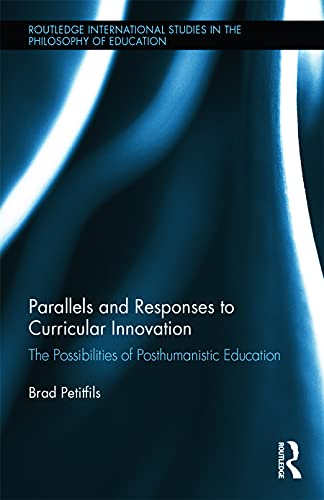
Inhaltsangabe
This volume explores two radical shifts in history and subsequent responses in curricular spaces: the move from oral to print culture in the 15th century and the rise of the Society of Jesus (the Jesuits) who created the first "global network" of education, and the move from print to digital culture in the 20th century and the rise of what the philosopher Jean Baudrillard called "hyperreality." The resulting dilemma calls for a curriculum that highlights the key tension between Man and Machine. The proposition of posthumanistic education, then, is meant to help students discern their humanness in the face of the complications that come along with digital life.
Die Inhaltsangabe kann sich auf eine andere Ausgabe dieses Titels beziehen.
Über die Autorin bzw. den Autor
Brad Petitfils teaches at Loyola University New Orleans, USA. His research focuses on hyperreality and posthumanism and the ways these theories affect the undergraduate classroom and the development of young adults. He teaches First-Year Seminars and is the co-director of Loyola's summer abroad program in Paris, France.
„Über diesen Titel“ kann sich auf eine andere Ausgabe dieses Titels beziehen.
Suchergebnisse für Parallels and Responses to Curricular Innovation: The...

Beispielbild für diese ISBN
Parallels and Responses to Curricular Innovation: The Possibilities of Posthumanistic Education (Routledge International Studies in the Philosophy of Education)
Anbieter: Ria Christie Collections, Uxbridge, Vereinigtes Königreich
Verkäuferbewertung 5 von 5 Sternen

Zustand: New. In. Artikel-Nr. ria9780415733793_new
Neu kaufen
EUR 243,75
EUR 13,98 Versand
Versand von Vereinigtes Königreich nach USA
Versand von Vereinigtes Königreich nach USA
Anzahl: Mehr als 20 verfügbar
Beispielbild für diese ISBN
Parallels and Responses to Curricular Innovation : The Possibilities of Posthumanistic Education
Anbieter: Buchpark, Trebbin, Deutschland
Verkäuferbewertung 5 von 5 Sternen
Zustand: Sehr gut. Zustand: Sehr gut | Sprache: Englisch | Produktart: Bücher | This volume explores two radical shifts in history and subsequent responses in curricular spaces: the move from oral to print culture during the transition between the 15th and 16th centuries and the rise of the Jesuits, and the move from print to digital culture during the transition between the 20th and 21st centuries and the rise of what the philosopher Jean Baudrillard called "hyperreality."The curricular innovation that accompanied the first shift is considered through the rise of the Society of Jesus (the Jesuits). These men created the first "global network" of education, and developed a humanistic curriculum designed to help students navigate a complicated era of the known (human-centered) and unknown (God-centered) universe.The curricular innovation that is proposed for the current shift is guided by the question: What should be the role of undergraduate education become in the 21st century? Today, the tension between the known and unknown universe is concentrated on the interrelationships between our embodied spaces and our digitally mediated ones. As a result, today's undergraduate students should be challenged to understand how-in the objectively focused, commodified, STEM-centric landscape of higher education-the human subject is decentered by the forces of hyperreality, and in turn, how the human subject might be recentered to balance our humanness with the new realities of digital living. Therein, one finds the possibility of posthumanistic education. Artikel-Nr. 24830706/2
Gebraucht kaufen
EUR 156,57
EUR 105,00 Versand
Versand von Deutschland nach USA
Versand von Deutschland nach USA
Anzahl: 1 verfügbar
Beispielbild für diese ISBN
Parallels and Responses to Curricular Innovation: The Possibilities of Posthumanistic Education
Anbieter: Revaluation Books, Exeter, Vereinigtes Königreich
Verkäuferbewertung 5 von 5 Sternen
Hardcover. Zustand: Brand New. 1st edition. 154 pages. 9.00x6.25x0.50 inches. In Stock. Artikel-Nr. x-0415733790
Neu kaufen
EUR 316,88
EUR 11,67 Versand
Versand von Vereinigtes Königreich nach USA
Versand von Vereinigtes Königreich nach USA
Anzahl: 2 verfügbar
Beispielbild für diese ISBN
Parallels and Responses to Curricular Innovation: The Possibilities of Posthumanistic Education: 36 (Routledge International Studies in the Philosophy of Education)
Anbieter: Kennys Bookstore, Olney, MD, USA
Verkäuferbewertung 5 von 5 Sternen
Zustand: New. Series: Routledge International Studies in the Philosophy of Education. Num Pages: 154 pages, 1 black & white tables. BIC Classification: JNB; JNKC; JNM. Category: (UP) Postgraduate, Research & Scholarly; (UU) Undergraduate. Dimension: 229 x 152 x 10. Weight in Grams: 340. . 2014. 1st Edition. hardcover. . . . . Books ship from the US and Ireland. Artikel-Nr. V9780415733793
Neu kaufen
EUR 319,65
EUR 9,01 Versand
Versand innerhalb von USA
Versand innerhalb von USA
Anzahl: Mehr als 20 verfügbar