Conjectures and Refutations: The Growth of Scientific Knowledge: Volume 17 (Routledge Classics) - Softcover
Buch 121 von 150: Routledge Classics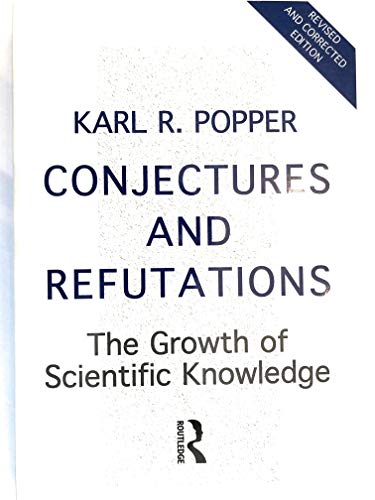
Inhaltsangabe
The way in which knowledge progresses, and especially our scientific knowledge, is by unjustified (and unjustifiable) anticipations, by guesses, by tentative solutions to our problems, by conjectures. These conjectures are controlled by criticism: that is, by attempted refutations, which include severely critical tests. They may survive these tests; but they can never be positively justified: they can neither be established as certainly true nor even as 'probable' (in the sense of the probability calculus). Criticism of our conjectures is of decisive importance: by bringing out our mistakes it makes us understand the difficulties of the problems which we try to solve. This is how we become better acquainted with our problem, and able to propose more mature solutions: the very refutation of a theory - that is, of a tentative solution to our problem - is always a step forward that takes us nearer the truth. And this is how we can learn from our mistakes. As we learn from our mistakes our knowledge grows, even though we may never know - that is, know for certain. Since our knowledge can grow, there can be no reason here for despair of reason. And since we can never know for certain, the can be no authority here for any claim to authority, for conceit over our knowledge, or for smugness. The essays and lectures of which this book is composed apply this thesis to many topics, ranging from problems of the philosophy and history of the physical and social sciences to historical and political problems.
Die Inhaltsangabe kann sich auf eine andere Ausgabe dieses Titels beziehen.
Críticas
'Popper holds that truth is not manifest, but extremely elusive, he believes that men need above all things, open-mindedness, imagination, and a constant willingness to be corrected.' – Maurice Cranston, Listener
Reseña del editor
The way in which knowledge progresses, and especially our scientific knowledge, is by unjustified (and unjustifiable) anticipations, by guesses, by tentative solutions to our problems, by conjectures. These conjectures are controlled by criticism: that is, by attempted refutations, which include severely critical tests. They may survive these tests; but they can never be positively justified: they can neither be established as certainly true nor even as 'probable' (in the sense of the probability calculus). Criticism of our conjectures is of decisive importance: by bringing out our mistakes it makes us understand the difficulties of the problems which we try to solve. This is how we become better acquainted with our problem, and able to propose more mature solutions: the very refutation of a theory - that is, of a tentative solution to our problem - is always a step forward that takes us nearer the truth. And this is how we can learn from our mistakes. As we learn from our mistakes our knowledge grows, even though we may never know - that is, know for certain. Since our knowledge can grow, there can be no reason here for despair of reason. And since we can never know for certain, the can be no authority here for any claim to authority, for conceit over our knowledge, or for smugness.
The essays and lectures of which this book is composed apply this thesis to many topics, ranging from problems of the philosophy and history of the physical and social sciences to historical and political problems.
„Über diesen Titel“ kann sich auf eine andere Ausgabe dieses Titels beziehen.
Weitere beliebte Ausgaben desselben Titels

Suchergebnisse für Conjectures and Refutations: The Growth of Scientific...

Beispielbild für diese ISBN
Conhjectures and Refutations: The Growth of Scientific Knowledge
Anbieter: Windows Booksellers, Eugene, OR, USA
Verkäuferbewertung 5 von 5 Sternen

Paperback. Handsome copy 431 pp. Artikel-Nr. 735915
Beispielbild für diese ISBN
Conjectures and Refutations: The Growth of Scientific Knowledge (Revised and Corrected Edn)
Anbieter: Anybook.com, Lincoln, Vereinigtes Königreich
Verkäuferbewertung 5 von 5 Sternen
Zustand: Poor. This is an ex-library book and may have the usual library/used-book markings inside.This book has soft covers. Book contains pen markings. In poor condition, suitable as a reading copy. Please note the Image in this listing is a stock photo and may not match the covers of the actual item,800grams, ISBN:9780415043182. Artikel-Nr. 4317225
Gebraucht kaufen
EUR 8,82
Versand:
EUR 15,33
Von Vereinigtes Königreich nach USA
Anzahl: 1 verfügbar
Beispielbild für diese ISBN
Conjectures and Refutations: The Growth of Scientific Knowledge (Revised and Corrected Edn)
Anbieter: Anybook.com, Lincoln, Vereinigtes Königreich
Verkäuferbewertung 5 von 5 Sternen
Zustand: Poor. This is an ex-library book and may have the usual library/used-book markings inside.This book has soft covers. Book contains pen, pencil & highlighter markings. In poor condition, suitable as a reading copy. Please note the Image in this listing is a stock photo and may not match the covers of the actual item,800grams, ISBN:9780415043182. Artikel-Nr. 4317226
Gebraucht kaufen
EUR 8,82
Versand:
EUR 15,33
Von Vereinigtes Königreich nach USA
Anzahl: 1 verfügbar
Beispielbild für diese ISBN
Conjectures and Refutations: The Growth of Scientific Knowledge (Revised and Corrected Edn)
Anbieter: Anybook.com, Lincoln, Vereinigtes Königreich
Verkäuferbewertung 5 von 5 Sternen
Zustand: Poor. This is an ex-library book and may have the usual library/used-book markings inside.This book has soft covers. Book contains pen & pencil markings. In poor condition, suitable as a reading copy. Please note the Image in this listing is a stock photo and may not match the covers of the actual item,800grams, ISBN:9780415043182. Artikel-Nr. 4317227
Gebraucht kaufen
EUR 8,82
Versand:
EUR 15,33
Von Vereinigtes Königreich nach USA
Anzahl: 1 verfügbar
Beispielbild für diese ISBN
Conjectures and Refutations : The Growth of Scientific Knowledge
Anbieter: Anytime Books, London, Vereinigtes Königreich
Verkäuferbewertung 5 von 5 Sternen
Soft cover. Zustand: Very Good. Third revised ed. pp.xiii.431. Artikel-Nr. 006176
Gebraucht kaufen
EUR 23,57
Versand:
EUR 32,04
Von Vereinigtes Königreich nach USA
Anzahl: 1 verfügbar
Beispielbild für diese ISBN
Conjectures and Refutations: The Growth of Scientific Knowledge (Routledge Classics)
Verlag:
Taylor & Francis Ltd, United Kingdom, London, 1969
ISBN 10: 0415043182
ISBN 13: 9780415043182
Gebraucht
Paperback
Anbieter: WorldofBooks, Goring-By-Sea, WS, Vereinigtes Königreich
Verkäuferbewertung 5 von 5 Sternen
Paperback. Zustand: Very Good. The way in which knowledge progresses, and especially our scientific knowledge, is by unjustified (and unjustifiable) anticipations, by guesses, by tentative solutions to our problems, by conjectures. These conjectures are controlled by criticism: that is, by attempted refutations, which include severely critical tests. They may survive these tests; but they can never be positively justified: they can neither be established as certainly true nor even as 'probable' (in the sense of the probability calculus). Criticism of our conjectures is of decisive importance: by bringing out our mistakes it makes us understand the difficulties of the problems which we try to solve. This is how we become better acquainted with our problem, and able to propose more mature solutions: the very refutation of a theory - that is, of a tentative solution to our problem - is always a step forward that takes us nearer the truth. And this is how we can learn from our mistakes. As we learn from our mistakes our knowledge grows, even though we may never know - that is, know for certain. Since our knowledge can grow, there can be no reason here for despair of reason. And since we can never know for certain, the can be no authority here for any claim to authority, for conceit over our knowledge, or for smugness. The essays and lectures of which this book is composed apply this thesis to many topics, ranging from problems of the philosophy and history of the physical and social sciences to historical and political problems. The book has been read, but is in excellent condition. Pages are intact and not marred by notes or highlighting. The spine remains undamaged. Artikel-Nr. GOR001387235
Gebraucht kaufen
EUR 58,59
Versand:
EUR 6,41
Von Vereinigtes Königreich nach USA
Anzahl: 1 verfügbar