
Verwandte Artikel zu The Outsider: My Life in Intrigue
Inhaltsangabe
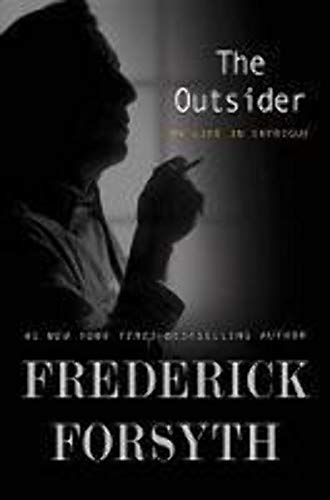
From Frederick Forsyth, the grand master of international suspense, comes his most intriguing story ever—his own.
For more than forty years, Frederick Forsyth has been writing extraordinary real-world novels of intrigue, from the groundbreakingThe Day of the Jackal to the prescient The Kill List. Whether writing about the murky world of arms dealers, the shadowy Nazi underground movement, or the intricacies of worldwide drug cartels, every plot has been chillingly plausible because every detail has been minutely researched.
But what most people don’t know is that some of his greatest stories of intrigue have been in his own life.
He was the RAF’s youngest pilot at the age of nineteen, barely escaped the wrath of an arms dealer in Hamburg, got strafed by a MiG during the Nigerian civil war, landed during a bloody coup in Guinea-Bissau (and was accused of helping fund a 1973 coup in Equatorial Guinea). The Stasi arrested him, the Israelis feted him, the IRA threatened him, and a certain attractive Czech secret police agent—well, her actions were a bit more intimate. And that’s just for starters.
It is a memoir like no other—and a book of pure delight.
Die Inhaltsangabe kann sich auf eine andere Ausgabe dieses Titels beziehen.
Über die Autorin bzw. den Autor
Frederick Forsyth is the author of fifteen novels, from 1971’s The Day of the Jackalto 2013’s The Kill List, and two short story collections. A former pilot and print and television reporter for Reuters and the BBC, he won the Diamond Dagger Award from the Crime Writers’ Association in 2012 for a career of sustained excellence. Forsyth lives in England.
Auszug. © Genehmigter Nachdruck. Alle Rechte vorbehalten.
***This excerpt is from an advance uncorrected proof***
Copyright © 2015 Frederick Forsyth
WHISPERED WORDS
My father was born in 1906, the eldest son of a frequently absent Chief Petty Officer, Royal Navy, in Chatham, Kent, and emerged at twenty from the Dockyard School to an economy that was creating one job for every ten young men in the labor pool. The other nine were destined for the dole queue.
He had studied to be a naval architect, but as the Great Depression loomed, no one wanted ships to be built. The Hitlerian threat had not materialized and there were more merchant ships than anyone needed to carry the diminishing industrial product. After five years scraping a living from little more than odd jobs, he followed the popular advice of the age: Go East, Young Man. He applied for and secured a post as a rubber planter in Malaya.
Today it would seem strange to appoint a young man with not a word of Malay nor knowledge of the Orient to go to the other end of the world to manage many thousands of acres of plantation and a large labour force of Malays and Chinese. But those were the days of empire, when such challenges were perfectly normal.
So he packed his things, said goodbye to his parents and took ship for Singapore. He learned Malay and the intricacies of estate management and rubber production, and ran his estate for five years. Each day, he wrote a love letter to the girl with whom he had been “walking out,” as they called dating back then, and she wrote to him. The next liner from Britain to Singapore brought the week’s supply of letters and they came to the estate in Johore on the weekly riverboat.
Life was lonely and isolated, illuminated by the weekly motorcycle ride south through the jungle, out onto the main road, across the causeway and into Changi for a convivial evening at the planters’ club. His estate consisted of a huge tract of rubber trees set in parallel rows and surrounded by jungle which was home to tigers, black panthers, and the much-feared hamadryad or king cobra. There was no car, because the track to the main road ten miles through the jungle was a narrow, winding line of red laterite gravel, so he rode a motorcycle.
And there was the village in which the labour force of Chinese tappers lived with their wives and families. And like any village there were a few craftsmen – a butcher, a baker, a blacksmith and so forth.
He stuck it for four years until it became plain there was little enough future in it. Rubber had slumped on the market. European rearmament had not yet started, but the new synthetics were taking more and more market share. The planters were asked to take a twenty percent salary cut as a condition of continued employment. For the bachelors, the choice was either send for their fiancées to come and join them, or to go home to England. By 1935, he was havering between the two when something happened.
One night his houseboy roused him with a request.
“Tuan, the village carpenter is outside. He begs to see you.”
The routine was usually rise at five, tour the estate for two hours, then the morning reception when he would sit on the verandah and hear any petitions, complaints or adjudications in quarrels. Because of the early rise, he turned in at nine p.m. and this request was after ten o’clock. He was about to say “In the morning” when it occurred to him that if it could not wait, it might be serious.
“Bring him in,” he said. The houseboy demurred.
“He will not come, tuan. He is not worthy.”
My father rose, opened the screen door and went out to the verandah. Outside, the tropical night was warm velvet and the mosquitos voracious. Standing in a pool of light below the verandah was the village carpenter, a Japanese, the only one in the village. My father knew he had a wife and child and they never mixed with anyone. The man bowed deeply.
“It is my son, tuan. The boy is very ill. I fear for him.”
Dad called for lanterns and they went to the village. The child was about ten and wracked with pain from his stomach. His mother, an agonized face, crouched in the corner.
My father was no doctor, not even a paramedic, but a compulsory course of first aid and a clutch of medical textbooks gave him enough knowledge to recognize acute appendicitis. It was pitch black and closing on midnight. Changi hospital was eighty miles away, but he knew that if appendicitis turned to peritonitis, it would kill.
He ordered his motorcycle brought out, fully fuelled. The father used his wife’s broad sash, the obi, to fasten the child on the pillion, tied to my father’s back, and he set off. He told me later it was a hellish journey, for all the predators hunt at night. It was nearly an hour down the rutted track to the main road, then due south for the Causeway.
Dawn was close to breaking some hours later when he rolled into the forecourt of Changi General Hospital, yelling for someone to come and help him. Nursing staff appeared and wheeled the child away. By luck, a British doctor was coming off night shift, but took one look and rushed the boy to surgery.
The doctor joined my father for tiffin in the canteen and told him he had been just in time. The appendix was just about to burst, with probably lethal results. But the boy would live and was even then asleep. He gave the obi back.
After re-fuelling, my father rode back to his estate to reassure the impassive but hollow-eyed parents and catch up with the delayed day’s work. A fortnight later, the riverboat brought the mail package, the usual stores, and a small Japanese boy with a shy smile and a scar.
Four days later, the carpenter appeared again, this time in daylight. He was waiting near the bungalow when Dad returned from the latex store for tea. He kept his eyes on the ground as he spoke.
‘Tuan, my son will live. In my culture when a man owes what I owe you, he must offer the most valuable thing that he has. But I am a poor man and have nothing to offer save one thing. Advice.’
Then he raised his eyes and stared my father in the face.
‘Leave Malaya, tuan. If you value your life, leave...
„Über diesen Titel“ kann sich auf eine andere Ausgabe dieses Titels beziehen.
Suchergebnisse für The Outsider: My Life in Intrigue

Beispielbild für diese ISBN
The Outsider My Life in Intrig
Anbieter: World of Books (was SecondSale), Montgomery, IL, USA
Verkäuferbewertung 5 von 5 Sternen

Zustand: Very Good. Item in very good condition! Textbooks may not include supplemental items i.e. CDs, access codes etc. Artikel-Nr. 00101961654
Gebraucht kaufen
EUR 4,03
Versand gratis
Versand innerhalb von USA
Versand innerhalb von USA
Anzahl: 4 verfügbar
Beispielbild für diese ISBN
The Outsider: My Life in Intrigue
Verlag:
G.P. Putnam's Sons (edition First Edition), 2015
ISBN 10: 0399176071
ISBN 13: 9780399176074
Gebraucht
Hardcover
Erstausgabe
Anbieter: BooksRun, Philadelphia, PA, USA
Verkäuferbewertung 5 von 5 Sternen
Hardcover. Zustand: Very Good. First Edition. With dust jacket. It's a well-cared-for item that has seen limited use. The item may show minor signs of wear. All the text is legible, with all pages included. It may have slight markings and/or highlighting. Artikel-Nr. 0399176071-8-1-29
Gebraucht kaufen
EUR 5,05
Versand gratis
Versand innerhalb von USA
Versand innerhalb von USA
Anzahl: 2 verfügbar
Foto des Verkäufers
The Outsider: My Life in Intrigue
Anbieter: Dream Books Co., Denver, CO, USA
Verkäuferbewertung 5 von 5 Sternen
Zustand: good. Gently used with minimal wear on the corners and cover. A few pages may contain light highlighting or writing, but the text remains fully legible. Dust jacket may be missing, and supplemental materials like CDs or codes may not be included. May be ex-library with library markings. Ships promptly! Artikel-Nr. DBV.0399176071.G
Gebraucht kaufen
EUR 5,99
Versand gratis
Versand innerhalb von USA
Versand innerhalb von USA
Anzahl: 1 verfügbar
Beispielbild für diese ISBN
The Outsider: My Life in Intrigue
Anbieter: Wonder Book, Frederick, MD, USA
Verkäuferbewertung 5 von 5 Sternen
Zustand: Very Good. Very Good condition. Good dust jacket. With remainder mark. A copy that may have a few cosmetic defects. May also contain light spine creasing or a few markings such as an owner's name, short gifter's inscription or light stamp. Artikel-Nr. M05G-01826
Gebraucht kaufen
EUR 6,40
Versand gratis
Versand innerhalb von USA
Versand innerhalb von USA
Anzahl: 1 verfügbar
Beispielbild für diese ISBN
The Outsider : My Life in Intrigue
Verlag:
Penguin Publishing Group, 2015
ISBN 10: 0399176071
ISBN 13: 9780399176074
Gebraucht
Hardcover
Erstausgabe
Anbieter: Better World Books, Mishawaka, IN, USA
Verkäuferbewertung 5 von 5 Sternen
Zustand: Good. First Edition. Pages intact with minimal writing/highlighting. The binding may be loose and creased. Dust jackets/supplements are not included. Stock photo provided. Product includes identifying sticker. Better World Books: Buy Books. Do Good. Artikel-Nr. 5730255-6
Gebraucht kaufen
EUR 6,72
Versand gratis
Versand innerhalb von USA
Versand innerhalb von USA
Anzahl: 1 verfügbar
Beispielbild für diese ISBN
The Outsider : My Life in Intrigue
Verlag:
Penguin Publishing Group, 2015
ISBN 10: 0399176071
ISBN 13: 9780399176074
Gebraucht
Hardcover
Erstausgabe
Anbieter: Better World Books: West, Reno, NV, USA
Verkäuferbewertung 5 von 5 Sternen
Zustand: Very Good. First Edition. Former library copy. Pages intact with possible writing/highlighting. Binding strong with minor wear. Dust jackets/supplements may not be included. Includes library markings. Stock photo provided. Product includes identifying sticker. Better World Books: Buy Books. Do Good. Artikel-Nr. GRP102117083
Gebraucht kaufen
EUR 6,72
Versand gratis
Versand innerhalb von USA
Versand innerhalb von USA
Anzahl: 1 verfügbar
Beispielbild für diese ISBN
The Outsider : My Life in Intrigue
Verlag:
Penguin Publishing Group, 2015
ISBN 10: 0399176071
ISBN 13: 9780399176074
Gebraucht
Hardcover
Erstausgabe
Anbieter: Better World Books, Mishawaka, IN, USA
Verkäuferbewertung 5 von 5 Sternen
Zustand: Good. First Edition. Former library copy. Pages intact with minimal writing/highlighting. The binding may be loose and creased. Dust jackets/supplements are not included. Includes library markings. Stock photo provided. Product includes identifying sticker. Better World Books: Buy Books. Do Good. Artikel-Nr. 8397556-6
Gebraucht kaufen
EUR 6,72
Versand gratis
Versand innerhalb von USA
Versand innerhalb von USA
Anzahl: 1 verfügbar
Beispielbild für diese ISBN
The Outsider : My Life in Intrigue
Verlag:
Penguin Publishing Group, 2015
ISBN 10: 0399176071
ISBN 13: 9780399176074
Gebraucht
Hardcover
Erstausgabe
Anbieter: Better World Books, Mishawaka, IN, USA
Verkäuferbewertung 5 von 5 Sternen
Zustand: Very Good. First Edition. Former library copy. Pages intact with possible writing/highlighting. Binding strong with minor wear. Dust jackets/supplements may not be included. Includes library markings. Stock photo provided. Product includes identifying sticker. Better World Books: Buy Books. Do Good. Artikel-Nr. GRP102117083
Gebraucht kaufen
EUR 6,72
Versand gratis
Versand innerhalb von USA
Versand innerhalb von USA
Anzahl: 1 verfügbar
Beispielbild für diese ISBN
The Outsider: My Life in Intrigue
Anbieter: ThriftBooks-Dallas, Dallas, TX, USA
Verkäuferbewertung 5 von 5 Sternen
Hardcover. Zustand: Very Good. No Jacket. May have limited writing in cover pages. Pages are unmarked. ~ ThriftBooks: Read More, Spend Less. Artikel-Nr. G0399176071I4N00
Gebraucht kaufen
EUR 6,73
Versand gratis
Versand innerhalb von USA
Versand innerhalb von USA
Anzahl: 1 verfügbar
Beispielbild für diese ISBN
The Outsider: My Life in Intrigue
Anbieter: ThriftBooks-Dallas, Dallas, TX, USA
Verkäuferbewertung 5 von 5 Sternen
Hardcover. Zustand: Very Good. No Jacket. Missing dust jacket; May have limited writing in cover pages. Pages are unmarked. ~ ThriftBooks: Read More, Spend Less. Artikel-Nr. G0399176071I4N01
Gebraucht kaufen
EUR 6,73
Versand gratis
Versand innerhalb von USA
Versand innerhalb von USA
Anzahl: 1 verfügbar