
Verwandte Artikel zu How Did I Get Here?: A Memoir
Inhaltsangabe
From his hardscrabble post-World War II Ontario childhood and coming of age to Mad Men-era New York City and the creative pinnacle of advertising, to the hallowed halls of Saturday Night Live and The New Yorker, Bruce McCall’s personal and creative journey is stunningly honest, bittersweet, and, above all, inspiring.
Beloved for his strikingly original and wickedly perceptive New Yorker covers, as well as his many Shouts and Murmurs, Bruce is a rare double threat as an artist and writer. Self-taught in both disciplines, his artistic world has captured the imagination of a loyal fan base that includes no less than David Letterman (whom he coauthored a book with) and other satire aficionados. Pulling no punches, How Did I Get Here? chronicles the evolution of his artistic genius as well as his journey from gifted childhood scribbler to passionate automobile enthusiast, a hobby that took him to the heights of the Detroit and Manhattan advertising worlds. His long-held passion for drawing and writing, which mostly lay dormant during his Mad Men days, reemerged later in life as he left the realm of advertising for the world of arts and letters, most notably at the National Lampoon, as a writer for Saturday Night Live in its first incarnation, and then of course at The New Yorker, as well as other Conde Nast magazines, such as Vanity Fair. His is an unorthodox life and career path, traversing through worlds that have now become iconic, giving us rich first-hand insight into Bruce's unique creative development and process, and providing a rare window into both the highs and the lows that define an artist's career and life.
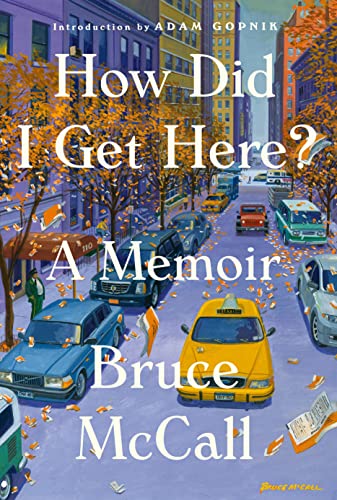
With wit, candor, and cover illustrations showcasing Bruce's storied career, Bruce McCall’s memoir will charm his many fans and anyone who knows and loves the places and eras he describes so well.
Die Inhaltsangabe kann sich auf eine andere Ausgabe dieses Titels beziehen.
Über die Autorin bzw. den Autor
Bruce McCall began his career in a commercial art studio, switched to journalism and then advertising, and began writing and painting humorous subjects in the seventies, first with National Lampoon and ultimately for The New Yorker. McCall has published six previous books, including This Land Was Made for You and Me (But Mostly Me) in collaboration with David Letterman. He lives in New York City.
Auszug. © Genehmigter Nachdruck. Alle Rechte vorbehalten.
Chapter 1
Be Careful What You Wish For
Colonel John Graves Simcoe delivered the first valentine card in North America. A century later, another colonel, James Sutherland "Buster" Brown, Simcoe born and bred, drafted Defence Scheme No. 1, the Canadian government's secret 1921 plan to invade key U.S. cities in the event of war.
That about covers the claim to fame of Simcoe, Ontario. I was born there when it was a town of six thousand; now it's more than doubled, a bedroom community for Hamilton and Toronto. Simcoe prospered with a rich agricultural base, and tobacco was the big industry when I was a boy. No Ontario town was ever nominated to be sister city to Florence, and there were good reasons why Simcoe was among the nonstarters. Scottish conservatism is as close to the opposite of Florentine culture as can be imagined. Piano lessons and church choirs sufficed as culture, which otherwise had no role in the life of the town.
Kids like me avoided Sunday school and regular church attendance. We were unwitting cultural morons who couldn't miss what we never had. As did all heathens, we wallowed in an idyllic freedom. This got a huge boost from the Second World War, which removed innumerable dads and further loosened the controls on our behavior. Domestic life and disciplining kids became, by default, the duty of wives, and wives of that era seldom ruled households harshly.
The McCall family was big-five boys and, eventually, one girl: Mike, Hugh, me, twins Tom and Walter, and Chris. I attribute my lifelong shunning of group activities to this. My antipathy took a brief time-out when I was suckered into Lord Baden-Powell's Boy Scouts as a Cub, at the bottom of a hierarchy of ranks not unlike the arrangements in the Vatican. Boy Scouts patiently climbed up in modest increments: at the summit stood the Sea Scouts, as elite as the King's Mounted Household Guards. I never saw a Sea Scout. I still suspect they were a gaudy invention, like Jesus, to keep all Boy Scouts striving.
I salivated when I landed on the Sea Scouts section of the official Scouts catalog. What greedy kid wouldn't want that inventory? There were silken neckerchiefs. An over-the-shoulder leather Sam Browne belt. A steel canteen. A second belt around the waist, its clasp ingeniously mating two halves to form the Boy Scouts escutcheon. A small leather case clipped to the belt for fishing lures, small change, the odd whistle or rubber band. A hornpipe dangling from the same belt. Over the left shoulder, a set of semaphore signaling flags in a cylindrical leather case. There were pockets and flaps on the official Sea Scout shirt. Binoculars on a strap slung around the neck. Knee socks. A pair of waterproof Sea Scout brogans. Sewn onto the shirtfront and sleeves, resembling a horde of caterpillars, were cloth Sea Scout badges of merit: bed making, swimming, diving, drowning-cat rescue, tree felling, completion of an anti-seasickness course. Badges commemorating a fire extinguished, a torpedo assembled, a torpedo disassembled. And in the Sea Scout model's hand, a silver whistle so powerful that when blown in Cairo it could be heard in Johannesburg.
Only the sons of mining company CEOs, arms dealers, and senior officers of secret banks could afford the complete Sea Scout uniform. I grieved for my fundlessness: my bilious-green, beanie-like peaked cap, cut to the pattern of every English public school boy's cap since Tom Brown's School Days, was my only item of Cubs regalia.
Ill fortune soon proved good fortune shortly after my enthusiasm for Lord Baden-Powell's mild outdoor adventuring, feeble at the start, crashed. Our pack leader was exposed as a pederast and fled town on his Harley-Davidson with sidecar. I hadn't the money for Sea Scouts gewgaws, and had already tired of sitting on my haunches in some ratty clubhouse, imitating a talking wolf by shouting, "A-Kay-LUH!" I slipped away. The Cubs cap hung around the house, a reminder of the dangers of joining up, until someone (me, legend has it) fed it one day to Billy Perkins's dog, Tip.
The toys and tools of a happy boyhood circa 1943 demanded improvisation more than cash. While American kids feasted on tons of magnificent plastic junk, Canada couldn't produce toys in wartime conditions beyond a handful of crude pot-metal Hurricanes. In Simcoe, fifty cents could buy the indiscriminate kid a tommy gun cut out of a chunk of wood that resembled a folded umbrella. Some of our improvisations:
The green steel pot Mother used to boil potatoes made a perfect Japanese Imperial Army helmet for Pacific jungle skirmishes in the lilac bushes.
The flour canister in the kitchen became a snowbound hell for the five plastic British soldiers-unfazed by their gas masks-sent to ambush Nazis in the wastes of Norway. Mother later discovered a Brit soldier buried deep in the flour, perfectly preserved.
Rich brown horse chestnuts, tied by strings to hankies, subbed for a band of Wehrmacht parachutists floating down from a second-story sunporch window to land on Crete.
A working cap gun bestowed prestige-and what felt like real killing power-on its owner. A mouth-made firing noise might spray a foe with spittle, but no firing noise from a human source could beat the three or four eardrum-puncturing bang-bang-bang-bangs in a cap-gun blast. A functioning gun cost an eight-year-old partisan big money. A discarded cap gun retrieved from the battlefield, sans trigger and missing its fake-pearl celluloid handle, was as close as I ever came. Even rarer than a working gun were the dirty-red rolls of caps required to make it go bang! and emit an acrid aroma. These were forever in short supply. Maybe the army maintained an elite Cap Gun Brigade that claimed top priority-another damn casualty of wartime restrictions.
Weekly Saturday matinees ran war movies. Fifty-two weeks' worth per year exhausted the supply, leaving us to sit through Durango Kid westerns, Boston Blackie detective junk, and the odd stale box-office hit, usually a musical. In retrospect, while certain Hollywood war flicks charged the imagination and lifted the soul, many were so cheaply made that footage of a World War I Spad was suddenly spliced into the frenzy of World War II dogfights. The best war movies were British: Target for Tonight, In Which We Serve, Five Graves to Cairo, et al.
Authenticity was the difference. They seemed more realistic than the stagey, broad American fare like Edge of Darkness or Desperate Journey.
Toboggans rocketed us down Simcoe's steepest grade, off the first tee of the Norfolk Country Club. Snowshoes had been supplied by our boisterous cousins, the Stewart boys. I never got good at snowshoeing, which requires control and is more like walking hard than sliding along on a pair of skis. A bunch of skis reposed in the shadows but were seldom used, because Simcoe lacked the gradients they were meant for.
The substantial Jackson house sat on a hill directly facing our peeling stucco home across Talbot Street. Daredevil kids lugged their sleds up to the Jacksons' front lawn, then dived downhill belly-first on the sleds. A Flexible Flyer, with glass-smooth steel runners, was the ride of choice. Victory went to the sledboy who eked out energy enough to keep his momentum as he reached Talbot Street and his path flattened out. He summoned the last erg of sledpower as he and his mount transected the slippery street and crossed the finish line in a controlled crash. On winter afternoons in Simcoe, darkness fell around four o'clock with an almost audible thud. Cars, headlights blazing, arrowed past. No walkie-talkies linked sledboy and headquarters. A shouted "Look out!" curbed-or tried to curb-sled and pilot as the operator...
„Über diesen Titel“ kann sich auf eine andere Ausgabe dieses Titels beziehen.
Suchergebnisse für How Did I Get Here?: A Memoir

Beispielbild für diese ISBN
How Did I Get Here?: A Memoir
Anbieter: ThriftBooks-Dallas, Dallas, TX, USA
Verkäuferbewertung 5 von 5 Sternen

Hardcover. Zustand: Very Good. No Jacket. Former library book; May have limited writing in cover pages. Pages are unmarked. ~ ThriftBooks: Read More, Spend Less. Artikel-Nr. G0399172289I4N10
Gebraucht kaufen
EUR 6,24
Versand gratis
Versand innerhalb von USA
Versand innerhalb von USA
Anzahl: 1 verfügbar
Beispielbild für diese ISBN
How Did I Get Here?: A Memoir
Anbieter: ThriftBooks-Phoenix, Phoenix, AZ, USA
Verkäuferbewertung 5 von 5 Sternen
Hardcover. Zustand: Very Good. No Jacket. Former library book; May have limited writing in cover pages. Pages are unmarked. ~ ThriftBooks: Read More, Spend Less. Artikel-Nr. G0399172289I4N10
Gebraucht kaufen
EUR 6,24
Versand gratis
Versand innerhalb von USA
Versand innerhalb von USA
Anzahl: 1 verfügbar
Beispielbild für diese ISBN
How Did I Get Here?: A Memoir
Anbieter: ThriftBooks-Atlanta, AUSTELL, GA, USA
Verkäuferbewertung 5 von 5 Sternen
Hardcover. Zustand: Very Good. No Jacket. Former library book; May have limited writing in cover pages. Pages are unmarked. ~ ThriftBooks: Read More, Spend Less. Artikel-Nr. G0399172289I4N10
Gebraucht kaufen
EUR 6,24
Versand gratis
Versand innerhalb von USA
Versand innerhalb von USA
Anzahl: 2 verfügbar
Beispielbild für diese ISBN
How Did I Get Here?: A Memoir
Anbieter: ThriftBooks-Reno, Reno, NV, USA
Verkäuferbewertung 5 von 5 Sternen
Hardcover. Zustand: Very Good. No Jacket. Former library book; May have limited writing in cover pages. Pages are unmarked. ~ ThriftBooks: Read More, Spend Less. Artikel-Nr. G0399172289I4N10
Gebraucht kaufen
EUR 6,24
Versand gratis
Versand innerhalb von USA
Versand innerhalb von USA
Anzahl: 1 verfügbar
Beispielbild für diese ISBN
How Did I Get Here? : A Memoir
Verlag:
Penguin Publishing Group, 2020
ISBN 10: 0399172289
ISBN 13: 9780399172281
Gebraucht
Hardcover
Anbieter: Better World Books, Mishawaka, IN, USA
Verkäuferbewertung 5 von 5 Sternen
Zustand: Very Good. Former library copy. Pages intact with possible writing/highlighting. Binding strong with minor wear. Dust jackets/supplements may not be included. Includes library markings. Stock photo provided. Product includes identifying sticker. Better World Books: Buy Books. Do Good. Artikel-Nr. 39982355-6
Gebraucht kaufen
EUR 6,40
Versand gratis
Versand innerhalb von USA
Versand innerhalb von USA
Anzahl: 1 verfügbar
Beispielbild für diese ISBN
How Did I Get Here? : A Memoir
Verlag:
Penguin Publishing Group, 2020
ISBN 10: 0399172289
ISBN 13: 9780399172281
Gebraucht
Hardcover
Anbieter: Better World Books: West, Reno, NV, USA
Verkäuferbewertung 5 von 5 Sternen
Zustand: Good. Former library copy. Pages intact with minimal writing/highlighting. The binding may be loose and creased. Dust jackets/supplements are not included. Includes library markings. Stock photo provided. Product includes identifying sticker. Better World Books: Buy Books. Do Good. Artikel-Nr. 40762572-6
Gebraucht kaufen
EUR 6,40
Versand gratis
Versand innerhalb von USA
Versand innerhalb von USA
Anzahl: 1 verfügbar
Beispielbild für diese ISBN
How Did I Get Here? : A Memoir
Verlag:
Penguin Publishing Group, 2020
ISBN 10: 0399172289
ISBN 13: 9780399172281
Gebraucht
Hardcover
Anbieter: Better World Books, Mishawaka, IN, USA
Verkäuferbewertung 5 von 5 Sternen
Zustand: Good. Former library copy. Pages intact with minimal writing/highlighting. The binding may be loose and creased. Dust jackets/supplements are not included. Includes library markings. Stock photo provided. Product includes identifying sticker. Better World Books: Buy Books. Do Good. Artikel-Nr. 40762572-6
Gebraucht kaufen
EUR 6,40
Versand gratis
Versand innerhalb von USA
Versand innerhalb von USA
Anzahl: 1 verfügbar
Beispielbild für diese ISBN
How Did I Get Here?: A Memoir
Anbieter: Wonder Book, Frederick, MD, USA
Verkäuferbewertung 5 von 5 Sternen
Zustand: Good. Good condition. Very Good dust jacket. A copy that has been read but remains intact. May contain markings such as bookplates, stamps, limited notes and highlighting, or a few light stains. Artikel-Nr. Q13Q-00388
Gebraucht kaufen
EUR 7,55
Versand gratis
Versand innerhalb von USA
Versand innerhalb von USA
Anzahl: 1 verfügbar
Beispielbild für diese ISBN
How Did I Get Here?: A Memoir
Verlag:
Blue Rider Press (edition Illustrated), 2020
ISBN 10: 0399172289
ISBN 13: 9780399172281
Gebraucht
Hardcover
Anbieter: BooksRun, Philadelphia, PA, USA
Verkäuferbewertung 5 von 5 Sternen
Hardcover. Zustand: Very Good. Illustrated. With dust jacket. It's a well-cared-for item that has seen limited use. The item may show minor signs of wear. All the text is legible, with all pages included. It may have slight markings and/or highlighting. Artikel-Nr. 0399172289-11-6-29
Gebraucht kaufen
EUR 7,73
Versand gratis
Versand innerhalb von USA
Versand innerhalb von USA
Anzahl: 1 verfügbar
Beispielbild für diese ISBN
How Did I Get Here?
Anbieter: BookOutlet, Jefferson City, TN, USA
Verkäuferbewertung 5 von 5 Sternen
Hardcover. Zustand: New. Hardcover. Publisher overstock, may contain remainder mark on edge. Artikel-Nr. 9780399172281B