
Verwandte Artikel zu The Secret War for the Union: The Untold Story of Military...
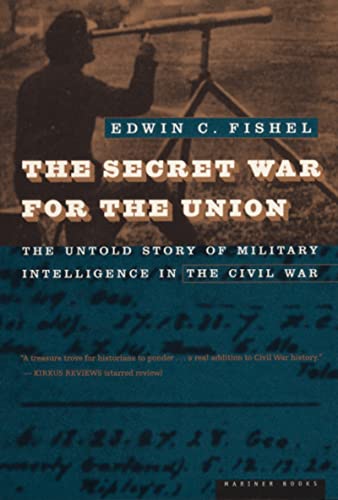
The Secret War for the Union: The Untold Story of Military Intelligence in the Civil War – How Intelligence Shaped Victory, Defeat, and the Decisions of Commanders - Softcover
Inhaltsangabe
Most histories of the Civil War explain victory and defeat in terms of the skill of commanders and their troops. Intelligence records disappeared after the war, and thus a critically important element has largely been ignored. Fishel has unearthed substantial collections of such records, and his "intelligence explanation" radically alters history's understanding of the campaigns. The Secret War for the Union is one of the most important Civil War works ever published.
Die Inhaltsangabe kann sich auf eine andere Ausgabe dieses Titels beziehen.
Über die Autorin bzw. den Autor
Edwin C. Fishel began thirty years of service during World War II, working first as a chief intelligence reporter in the National Security Agency and later as the director of the National Cryptologic School Press. He lives in Arlington, Virgina.
Auszug. © Genehmigter Nachdruck. Alle Rechte vorbehalten.
The Secret War for the Union
The Untold Story of Military Intelligence in the Civil War
By Edwin C. FishelHoughton Mifflin Harcourt Publishing Company
Copyright © 1996 Edwin C. Fishel
All rights reserved.
ISBN: 978-0-395-90136-6All rights reserved.
Contents
Title Page,
Table of Contents,
Copyright,
Dedications,
List of Illustrations,
List of Maps,
Foreword,
Introduction,
Twenty Thousand Potential Spies,
First Bull Run,
"Known in Richmond in Twenty-Four Hours",
The Phony War of 1861–62,
Mr. Pinkerton's Unique Arithmetic,
"Outnumbered" on the Peninsula,
Hard Lessons from Professor Jackson,
Too Little and Too Soon,
All the Plans of the Rebels,
Luck Runs Out for Palmer and Stine,
The Blind Campaign of Fredericksburg,
A New Client for Attorney Sharpe,
Ten Days of Southern Hospitality,
Rebel Spies Are Now Second Best,
The Gray Fox Swallows the Bait,
Pinpoint Intelligence and Hairline Planning,
Illustrations,
Paralyzed by a Real Jackson and a Phantom Longstreet,
Lee's Army Vanishes,
Pursuit,
Lost Intelligence, Lost Battle,
Joe Hooker's Magnificent Error,
Reaping the Pennsylvania Harvest,
The Thirtieth of June,
Decision and Victory,
Epilogue,
Appendix 1,
Appendix 2,
Appendix 3,
Appendix 4,
Appendix 5,
Appendix 6,
Appendix 7,
Appendix 8,
Comment on Sources,
List of Abbreviations and Short Titles,
Notes,
Bibliography,
Sources and Acknowledgments,
Index,
About the Author,
Footnotes,
CHAPTER 1
Twenty Thousand Potential Spies
January–July 1861
IT WOULD BE DIFFICULT to imagine a nation entering a war more unprepared to obtain information about its enemy than the United States of 1861. In the almost ludicrously small U.S. Army there was no intelligence staff, no corps of spies, trained or otherwise. There was not so much as a concept on which a plan for these services could be based. If, hidden away in some file of regulations, there was even one paragraph for the guidance of a commander with an intelligence problem to solve, it was for all practical purposes unknown in 1861, and its obscurity was preserved throughout the war.
There was not even an official name for such activities. The word intelligence meant new information on any subject. Its nearest equivalent in the military lexicon of the 1860s was "secret service" — without initial capitals. However, "secret service" referred not only to the work now known as intelligence but often to nonmilitary detective work as well. And though it denoted this group of activities, it did not refer to any organization that conducted them, for there was none; the national Secret Service that has often been mentioned and even depicted by Civil War historians did not exist, from the beginning of the war to its end.
Yet there were reasons why the nation might have had a strong "secret service." Espionage directed by George Washington — who used the term intelligence in its modern military sense — had made a definite contribution to the winning of the Revolutionary War. So there might well have been a tradition of activity and adeptness in intelligence work strong enough to last until the next great test of national strength eighty-five years later. But it was forgotten by the time of the second war with Britain in 1812; then there was a total lack of organized intelligence work, with results such as the loss of Detroit and Washington, when British deception persuaded the Americans that they were outnumbered. In the Mexican War army engineers were drawn into the intelligence business as investigators of terrain features and the enemy's man-made defenses; Captain Robert E. Lee and Second Lieutenant George B. McClellan, engineer officers and future commanders of opposing armies, distinguished themselves as providers of intelligence. For coverage outside the engineers' reach, their commander, General Winfield Scott, had a company of Mexican banditti. The association of engineers with intelligence work was becoming a tradition, but it was an activity without a name or an identity.
European military writers, whom American officers could quote from memory, had strongly, almost vehemently, urged the importance of having good information about the enemy. Hundreds of the nation's career officers knew the dictum of Frederick the Great: "It is pardonable to be defeated, but not to be taken by surprise." Equally familiar was Marshal Saxe's injunction that "too much attention cannot be given to spies and guides. ... they are as necessary to a general as the eyes are to the head"; and Jomini's question, "How can any man decide what he should do himself if he is ignorant of what his enemy is about?" Evidently the Europeans' urgings on the importance of intelligence were regarded as precepts to be taken into account only when the nation would go to war. But the neglect of the example set by General Washington is less easy to explain away. It is true that the records of his espionage service lay buried until the twentieth century, and that without history tradition has a hard existence. Yet the seeds of a strong intelligence organization had been planted in the nation's first army. That they withered away probably was due to the nation's isolation; a healthy wariness of foreign powers was lacking.
But the absence of intelligence organization or activity is no more strange than half a dozen other lacks that plagued the 1861 army. Although good weapons had been invented and were available, nearly all of those in use were badly antiquated. There was a dearth of officers trained in the higher arts of generalship; the septuagenarian Generals Winfield Scott and John E. Wool had commanded forces that were called armies in earlier wars but would not be large enough to merit the term in the 1860s. Younger officers' command experience was almost altogether limited to the companies, battalions, and regiments that had served on the western plains and the Pacific coast. The only way to acquaint these officers with the management of large forces was to send them to European armies as observers, and very few had that experience.
If some officers with ideas ahead of their time had set about to found an intelligence organization, the approaching division of the nation into warring halves would have stood in their way. Conducting, or even planning, espionage against foreign powers would have seemed a waste of money, when the only war likely to occur was an internal one. With all of the top positions in the army held by Southern officers, it would have been impossible to limit such preparations to officers certain to remain with the North when war came. And other factors discouraged intelligence planning. Overt sources of information — prisoners, deserters, refugees, enemy pickets — required only the application of interrogating skills. Cavalry reconnaissance, certain to be a major source, was already practiced against hostile Indians. Captured documents could be counted on as a source in any war that should develop, but how could a planning or training officer prepare for that? Enemy newspapers would be useful; they would be acquired as part of the contraband commerce that develops in a war.
Definite opportunities for intelligence planning were offered by two technological advances of recent times. Balloon reconnaissance was adopted early in the war, but only at the...
„Über diesen Titel“ kann sich auf eine andere Ausgabe dieses Titels beziehen.
Suchergebnisse für The Secret War for the Union: The Untold Story of Military...

Beispielbild für diese ISBN
The Secret War For The Union: The Untold Story of Military Intelligence in the Civil War - How Intelligence Shaped Victory, Defeat, and the Decisions of Commanders
Anbieter: World of Books (was SecondSale), Montgomery, IL, USA
Verkäuferbewertung 5 von 5 Sternen

Zustand: Good. Item in good condition. Textbooks may not include supplemental items i.e. CDs, access codes etc. Artikel-Nr. 00090149622
Gebraucht kaufen
EUR 6,57
Versand gratis
Versand innerhalb von USA
Versand innerhalb von USA
Anzahl: 4 verfügbar
Beispielbild für diese ISBN
The Secret War for the Union
Anbieter: Wonder Book, Frederick, MD, USA
Verkäuferbewertung 5 von 5 Sternen
Zustand: Very Good. Very Good condition. A copy that may have a few cosmetic defects. May also contain light spine creasing or a few markings such as an owner's name, short gifter's inscription or light stamp. Artikel-Nr. E16D-00677
Gebraucht kaufen
EUR 6,67
Versand gratis
Versand innerhalb von USA
Versand innerhalb von USA
Anzahl: 2 verfügbar
Beispielbild für diese ISBN
The Secret War for the Union
Anbieter: Wonder Book, Frederick, MD, USA
Verkäuferbewertung 5 von 5 Sternen
Zustand: Good. Good condition. A copy that has been read but remains intact. May contain markings such as bookplates, stamps, limited notes and highlighting, or a few light stains. Artikel-Nr. R14P-00711
Gebraucht kaufen
EUR 6,67
Versand gratis
Versand innerhalb von USA
Versand innerhalb von USA
Anzahl: 1 verfügbar
Beispielbild für diese ISBN
The Secret War for the Union: The Untold Story of Military Intelligence in the Civil War
Anbieter: ThriftBooks-Atlanta, AUSTELL, GA, USA
Verkäuferbewertung 5 von 5 Sternen
Paperback. Zustand: Good. No Jacket. Pages can have notes/highlighting. Spine may show signs of wear. ~ ThriftBooks: Read More, Spend Less. Artikel-Nr. G0395901367I3N00
Gebraucht kaufen
EUR 6,79
Versand gratis
Versand innerhalb von USA
Versand innerhalb von USA
Anzahl: 1 verfügbar
Beispielbild für diese ISBN
The Secret War for the Union: The Untold Story of Military Intelligence in the Civil War
Anbieter: ThriftBooks-Dallas, Dallas, TX, USA
Verkäuferbewertung 5 von 5 Sternen
Paperback. Zustand: Good. No Jacket. Pages can have notes/highlighting. Spine may show signs of wear. ~ ThriftBooks: Read More, Spend Less. Artikel-Nr. G0395901367I3N00
Gebraucht kaufen
EUR 6,79
Versand gratis
Versand innerhalb von USA
Versand innerhalb von USA
Anzahl: 1 verfügbar
Beispielbild für diese ISBN
The Secret War for the Union : The Untold Story of Military Intelligence in the Civil War
Verlag:
HarperCollins Publishers, 1998
ISBN 10: 0395901367
ISBN 13: 9780395901366
Gebraucht
Softcover
Anbieter: Better World Books, Mishawaka, IN, USA
Verkäuferbewertung 5 von 5 Sternen
Zustand: Good. Re. Pages intact with minimal writing/highlighting. The binding may be loose and creased. Dust jackets/supplements are not included. Stock photo provided. Product includes identifying sticker. Better World Books: Buy Books. Do Good. Artikel-Nr. 5511172-6
Gebraucht kaufen
EUR 7,55
Versand gratis
Versand innerhalb von USA
Versand innerhalb von USA
Anzahl: 1 verfügbar
Beispielbild für diese ISBN
The Secret War for the Union : The Untold Story of Military Intelligence in the Civil War
Verlag:
HarperCollins Publishers, 1998
ISBN 10: 0395901367
ISBN 13: 9780395901366
Gebraucht
Softcover
Anbieter: Better World Books, Mishawaka, IN, USA
Verkäuferbewertung 5 von 5 Sternen
Zustand: Very Good. Re. Pages intact with possible writing/highlighting. Binding strong with minor wear. Dust jackets/supplements may not be included. Stock photo provided. Product includes identifying sticker. Better World Books: Buy Books. Do Good. Artikel-Nr. 4812367-6
Gebraucht kaufen
EUR 7,55
Versand gratis
Versand innerhalb von USA
Versand innerhalb von USA
Anzahl: 1 verfügbar
Foto des Verkäufers
The Secret War For The Union: The Untold Story of Military Intelligence in the Civil War
Anbieter: Alicesrestraunt, O Fallon, MO, USA
Verkäuferbewertung 5 von 5 Sternen
Soft cover. Zustand: Fair. No Jacket. Most histories of the Civil War explain victory and defeat in terms of the skill of commanders and their troops. Intelligence records disappeared after the war, and thus a critically important element has largely been ignored. Fishel has unearthed substantial collections of such records, and his "intelligence explanation" radically alters history's understanding of the campaigns. The Secret War for the Union is one of the most important Civil War works ever published. Condition: Covers have shelf wear and corner thumbing. Pages are clean and binding is secure. Artikel-Nr. ABE-1714416950510
Gebraucht kaufen
EUR 5,49
EUR 4,98 Versand
Versand innerhalb von USA
Versand innerhalb von USA
Anzahl: 1 verfügbar
Foto des Verkäufers
The Secret War for the Union: The Untold Story of Military Intelligence in the Civil War
Verlag:
Houghton Mifflin Company, New York, 1996
ISBN 10: 0395901367
ISBN 13: 9780395901366
Gebraucht
Paperback
Anbieter: PsychoBabel & Skoob Books, Didcot, Vereinigtes Königreich
Verkäuferbewertung 5 von 5 Sternen
Paperback. Zustand: Very Good. Paperback. Page block and page edges are tanned, with a few marks on the former. All text is clear. TS. Used. Artikel-Nr. 501059
Gebraucht kaufen
EUR 18,18
EUR 14,71 Versand
Versand von Vereinigtes Königreich nach USA
Versand von Vereinigtes Königreich nach USA
Anzahl: 1 verfügbar
Beispielbild für diese ISBN
Secret War for the Union
Anbieter: PBShop.store US, Wood Dale, IL, USA
Verkäuferbewertung 5 von 5 Sternen
PAP. Zustand: New. New Book. Shipped from UK. Established seller since 2000. Artikel-Nr. L2-9780395901366
Neu kaufen
EUR 40,26
Versand gratis
Versand innerhalb von USA
Versand innerhalb von USA
Anzahl: Mehr als 20 verfügbar