
Verwandte Artikel zu Mill
Inhaltsangabe
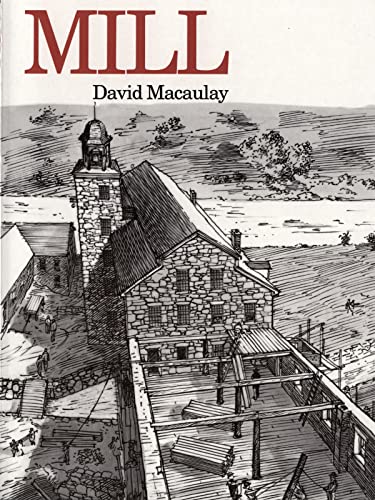
The mills at Wicksbridge are imaginary, but their planning, construction, and operation are quite typical of mills developed in New England throughout the nineteenth century.
Die Inhaltsangabe kann sich auf eine andere Ausgabe dieses Titels beziehen.
Über die Autorin bzw. den Autor
David Macaulay is an award-winning author and illustrator whose books have sold millions of copies in the United States alone, and his work has been translated into a dozen languages. Macaulay has garnered numerous awards including the Caldecott Medal and Honor Awards, the Boston Globe–Horn Book Award, the Christopher Award, an American Institute of Architects Medal, and the Washington Post–Children’s Book Guild Nonfiction Award. In 2006, he was the recipient of a MacArthur Fellowship, given “to encourage people of outstanding talent to pursue their own creative, intellectual, and professional inclinations.” Superb design, magnificent illustrations, and clearly presented information distinguish all of his books. David Macaulay lives with his family in Vermont.
Auszug. © Genehmigter Nachdruck. Alle Rechte vorbehalten.
Mill
By David MacaulayHoughton Mifflin Harcourt Publishing Company
Copyright © 1983 David Macaulay
All rights reserved.
ISBN: 978-0-395-52019-2All rights reserved.
Contents
Title Page,
Contents,
Copyright,
Acknowledgments,
Preface,
Mill,
Introduction,
The Yellow Mill,
Excerpts from the Diary of Zachariah Plimpton,
Excerpts of a Letter from Selinda Sparrow,
Excerpts from the Diary of Zachariah Plimpton,
The Stone Mill,
Excerpts from the Diary of Zachariah Plimpton,
Excerpts from the Diary of Ephraim Dodge,
Excerpts of a Letter from Betsey Oliver,
Excerpts from the Diary of Ephraim Dodge,
Excerpts from the Diary of William Plimpton,
The Plimpton Mill,
Excerpts of a Letter from Dora Sullivan,
Excerpts from the Diary of Alonzo Humphrey,
The Harwood Mill,
Epilogue,
Glossary,
About the Author,
CHAPTER 1
The Yellow Mill
On February 27, 1810, a partnership was formed in Providence, Rhode Island, for the purpose of building and operating a cotton mill. The older partners, who knew almost nothing about setting up such a mill, included Silas Wicks, Zenus and Sylvanus Chaney, and Judge Pardon Fiske. Wicks and the Chaney brothers had amassed considerable fortunes in shipping and foreign trade; Fiske's wealth came from farming. The youngest partner, twenty-seven-year-old Zachariah Plimpton, had grown up in England and knew a great deal about cotton textile manufacture. At the age of fourteen, he had been apprenticed to a prosperous mill owner and for the next eight years had worked in every area of cotton spinning, weaving, and factory management. He came to America at the age of twenty-two to escape an arranged marriage and soon found work as an agent, managing a small Rhode Island mill. The subsequent success of that mill established Plimpton's reputation as one of the ablest men in the business.
At their first meeting, each partner took responsibility for a particular aspect of the new venture. Wicks and Judge Fiske would pay for the machinery and initial supply of cotton. The Chaneys were to provide the materials, workers, and money to build the mill. Plimpton was to design and supervise the construction of the mill and to act as its agent when it was finished. At his suggestion, the partners agreed to operate about seven hundred and fifty spindles for spinning cotton and to run all the machinery with water power.
Plimpton soon compiled a list of available mill sites, and on Monday, March 19, he set off to choose the best one. The requirements that concerned him most were access to a river for power and to a road or canal for transportation. At each location he first estimated the river's flow, and determined the highest available head.
Plimpton carefully recorded his findings and, after comparing a number of possibilities, chose a piece of property on the Swift River about half a mile below the falls. Included with the land was the valuable mill privilege that permitted the owner to divert a percentage of the river's flow to power one or more new mills. Between the top of the falls and the beginning of the property, the river dropped almost thirteen feet. Along the rapids immediately adjacent to the site, it dropped another five.
On his return to Providence, Plimpton set about designing a water wheel that would use the river's power most efficiently. He calculated that by building a dam across the rapids he could create a six- or seven-foot head without affecting the mills upstream. After comparing the power from each type of wheel with the needs of the machinery, he settled on a breast wheel. Like the overshot wheel, it was turned by the weight of the water in its buckets, but it did not require as great a head. Instead of coming over the top of the wheel, water entered the buckets of the breast wheel from the upstream side and turned in a direction opposite to that of the overshot wheel. Plimpton saw this as a great advantage in times of flooding. The higher the water level in the river, the more chance there was of it backing up into the wheelpit and decreasing the efficiency of the wheel. Because of its direction of rotation, the breast wheel would tend to push the backwater away, whereas the overshot wheel would draw it underneath itself and further reduce its efficiency.
The floor of the wheelpit on the upstream side was carefully formed to follow the circumference of the breast wheel. This curved section of floor, called the breast, left so little space between itself and the wheel that the water was kept in the buckets until they had reached the lowest point in their rotation. Because water entered the buckets midway up the height of the wheel, the wheel Plimpton designed was called a midbreast wheel.
Although he could plan the mill based on the amount of machinery it had to house, Plimpton could not determine its precise dimensions without first designing the power train. The rotary motion of the water wheel was transferred to a vertical shaft through an arrangement of bevel gears. Through an additional set of bevel gears, the rotation of the vertical shaft was transferred to a horizontal shaft called a line shaft. Each machine was connected to the line shaft either by a small vertical drive shaft or by a continuous rope or leather belt.
After determining the length of the longest line shaft, Plimpton decided on the length of the building. The width was established by first laying out the machinery along the line shafts and then placing the walls as close to it as possible, in order to let the most daylight into the work space.
Because of its availability, wood was the most practical building material. Since most of his experience in England had been with brick and stone construction, Plimpton hired a millwright named Benjamin Quigg to design the building's timber frame and to supervise its eventual construction.
In early April, Plimpton presented the plans to his partners. The mill was to be sixty-four feet long by thirty-four feet wide, with two full stories and a usable attic. While comparatively large windows would serve the lower floors, two narrow strips of windows, called trapdoor monitors, one on each side of the roof, would let light into the attic. At one end of the building, he had placed a small projecting shed to house the wheel. On the peak of the roof at the other end, he had designed a simple cupola to house the bell.
They were all delighted with Plimpton's efforts and urged that construction begin as soon as possible.
After calculating approximately how much timber would be needed for the siding, roofing, and flooring, Quigg went to a number of saw mills near the site and bought all the well-seasoned wood he could find. Plimpton remained behind to order such items as window frames, glass, nails, tools, and various cast-iron pieces, which were to be manufactured in the Providence area.
Two days later, Plimpton joined Quigg at the Eagle, a tavern near the falls. Both men rented beds there for the duration of the project.
The following morning, Quigg began felling trees he had already marked for the main frame of the building. Plimpton, meanwhile, made arrangements with a local farmer to quarry stone for the foundations and wheelpit from an exposed ledge on his property.
Two weeks later, close to a dozen men, most of them itinerant laborers lodging at nearby farms, were quarrying stone and loading it onto sleds.
While others hauled the trees that Quigg had cut, a third group prepared the site and cleared an area where the various...
„Über diesen Titel“ kann sich auf eine andere Ausgabe dieses Titels beziehen.
Suchergebnisse für Mill

Beispielbild für diese ISBN
Mill
Anbieter: World of Books (was SecondSale), Montgomery, IL, USA
Verkäuferbewertung 5 von 5 Sternen

Zustand: Good. Item in good condition. Textbooks may not include supplemental items i.e. CDs, access codes etc. Artikel-Nr. 00110728030
Gebraucht kaufen
EUR 4,03
Versand gratis
Versand innerhalb von USA
Versand innerhalb von USA
Anzahl: 1 verfügbar
Beispielbild für diese ISBN
Mill
Anbieter: World of Books (was SecondSale), Montgomery, IL, USA
Verkäuferbewertung 5 von 5 Sternen
Zustand: Very Good. Item in very good condition! Textbooks may not include supplemental items i.e. CDs, access codes etc. Artikel-Nr. 00110832769
Gebraucht kaufen
EUR 4,48
Versand gratis
Versand innerhalb von USA
Versand innerhalb von USA
Anzahl: 1 verfügbar
Beispielbild für diese ISBN
Mill
Verlag:
Clarion Books (edition Illustrated), 1989
ISBN 10: 0395520193
ISBN 13: 9780395520192
Gebraucht
Paperback
Anbieter: BooksRun, Philadelphia, PA, USA
Verkäuferbewertung 5 von 5 Sternen
Paperback. Zustand: Fair. Illustrated. The item might be beaten up but readable. May contain markings or highlighting, as well as stains, bent corners, or any other major defect, but the text is not obscured in any way. Artikel-Nr. 0395520193-7-1
Gebraucht kaufen
EUR 6,22
Versand gratis
Versand innerhalb von USA
Versand innerhalb von USA
Anzahl: 1 verfügbar
Beispielbild für diese ISBN
Mill
Verlag:
HarperCollins Publishers, 1989
ISBN 10: 0395520193
ISBN 13: 9780395520192
Gebraucht
Softcover
Anbieter: Better World Books, Mishawaka, IN, USA
Verkäuferbewertung 5 von 5 Sternen
Zustand: Good. Former library copy. Pages intact with minimal writing/highlighting. The binding may be loose and creased. Dust jackets/supplements are not included. Includes library markings. Stock photo provided. Product includes identifying sticker. Better World Books: Buy Books. Do Good. Artikel-Nr. 5469199-6
Gebraucht kaufen
EUR 10,15
Versand gratis
Versand innerhalb von USA
Versand innerhalb von USA
Anzahl: 1 verfügbar
Beispielbild für diese ISBN
Mill
Verlag:
HarperCollins Publishers, 1989
ISBN 10: 0395520193
ISBN 13: 9780395520192
Gebraucht
Softcover
Anbieter: Better World Books, Mishawaka, IN, USA
Verkäuferbewertung 5 von 5 Sternen
Zustand: Good. Pages intact with minimal writing/highlighting. The binding may be loose and creased. Dust jackets/supplements are not included. Stock photo provided. Product includes identifying sticker. Better World Books: Buy Books. Do Good. Artikel-Nr. 4463459-6
Gebraucht kaufen
EUR 10,15
Versand gratis
Versand innerhalb von USA
Versand innerhalb von USA
Anzahl: 2 verfügbar
Beispielbild für diese ISBN
Mill
Verlag:
HarperCollins Publishers, 1989
ISBN 10: 0395520193
ISBN 13: 9780395520192
Gebraucht
Softcover
Anbieter: Better World Books, Mishawaka, IN, USA
Verkäuferbewertung 5 von 5 Sternen
Zustand: Very Good. Pages intact with possible writing/highlighting. Binding strong with minor wear. Dust jackets/supplements may not be included. Stock photo provided. Product includes identifying sticker. Better World Books: Buy Books. Do Good. Artikel-Nr. 6284951-6
Gebraucht kaufen
EUR 10,15
Versand gratis
Versand innerhalb von USA
Versand innerhalb von USA
Anzahl: 2 verfügbar
Beispielbild für diese ISBN
Mill
Verlag:
Houghlin Mifflin Co., Boston, 1983
ISBN 10: 0395520193
ISBN 13: 9780395520192
Gebraucht
Soft cover
Anbieter: Browse Awhile Books, Tipp City, OH, USA
Verkäuferbewertung 5 von 5 Sternen
Soft cover. Zustand: Very Good. Later Printing. Artikel-Nr. 1139405
Gebraucht kaufen
EUR 10,78
EUR 6,11 Versand
Versand innerhalb von USA
Versand innerhalb von USA
Anzahl: 1 verfügbar
Beispielbild für diese ISBN
Mill
Anbieter: Revaluation Books, Exeter, Vereinigtes Königreich
Verkäuferbewertung 5 von 5 Sternen
Paperback. Zustand: Brand New. 1st edition. 128 pages. 12.25x9.00x0.50 inches. In Stock. Artikel-Nr. xr0395520193
Neu kaufen
EUR 20,61
EUR 14,58 Versand
Versand von Vereinigtes Königreich nach USA
Versand von Vereinigtes Königreich nach USA
Anzahl: 2 verfügbar
Beispielbild für diese ISBN
Mill
Anbieter: Majestic Books, Hounslow, Vereinigtes Königreich
Verkäuferbewertung 4 von 5 Sternen

Zustand: New. pp. 128. Artikel-Nr. 8175944
Neu kaufen
EUR 28,49
EUR 7,58 Versand
Versand von Vereinigtes Königreich nach USA
Versand von Vereinigtes Königreich nach USA
Anzahl: 1 verfügbar