
Verwandte Artikel zu The Power Broker: Robert Moses and the Fall of New...
Inhaltsangabe
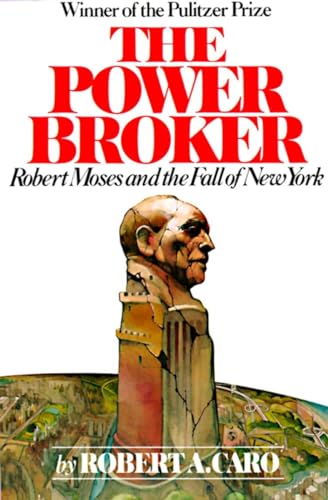
PULITZER PRIZE WINNER • A modern American classic, this huge and galvanizing biography of Robert Moses reveals not only the saga of one man’s incredible accumulation of power but the story of his shaping (and mis-shaping) of twentieth-century New York.
One of the Modern Library’s hundred greatest books of the twentieth century, Robert Caro's monumental book makes public what few outsiders knew: that Robert Moses was the single most powerful man of his time in the City and in the State of New York. And in telling the Moses story, Caro both opens up to an unprecedented degree the way in which politics really happens—the way things really get done in America's City Halls and Statehouses—and brings to light a bonanza of vital information about such national figures as Alfred E. Smith and Franklin D. Roosevelt (and the genesis of their blood feud), about Fiorello La Guardia, John V. Lindsay and Nelson Rockefeller.
But The Power Broker is first and foremost a brilliant multidimensional portrait of a man—an extraordinary man who, denied power within the normal framework of the democratic process, stepped outside that framework to grasp power sufficient to shape a great city and to hold sway over the very texture of millions of lives. We see how Moses began: the handsome, intellectual young heir to the world of Our Crowd, an idealist. How, rebuffed by the entrenched political establishment, he fought for the power to accomplish his ideals. How he first created a miraculous flowering of parks and parkways, playlands and beaches—and then ultimately brought down on the city the smog-choked aridity of our urban landscape, the endless miles of (never sufficient) highway, the hopeless sprawl of Long Island, the massive failures of public housing, and countless other barriers to humane living. How, inevitably, the accumulation of power became an end in itself.
Moses built an empire and lived like an emperor. He was held in fear—his dossiers could disgorge the dark secret of anyone who opposed him. He was, he claimed, above politics, above deals; and through decade after decade, the newspapers and the public believed. Meanwhile, he was developing his public authorities into a fourth branch of government known as "Triborough"—a government whose records were closed to the public, whose policies and plans were decided not by voters or elected officials but solely by Moses—an immense economic force directing pressure on labor unions, on banks, on all the city's political and economic institutions, and on the press, and on the Church. He doled out millions of dollars' worth of legal fees, insurance commissions, lucrative contracts on the basis of who could best pay him back in the only coin he coveted: power. He dominated the politics and politicians of his time—without ever having been elected to any office. He was, in essence, above our democratic system.
Robert Moses held power in the state for 44 years, through the governorships of Smith, Roosevelt, Lehman, Dewey, Harriman and Rockefeller, and in the city for 34 years, through the mayoralties of La Guardia, O'Dwyer, Impellitteri, Wagner and Lindsay, He personally conceived and carried through public works costing 27 billion dollars—he was undoubtedly America's greatest builder.
This is how he built and dominated New York—before, finally, he was stripped of his reputation (by the press) and his power (by Nelson Rockefeller). But his work, and his will, had been done.
Die Inhaltsangabe kann sich auf eine andere Ausgabe dieses Titels beziehen.
Über die Autorin bzw. den Autor
For his biographies of Robert Moses and Lyndon Johnson, ROBERT A. CARO has twice won the Pulitzer Prize for Biography, has three times won the National Book Critics Circle Award, and has also won virtually every other major literary honor, including the National Book Award, the Gold Medal in Biography from the American Academy of Arts and Letters, and the Francis Parkman Prize, awarded by the Society of American Historians to the book that best “exemplifies the union of the historian and the artist.” In 2010 President Barack Obama awarded Caro the National Humanities Medal, stating at the time: “I think about Robert Caro and reading The Power Broker back when I was twenty-two years old and just being mesmerized, and I’m sure it helped to shape how I think about politics.” In 2016 he received the National Book Award for Lifetime Achievement. The London Sunday Times has said that Caro is “The greatest political biographer of our times.”
Caro’s first book, The Power Broker: Robert Moses and the Fall of New York, everywhere acclaimed as a modern classic, was chosen by the Modern Library as one of the hundred greatest nonfiction books of the twentieth century. It is, according to David Halberstam, “Surely the greatest book ever written about a city.” And The New York Times Book Review said: “In the future, the scholar who writes the history of American cities in the twentieth century will doubtless begin with this extraordinary effort.”
The first volume of The Years of Lyndon Johnson, The Path to Power, was cited by The Washington Post as “proof that we live in a great age of biography . . . [a book] of radiant excellence . . . Caro’s evocation of the Texas Hill Country, his elaboration of Johnson’s unsleeping ambition, his understanding of how politics actually work, are—let it be said flat out—at the summit of American historical writing.” Professor Henry F. Graff of Columbia University called the second volume, Means of Ascent, “brilliant. No review does justice to the drama of the story Caro is telling, which is nothing less than how present-day politics was born.” The London Times hailed volume three, Master of the Senate, as “a masterpiece . . . Robert Caro has written one of the truly great political biographies of the modern age.” The Passage of Power, volume four, has been called “Shakespearean . . . A breathtakingly dramatic story [told] with consummate artistry and ardor” (The New York Times) and “as absorbing as a political thriller . . . By writing the best presidential biography the country has ever seen, Caro has forever changed the way we think about, and read, American history” (NPR). On the cover of The New York Times Book Review, President Bill Clinton praised it as “Brilliant . . . Important . . . Remarkable. With this fascinating and meticulous account Robert Caro has once again done America a great service.”
“Caro has a unique place among American political biographers,” The Boston Globe said . . . “He has become, in many ways, the standard by which his fellows are measured.” And Nicholas von Hoffman wrote: “Caro has changed the art of political biography.”
Born and raised in New York City, Caro graduated from Princeton University, was later a Nieman Fellow at Harvard University, and worked for six years as an investigative reporter for Newsday. He lives in New York City with his wife, Ina, the historian and writer.
Von der hinteren Coverseite
This is the first and foremost a brilliant multidimensional portrait of a man-an extraordinary man who, denied power within the normal framework of the democratic process, stepped outside that framework to grasp power sufficient to shape a great city and hold sway over the very texture of millions of lives.
Aus dem Klappentext
One of the most acclaimed books of our time, winner of both the Pulitzer and the Francis Parkman prizes, The Power Broker tells the hidden story behind the shaping (and mis-shaping) of twentieth-century New York (city and state) and makes public what few have known: that Robert Moses was, for almost half a century, the single most powerful man of our time in New York, the shaper not only of the city's politics but of its physical structure and the problems of urban decline that plague us today.
In revealing how Moses did it--how he developed his public authorities into a political machine that was virtually a fourth branch of government, one that could bring to their knees Governors and Mayors (from La Guardia to Lindsay) by mobilizing banks, contractors, labor unions, insurance firms, even the press and the Church, into an irresistible economic force--Robert Caro reveals how power works in all the cities of the United States. Moses built an empire and lived like an emperor. He personally conceived and completed public works costing 27 billion dollars--the greatest builder America (and probably the world) has ever known. Without ever having been elected to office, he dominated the men who were--even his most bitter enemy, Franklin D. Roosevelt, could not control him--until he finally encountered, in Nelson Rockefeller, the only man whose power (and ruthlessness in wielding it) equalled his own.
Auszug. © Genehmigter Nachdruck. Alle Rechte vorbehalten.
Excerpted from the Introduction
Wait Until the Evening
“One must wait until the evening
To see how splendid the day has been.”
—SOPHOCLES
As THE CAPTAIN of the Yale swimming team stood beside the pool, still dripping after his laps, and listened to Bob Moses, the team's second-best freestyler, he didn't know what shocked him more—the suggestion or the fact that it was Moses who was making it.
Ed Richards knew that Moses was brilliant—even "Five A" Johnson, who regularly received the top grade in every course he took each term, said that Moses could have stood first in the Class of 1909 if he hadn't spent so much time reading books that had nothing to do with his assignments—but the quality that had most impressed Richards and the rest of '09 was his idealism. The poems that the olive-skinned, big-eyed Jew from New York wrote for the Yale literary magazines, sitting up late at night, his bedroom door closed against the noise from the horseplay in the dormitory, were about Beauty and Truth. When the bull sessions got around, as they did so often, now that the Class was in its senior year, to the subject of careers, Moses was always talking—quite movingly, too—about dedicating his life to public service, to helping the lower classes. And just the other evening, in the midst of a desultory discussion about which fraternity's nominee should be elected class treasurer, Moses had jumped to his feet and argued so earnestly that class officers should be chosen on merit rather than fraternity affiliation, that the criterion shouldn't be who a man's friends were but what he could do, that Johnson had said to Richards afterwards, "I feel as if I've had an awakening tonight." And now, Richards realized, this same Bob Moses was suggesting that they get money for the swimming team by deliberately misleading Og Reid.
Ogden Mills Reid was the best thing that had ever happened to swimming at Yale. Since the legendary Walter Camp, athletic director as well as football coach, was hoarding the football receipts for a new stadium, there was no money to replace the dank, low-ceilinged pool, which wasn't even the right length for intercollegiate swimming events. There was no allocation from the university for travel expenses or even for a coach. But Reid, who had been Yale's first great swimmer, not only paid the team's expenses but, week after week, traveled up to New Haven from New York to do the coaching himself. This year, after a long fight, Moses had succeeded in organizing the wrestling, fencing, hockey, basketball and swimming teams into a "Minor Sports Association" which would conduct a general fund-raising effort and divide the money among the teams, in the hope that the existence of such a formal organization would coax new contributions from alumni. The theory was good, Richards had thought at the time, but there was one hitch: any money contributed specifically to one of the teams also had to go into the general fund. Richards doubted that Reid, who was interested only in swimming, would want to contribute to a general fund and he wondered if the swimmers might not end up with even less money than before. But Moses had seemed to have no fears on that score. And now, standing beside the pool, Richards was beginning to understand why. Moses, dressed in suit, vest and a high collar that was wilting in the dampness, had just announced that he was skipping practice to go to New York and see Reid, and when Richards had expressed his doubts that the alumnus would contribute, Moses had smiled and said, "Oh, that's all right. I just won't tell him it's going to an association. He'll think it's the regular contribution to the swimming team."
Now Richards said slowly, "I think that's a little bit tricky, Bob. I think that's a little bit smooth. I don't like that at all."
With astonishing rapidity, the face over the high collar turned pale, almost white. Moses' fists came up for a moment before he lowered them. "Well, you've got nothing to say about it," he said.
"Yes, I do," Richards said. "I'm the captain. I'm responsible. And I'm telling you not to do it."
"Well, I'm going to do it anyway," Moses said.
"If you do," Richards said, "I'll go to Og and tell him that the money isn't going where he thinks it is."
Moses' voice suddenly dropped. His tone was threatening. "If you don't let me do it," he said, "I'm going to resign from the team."
He thought he was bluffing me, Richards would recall later. He thought I wouldn't let him resign. "Well, Bob," Richards said, "your resignation is accepted."
Bob Moses turned and walked out of the pool. He never swam for Yale again.
Forty-five years later, a new mayor of New York was being sworn in at City Hall. Under huge cut-glass chandeliers Robert F. Wagner, Jr., took the oath of office and then, before hundreds of spectators, personally administered the oath, and handed the coveted official appointment blanks, to his top appointees.
But to a handful of the spectators, the real significance of the ceremony was in an oath not given. When Robert Moses came forward, Wagner swore him in as City Park Commissioner and as City Construction Coordinator—and then, with Moses still waiting expectantly, stopped and beckoned forward the next appointee.
To those spectators, Wagner's gesture signaled triumph. They were representatives of the so-called "Good Government" organizations of the city: the Citizens Union, the City Club, liberal elements of the labor movement. They had long chafed at the power that Moses had held under previous mayors as Park Commissioner, Construction Coordinator and member of the City Planning Commission. They had determined to try to curb his sway under Wagner and they had decided to make the test of strength the Planning Commission membership. This, they had decided after long analysis and debate, was Moses' weak point: As Park Commissioner and Construction Coordinator he proposed public works projects, and the City Charter had surely never intended that an officeholder who proposed projects should sit on the Planning Commission, whose function was to pass on the merits of those projects. For nine weeks, ever since Wagner's election, they had been pressing him not to reappoint Moses to the commission. Although Wagner had told them he agreed fully with their views and had even hinted that, on Inauguration Day, there would be only two jobs waiting for Moses, they had been far from sure that he meant it. But now they realized that Wagner had in fact not given Moses the third oath—and the Planning Commission job. And, looking at Moses, they could see he realized it, too. His face, normally swarthy, was pale with rage.
The more observant among these spectators, however, noticed that after the ceremonies Moses followed Wagner into his inner office. They knew all too well what he would be saying to the new mayor; he had said it often enough, publicly and privately, orally and in writing, to Wagner's predecessors, Vincent R. Impellitteri and William O'Dwyer, and, even earlier, to the great La Guardia. "He's threatening to resign," they whispered to one another.
They were right. Behind the closed doors of the inner office, Moses was putting it to Wagner straight: If he didn't get the third post, he would quit the other two. And he'd do it right now. Wagner tried frantically to stall. The Planning Commission oath? The Mayor said. There must have been an oversight. Some clerk must have forgotten to fill out the appointment blank. Nothing to worry about. He'd see to it in a few days. Moses walked out of the...
„Über diesen Titel“ kann sich auf eine andere Ausgabe dieses Titels beziehen.
Suchergebnisse für The Power Broker: Robert Moses and the Fall of New...

Beispielbild für diese ISBN
The Power Broker (Pulitzer Prize Winner): Robert Moses and the Fall of New York
Anbieter: World of Books (was SecondSale), Montgomery, IL, USA
Verkäuferbewertung 5 von 5 Sternen

Paperback. Zustand: Very Good. PULITZER PRIZE WINNER * A modern American classic, this huge and galvanizing biography of Robert Moses reveals not only the saga of one man's incredible accumulation of power but the story of his shaping (and mis-shaping) of twentieth-century New York. One of the Modern Library's hundred greatest books of the twentieth century, Robert Caro's monumental book makes public what few outsiders knew: that Robert Moses was the single most powerful man of his time in the City and in the State of New York. And in telling the Moses story, Caro both opens up to an unprecedented degree the way in which politics really happens--the way things really get done in America's City Halls and Statehouses--and brings to light a bonanza of vital information about such national figures as Alfred E. Smith and Franklin D. Roosevelt (and the genesis of their blood feud), about Fiorello La Guardia, John V. Lindsay and Nelson Rockefeller. But The Power Broker is first and foremost a brilliant multidimensional portrait of a man--an extraordinary man who, denied power within the normal framework of the democratic process, stepped outside that framework to grasp power sufficient to shape a great city and to hold sway over the very texture of millions of lives. We see how Moses began: the handsome, intellectual young heir to the world of Our Crowd, an idealist. How, rebuffed by the entrenched political establishment, he fought for the power to accomplish his ideals. How he first created a miraculous flowering of parks and parkways, playlands and beaches--and then ultimately brought down on the city the smog-choked aridity of our urban landscape, the endless miles of (never sufficient) highway, the hopeless sprawl of Long Island, the massive failures of public housing, and countless other barriers to humane living. How, inevitably, the accumulation of power became an end in itself. Moses built an empire and lived like an emperor. He was held in fear--his dossiers could disgorge the dark secret of anyone who opposed him. He was, he claimed, above politics, above deals; and through decade after decade, the newspapers and the public believed. Meanwhile, he was developing his public authorities into a fourth branch of government known as "Triborough"--a government whose records were closed to the public, whose policies and plans were decided not by voters or elected officials but solely by Moses--an immense economic force directing pressure on labor unions, on banks, on all the city's political and economic institutions, and on the press, and on the Church. He doled out millions of dollars' worth of legal fees, insurance commissions, lucrative contracts on the basis of who could best pay him back in the only coin he coveted: power. He dominated the politics and politicians of his time--without ever having been elected to any office. He was, in essence, above our democratic system. Robert Moses held power in the state for 44 years, through the governorships of Smith, Roosevelt, Lehman, Dewey, Harriman and Rockefeller, and in the city for 34 years, through the mayoralties of La Guardia, O'Dwyer, Impellitteri, Wagner and Lindsay, He personally conceived and carried through public works costing 27 billion dollars--he was undoubtedly America's greatest builder. This is how he built and dominated New York--before, finally, he was stripped of his reputation (by the press) and his power (by Nelson Rockefeller). But his work, and his will, had been done. Artikel-Nr. 00109990749
Gebraucht kaufen
EUR 9,30
Versand gratis
Versand innerhalb von USA
Versand innerhalb von USA
Anzahl: 5 verfügbar
Beispielbild für diese ISBN
The Power Broker (Pulitzer Prize Winner): Robert Moses and the Fall of New York
Anbieter: World of Books (was SecondSale), Montgomery, IL, USA
Verkäuferbewertung 5 von 5 Sternen
Paperback. Zustand: Fair. PULITZER PRIZE WINNER * A modern American classic, this huge and galvanizing biography of Robert Moses reveals not only the saga of one man's incredible accumulation of power but the story of his shaping (and mis-shaping) of twentieth-century New York. One of the Modern Library's hundred greatest books of the twentieth century, Robert Caro's monumental book makes public what few outsiders knew: that Robert Moses was the single most powerful man of his time in the City and in the State of New York. And in telling the Moses story, Caro both opens up to an unprecedented degree the way in which politics really happens--the way things really get done in America's City Halls and Statehouses--and brings to light a bonanza of vital information about such national figures as Alfred E. Smith and Franklin D. Roosevelt (and the genesis of their blood feud), about Fiorello La Guardia, John V. Lindsay and Nelson Rockefeller. But The Power Broker is first and foremost a brilliant multidimensional portrait of a man--an extraordinary man who, denied power within the normal framework of the democratic process, stepped outside that framework to grasp power sufficient to shape a great city and to hold sway over the very texture of millions of lives. We see how Moses began: the handsome, intellectual young heir to the world of Our Crowd, an idealist. How, rebuffed by the entrenched political establishment, he fought for the power to accomplish his ideals. How he first created a miraculous flowering of parks and parkways, playlands and beaches--and then ultimately brought down on the city the smog-choked aridity of our urban landscape, the endless miles of (never sufficient) highway, the hopeless sprawl of Long Island, the massive failures of public housing, and countless other barriers to humane living. How, inevitably, the accumulation of power became an end in itself. Moses built an empire and lived like an emperor. He was held in fear--his dossiers could disgorge the dark secret of anyone who opposed him. He was, he claimed, above politics, above deals; and through decade after decade, the newspapers and the public believed. Meanwhile, he was developing his public authorities into a fourth branch of government known as "Triborough"--a government whose records were closed to the public, whose policies and plans were decided not by voters or elected officials but solely by Moses--an immense economic force directing pressure on labor unions, on banks, on all the city's political and economic institutions, and on the press, and on the Church. He doled out millions of dollars' worth of legal fees, insurance commissions, lucrative contracts on the basis of who could best pay him back in the only coin he coveted: power. He dominated the politics and politicians of his time--without ever having been elected to any office. He was, in essence, above our democratic system. Robert Moses held power in the state for 44 years, through the governorships of Smith, Roosevelt, Lehman, Dewey, Harriman and Rockefeller, and in the city for 34 years, through the mayoralties of La Guardia, O'Dwyer, Impellitteri, Wagner and Lindsay, He personally conceived and carried through public works costing 27 billion dollars--he was undoubtedly America's greatest builder. This is how he built and dominated New York--before, finally, he was stripped of his reputation (by the press) and his power (by Nelson Rockefeller). But his work, and his will, had been done. Artikel-Nr. 00110722922
Gebraucht kaufen
EUR 9,30
Versand gratis
Versand innerhalb von USA
Versand innerhalb von USA
Anzahl: 4 verfügbar
Beispielbild für diese ISBN
The Power Broker (Pulitzer Prize Winner): Robert Moses and the Fall of New York
Anbieter: World of Books (was SecondSale), Montgomery, IL, USA
Verkäuferbewertung 5 von 5 Sternen
Paperback. Zustand: Good. PULITZER PRIZE WINNER * A modern American classic, this huge and galvanizing biography of Robert Moses reveals not only the saga of one man's incredible accumulation of power but the story of his shaping (and mis-shaping) of twentieth-century New York. One of the Modern Library's hundred greatest books of the twentieth century, Robert Caro's monumental book makes public what few outsiders knew: that Robert Moses was the single most powerful man of his time in the City and in the State of New York. And in telling the Moses story, Caro both opens up to an unprecedented degree the way in which politics really happens--the way things really get done in America's City Halls and Statehouses--and brings to light a bonanza of vital information about such national figures as Alfred E. Smith and Franklin D. Roosevelt (and the genesis of their blood feud), about Fiorello La Guardia, John V. Lindsay and Nelson Rockefeller. But The Power Broker is first and foremost a brilliant multidimensional portrait of a man--an extraordinary man who, denied power within the normal framework of the democratic process, stepped outside that framework to grasp power sufficient to shape a great city and to hold sway over the very texture of millions of lives. We see how Moses began: the handsome, intellectual young heir to the world of Our Crowd, an idealist. How, rebuffed by the entrenched political establishment, he fought for the power to accomplish his ideals. How he first created a miraculous flowering of parks and parkways, playlands and beaches--and then ultimately brought down on the city the smog-choked aridity of our urban landscape, the endless miles of (never sufficient) highway, the hopeless sprawl of Long Island, the massive failures of public housing, and countless other barriers to humane living. How, inevitably, the accumulation of power became an end in itself. Moses built an empire and lived like an emperor. He was held in fear--his dossiers could disgorge the dark secret of anyone who opposed him. He was, he claimed, above politics, above deals; and through decade after decade, the newspapers and the public believed. Meanwhile, he was developing his public authorities into a fourth branch of government known as "Triborough"--a government whose records were closed to the public, whose policies and plans were decided not by voters or elected officials but solely by Moses--an immense economic force directing pressure on labor unions, on banks, on all the city's political and economic institutions, and on the press, and on the Church. He doled out millions of dollars' worth of legal fees, insurance commissions, lucrative contracts on the basis of who could best pay him back in the only coin he coveted: power. He dominated the politics and politicians of his time--without ever having been elected to any office. He was, in essence, above our democratic system. Robert Moses held power in the state for 44 years, through the governorships of Smith, Roosevelt, Lehman, Dewey, Harriman and Rockefeller, and in the city for 34 years, through the mayoralties of La Guardia, O'Dwyer, Impellitteri, Wagner and Lindsay, He personally conceived and carried through public works costing 27 billion dollars--he was undoubtedly America's greatest builder. This is how he built and dominated New York--before, finally, he was stripped of his reputation (by the press) and his power (by Nelson Rockefeller). But his work, and his will, had been done. Artikel-Nr. 00109841072
Gebraucht kaufen
EUR 9,30
Versand gratis
Versand innerhalb von USA
Versand innerhalb von USA
Anzahl: Mehr als 20 verfügbar
Beispielbild für diese ISBN
The Power Broker (Pulitzer Prize Winner): Robert Moses and the Fall of New York
Anbieter: Housing Works Online Bookstore, New York, NY, USA
Verkäuferbewertung 5 von 5 Sternen
Paperback. Zustand: Very Good. later Printing. Artikel-Nr. mon-uvg-0394720245
Gebraucht kaufen
EUR 9,78
EUR 3,56 Versand
Versand innerhalb von USA
Versand innerhalb von USA
Anzahl: 1 verfügbar
Beispielbild für diese ISBN
The Power Broker: Robert Moses and the Fall of New York
Anbieter: Night Heron Books, Laramie, WY, USA
Verkäuferbewertung 5 von 5 Sternen
paperback. Zustand: Very Good. Binding tight.Cover clean.Minor wear to page edges and corners. Paperback.No writing, highlighting, or marks in text. Artikel-Nr. 769787
Gebraucht kaufen
EUR 14,72
EUR 3,80 Versand
Versand innerhalb von USA
Versand innerhalb von USA
Anzahl: 1 verfügbar
Beispielbild für diese ISBN
The Power Broker (Pulitzer Prize Winner): Robert Moses and the Fall of New York
Anbieter: Dan Pope Books, West Hartford, CT, USA
Verkäuferbewertung 5 von 5 Sternen
Soft cover. Zustand: Fine. Trade paperback, 43rd pritning, as new, a tight clean copy, without any marks. Artikel-Nr. SNS-Caro-Nonfiction
Gebraucht kaufen
EUR 18,40
EUR 4,02 Versand
Versand innerhalb von USA
Versand innerhalb von USA
Anzahl: 1 verfügbar
Foto des Verkäufers
The Power Broker: Robert Moses and the Fall of New York
Anbieter: Old Book Shop of Bordentown (ABAA, ILAB), Bordentown, NJ, USA
Verkäuferbewertung 3 von 5 Sternen

Softcover. Thick softcover, section of maps at front, 1246 pp. plus xxxiv page index. Illustrated with three sections of photographs. Near fine, minimal wear at the tips. Winner of the Pulitzer Prize and named one of the 100 greatest non-fiction books of the 20trh century. One of the essential history works, the in depth study of New York City urban planner and power broker of the and one of the most influential men in the history of New York City and its suburbs, Robert Moses (1888-1981). Never elected to any office, Mosed had a four decade career during which he held as many as twelve municipal and regional titles, including New York Department of Parks and Recreation Commissioner (1934-1960) and Long Island State Park Commission chairman 1924-1963). He created and chaired the Triborough Bridge and Tunnel Authority (1934-1968). It was at Moses' direction that most of the parkways and major highways leading to and from the City were created, resulting in the mass exodus of city dwellers to the suburbs of Long Island (the Northern, Southern and Meadowbrook State Parkways) , Westchester (the Taconic State Parkway), southern Connecticut and the outer boroughs (Triborough Bridge,.Brooklyn-Battery Tunnel and Queens- Midtown Tunnel). He also created Jones Beach State Park on Long Island and oversaw the building of the`1939 World's Fair. Until the early 1960s, Moses was rarely thwarted in his planning though often (and sometimes vociferously) groups would protest the destruction of entire neighborhood in order to run expressways to the suburbs. (Depending on who is telling the story, he was also the person most directly responsible for the Brooklyn Dodgers leaving for Los Angeles when he tried the force a new stadium ofr them to be built in Queens on the former World's Fair site.). Artikel-Nr. E32019
Gebraucht kaufen
EUR 20,71
EUR 4,46 Versand
Versand innerhalb von USA
Versand innerhalb von USA
Anzahl: 1 verfügbar
Foto des Verkäufers
The Power Broker: Robert Moses and the Fall of New York
Verlag:
Vintage Books, New York, 1974
ISBN 10: 0394720245
ISBN 13: 9780394720241
Gebraucht
Softcover
Anbieter: Old Book Shop of Bordentown (ABAA, ILAB), Bordentown, NJ, USA
Verkäuferbewertung 3 von 5 Sternen
Softcover. Zustand: Fine. Fine, fresh copy with minor wear to extremities. Hardcover. 1245 pp with index and black and white photographs. This book chronicles the like of Robert Moses, detailing his rise to power and the profound impact he had on New York City through urban planning and political maneuvering. Artikel-Nr. E36049
Gebraucht kaufen
EUR 22,96
EUR 4,46 Versand
Versand innerhalb von USA
Versand innerhalb von USA
Anzahl: 1 verfügbar
Beispielbild für diese ISBN
The Power Broker: Robert Moses and the Fall of New York
Anbieter: Eagle Eye Books, Decatur, GA, USA
Verkäuferbewertung 4 von 5 Sternen

Paper Back. Zustand: New. Artikel-Nr. 701801
Neu kaufen
EUR 24,84
EUR 3,56 Versand
Versand innerhalb von USA
Versand innerhalb von USA
Anzahl: 1 verfügbar
Beispielbild für diese ISBN
The Power Broker: Robert Moses and the Fall of New York
Anbieter: Roundabout Books, Greenfield, MA, USA
Verkäuferbewertung 4 von 5 Sternen
paperback. Zustand: New. Condition Notes: New from the publisher. Artikel-Nr. 1574515