
Verwandte Artikel zu Spinning Straw Into Gold: What Fairy Tales Reveal About...
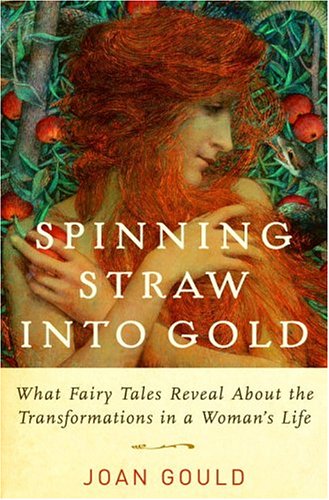
Spinning Straw Into Gold: What Fairy Tales Reveal About The Transformations In A Woman's Life - Hardcover
Inhaltsangabe
“What’s your favorite fairy tale?” Joan Gould asks in the Introduction to this brilliantly original book about the hidden meanings in fairy tales and what these beloved stories reveal about a woman’s life.
Whether your answer is “Cinderella” (most women’s choice), “Hansel and Gretel,” or another tale, your favorite conveys something significant about you, your experiences, and your soul– something perhaps not obvious to outsiders and possibly not entirely clear to you.
Throughout this illuminating book, Gould delves into the deeper meanings behind fairy tales and myths–helping you to understand not only what your choice of fairy tale may mean for you, but also what you need to be doing during the three main stages of development: maiden, matron, and crone.
“This is a book about women,” Gould writes, “specifically about fairy tales and the way they illuminate the metamorphoses at each stage of a woman’s life: those shifts in consciousness as well as biology that propel women from one level of being to another.” As Gould expertly addresses the transformations many women experience–marriage, childbirth, and widowhood–her keen observations may surprise you, and it is through these revelations, that Gould truly works her magic.
The story of Sleeping Beauty allegorizes the role that waiting plays in the attainment of womanhood; “Rapunzel” illuminates a bride’s ambivalence toward her impending nuptials; “The Seal Wife” acknowledges a mother’s sense of loss of self to the demands of her family. Most poignantly, through the myth of Demeter and Persephone, Gould grapples with the final stage of a woman’s life, the unexpected expansion of a woman’s spirit in old age.
Full of archetypal figures known to us all, this wonderfully perceptive work is also populated with narratives from the lives of ordinary women. These personal stories– of Sleeping Beauties who fell asleep in puberty and awoke ten years later to find themselves married to the wrong man, or the right one–illustrate the rich insights that are to be gained from familiar story figures. Replete with a wealth of wisdom about the private battles and public roles each woman must face in her life, Spinning Straw into Gold explores the choices, demands, and changes a woman must face every day.
Die Inhaltsangabe kann sich auf eine andere Ausgabe dieses Titels beziehen.
Über die Autorin bzw. den Autor
JOAN GOULD’s work has appeared in many publications, including The New York Times, Esquire, and Sports Illustrated. The author of Spirals, she lives in Rye, New York.
Auszug. © Genehmigter Nachdruck. Alle Rechte vorbehalten.
Chapter 1
Snow White: Breaking Away from Mother
The youngest heroine in this book, at least the youngest emotionally, is a girl who hasn’t yet completed her first transformation of consciousness: puberty, which eventually produces an independent sexual woman from a dependent child. Snow White’s body has begun to change by the time her story is under way—we know this from the violence of her stepmother’s reactions to her beauty—but her self-awareness hasn’t taken into account the biological upheaval starting to take place inside her.
Adolescence involves a break with the past, as well as a thrust toward the future. Without any choice, either too soon or too late to suit her, a girl loses the flat, lean body that she took for granted and finds that she has become a sexual creature, obscurely desired or threatened from all sides. At this stage, she must learn to see herself as separate from her background, her parents, and her home, with as few recriminations as possible toward those who made her what she is at present. She must picture a future different from the present, taking place against a background that she can’t visualize, in which she will answer to another name. Possibility opens up in front of her, dazzling her with its prospects, but at the same time she finds herself stripped of the protection she has taken for granted until now. Liberation is always a loss as well as a gain.
How, and when, do women get to know themselves as self-willed sexual beings, distinct from their families? By looking in a mirror, especially during adolescence, which is not at all the way a boy learns to know himself. Teenage girls peer into mirrors all day long to find out how others see them, what impact they’re going to have on the world around them, what can be improved or projected better or awaited, and what can only be deplored—critiques in the mirror’s voice that change from hour to hour. (“Flat,” says the mirror. “Still flat. You’ll never get a man, not with those goose bumps you call breasts. Why don’t you rethink your hair? Some streaks—that might be good. Or a French braid. And don’t stand like a Girl Scout at flag-raising. You want to smolder. . . . That’s better. You know what? You’ve got potential, girl. Your day is coming.”)
This isn’t the time-wasting obsession that adults think it is. Like it or not, an adolescent girl recognizes that she’s an object as well as a subject, a soul encased in a carcass that’s the material she was given to work with in order to attract a mate and advance nature’s program of making a mother of her.
At any age, can a woman stand in front of a mirror for more than thirty seconds and acknowledge herself simply as an object in space, without correcting her appearance in some way—running her fingers through her hair or wiping the corners of her lips—while making some silent comment about her looks, more often than not unfavorable?
In short, looks matter. We can manage to be more than the body, but there’s no way we can be less.
“Snow White” is a story about looks, looking and being looked at, a glittery tale of a window, a snowfall, a mirror, and a coffin made of glass. The females in it are a good mother who looks out the window at a fresh snowfall, a bad mother who looks only at her own reflection in the mirror, and a daughter who lies still as death and is looked at. But any story that deals with looks and looking is necessarily a story about time, which is a force that defeats beauty.
A girl named Snow White lives with her stepmother, a Queen obsessed with her own appearance, who possesses a magic mirror. But in a palace ruled by this mirror’s pronouncements as to who is the most beautiful in the land, how is it that the heroine has no mirror of her own, or, if she has one, lacks the heart to use it? Who has convinced her that her looks aren’t worth bothering about, since no one will pay attention to her anyway? While the Queen glories in her superiority, her stepdaughter, who is just coming into her own beauty, has no idea what she looks like, none of the usual self-consciousness of adolescence, which is how we know that she hasn’t yet gone through the turmoil that is about to engulf her.
A child’s first mirror is her mother’s eyes, which determine what reflections she’ll see for the rest of her life. If a mother admires her daughter—let’s say the girl is eleven or twelve years old and prepubescent—the girl learns to use an actual mirror as a tool for self-study. (I didn’t say if the mother “loves her daughter,” since we don’t know how to recognize love in its many guises. “Admires” is the operative word here.) She does this because of the confidence her mother pours into her.
Snow White, on the other hand, has no picture of her future as a sexual creature when we first meet her. Except for the Queen, she’s the only female in the palace; there are no siblings or friends, no other images of womanhood in front of her. Her stepmother is what it means to be female; her stepmother is Queen, but the girl is nothing like her stepmother and, what’s more, never will be, which means that there must be something the matter with her. The longer she scrutinizes the older woman, the more of an outcast she feels in a woman’s world, scrutiny being the female equivalent of male sparring as a way for two people of the same gender to gauge each other’s strength.
But there are sexually mature girls, there are even grown women, who don’t acquire their own mirrors because, for one reason or another, their vision has been blinkered by their mothers and they can’t bear to come face-to-face with their unaccepted and unacceptable selves.
“I was around fourteen—maybe fifteen—when my mother paid one of her rare visits to the house where I was being brought up by my grandmother,” said a friend of mine who is now the mother of three children. “I was coming out of the shower when she walked into the bathroom and saw me naked for the first time in six months. Maybe more. From her look of shock, I understood what she was seeing: my developing breasts, nipples that had grown darker and slightly puffy, pubic hair, rounded hips and belly. She left in a hurry and shut the door. I looked in the bathroom mirror, which had been there all along, of course, but I didn’t see beauty reflected back at me. I saw danger. I loathed the body that was causing this separation between us. From that time on, I did my best to make myself disappear: anorexia, hair hanging over my face, baggy T-shirts to hide those breasts. All the sad disguises. Not until I was in the delivery room years later, giving birth to my first child, did I understand the power and beauty of a woman’s body.”
Like many of the best-loved tales, the Grimms’ story of Snow White starts with a wish.
On a day in the middle of winter, a Queen sits beside her window, watching a snowstorm while she sews. Suddenly her needle slips, she pricks her finger, and three drops of blood fall upon the snow: always three, the magic number. The red drops look pretty on the snow, and she thinks to herself, “Would that I had a child as white as snow, as red as blood, and as black as the ebony window frame.”
White, red, black. Seeing nothing but snow in front of her, the original Queen, who is the Good Mother, has summoned the ancient trinity of colors to compose a wish-child. Together they form a series, putting us on notice in the opening sentences that this will be a magical story in which each color, in turn, will determine a stage in the life...
„Über diesen Titel“ kann sich auf eine andere Ausgabe dieses Titels beziehen.
Suchergebnisse für Spinning Straw Into Gold: What Fairy Tales Reveal About...

Beispielbild für diese ISBN
Spinning Straw into Gold: What Fairy Tales Reveal About the Transformations in a Woman's Life
Anbieter: Wonder Book, Frederick, MD, USA
Verkäuferbewertung 5 von 5 Sternen

Zustand: Good. Good condition. Good dust jacket. A copy that has been read but remains intact. May contain markings such as bookplates, stamps, limited notes and highlighting, or a few light stains. Artikel-Nr. Q21N-01388
Gebraucht kaufen
EUR 6,40
Versand gratis
Versand innerhalb von USA
Versand innerhalb von USA
Anzahl: 1 verfügbar
Beispielbild für diese ISBN
Spinning Straw into Gold : What Fairy Tales Reveal about the Transformations in a Woman's Life
Verlag:
Random House Publishing Group, 2005
ISBN 10: 0394585321
ISBN 13: 9780394585321
Gebraucht
Hardcover
Anbieter: Better World Books, Mishawaka, IN, USA
Verkäuferbewertung 5 von 5 Sternen
Zustand: Good. Pages intact with minimal writing/highlighting. The binding may be loose and creased. Dust jackets/supplements are not included. Stock photo provided. Product includes identifying sticker. Better World Books: Buy Books. Do Good. Artikel-Nr. 501278-75
Gebraucht kaufen
EUR 8,75
Versand gratis
Versand innerhalb von USA
Versand innerhalb von USA
Anzahl: 1 verfügbar
Beispielbild für diese ISBN
Spinning Straw into Gold : What Fairy Tales Reveal about the Transformations in a Woman's Life
Verlag:
Random House Publishing Group, 2005
ISBN 10: 0394585321
ISBN 13: 9780394585321
Gebraucht
Hardcover
Anbieter: Better World Books, Mishawaka, IN, USA
Verkäuferbewertung 5 von 5 Sternen
Zustand: Very Good. Former library copy. Pages intact with possible writing/highlighting. Binding strong with minor wear. Dust jackets/supplements may not be included. Includes library markings. Stock photo provided. Product includes identifying sticker. Better World Books: Buy Books. Do Good. Artikel-Nr. 6039452-6
Gebraucht kaufen
EUR 8,75
Versand gratis
Versand innerhalb von USA
Versand innerhalb von USA
Anzahl: 1 verfügbar
Beispielbild für diese ISBN
Spinning Straw into Gold: What Fairy Tales Reveal About the Transformations in a Woman's Life
Verlag:
Random House, 2005
ISBN 10: 0394585321
ISBN 13: 9780394585321
Gebraucht
Hardcover
Erstausgabe
Anbieter: Books Do Furnish A Room, Durham, NC, USA
Verkäuferbewertung 4 von 5 Sternen

Hardcover. Zustand: Very Good. Zustand des Schutzumschlags: Very Good. 1st Edition. Pages unmarked. Dust jacket glossy. Binding square & firm. Artikel-Nr. 112277
Gebraucht kaufen
EUR 9,15
EUR 4,80 Versand
Versand innerhalb von USA
Versand innerhalb von USA
Anzahl: 1 verfügbar
Beispielbild für diese ISBN
Spinning Straw Into Gold: What Fairy Tales Reveal about the Transformations in a Woman's Life
Verlag:
Random House, New York, 2005
ISBN 10: 0394585321
ISBN 13: 9780394585321
Gebraucht
Hardcover
Erstausgabe
Anbieter: Abacus Bookshop, Pittsford, NY, USA
Verkäuferbewertung 5 von 5 Sternen
hardcover. Zustand: Fine copy in fine dust jacket. 1st. 8vo, 401 pp. Artikel-Nr. 063224
Gebraucht kaufen
EUR 11,44
EUR 3,55 Versand
Versand innerhalb von USA
Versand innerhalb von USA
Anzahl: 1 verfügbar
Foto des Verkäufers
Spinning Straw into Gold: What Fairy Tales Reveal About the Transformations in a Woman's Life
Anbieter: ThriftBooksVintage, Tukwila, WA, USA
Verkäuferbewertung 5 von 5 Sternen
Hardcover. Zustand: Good. Zustand des Schutzumschlags: Fair. Dust jacket in acceptable condition. Second printing. SIGNED and inscribed by the author. Shelf and handling wear to cover and binding, with general signs of previous use. Moderate wear to boards, wear and tears to dust jacket due to age and use. All pages are intact, binding is sound. Secure packaging for safe delivery. signed and inscribed by author. Artikel-Nr. 1866179669
Gebraucht kaufen
EUR 30,20
Versand gratis
Versand innerhalb von USA
Versand innerhalb von USA
Anzahl: 1 verfügbar
Beispielbild für diese ISBN
Spinning Straw into Gold; What Fairy Tales Reveal About the Transformations in a Woman's Life
Verlag:
Random House, Inc., New York
ISBN 10: 0394585321
ISBN 13: 9780394585321
Gebraucht
Hardcover
Erstausgabe
Anbieter: Spafford Books (ABAC / ILAB), Regina, SK, Kanada
Verkäuferbewertung 5 von 5 Sternen
[0-394-58532-1] 2005, 1st edition, 1st printing. (hardcover) Fine in near fine dust jacket. xxvii, 401pp. 8vo. Rich with the archetypal figures we all know from fairy tales, along with the narratives of ordinary women. A perceptive, wise exploration of the demands, choices, and changes women are faced with each day. Jacket shows only the faintest of wear; else is clean, crisp, tight, bright. Artikel-Nr. 127801
Gebraucht kaufen
EUR 12,84
EUR 20,44 Versand
Versand von Kanada nach USA
Versand von Kanada nach USA
Anzahl: 1 verfügbar