
Verwandte Artikel zu Bellow: A Biography
Inhaltsangabe
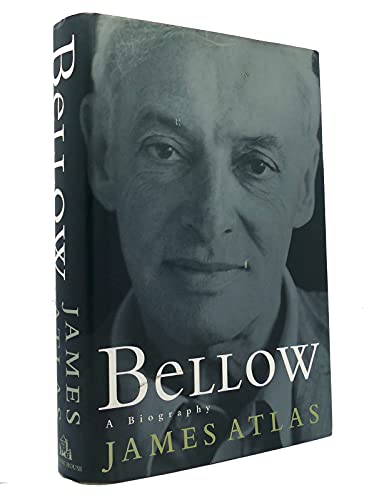
Chronicles the life of the Nobel Prize-winning writer, focusing on the period between 1944 and 1976 that saw the creation of such modern classics as "The Adventures of Augie March" and "Humbolt's Gift."
Die Inhaltsangabe kann sich auf eine andere Ausgabe dieses Titels beziehen.
Über die Autorin bzw. den Autor
James Atlas is the founding editor of the Lipper/Viking Penguin Lives Series. A longtime contributor to The New Yorker, he was an editor at The New York Times Magazine for many years. His work has appeared in The New York Times Book Review, The New York Review of Books, The London Review of Books, Vanity Fair, and many other journals. He is the author of Delmore Schwartz: The Life of an American Poet, which was nominated for the National Book Award.
Aus dem Klappentext
iginal, Bellow: A Biography is an extraordinary achievement, the brilliant and long-awaited biography of the Nobel Prize-winning author of Herzog, The Adventures of Augie March, and other bestsellers. National Book Award nominee James Atlas here gives the first definitive account of Bellow's turbulent personal and professional life, as it unfolded against the background of twentieth-century events--the Depression, World War II, the upheavals of the sixties--and amid all the complexities of the Jewish-immigrant experience in America, which generated a vibrant new literature. <br> Saul Bellow's parents fled Russia in 1913 and settled with relatives in Canada, where Saul was born. Bellow's boyhood in Quebec and Chicago, marked by his family's transient existence and struggle for economic survival (his father was a bootlegger for a time), provided inspiration for many of the memorable characters and scenes that animate his fiction. It was in Ch
Auszug. © Genehmigter Nachdruck. Alle Rechte vorbehalten.
I was, in 1937, a very young, married man who had quickly lost his first job and who lived with his in-laws. His affectionate, loyal, and pretty wife insisted that he must be given a chance to write something."
But what? In "Starting Out in Chicago," originally delivered as a Brandeis commencement address in 1974, Saul Bellow provided a memorable portrait of his beginnings as a writer. If the year is wrong--it was 1938, just a year before the outbreak of World War II in Europe--the details are painfully accurate. This brief memoir, more than anything else he ever wrote, captures the early stage of that momentous confrontation in which "American society and S. Bellow came face to face." He was twenty-two years old.
The job he'd lost was a stint in his older brother Maurice's coalyard, and he was fired for absenteeism. Maurice, not unreasonably, expected his brother to keep regular hours; Bellow had other ideas about how to spend his time: He wanted to write.
His in-laws' apartment on North Virginia Avenue in the Northwest Side neighborhood of Ravenswood was drab and anonymous, one of the thousands of identical brick dwellings that sprawled mile upon mile across a dull, orderly grid of streets. While his wife, Anita, attended classes at the School of Social Service Administration at the university, Bellow sat at a bridge table in the back bedroom:
My table faced three cement steps that rose from the cellar into the brick gloom of a passageway. Only my mother-in-law was at home. A widow, then in her seventies [actually, her mid-sixties], she wore a heavy white braid down her back. She had been a modern woman and a socialist and suffragette in the old country. She was attractive in a fragile, steely way. You felt Sophie's [Sonya's] strength of will in all things. She kept a neat house. The very plants, the ashtrays, the pedestals, the doilies, the chairs, revealed her mastery. Each object had its military place. Her apartment could easily have been transferred to West Point.
Lunch occurred at half past twelve. The cooking was good. We ate together in the kitchen. The meal was followed by an interval of stone. My mother-in-law took a nap. I went into the street. Ravenswood was utterly empty. I walked about with something like a large stone in my belly. I often turned into Lawrence Avenue and stood on the bridge looking into the drainage canal. If I had been a dog I would have howled.
American writers are largely self-made. William Faulkner emerged out of the somnolent town of Oxford, Mississippi; Ernest Hemingway was brought up in the bland suburb of Oak Park, just a few miles from Ravenswood; Sinclair Lewis hailed from Sauk Centre, Minnesota. They simply "materialized somehow," as Bellow put it. But even by the folkloric standards of American literature, Bellow's remoteness from the centers of culture was extreme. "Bernanos, the French religious novelist, said that his soul could not bear to be cut off from its kind, and that was why he did his work in cafés," Bellow noted enviously: "Cafés indeed! I would have kissed the floor of a café. There were no cafés in Chicago. There were greasy-spoon cafeterias, one-arm joints, taverns. I never yet heard of a writer who broughthis manuscripts into a tavern."
Over the years, he collected a virtual anthology of disparaging observations that visitors had made about the city: Oscar Wilde found the Water Tower, one of the few buildings to survive the great Chicago fire of 1871, an offense against good taste; "he was amazed that people could so abuse Gothic art." Rudyard Kipling was appalled by the Palmer House, "a gilded and mirrored rabbit-warren crammed with people talking about money and spitting about everywhere." Edmund Wilson was oppressed by the canyons of La Salle Street: "In the morning, the winter sun does not seem to give any light: it leaves the streets dull. It is more like a forge which has just been started up, and is beginning to burn red in an atmosphere darkened by coal-fumes."
It would have been hard to deny the truth of what they saw: Culture in Chicago was a marginal enterprise. Dominated by the brute forces of industry, by stockyards and farm-machinery works and automobile assembly lines, it was the city, in Sandburg's famous line, of "big shoulders." Yet it was also true that Chicago possessed an indigenous literature. In the decades just before and after 1900, novels by Chicago writers crowded the shelves: Frank Norris's The Pit (1903), about wheat speculators on the floor of the Chicago Board of Trade; Willa Cather's The Song of the Lark (1915), about a young lady from Nebraska who came to study music in the city; Upton Sinclair's The Jungle (1906), a raw depiction of the harsh existence of a Lithuanian immigrant family in the South Side stockyards; Theodore Dreiser's Frank Cowperwood trilogy, based on the career of Charles T. Yerkes, the Chicago railroad financier; the works of Sherwood Anderson. The Chicago Renaissance was a fact. "Find a writer who is indubitably an American in every pulse-beat, snort and adenoid, an American who has something new and peculiarly American to say and who says it in an unmistakable American way," H. L. Mencken declared, "and nine times out of ten you will find that he has some sort of connection with the gargantuan and inordinate abattoir by Lake Michigan."
What nineteenth-century Paris had been to Lucien de Rubempré, the hero of Balzac's Lost Illusions, twentieth-century Chicago was to young men and women from Terre Haute or Valparaiso: "the place," wrote Bellow, "the incredible, vital, sinful, fascinating big city." If there were no cafés, there was still a tremendous concentration of vivid private experience--evidence, Bellow contended in his memoir, "that the life lived in great manufacturing, shipping, and banking centers, with their slaughter stink, their great slums, prisons, hospitals, and schools, was also a human life." Milton Friedman, who brought honor to the university by winning a Nobel Prize in economics in 1976 (the same year that Bellow won in literature), has speculated that the city's reputation for nurturing literary and intellectual talent can be traced to the same geographical centrality that made it a great industrial power. Chicago, Friedman noted, was "a new, raw city bursting with energy, far less sophisticated than New York, but for that very reason far more tolerant of diversity, of heterodox ideas." New York looked east, to the Old World. Chicago looked west, to the frontier--in effect, inventing its own frontiers.
This energy was the catalyst of Bellow's art. In his hands, the city would become a character in its own right, the center of both his life and his work. The shelf of books he produced over the course of a career sustained for more than half a century was to make "Bellow's Chicago" as familiar a locale in literature as Joyce's Dublin. It wasn't an achievement that his circumstances preordained; the absence of encouragement, of community, of any plausible way to make a living would have provoked a person far sturdier than Bellow to despair. But he was armored against disappointment by a stubborn belief in his destiny--a belief he maintained in the absence of both proof and...
„Über diesen Titel“ kann sich auf eine andere Ausgabe dieses Titels beziehen.
Suchergebnisse für Bellow: A Biography

Beispielbild für diese ISBN
Bellow: A Biography
Anbieter: World of Books (was SecondSale), Montgomery, IL, USA
Verkäuferbewertung 5 von 5 Sternen

Zustand: Good. Item in good condition. Textbooks may not include supplemental items i.e. CDs, access codes etc. Artikel-Nr. 00107642075
Gebraucht kaufen
EUR 5,35
Versand gratis
Versand innerhalb von USA
Versand innerhalb von USA
Anzahl: 1 verfügbar
Beispielbild für diese ISBN
Bellow: A Biography
Anbieter: ThriftBooks-Dallas, Dallas, TX, USA
Verkäuferbewertung 5 von 5 Sternen
Hardcover. Zustand: Good. No Jacket. Pages can have notes/highlighting. Spine may show signs of wear. ~ ThriftBooks: Read More, Spend Less. Artikel-Nr. G0394585011I3N00
Gebraucht kaufen
EUR 5,79
Versand gratis
Versand innerhalb von USA
Versand innerhalb von USA
Anzahl: 1 verfügbar
Beispielbild für diese ISBN
Bellow: A Biography
Anbieter: Wonder Book, Frederick, MD, USA
Verkäuferbewertung 5 von 5 Sternen
Zustand: Good. Good condition. Good dust jacket. A copy that has been read but remains intact. May contain markings such as bookplates, stamps, limited notes and highlighting, or a few light stains. Artikel-Nr. H03B-02805
Gebraucht kaufen
EUR 6,43
Versand gratis
Versand innerhalb von USA
Versand innerhalb von USA
Anzahl: 1 verfügbar
Beispielbild für diese ISBN
Bellow : A Biography
Verlag:
Random House, Incorporated, 1999
ISBN 10: 0394585011
ISBN 13: 9780394585017
Gebraucht
Hardcover
Anbieter: Better World Books, Mishawaka, IN, USA
Verkäuferbewertung 5 von 5 Sternen
Zustand: Good. 2002 Modern Library ed. Former library copy. Pages intact with minimal writing/highlighting. The binding may be loose and creased. Dust jackets/supplements are not included. Includes library markings. Stock photo provided. Product includes identifying sticker. Better World Books: Buy Books. Do Good. Artikel-Nr. GRP27402801
Gebraucht kaufen
EUR 6,49
Versand gratis
Versand innerhalb von USA
Versand innerhalb von USA
Anzahl: 2 verfügbar
Beispielbild für diese ISBN
Bellow : A Biography
Verlag:
Random House, Incorporated, 1999
ISBN 10: 0394585011
ISBN 13: 9780394585017
Gebraucht
Hardcover
Anbieter: Better World Books: West, Reno, NV, USA
Verkäuferbewertung 5 von 5 Sternen
Zustand: Good. 2002 Modern Library ed. Former library copy. Pages intact with minimal writing/highlighting. The binding may be loose and creased. Dust jackets/supplements are not included. Includes library markings. Stock photo provided. Product includes identifying sticker. Better World Books: Buy Books. Do Good. Artikel-Nr. GRP27402801
Gebraucht kaufen
EUR 6,49
Versand gratis
Versand innerhalb von USA
Versand innerhalb von USA
Anzahl: 1 verfügbar
Beispielbild für diese ISBN
Bellow: A Biography
Anbieter: A Squared Books (Don Dewhirst), South Lyon, MI, USA
Verkäuferbewertung 5 von 5 Sternen
hardcover. Zustand: Very Good. Zustand des Schutzumschlags: Very Good. 2000; New York; black illustrated glossy paper dust jacket with white titles; dust jacket contains rubbing and wear; interior is clean and unmarked; 8vo, 7 3/4" to 9 3/4" tall; 686 pages. Artikel-Nr. SKU1159736
Gebraucht kaufen
EUR 7,59
EUR 5,63 Versand
Versand innerhalb von USA
Versand innerhalb von USA
Anzahl: 1 verfügbar
Beispielbild für diese ISBN
Bellow: A Biography
Verlag:
Random House, New York, 2000
ISBN 10: 0394585011
ISBN 13: 9780394585017
Gebraucht
Hardcover
Erstausgabe
Anbieter: Abacus Bookshop, Pittsford, NY, USA
Verkäuferbewertung 5 von 5 Sternen
hardcover. Zustand: Fine copy in fine dust jacket. Illus. with photos (illustrator). 1st. 8vo, 686 pp. Artikel-Nr. 047967
Gebraucht kaufen
EUR 13,39
EUR 3,47 Versand
Versand innerhalb von USA
Versand innerhalb von USA
Anzahl: 1 verfügbar
Beispielbild für diese ISBN
Bellow
Anbieter: Argosy Book Store, ABAA, ILAB, New York, NY, USA
Verkäuferbewertung 5 von 5 Sternen
hardcover. Zustand: near fine. Zustand des Schutzumschlags: near fine. First. Illustrated with black and white photographs. 686 pages. Thick 8vo, gray boards, dust wrapper. New York: Random House, (2000). A near fine copy in a near fine dust wrapper. Artikel-Nr. 304500
Gebraucht kaufen
EUR 15,07
EUR 5,20 Versand
Versand innerhalb von USA
Versand innerhalb von USA
Anzahl: 1 verfügbar
Foto des Verkäufers
Bellow
Verlag:
Random House USA Inc, New York, 1999
ISBN 10: 0394585011
ISBN 13: 9780394585017
Gebraucht
Hardcover
Erstausgabe
Anbieter: Blind-Horse-Books (ABAA), DeLand, FL, USA
Verkäuferbewertung 5 von 5 Sternen
Hardcover in Dust Jacket. Zustand: Very Good. Zustand des Schutzumschlags: New. First Edition, First Printing. Detailing Bellow's volatile marriages and numerous tempestuous relationships with women, prominent intellectuals, publishers, and friends, Bellow: A Biography is a magnificent chronicle of the life of one of the premier writers in the English language. No Flaws or Blemishes but underling on page 3, 271, 273, and 274. Background Information: 'James Atlas is a model biographer. He writes with the conversational ease of a born storyteller, giving us both a richly informed history of one of America's most original and gifted writers and a mythos of the artist's life in the perilous twentieth century. . as fascinating a portrait as any of Bellow's arresting fictional characters.' [Joyce Carol Oates]. Artikel-Nr. 013698
Gebraucht kaufen
EUR 17,81
EUR 5,20 Versand
Versand innerhalb von USA
Versand innerhalb von USA
Anzahl: 1 verfügbar
Beispielbild für diese ISBN
Bellow
Anbieter: WorldofBooks, Goring-By-Sea, WS, Vereinigtes Königreich
Verkäuferbewertung 5 von 5 Sternen
Hardback. Zustand: Very Good. The book has been read, but is in excellent condition. Pages are intact and not marred by notes or highlighting. The spine remains undamaged. Artikel-Nr. GOR007473300
Gebraucht kaufen
EUR 18,16
EUR 6,54 Versand
Versand von Vereinigtes Königreich nach USA
Versand von Vereinigtes Königreich nach USA
Anzahl: 1 verfügbar