
Verwandte Artikel zu Being Direct: Making Advertising Pay: Direct Marketing...
Inhaltsangabe
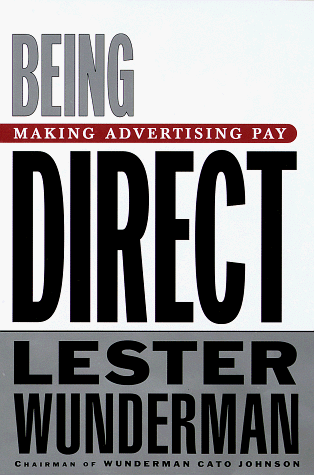
The creator of direct marketing discusses his development of the successful marketing strategy and explains how the interactive techniques that he created will transform the world of business and sales in the future. 25,000 first printing. Tour.
Die Inhaltsangabe kann sich auf eine andere Ausgabe dieses Titels beziehen.
Über die Autorin bzw. den Autor
Lester Wunderman is Chairman of Wunderman, Cato, Johnson and Senior Adviser to the Board of Directors of Young and Rubicam, with which it merged in 1973. He has received countless awards for his contributions to the field of direct marketing and has been named to the Direct Marketing Hall of Fame. He has served as Director and Secretary Treasurer of the American Association of Advertising and was Director of the Advertising Council. This is his first book. He lives in New York City with his wife, Sue Cott.
Auszug. © Genehmigter Nachdruck. Alle Rechte vorbehalten.
NINETEEN THINGS ALL SUCCESSFUL DIRECT MARKETING COMPANIES SHOULD KNOW
1. Direct Marketing Is a Strategy, Not a Tactic
It's not an ad with a coupon, it's not a commercial with a toll-free number, it's not a mailing, a phone call, a promotion, a database, or a Web site; It's a commitment to getting and keeping valuable customers.
2. The Consumer, Not the Product, Must Be the Hero
The product must create value for each of its consumers. It must satisfy consumers' unique differences, not their commonalities. The call of the Industrial Revolution was manufacturers saying, "This is what I make, don't you want it?" The call of the Information Age is consumers asking, "This is what I need, won't you make it?"
3. Communicate with Each Customer or Prospect as an Audience of One
Advertising must be as relevant to each consumer as the product or service is. General advertising and more targeted direct marketing must both be part of a holistic communication strategy.
4. Answer the Question "Why Should I?"
The most dangerous question a prospect or customer asks is "Why should I?" And he may ask it more than once -- but never of you. The product and its communication stream must continue to provide him with both rational and emotional answers.
5. Advertising Must Change Behavior, Not Just Attitudes
Favorable consumer attitudes go only part of the way to creating sales. It's also the consumer's accountable actions such as inquiries, product trials, purchases, and repurchases that create profits.
6. The Next Step: Profitable Advertising
The results of advertising are increasingly measurable; they must now become accountable. Advertising can't be just a contribution to goodwill -- it must become an investment in profits.
7. Build the "Brand Experience"
Customers have to know and feel the brand as an experience that serves their individual needs. It has to be a total and ongoing immersion in satisfaction that includes everything from packaging to point of purchase, repurchase, and after-sale service and communications.
8. Create Relationships
Relationships continue to grow -- encounters do not. The better the buyer-seller relationship, the greater the profit.
9. Know and Invest in Each Customer's Lifetime Value
One automobile dealer calculated that a lifetime of cars sold to one customer would be worth $332,000. How much should a marketer spend to create such a loyal lifetime customer for a given product or service?
10. "Suspects" Are Not "Prospects"
"Prospects" are consumers who are able, ready, and willing to buy, "suspects" are merely eligible to do so. Communicating with prospects reduces the cost of sales; communicating with suspects raises the cost of advertising.
11. Media is Contact Strategy
Measurable results from media, not the number of exposures, are what counts. Measurements such as "reach" and "frequency" are out of date. Only "Contacts" can begin relationships.
12. Be Accessible to Your Customers
Be there for your customers--be their database and source of information and service through as many channels of communication as possible. They can't tell you what they need unless they can reach you.
13. Encourage Interactive Dialogues
Listen to consumers rather than talk at them. Let them "advertise" their individual needs. They'll be grateful for your responsiveness. Convert one-way advertising to two-way information sharing.
14. Learn the Missing "When?"
The answer "Not now" is as dangerous to advertising as "Not this." Only consumers know when they are ready to buy, and they will tell you if you ask them in the right way.
15. Create an Advertising Curriculum That Teaches as It Sells
A "curriculum" is a learning system that teaches one "bit" of information at a time. Each advertising message (bit) can build on the learning of the previous one. It can teach consumers why your product is superior and why they should buy it.
16. Acquire Customers with the Intention to Loyalize Them
Promotions sell product trials -- but not ongoing brand loyalty. They may also attract the wrong customers, who may never become loyal. The right customers must be acquired and persuaded to want what the product does and not what the promotion offers. The right customers may in fact be your competitor's best customers.
17. Loyalty Is a Continuity Program
"Totally satisfied" customers are least likely to fall away. Those who are merely "satisfied" may fall away without warning. To build ongoing relationships, rewards for good customers should be tenure-based (on previous purchases, usage behavior, and length of relationship). Rewarding "tenure" can prevent competitors from "conquesting" your best customers.
18. Your Share of Loyal Customers, Not Your Share of Market, Creates Profits
Spend more on the good customers you have. Ninety percent of most companies' profits come from repeat customers. It costs six to ten times as much to get a new customer as to keep an old one.
19. You Are What You Know
Data is an expense -- knowledge is a bargain. Collect only data that can become information, which, in turn, can become knowledge. Only knowledge can build on success and minimize failure. A company is no better than what it knows.
„Über diesen Titel“ kann sich auf eine andere Ausgabe dieses Titels beziehen.
Suchergebnisse für Being Direct: Making Advertising Pay: Direct Marketing...

Beispielbild für diese ISBN
Being Direct: Direct Marketing That Works
Anbieter: World of Books (was SecondSale), Montgomery, IL, USA
Verkäuferbewertung 5 von 5 Sternen

Hardback. Zustand: Good. Artikel-Nr. 00101389719
Gebraucht kaufen
EUR 5,85
Versand gratis
Versand innerhalb von USA
Versand innerhalb von USA
Anzahl: 7 verfügbar
Beispielbild für diese ISBN
Being Direct: Direct Marketing That Works
Anbieter: World of Books (was SecondSale), Montgomery, IL, USA
Verkäuferbewertung 5 von 5 Sternen
Hardback. Zustand: Fair. Artikel-Nr. 00100675089
Gebraucht kaufen
EUR 5,85
Versand gratis
Versand innerhalb von USA
Versand innerhalb von USA
Anzahl: 1 verfügbar
Beispielbild für diese ISBN
Being Direct: Making Advertising Pay
Verlag:
Random House (edition First Edition), 1996
ISBN 10: 0394540638
ISBN 13: 9780394540634
Gebraucht
Hardcover
Erstausgabe
Anbieter: BooksRun, Philadelphia, PA, USA
Verkäuferbewertung 5 von 5 Sternen
Hardcover. Zustand: Very Good. First Edition. With dust jacket. It's a well-cared-for item that has seen limited use. The item may show minor signs of wear. All the text is legible, with all pages included. It may have slight markings and/or highlighting. Artikel-Nr. 0394540638-11-1-29
Gebraucht kaufen
EUR 5,85
Versand gratis
Versand innerhalb von USA
Versand innerhalb von USA
Anzahl: 1 verfügbar
Beispielbild für diese ISBN
Being Direct: Making Advertising Pay
Anbieter: Wonder Book, Frederick, MD, USA
Verkäuferbewertung 5 von 5 Sternen
Zustand: As New. Like New condition. Very Good dust jacket. Special edition. A near perfect copy that may have very minor cosmetic defects. Artikel-Nr. T06A-06398
Gebraucht kaufen
EUR 6,43
Versand gratis
Versand innerhalb von USA
Versand innerhalb von USA
Anzahl: 1 verfügbar
Beispielbild für diese ISBN
Being Direct: Making Advertising Pay
Anbieter: Wonder Book, Frederick, MD, USA
Verkäuferbewertung 5 von 5 Sternen
Zustand: Good. Good condition. Good dust jacket. A copy that has been read but remains intact. May contain markings such as bookplates, stamps, limited notes and highlighting, or a few light stains. Artikel-Nr. H15C-00552
Gebraucht kaufen
EUR 6,43
Versand gratis
Versand innerhalb von USA
Versand innerhalb von USA
Anzahl: 1 verfügbar
Beispielbild für diese ISBN
Being Direct: Making Advertising Pay
Anbieter: ThriftBooks-Dallas, Dallas, TX, USA
Verkäuferbewertung 5 von 5 Sternen
Hardcover. Zustand: As New. No Jacket. Pages are clean and are not marred by notes or folds of any kind. ~ ThriftBooks: Read More, Spend Less. Artikel-Nr. G0394540638I2N00
Gebraucht kaufen
EUR 6,63
Versand gratis
Versand innerhalb von USA
Versand innerhalb von USA
Anzahl: 1 verfügbar
Beispielbild für diese ISBN
Being Direct : Making Advertising Pay
Verlag:
Random House, Incorporated, 1998
ISBN 10: 0394540638
ISBN 13: 9780394540634
Gebraucht
Hardcover
Erstausgabe
Anbieter: Better World Books: West, Reno, NV, USA
Verkäuferbewertung 5 von 5 Sternen
Zustand: Good. 1st. Pages intact with minimal writing/highlighting. The binding may be loose and creased. Dust jackets/supplements are not included. Stock photo provided. Product includes identifying sticker. Better World Books: Buy Books. Do Good. Artikel-Nr. 3246478-6
Gebraucht kaufen
EUR 6,75
Versand gratis
Versand innerhalb von USA
Versand innerhalb von USA
Anzahl: 1 verfügbar
Beispielbild für diese ISBN
Being Direct : Making Advertising Pay
Verlag:
Random House, Incorporated, 1998
ISBN 10: 0394540638
ISBN 13: 9780394540634
Gebraucht
Hardcover
Erstausgabe
Anbieter: Better World Books: West, Reno, NV, USA
Verkäuferbewertung 5 von 5 Sternen
Zustand: Very Good. 1st. Pages intact with possible writing/highlighting. Binding strong with minor wear. Dust jackets/supplements may not be included. Stock photo provided. Product includes identifying sticker. Better World Books: Buy Books. Do Good. Artikel-Nr. 4441430-6
Gebraucht kaufen
EUR 6,75
Versand gratis
Versand innerhalb von USA
Versand innerhalb von USA
Anzahl: 1 verfügbar
Beispielbild für diese ISBN
Being Direct : Making Advertising Pay
Verlag:
Random House, Incorporated, 1998
ISBN 10: 0394540638
ISBN 13: 9780394540634
Gebraucht
Hardcover
Erstausgabe
Anbieter: Better World Books, Mishawaka, IN, USA
Verkäuferbewertung 5 von 5 Sternen
Zustand: Very Good. 1st. Pages intact with possible writing/highlighting. Binding strong with minor wear. Dust jackets/supplements may not be included. Stock photo provided. Product includes identifying sticker. Better World Books: Buy Books. Do Good. Artikel-Nr. 4441430-6
Gebraucht kaufen
EUR 6,75
Versand gratis
Versand innerhalb von USA
Versand innerhalb von USA
Anzahl: 2 verfügbar
Beispielbild für diese ISBN
Being Direct: Making Advertising Work
Anbieter: AwesomeBooks, Wallingford, Vereinigtes Königreich
Verkäuferbewertung 5 von 5 Sternen
Hardcover. Zustand: Very Good. Being Direct: Making Advertising Work This book is in very good condition and will be shipped within 24 hours of ordering. The cover may have some limited signs of wear but the pages are clean, intact and the spine remains undamaged. This book has clearly been well maintained and looked after thus far. Money back guarantee if you are not satisfied. See all our books here, order more than 1 book and get discounted shipping. Artikel-Nr. 7719-9780394540634
Gebraucht kaufen
EUR 4,66
EUR 4,87 Versand
Versand von Vereinigtes Königreich nach USA
Versand von Vereinigtes Königreich nach USA
Anzahl: 2 verfügbar