
Verwandte Artikel zu A Discovery of Strangers
Inhaltsangabe
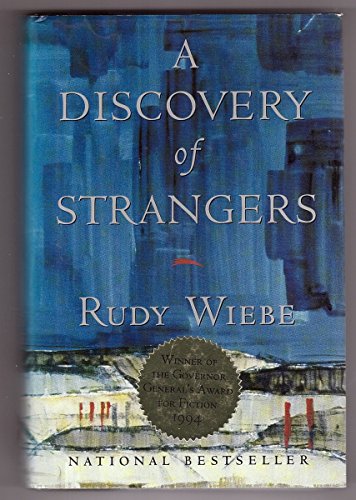
A Discovery of Strangers is a story--based on true events--of love and innocence, murder, greed and passion set within the terrifying, fragile Arctic landscape. In 1820, John Franklin's small group of British officers and Canadian voyageurs, on their first expedition to search for a route through the incomprehensible North, encounter the Yellowknife Indians -- and Greenstockings, fifteen-year-old daughter of Keskarrah, elder of the Yellowknife, meets young Robert Hood, son of a Lancashire clergyman. Wordless, they devise a language of their own as their two worlds clash.
Die Inhaltsangabe kann sich auf eine andere Ausgabe dieses Titels beziehen.
Auszug. © Genehmigter Nachdruck. Alle Rechte vorbehalten.
Chapter 1
The Animals in This Country
The land is so long, and the people travelling in it so few, the curious animals barely notice them from one lifetime to the next. The human beings whose name is Tetsot’ine live here with great care, their feet travelling year after year those paths where the animals can easily avoid them if they want to, or follow, or circle back ahead to watch them with little danger. Therefore, when the first one or two Whites appeared in this country, an animal would have had to search for four lifetimes to find them being paddled about, or walking, or bent and staggering, somewhere on the inexorable land.
About that time some of the animals did begin to hear strange noises, bits of shriek and hammer above the wavering roar of rapids or the steady flagellation of wind. These were strangers, so different, so blatantly loud the caribou themselves could not help hearing them long before they needed to be smelled, and some animals drifted around to see what made the trees in one place scream and smash that way, the rocks clang. They noticed creatures that looked like humans standing motionless here and there, abruptly pointing and shrieking, pounding! pounding! scuttling about all day and sometimes at night as well, when tendrils of bush along the river might spring up suddenly into terrifying flame. And the animals understood then that such brutal hiss and clangour must bring on a winter even colder than usual.
And shortly after, when wind hammered the snow hard as folded rock under the thickest trees, and growing ice choked the rapids into silence, they knew that of course they had been right. Then an erratic cracking open, or a tree splitting, could be heard so far it seemed they were alert to every sound happening anywhere in the world, and the racket these strange human beings made in one place mattered nothing at all. The animals simply moved away into their necessary silence, travelling where they pleased, as they always had inside that clenched fist of the long darkness, their powerful feathered, furred bodies as light as flecks of ice sifting over snow, as light and quick as breathing.
But throughout the dark weight of midwinter, with moss and lichens always harder to smell and paw from under the crusted snow, all the caribou knew that the sun would certainly return again. And eventually it did; its rim grew slowly day by day up out of darkness into red brilliance, until finally the cows and calves recognized themselves together as they always were, in the whole giant ball of it shimmering through ice fog, round and complete again on the distant edge of the sky. The cows lay in their hollows of snow on a drifted lake, their calves from the previous spring sheltered against their backs out of the wind. Their blunt, furry noses lifted from the angles of their folded legs, their nostrils opened to the burning air: it was sharp as ice, gentle with all the smells they recognized, arctic and safe. Lying safe, alert in this instant of rest, they were reassured that when that blazing sun stands three times its height over the glazed levels of this lake, they will feel the restlessness of their young grow heavier within them. And then they will move again into their continual travel.
Gradually at first, then more steadily, like driftwood discovering a momentary current, hesitating into daily eddies of moss or crusted erratics but leaning more certainly down into motion along this contorted river, or this lakeshore; easily avoiding the noisy, devastated esker between Roundrock and Winter lakes and their connecting tributary streams. Seeking steadily north. From every direction more and more of them will drift together, thousands and tens of thousands drawn together by the lengthening light into the worn paths of their necessary journey, an immense dark river of life flowing north to the ocean, to the calving grounds where they know themselves to have been born.
The caribou cow with three tines on each of her antlers lay curled, bedded and at momentary rest with her calf in the lee of her body. She had once been a woman; in fact, she has already been born a woman twice. But she has never liked that very much, and each time she is born that way she lives human only until her dreams are strong enough to call her innumerable caribou family, and they come for her. One morning people will awaken, and their child is gone. They search everywhere to find her, and finally notice the two pointed tracks that come to their lodge in the hard travelling snow, and the three tracks that leave. Then the Tetsot’ine – Those Who Know Something a Little – understand what has happened.
“We have lost another good child to the caribou,” they begin to wail. “She will never play and make a fire with us, or dance, or sew clothes and bear strong children, or comfort us when we are hungry and sick. No-o-o-o, oh no, no. We will never see that good child again.”
And they will, of course, be right. If the three-tined cow with her calf alive beside her had had a name, it would have been ?Elyáske. All the animals knew this, but they didn’t think about that.
The silver wolf who lived with the caribou had never been anything but a wolf, and he would have defied any animal, and that included the seven members of his pack, to know his name. However, sometimes when the strands of their twilight howl strayed alone and united again over the long evening hills, or his voice deepened into that longer warning other males could only hear and avoid, the silver wolf remembered himself as Na?ácho roaming alone, a presence of untouchable enigma between the eskers and the ocean, an apparition so gigantic that people are like mosquitoes to him, trifles to swat and eat whatever tasty parts he deigns to tear out of them. But Na?ácho lives best in memory; he cannot see very well, nor hear, and he hunts alone mostly by smell, so the silver wolf liked being what he is now better, though he was only a little longer than a human sleeping, or possibly collapsed in the snow. He liked the skill and nerve of having to be precisely careful. He could run so swiftly that the opening moss was far too slow to swallow him, he could see an eyelid flicker and hear a caribou calf’s heart beat steady and unaware in the shelter of its mother, the folds of rocks now hid him silent as breath. And he could still smell anything he sniffed after, drawing winter air like bloody slivers into his deliberating nose. Above all, he liked the female wolf who hunted beside him.
It was that female, white as a numinous drift, who turned left to lie in wait when the silver male led their hunting pack out of the brush above the falls and onto Lastfire Lake. She had played with him below the falls all afternoon, stretching languidly near him, urinating to give him something to sniff and claw over with snow, stiff-legged, and bumping into him and dancing away and bumping until they licked each other’s laughing faces, rolling over and under each other, their teeth gleaming like icicles. All afternoon the other six wolves lay easily about on the snow and watched them play, especially the heavy brown male who occasionally seemed to be a little too close, and the silver wolf would whirl on him, forcing him to creep back, crouch and fawn, even to roll over on his back with paws helpless in the air, pleading open-mouthed, throat vulnerable, like any puppy. When the white wolf finally permitted the silver male to mount her, the brown wolf sank down with his long, sharp head along his paws, watching them intensely.
And for a time the two alpha wolves were joined together, were one great doubled animal whose every hair bristled red in the level blazing light; whose twin heads pointed in opposite directions, aimed still and alert towards whatever might...
„Über diesen Titel“ kann sich auf eine andere Ausgabe dieses Titels beziehen.
Suchergebnisse für A Discovery of Strangers

Beispielbild für diese ISBN
A Discovery Of Strangers
Anbieter: World of Books (was SecondSale), Montgomery, IL, USA
Verkäuferbewertung 5 von 5 Sternen

Zustand: Very Good. Item in very good condition! Textbooks may not include supplemental items i.e. CDs, access codes etc. Artikel-Nr. 00093246217
Gebraucht kaufen
EUR 3,95
Versand gratis
Versand innerhalb von USA
Versand innerhalb von USA
Anzahl: 4 verfügbar
Beispielbild für diese ISBN
A Discovery Of Strangers
Anbieter: World of Books (was SecondSale), Montgomery, IL, USA
Verkäuferbewertung 5 von 5 Sternen
Zustand: Good. Item in good condition. Textbooks may not include supplemental items i.e. CDs, access codes etc. Artikel-Nr. 00100103938
Gebraucht kaufen
EUR 3,95
Versand gratis
Versand innerhalb von USA
Versand innerhalb von USA
Anzahl: 1 verfügbar
Beispielbild für diese ISBN
A Discovery of Strangers
Anbieter: Better World Books, Mishawaka, IN, USA
Verkäuferbewertung 5 von 5 Sternen
Zustand: Very Good. Pages intact with possible writing/highlighting. Binding strong with minor wear. Dust jackets/supplements may not be included. Stock photo provided. Product includes identifying sticker. Better World Books: Buy Books. Do Good. Artikel-Nr. 3244476-75
Gebraucht kaufen
EUR 6,55
Versand gratis
Versand innerhalb von USA
Versand innerhalb von USA
Anzahl: 1 verfügbar
Beispielbild für diese ISBN
A Discovery of Strangers
Anbieter: Better World Books, Mishawaka, IN, USA
Verkäuferbewertung 5 von 5 Sternen
Zustand: Good. Pages intact with minimal writing/highlighting. The binding may be loose and creased. Dust jackets/supplements are not included. Stock photo provided. Product includes identifying sticker. Better World Books: Buy Books. Do Good. Artikel-Nr. 4383133-6
Gebraucht kaufen
EUR 6,55
Versand gratis
Versand innerhalb von USA
Versand innerhalb von USA
Anzahl: 1 verfügbar
Beispielbild für diese ISBN
A Discovery of Strangers
Anbieter: AwesomeBooks, Wallingford, Vereinigtes Königreich
Verkäuferbewertung 5 von 5 Sternen
Hardcover. Zustand: Very Good. A Discovery of Strangers This book is in very good condition and will be shipped within 24 hours of ordering. The cover may have some limited signs of wear but the pages are clean, intact and the spine remains undamaged. This book has clearly been well maintained and looked after thus far. Money back guarantee if you are not satisfied. See all our books here, order more than 1 book and get discounted shipping. Artikel-Nr. 7719-9780394280509
Gebraucht kaufen
EUR 10,29
EUR 4,81 Versand
Versand von Vereinigtes Königreich nach USA
Versand von Vereinigtes Königreich nach USA
Anzahl: 2 verfügbar
Beispielbild für diese ISBN
A Discovery of Strangers
Verlag:
Alfred A. Knopf, Toronto, Canada, 1994
ISBN 10: 0394280504
ISBN 13: 9780394280509
Gebraucht
Hardcover
Erstausgabe
Anbieter: Joy of Books, Etobicoke, ON, Kanada
Verkäuferbewertung 5 von 5 Sternen
Hardcover. Zustand: New in As New jacket. Publisher (illustrator). 1st Edition. 12mo-over 6¾-7¾" tall. In mint condition, book and jacket, this Governor General's Award Winner is set in 1820 when John Franklin's first Expedition encountered the Yellowknife Indians, on whom the explorers would depend for their survival in the search for a route through the Arctic. A must read novel for those following the Franklin saga, based on historical journals of young Robert Hood, son of a Lancashire clergyman."Weibe weaves a novel of mesmerizing intensity around their story and around the men and women-the Yellowknife families, British officers and Canadian voyageurs-caught up so strangely and inextricably together, enmeshing us ina world that will swiftly change forever.". Artikel-Nr. 000188
Gebraucht kaufen
EUR 15,18
EUR 9,10 Versand
Versand von Kanada nach USA
Versand von Kanada nach USA
Anzahl: 1 verfügbar
Beispielbild für diese ISBN
A Discovery of Strangers
Anbieter: Bahamut Media, Reading, Vereinigtes Königreich
Verkäuferbewertung 5 von 5 Sternen
Hardcover. Zustand: Very Good. This book is in very good condition and will be shipped within 24 hours of ordering. The cover may have some limited signs of wear but the pages are clean, intact and the spine remains undamaged. This book has clearly been well maintained and looked after thus far. Money back guarantee if you are not satisfied. See all our books here, order more than 1 book and get discounted shipping. Artikel-Nr. 6545-9780394280509
Gebraucht kaufen
EUR 18,69
EUR 8,15 Versand
Versand von Vereinigtes Königreich nach USA
Versand von Vereinigtes Königreich nach USA
Anzahl: 2 verfügbar
Beispielbild für diese ISBN
Discovery of Strangers
Anbieter: Old Goat Books, Waterloo, ON, Kanada
Verkäuferbewertung 3 von 5 Sternen

Hardcover. Zustand: Fine. Zustand des Schutzumschlags: Fine. Jacket Condition: 'Fine' Condition: 'Fine'. Artikel-Nr. 9786848
Gebraucht kaufen
EUR 13,39
EUR 15,60 Versand
Versand von Kanada nach USA
Versand von Kanada nach USA
Anzahl: 1 verfügbar