
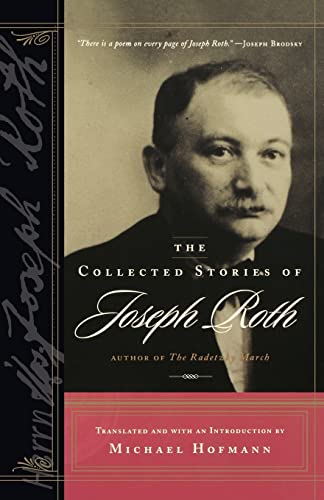
The Collected Stories of Joseph Roth (B'Nai B'Rith Jewish Heritage Classics) (B'Nai B'Rith Jewish Heritage Classics (Paperback)) - Softcover
Inhaltsangabe
The Collected Stories, in its variety and force, is the essential introduction to the fiction of Joseph Roth.
Appearing in English for the first time, The Collected Stories of Joseph Roth includes seventeen novellas and stories that echo the intensity and achievement of his greatest novel, The Radetzky March. Spanning the entire range of Roth's brief life (1894-1939) and showcasing the breadth of his literary powers, this collection features many stories just recently discovered. Roth's novellas and short stories will rank with Chekhov's as among the greatest of modern literature.Die Inhaltsangabe kann sich auf eine andere Ausgabe dieses Titels beziehen.
Über die Autorin bzw. den Autor
Joseph Roth (1894-1939) was the great elegist of the cosmopolitan culture that flourished in the dying days of the Austro-Hungarian Empire. He published several books and articles before his untimely death at the age of 44. Roth's writing has been admired by J. M. Coetzee, Jeffrey Eugenides, Elie Wiesel, and Nadine Gordimer, among many others.
Auszug. © Genehmigter Nachdruck. Alle Rechte vorbehalten.
The Collected Stories of Joseph Roth
By Joseph RothW. W. Norton & Company
Copyright © 2003 Joseph RothAll right reserved.
ISBN: 039332379X
Chapter One
THE HONORS STUDENT
(1916)
Anton, the son of the postman Andreas Wanzl, was the oddest child you ever saw. His thin, pale little face, with its sharply etched features, emphasized by a grave beak of a nose, was surmounted by an extremely sparse tuft of white blond hair. A lofty brow lorded it over a practically nonexistent pair of eyebrows, below which two pale blue deepset eyes peered earnestly and precociously into the world. A certain stubbornness showed in the narrow, bloodless lips, clamped tight. A fine, regular chin brought the ensemble to an unexpectedly imposing finale. The head was perched on a scrawny neck; the whole body was thin and frail. Altogether incongruous on such a frame were the powerful red hands that looked as though they had been glued on at the delicate wrists. Anton Wanzl was always neatly dressed and in clean clothes. Not a speck of dust on his jacket, no hole, however tiny, in his stockings, no mark or scar on his smooth, pallid little face. Anton Wanzl rarely played, he never got into fights, and he never stole red apples from the neighbor's garden. All Anton Wanzl did was study. He studied from morning till late at night. His textbooks and exercise books were nicely wrapped in crinkly white greaseproof paper, all bearing his name on the cover, written in an oddly small, pleasing hand for a child. His glowing reports, ceremonially folded, were kept in a large brick red envelope next to the album of specially beautiful stamps, for which Anton was even more envied than for his reports.
Anton Wanzl was the quietest boy in the whole town. At school, he sat still, with his arms crossed in the approved fashion, always keeping his precocious little eyes fixed on the teacher's mouth. He was top of the class, naturally. He was always held up to the others as an example; never was there any red ink in his books, with the exception of the mighty A that regularly graced all his work. Anton gave calm, factual answers, he was always there, always prepared, never sick. He sat on his bench at school as though nailed there. The most disagreeable thing for him were the breaks. Then everyone was made to go outside while the classroom was aired, and only the monitor stayed behind. Anton went out in the yard, hugged the wall fearfully, and didn't dare to take a single step, afraid he might get knocked to the ground by one of the noisy, rowdy boys. When the bell rang for resumption of class, Anton breathed a huge sigh of relief. Calmly, headmasterlike, he strode along behind the surging rabble of boys, calmly he took his place beside his bench, didn't say a word to anyone, stood there bolt upright, and sat down mechanically only once the teacher had given the command.
Anton Wanzl was not a happy child. He was consumed by a burning ambition. An iron desire to shine, to outdo all his comrades, almost destroyed his puny constitution. To begin with, Anton had only one end in mind. He wanted to be a monitor. At that time, this post was occupied by someone else, obviously not such an outstanding pupil, merely the oldest boy in the class, whose venerable years had sufficed to make him, in the eyes of the master, trustworthy. The monitor was a sort of stand-in for the master. He had to watch over his peers, "take the names" of boys who misbehaved and pass them to the master. He was, further, responsible for the state of the blackboard, for the presence of damp sponge and sharp chalk, and he collected the money for exercise books, inkwells, and repairs to cracked plaster and broken windowpanes. Such an office was vastly impressive to little Anton. He spent sleepless nights brooding determined, vengeful plans; he plotted endlessly how he might bring down the monitor and take over the position himself. One day he thought he had found a way.
The monitor had a weakness for colored pens and pencils, for canaries, doves, and little cakes. Such presents were acceptable bribes, and the giver could go on to make as much noise as he pleased. This was where Anton could take a hand. He never brought presents himself. But there was another boy, who also didn't pay tribute. Since the monitor couldn't denounce Anton because he was above suspicion, this other little boy, poor fellow, was the daily victim of his monitorial denunciations. Anton saw a wonderful opportunity. No one would guess that he wanted to be monitor. So, if he took the poor, beaten boy under his wing, and informed the teacher of the shameful venality of the young tyrant, that could only be termed just, fair, and courageous. And there would be no other candidate for the monitor's post than—Anton. So, one day, he plucked up courage and denounced the monitor. The boy was immediately stripped of his post, given a few blows with the cane, and Anton Wanzl was solemnly appointed in his place. He had made it.
Anton Wanzl loved sitting on the raised dais at the front. It was such a blissful feeling to look down on the classroom from a dignified height, to wave his pencil self-importantly, to issue warnings in some cases and to play God in others, writing down the names of the oblivious noisemakers, thus delivering them to a condign punishment, knowing in advance the form an implacable fate would take. One was taken into the master's confidence, permitted to carry exercise books, could appear important, enjoyed the awe of one's peers. But Anton Wanzl's ambition was not satisfied. He always had a fresh goal in mind. And it was toward this that he set himself to work as hard as he could.
He was not by any means a fawner. He kept a veneer of dignity, each one of his little actions was carefully considered, he liked to pay little acts of courtesy to the teachers, but never obsequiously, helping them into their coats, say, but always with a stern expression on his face. Each one of his flatteries was unobtrusive and had something of the character of an official act.
At home, he was called "Tonerl" and was a figure of some standing. His father was the typical small town postman, half public official, half private secretary, in on all kinds of family secrets, a little bit dignified, a little bit submissive, a little bit proud, and a little bit wanting a tip. He had the typical stooped walk of the postman; he scuffed his feet, he was small and thin like a little tailor, his cap was slightly too big for him and his trousers slightly too long, but all in all he was a "decent fellow," and enjoyed the good opinion of his superiors and the citizens of the town.
But to his one and only son, Herr Wanzl accorded a degree of respect that he otherwise felt only for the mayor and the Director of the Postal Service. Yes, Herr Wanzl would often think to himself on his Sunday afternoons off: the Director is the Director. But think of what my Anton might one day become! Mayor, secondary school headmaster, alderman, and—at this point Herr Wanzl took a huge leap of faith and imagination—perhaps even Minister? When he expressed such thoughts to his wife, she would dab her eyes with the corners of her blue apron, sigh, and go, "Ah. Ah." For Frau Margarethe Wanzl had an enormous respect for husband and son, and if she set a postman above all others, what...
„Über diesen Titel“ kann sich auf eine andere Ausgabe dieses Titels beziehen.
Weitere beliebte Ausgaben desselben Titels

Suchergebnisse für The Collected Stories of Joseph Roth (B'Nai B'Rith...

Beispielbild für diese ISBN
The Collected Stories of Joseph Roth
Anbieter: Books From California, Simi Valley, CA, USA
Verkäuferbewertung 4 von 5 Sternen

Paperback. Zustand: Good. Artikel-Nr. mon0003549444
Gebraucht kaufen
EUR 11,27
EUR 4,38 Versand
Versand innerhalb von USA
Versand innerhalb von USA
Anzahl: 1 verfügbar
Beispielbild für diese ISBN
The Collected Stories of Joseph Roth (B'Nai B'Rith Jewish Heritage Classics (Paperback))
Anbieter: Roundabout Books, Greenfield, MA, USA
Verkäuferbewertung 4 von 5 Sternen
Paperback. Zustand: New. New from the publisher. Artikel-Nr. 1411749
Beispielbild für diese ISBN
The Collected Stories of Joseph Roth (B'Nai B'Rith Jewish Heritage Classics)
Anbieter: medimops, Berlin, Deutschland
Verkäuferbewertung 5 von 5 Sternen

Zustand: acceptable. Ausreichend/Acceptable: Exemplar mit vollständigem Text und sämtlichen Abbildungen oder Karten. Schmutztitel oder Vorsatz können fehlen. Einband bzw. Schutzumschlag weisen unter Umständen starke Gebrauchsspuren auf. / Describes a book or dust jacket that has the complete text pages (including those with maps or plates) but may lack endpapers, half-title, etc. (which must be noted). Binding, dust jacket (if any), etc may also be worn. Artikel-Nr. M0039332379X-B
Gebraucht kaufen
EUR 15,92
EUR 20,00 Versand
Versand von Deutschland nach USA
Versand von Deutschland nach USA
Anzahl: 1 verfügbar
Beispielbild für diese ISBN
The Collected Stories Of Joseph Roth
Anbieter: Kennys Bookstore, Olney, MD, USA
Verkäuferbewertung 5 von 5 Sternen
Zustand: New. The Collected Stories, in its variety and force, is the essential introduction to the fiction of Joseph Roth. Num Pages: 288 pages, black & white illustrations. BIC Classification: FA; FYB. Category: (G) General (US: Trade). Dimension: 208 x 139 x 17. Weight in Grams: 330. . 2003. Paperback. . . . . Books ship from the US and Ireland. Artikel-Nr. V9780393323795
Neu kaufen
EUR 28,59
EUR 9,21 Versand
Versand innerhalb von USA
Versand innerhalb von USA
Anzahl: 2 verfügbar
Beispielbild für diese ISBN
The Collected Stories of Joseph Roth
Anbieter: Revaluation Books, Exeter, Vereinigtes Königreich
Verkäuferbewertung 5 von 5 Sternen
Paperback. Zustand: Brand New. reprint edition. 288 pages. 8.25x5.75x0.75 inches. In Stock. Artikel-Nr. x-039332379X
Neu kaufen
EUR 27,27
EUR 11,72 Versand
Versand von Vereinigtes Königreich nach USA
Versand von Vereinigtes Königreich nach USA
Anzahl: 2 verfügbar
Foto des Verkäufers
The Collected Stories of Joseph Roth
Anbieter: moluna, Greven, Deutschland
Verkäuferbewertung 5 von 5 Sternen
Zustand: New. The Collected Stories, in its variety and force, is the essential introduction to the fiction of Joseph Roth.Über den AutorJoseph Roth (1894-1939) was the great elegist of the cosmopolitan culture that flourishe. Artikel-Nr. 602725415
Neu kaufen
EUR 25,92
EUR 48,99 Versand
Versand von Deutschland nach USA
Versand von Deutschland nach USA
Anzahl: 2 verfügbar