
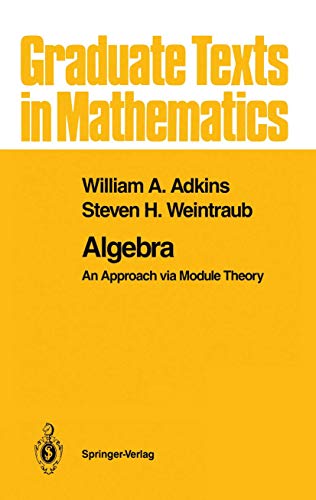
Verwandte Artikel zu Algebra: An Approach via Module Theory (Graduate Texts...
Inhaltsangabe
This book is designed as a text for a first-year graduate algebra course. As necessary background we would consider a good undergraduate linear algebra course. An undergraduate abstract algebra course, while helpful, is not necessary (and so an adventurous undergraduate might learn some algebra from this book). Perhaps the principal distinguishing feature of this book is its point of view. Many textbooks tend to be encyclopedic. We have tried to write one that is thematic, with a consistent point of view. The theme, as indicated by our title, is that of modules (though our intention has not been to write a textbook purely on module theory). We begin with some group and ring theory, to set the stage, and then, in the heart of the book, develop module theory. Having developed it, we present some of its applications: canonical forms for linear transformations, bilinear forms, and group representations. Why modules? The answer is that they are a basic unifying concept in mathematics. The reader is probably already familiar with the basic role that vector spaces play in mathematics, and modules are a generaliza tion of vector spaces. (To be precise, modules are to rings as vector spaces are to fields.
Die Inhaltsangabe kann sich auf eine andere Ausgabe dieses Titels beziehen.
Über die Autorin bzw. den Autor
William A. Adkins and Mark G. Davidson are currently professors of mathematics at Louisiana State University.
„Über diesen Titel“ kann sich auf eine andere Ausgabe dieses Titels beziehen.
Suchergebnisse für Algebra: An Approach via Module Theory (Graduate Texts...

Beispielbild für diese ISBN
Algebra: An Approach via Module Theory (Graduate Texts in Mathematics, 136)
Anbieter: Books From California, Simi Valley, CA, USA
Verkäuferbewertung 4 von 5 Sternen

Hardcover. Zustand: Good. Artikel-Nr. mon0003776346
Gebraucht kaufen
EUR 47,70
EUR 4,46 Versand
Versand innerhalb von USA
Versand innerhalb von USA
Anzahl: 2 verfügbar
Foto des Verkäufers
Algebra: An Approach via Module Theory
Verlag:
New York : Springer-Verlag, 1992
ISBN 10: 0387978399
ISBN 13: 9780387978390
Gebraucht
Hardcover
Anbieter: Klondyke, Almere, Niederlande
Verkäuferbewertung 5 von 5 Sternen

Zustand: Good. Original boards, illustrated with numerous equations and diagrams, 8vo.Graduate Texts in Mathematics, 136.; Spine discoloured, name in pen on title page. Artikel-Nr. 343233-ZA30
Gebraucht kaufen
EUR 49,50
EUR 20,00 Versand
Versand von Niederlande nach USA
Versand von Niederlande nach USA
Anzahl: 1 verfügbar
Beispielbild für diese ISBN
Algebra: An Approach via Module Theory (Graduate Texts in Mathematics, 136)
Anbieter: Books From California, Simi Valley, CA, USA
Verkäuferbewertung 4 von 5 Sternen
Hardcover. Zustand: Very Good. Artikel-Nr. mon0003833316
Gebraucht kaufen
EUR 68,63
EUR 4,46 Versand
Versand innerhalb von USA
Versand innerhalb von USA
Anzahl: 2 verfügbar
Beispielbild für diese ISBN
Algebra: An Approach via Module Theory (Graduate Texts in Mathematics, 136)
Anbieter: Ria Christie Collections, Uxbridge, Vereinigtes Königreich
Verkäuferbewertung 5 von 5 Sternen
Zustand: New. In English. Artikel-Nr. ria9780387978390_new
Neu kaufen
EUR 115,96
EUR 17,63 Versand
Versand von Vereinigtes Königreich nach USA
Versand von Vereinigtes Königreich nach USA
Anzahl: Mehr als 20 verfügbar
Beispielbild für diese ISBN
Algebra
Anbieter: Majestic Books, Hounslow, Vereinigtes Königreich
Verkäuferbewertung 4 von 5 Sternen
Zustand: New. pp. 544 52:B&W 6.14 x 9.21in or 234 x 156mm (Royal 8vo) Case Laminate on White w/Gloss Lam. Artikel-Nr. 7565107
Neu kaufen
EUR 127,53
EUR 7,67 Versand
Versand von Vereinigtes Königreich nach USA
Versand von Vereinigtes Königreich nach USA
Anzahl: 1 verfügbar
Beispielbild für diese ISBN
Algebra: An Approach via Module Theory Adkins, William A. & Steven Weintraub
Verlag:
New York : Springer-Verlag, 1992
ISBN 10: 0387978399
ISBN 13: 9780387978390
Gebraucht
Hardcover
Anbieter: BUCHSERVICE / ANTIQUARIAT Lars Lutzer, Wahlstedt, Deutschland
Verkäuferbewertung 5 von 5 Sternen
Hardcover. Zustand: gut. 1992. Algebra: An Approach via Module Theory In englischer Sprache. pages. Artikel-Nr. BN432124
Gebraucht kaufen
EUR 179,95
EUR 39,95 Versand
Versand von Deutschland nach USA
Versand von Deutschland nach USA
Anzahl: 1 verfügbar